









- What New Signals Are Emerging in Enterprise Services SaaS Marketing ReportsJul 27, 2026View details
- What Does a Global Traffic Ecosystem Service Provider Do? What Are the Differences from a Single Advertising AgencyJul 16, 2026View details
- What should you focus on in the latest enterprise SaaS report? From renewal rates and delivery costs to overseas growth opportunitiesJul 12, 2026View details
- What signals are worth paying attention to in a cross-border marketing trend report? B2B companies should look at these 6 signalsJul 11, 2026View details
- How to Read a Cross-Border Marketing Trends Report? Five Key Dimensions for Evaluating Channel OpportunitiesJul 11, 2026View details
- Which channel has the highest ROI in the global traffic ecosystem? Comparative analysis of search, social media, and advertisingJul 10, 2026View details
- What multilingual website services are available in Sanya? Which model is more suitable for local businesses going global?Jul 08, 2026View details
- How to view the complete list of China SaaS companies in the top 100? Practical methods for screening website-building and marketing service providersJul 08, 2026View details
What functions should a multilingual foreign trade website have? Don’t overlook the inquiry path
What functions does a multilingual foreign trade website have? For enterprises, the answer is definitely not just adding a few language versions. A truly effective website must simultaneously undertake search-based customer acquisition, brand trust building, localized content expression, and inquiry conversion handling. If it only solves the problem of “being understandable” but does not solve “being found, being willing to inquire, and being easy to submit,” the value of traffic will be wasted on a large scale.
1. What functions does a multilingual foreign trade website have, and does having the basics not mean being complete?
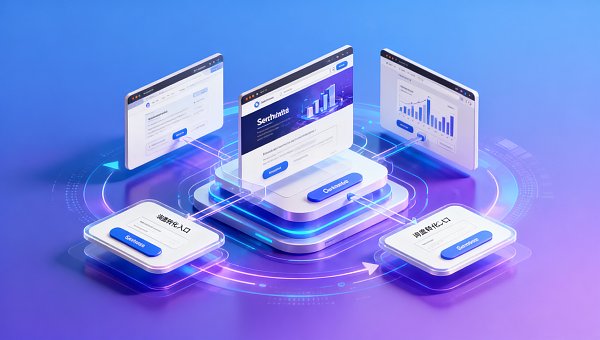
When many people search for what functions a multilingual foreign trade website has, their first reaction is language switching, product display, and contact information. This understanding is not wrong, but it is still relatively basic. For a foreign trade website, its functions should be built around four steps: “being searched, being understood, being trusted, and being contacted.”
The first layer is multilingual presentation. Pages in different languages cannot rely only on machine literal translation; navigation, buttons, form fields, image copy, and page paths also need to be handled. Otherwise, although users enter the page, they will quickly leave because of a fragmented reading experience.
The second layer is search friendliness. When truly answering what functions a multilingual foreign trade website has, it must include independent language pages, configurable titles and descriptions, internal links, page loading speed, and mobile adaptation. These capabilities determine whether the website can continuously obtain organic traffic.
The third layer is marketing conversion. A website is not an electronic brochure, but an inquiry entry point. Forms, buttons, instant communication tools, quotation requests, sample requests, and landing page tracking are all core functions.
The fourth layer is data analysis. Traffic sources, keyword performance, page dwell time, button clicks, and form submission rates should all be tracked. Without data, optimization can only rely on guesswork.
2. Why is it said that not missing the inquiry path is the key to the success or failure of a foreign trade website?
When discussing what functions a multilingual foreign trade website has, the most easily overlooked aspect is the inquiry path. Many websites have beautiful pages and complete translations, yet users cannot find the next step. This is not a traffic problem, but a lack of conversion path design.
A complete inquiry path usually includes the following nodes:
- After entering from search, the first screen clearly shows the industry, products, and advantages.
- While browsing, users can see inquiry buttons at any time.
- Product pages contain parameters, cases, delivery descriptions, and trust information.
- The form submission steps are short, and there are not too many fields.
- After submission, there is an automated response and a manual follow-up mechanism.
If a website has only one “Contact Us” entry and it is hidden in the footer, users often will not actively look for it. A better approach is to place conversion entry points with different purposes on the homepage, product pages, case pages, blog pages, and landing pages respectively.
For example, buttons such as “Get a Quote,” “Request a Catalog,” “Book a Demo,” and “Ask About Lead Time” align better with real decision-making psychology than a single “Submit.” Doing so is also more in line with the business objective behind the question of what functions a multilingual foreign trade website has.
3. For search-based customer acquisition, what specific capabilities does a multilingual website need?
To truly answer what functions a multilingual foreign trade website has, search capability must be discussed separately. This is because many websites do not lack content; rather, they are simply not being found by the target market at all.
For multilingual search-based customer acquisition, at least five types of capabilities are required.
1. Independent page capability for each language
Different languages should have independent URLs and independent content, rather than forcibly switching text within one page. This is more conducive to search engine recognition and also makes it easier to optimize content for different markets.
2. Localized keyword layout
Keywords cannot simply be directly translated. Search habits vary greatly across different markets, so product terms, scenario terms, question terms, and comparison terms all need to be re-researched in order to improve effective exposure.
3. Technical optimization capability
This includes page loading speed, mobile adaptation, sitemap, structured tags, certificate security, and the conciseness of page code. These factors directly affect crawling and ranking performance.
4. Ongoing content production capability
A foreign trade website needs continuous updates of industry articles, frequently asked questions, case pages, and solution pages. The closer the content is to actual search intent, the easier it is to attract high-quality inquiries.
5. Data tracking and iteration capability
Which languages bring traffic, which pages generate inquiries, and which keywords have high bounce rates all need to be analyzed regularly. Only in this way will the question of what functions a multilingual foreign trade website has not remain just a paper checklist.
When planning for the Russian-speaking market, if you want to balance website building, translation, and local search, you may refer to Russian Industry Website Construction and Marketing Solutions, and promote website construction and market promotion within the same system, which is more conducive to shortening the trial-and-error cycle.
4. When enterprises choose a solution, which functions should they focus on judging whether they are truly in place?
When you think again about what functions a multilingual foreign trade website has, you may wish to change the perspective: instead of looking at whether the functions are written in the proposal, look at whether the functions can truly be implemented and serve growth.
In addition, attention should also be paid to whether the service provider understands the integration of website and marketing. Simply building a website does not mean it can acquire customers. E-Marketing Information Technology (Beijing) Co., Ltd. has long provided full-chain services around intelligent website building, SEO optimization, social media marketing, and advertising placement. This kind of integrated capability is more suitable for website projects that require sustained growth.
5. What common misunderstandings during the construction process can greatly reduce the effectiveness of a multilingual website?
The reason many projects fail to deliver results is not that they do not know what functions a multilingual foreign trade website has, but that they fall into several high-frequency misunderstandings during execution.
Misunderstanding 1: Treating multilingual as translation
The core of a multilingual website is localization, not just replacing text. Page structure, expression habits, trust elements, and search term strategies all need to be adjusted according to the market.
Misunderstanding 2: Focusing only on the homepage and not on inner pages
Real traffic often comes from product pages, article pages, and solution pages. If inner pages are empty and generic, the website will find it difficult to capture segmented search demand.
Misunderstanding 3: Inquiry forms are too long
At the first-contact stage, users are not willing to fill in too much information. Priority should be given to collecting necessary fields first, and then supplementing details through subsequent communication.
Misunderstanding 4: No iteration after launch
Launching a website is only the beginning. Page data, keyword changes, and market feedback all require continuous adjustment; otherwise, rankings and conversions will gradually decline.
If the target market includes Russian-speaking regions, and you hope to simultaneously take into account domain name, translation, security, and search optimization, then Russian Industry Website Construction and Marketing Solutions, as this kind of one-stop capability, makes it easier to avoid operational losses caused by fragmented functions.
6. What functions does a multilingual foreign trade website have, and how should they ultimately be implemented into growth results?
Returning to the original question, what functions does a multilingual foreign trade website have? A complete answer should include: multilingual display, independent SEO configuration, localized content, mobile experience, trust information, a clear inquiry path, data tracking, and a continuous optimization mechanism.
A truly effective website is not one with more functions the better, but one in which every function serves customer acquisition and conversion. In particular, the inquiry path should be highly valued, forming a closed loop from entry point, page, and button to submission feedback.
If you are planning a new website or upgrading an old one, it is recommended to first sort out three things: target market languages, core traffic sources, and the most important conversion actions. Define these three items clearly first, and then decide the page structure and function priorities, and the results will usually be more stable.
When website construction and marketing operations can be advanced in an integrated manner, a multilingual foreign trade website truly becomes the infrastructure for global growth, rather than a set of online storefront pages that look complete but are actually difficult to convert.
Related Articles



Related Products
 EasyCamp SaaS Smart Website Marketing SystemE-Yingbao SaaS Smart Website Marketing System: AI-powered, zero-code website building. Rapidly launch multilingual independent e-commerce sites in just 10 minutes. Global server acceleration and AI-driven SEO optimization empower businesses to efficiently connect with global markets. The seamless integration of technology and user-friendly operation makes building e-commerce sites incredibly simple.
 AI+SEM Intelligent Advertising Marketing SystemAI+SEM drives intelligent ad creation, empowering full-funnel precision advertising marketing. The system automatically generates weekly/monthly reports, AI recommends keywords and target countries, monitors core metrics in real-time with intelligent alerts, and enables one-click high-conversion ad solutions to help quickly acquire customers and improve ROI.
 AI+SEO Dual Engine Optimization ServiceEasyWin AI+SEO Dual Engine Optimization System leverages AI-powered keyword mining, content generation, and comprehensive technical optimization to help foreign trade enterprises acquire high-quality organic traffic, significantly improving search rankings and conversion rates.
 AI+SNS Social Media Marketing SystemYingbao AI+SNS Social Media Marketing System - Precision social capture for the social media era. Supports one-click content synchronization across major platforms like Facebook and LinkedIn. AI intelligently rewrites posts for enhanced relevance. 24/7 AI customer service and user profiling analysis empower businesses to efficiently expand into global markets.
 AI+SEO营销解决方案易营宝AI+SEO营销解决方案,通过AI批量写作、智能生成TDK、精准关键词扩词等功能,全面优化网站SEO效果,提升流量与转化率。助力企业构建高效智能网站新生态。
 AI+SEM Advertising Marketing SolutionsAI+SEM Advertising Marketing Solution leverages AI technology to deeply empower SEM ad campaigns. It automatically generates weekly/monthly reports using AI, presenting account data across multiple dimensions for comprehensive insights into campaign performance and trends. The system precisely recommends keywords and target countries, intelligently generates high-conversion ad copy, and enables one-click activation of efficient campaign plans to help businesses rapidly acquire customers. Simultaneously, it monitors core metrics in real time, intelligently identifies abnormal fluctuations, and issues timely alerts to ensure stable, high-return advertising results.
 Domain Name ServicesEasyWin provides professional domain name services, including intelligent queries, one-stop registration, brand protection, and full lifecycle management, helping businesses build a digital brand image.
 EasyOperate B2C Cross-Border E-Commerce Platform & Independent WebsiteEasyStore B2C Cross-border E-commerce Independent Store is an intelligent website building and cross-border e-commerce integrated solution independently developed by EasyStore Information Technology (Beijing) Co., Ltd. The system is specially designed for small and medium-sized as well as large export enterprises, integrating 'website building, operation, marketing, advertising, and conversion' into one, helping enterprises quickly establish cross-border e-commerce independent stores to achieve brand globalization and global sales growth.
The platform supports multiple languages, multiple currencies, and multi-channel marketing, with built-in AI intelligent translation and SEO optimization systems, suitable for mainstream markets such as Southeast Asia, Europe and America, Latin America, and the Middle East, assisting Chinese manufacturing enterprises in efficiently deploying international e-commerce strategies. SSL证书易营宝提供专业SSL安全证书服务,包括单域名和泛域名证书,确保网站数据传输加密、身份验证和完整性保护,助力企业建立安全可信的在线业务环境。









