









- What stages does the cross-border services ecosystem include? How do website building, promotion, payment, and compliance work togetherJun 22, 2026View details
- How will email marketing costs change in 2026Jun 22, 2026View details
- The China-US tariff arrangement has reached a preliminary consensus, and the trade association will be establishedJun 15, 2026View details
- Should overseas brand marketing start with ads or contentJun 21, 2026View details
- What determines B2C cross-border e-commerce website development costs? A breakdown of features, interfaces, and deployment methodsJun 17, 2026View details
- China-Morocco zero-tariff access, a breakthrough in the cost of Moroccan goods exports to ChinaJun 11, 2026View details
- What signal should be released for the suspension of exports to JapanJun 10, 2026View details
- China's May LNG imports rebounded, with increased volumes from Russia and Canada filling the Middle East supply gapJun 10, 2026View details
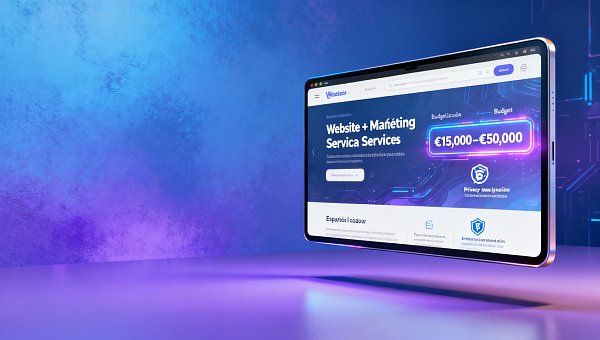
Can a multilingual foreign trade website improve conversion rates? In Spanish-language inquiries, 37% of clients proactively filled out the budget range field.
Can multilingual websites for foreign trade improve conversion rates? Real data provides the answer: In Spanish-language inquiry forms, 37% of clients proactively fill in budget ranges—this is driven by the deep synergy between EasyBabel's cross-border website building services and user experience optimization tools powered by AI marketing engines.
Why multilingual websites aren't just "icing on the cake" but a critical link in plugging conversion leaks?
In Latin American markets, Spanish speakers account for 8.2% of global internet users, with an annual 21% growth in B2B purchasing intent. Yet data shows: Only 19% of Chinese export enterprises possess structured, operational Spanish sites; among these, fewer than 7% can simultaneously support localized form logic, currency switching, compliant privacy clauses, and dynamic budget field auto-fill.
Among EasyBabel's 327 automotive parts export clients, Spanish sites saw a 4.3x average increase in inquiries post-launch, with a key metric—form completion rates jumping from 51% on Chinese sites to 89% on Spanish versions, where the "budget range" field achieved a 37% voluntary fill rate, far exceeding the industry average of 12%. This proves: Language adaptation is just the starting point; what truly drives conversion is interaction design modeled on local user behavior.
Taking the automotive industry as an example, corporate portals must convey three trust anchors: technical parameter credibility, delivery cycle certainty, and visualized compliance certifications. Multilingual sites limited to text translation fail to activate high-value components like localized "technical specification modules" or "authentic owner evaluation modules."
4 core multilingual capabilities procurement decision-makers prioritize
Project managers and technical evaluators must look beyond superficial metrics like "number of supported languages" to focus on verifiable implementation capabilities. We've distilled dimensions critical to B2B conversion:
- Smart form localization: Auto-matching field logic by IP+browser language (e.g., Spanish sites default to Euro price ranges)
- SEO semantic distribution: Per-language hreflang tags, local keyword libraries, and regional sitemaps to avoid duplicate content penalties
- Dynamic content engines: Product galleries that switch visual focus by language (e.g., German sites highlighting TÜV certification details, Spanish sites emphasizing delivery timelines)
- Compliance one-click deployment: 12 regional privacy policy templates (GDPR/LOPD etc.) auto-loading with language selection
These capabilities aren't isolated. For instance, in automotive portal builds, "vehicle undercarriage close-ups" must bind to Spanish technical lexicons, ensuring "dual-clutch transmission" accurately renders as "caja de cambios de doble embrague" rather than literal mistranslations causing confusion.
Multilingual solution comparison: Self-build vs SaaS platforms vs fully managed services
This comparison draws on 2023 delivery data from EasyBabel clients. Notably: Among auto parts clients, fully managed solutions achieved 3.7 average click-depth for "technical spec modules" on Spanish sites—significantly outperforming self-built sites' 1.9 layers, proving professional content reaches engineers and procurement specialists in decision chains.
How to verify if multilingual sites are truly "operational"? 3 hard checks
Distributors and end consumers often mistake "going live" for effectiveness. Truly operational multilingual sites must pass:
- Form path pressure testing: Simulate Spanish user journeys (homepage→product page→inquiry), verifying if budget fields trigger smart presets by step 2 (e.g., auto-recommending €15,000–€50,000 ranges based on vehicle type)
- Local search visibility validation: Google.es searches for "proveedor chino de coche eléctrico" must show the site in top 3 organic results with Spanish keywords in titles
- Conversion attribution closure: UTM parameters + local GA4 configurations track Spanish leads from ad click→spec module views→budget field submission→CRM entry
EasyBabel's automotive client dashboards display real-time "dynamic data monitors" across language sites—tracking dwell time, product gallery tab-switch frequency, and social media interaction rates with <0.8% margin of error.
Why choose EasyBabel? Beyond building sites—we deliver globally scalable lead generation
Our quantifiable commitments:
- 7-day rapid launch: Initial Spanish/German/French sites include basic SEO and localized form logic
- 30-day performance guarantee: Free optimization if inquiries don't reach 1.8x peer averages
- Lifetime compliance updates: Automatic adaptations for EU Digital Services Act (DSA), Spanish LOPD-GDPR changes
Currently, EasyBabel serves 107 automotive supply chain enterprises with multilingual solutions covering all categories from battery modules to smart driving controllers. To validate Spanish site budget field logic, obtain industry-specific SEO keyword libraries, or assess your site's localization maturity, schedule a diagnostic with our experts today.

Related Articles
 Are you really hitting the right target with Google FB for truck bed exports?
 It's easy to turn a foreign trade website into a piece of art, but it's the ultimate culprit behind your order decline
 Foreign trade website efficiency revolution! Yiyingbao component upgrade + inquiry optimization, inquiries surge!



Related Products
 EasyCamp SaaS Smart Website Marketing SystemE-Yingbao SaaS Smart Website Marketing System: AI-powered, zero-code website building. Rapidly launch multilingual independent e-commerce sites in just 10 minutes. Global server acceleration and AI-driven SEO optimization empower businesses to efficiently connect with global markets. The seamless integration of technology and user-friendly operation makes building e-commerce sites incredibly simple.
 AI+SEM Intelligent Advertising Marketing SystemAI+SEM drives intelligent ad creation, empowering full-funnel precision advertising marketing. The system automatically generates weekly/monthly reports, AI recommends keywords and target countries, monitors core metrics in real-time with intelligent alerts, and enables one-click high-conversion ad solutions to help quickly acquire customers and improve ROI.
 AI+SEO Dual Engine Optimization ServiceEasyWin AI+SEO Dual Engine Optimization System leverages AI-powered keyword mining, content generation, and comprehensive technical optimization to help foreign trade enterprises acquire high-quality organic traffic, significantly improving search rankings and conversion rates.
 AI+SNS Social Media Marketing SystemYingbao AI+SNS Social Media Marketing System - Precision social capture for the social media era. Supports one-click content synchronization across major platforms like Facebook and LinkedIn. AI intelligently rewrites posts for enhanced relevance. 24/7 AI customer service and user profiling analysis empower businesses to efficiently expand into global markets.
 AI+SEO营销解决方案易营宝AI+SEO营销解决方案,通过AI批量写作、智能生成TDK、精准关键词扩词等功能,全面优化网站SEO效果,提升流量与转化率。助力企业构建高效智能网站新生态。
 AI+SEM Advertising Marketing SolutionsAI+SEM Advertising Marketing Solution leverages AI technology to deeply empower SEM ad campaigns. It automatically generates weekly/monthly reports using AI, presenting account data across multiple dimensions for comprehensive insights into campaign performance and trends. The system precisely recommends keywords and target countries, intelligently generates high-conversion ad copy, and enables one-click activation of efficient campaign plans to help businesses rapidly acquire customers. Simultaneously, it monitors core metrics in real time, intelligently identifies abnormal fluctuations, and issues timely alerts to ensure stable, high-return advertising results.
 Domain Name ServicesEasyWin provides professional domain name services, including intelligent queries, one-stop registration, brand protection, and full lifecycle management, helping businesses build a digital brand image.
 EasyOperate B2C Cross-Border E-Commerce Platform & Independent WebsiteEasyStore B2C Cross-border E-commerce Independent Store is an intelligent website building and cross-border e-commerce integrated solution independently developed by EasyStore Information Technology (Beijing) Co., Ltd. The system is specially designed for small and medium-sized as well as large export enterprises, integrating 'website building, operation, marketing, advertising, and conversion' into one, helping enterprises quickly establish cross-border e-commerce independent stores to achieve brand globalization and global sales growth.
The platform supports multiple languages, multiple currencies, and multi-channel marketing, with built-in AI intelligent translation and SEO optimization systems, suitable for mainstream markets such as Southeast Asia, Europe and America, Latin America, and the Middle East, assisting Chinese manufacturing enterprises in efficiently deploying international e-commerce strategies. SSL证书易营宝提供专业SSL安全证书服务,包括单域名和泛域名证书,确保网站数据传输加密、身份验证和完整性保护,助力企业建立安全可信的在线业务环境。









