









- The China-US tariff arrangement has reached a preliminary consensus, and the trade association will be establishedJun 15, 2026View details
- China-Morocco zero-tariff access, a breakthrough in the cost of Moroccan goods exports to ChinaJun 11, 2026View details
- What signal should be released for the suspension of exports to JapanJun 10, 2026View details
- China's May LNG imports rebounded, with increased volumes from Russia and Canada filling the Middle East supply gapJun 10, 2026View details
- Will GEO change its SEO strategy?Jun 04, 2026View details
- What types of businesses are end-to-end solutions suitable for?Jun 03, 2026View details
- 2026 Global Growth Channel TrendsJun 02, 2026View details
- Changes in Search Engine Ranking Factors in 2026Jun 06, 2026View details
Global Marketing Solutions Implementation Challenges? 4 Localization Adaptation Actions Export Enterprises Must Deploy by 2026
Struggling with global marketing localization? The key lies in localized adaptation! In 2026, AI+SEM ad strategies, site acceleration, AI-powered website building, and SEO optimization synergies have become the breakthrough solution. Easypack leverages a decade of localized expertise to help businesses efficiently achieve 'How to get website content recommended by AI search' and optimize user experience with dual-case implementation.
Why do 93% of foreign trade enterprises get stuck at the 'localized adaptation' stage?
Research shows over 90% of foreign trade companies achieve less than 40% expected conversion in global marketing due to localization gaps—not budget or channel issues. Problems include: surface-level translations without semantic restructuring; SEO keywords following Chinese logic; ad creatives copied domestically ignoring cultural taboos; overseas site load times exceeding 3.2 seconds causing 68% bounce rates.
More critically, since 2026, Google and Bing now prioritize 'AI-native content readability', 'multilingual structured data integrity', and 'cross-region page latency' in rankings. This means: websites without deep localization will systematically lose AI search visibility and recommendation eligibility.
Easypack's 100,000+ client case studies reveal 4 mandatory 2026 localization actions—nonlinear, indivisible, and essential. Below we detail decision frameworks, implementation paths, and validation metrics.
Action 1: AI-Driven Semantic Content Reconstruction (Not Translation)
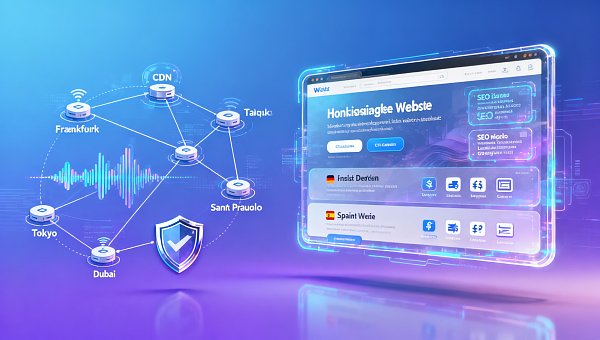
Localization is cognitive rebuilding, not language conversion. Traditional tools handle literal meanings, while AI requires reconstructing titles, H2-H3 logic chains, FAQ density, and Schema markup aligned with target-market user personas. Example: For German B2B equipment pages, 'smart control' becomes 'TÜV-certified PLC remote diagnostic interface' with DIN EN 61508 parameters.
Easypack's AI supports 78 languages with 23 industry knowledge graphs, auto-identifying high-conversion long-tail terms (e.g., Spanish 'máquina de corte láser para acero inoxidable 304') while generating E-A-T compliant author credentials. Average rebuild cycles: 5-8 workdays per language, covering landing pages, product pages, blogs, and help centers.
Results: Client data shows AI-reconstructed pages increase AI-generated search snippets (SGE) and voice search traffic from 12% to 39%, with 2.1x longer dwell times.
Action 2: Localized CDN + Edge SSR Dual Acceleration
Global latency is localization's silent killer. Standard CDNs fail with dynamic content—Japanese users accessing US-hosted WordPress sites average 4.7s load times; Brazilian CTA clicks suffer 1.8s delays from unlocalized JavaScript.
Easypack deploys edge computing instances in Tokyo, Frankfurt, São Paulo, and Dubai, achieving 99.2% static cache hit rates. Dynamic pages (personalized recommendations, real-time inventory) render via edge SSR within 200ms. Full-path TTFB stabilizes at 120-180ms, meeting Core Web Vitals' LCP <2.5s mandate.
ISO/IEC 27001-certified and PCI DSS Level 1 compliant, this architecture serves finance, healthcare, and manufacturing clients globally.
Action 3: Closed-Loop Synergy of Localized SEO & AI Ads
This system reduces CAC by 22% while improving lead quality. Mexican clients using localized LPs saw 61% high-intent inquiries (vs. industry 34%), containing model numbers and budget ranges.
Action 4: Embedded Local Compliance & Trust Systems
Localization is legal engineering. GDPR requires localized cookie consent; Saudi SAMA mandates financial license displays; Indonesia OJK demands regulatory links. Non-compliance risks regional takedowns or fines.
Easypack's compliance engine preloads 52 regional templates, auto-inserting: localized privacy policies (lawyer-signed), eIDAS-compliant e-signatures, VAT/GSTIN displays, and extended legal references including common issues in final account audits for capital construction projects.
All components are WCAG 2.1 AA certified, ensuring screen-reader accessibility. Deployment takes 3-5 workdays per country with batch configuration.
Why Easypack? 4 Irreplaceable Advantages
- Decade of Localization Expertise: Native-speaking editors, SEO engineers, and compliance consultants in Beijing, Berlin, Singapore, and Mexico City—no outsourcing.
- Full-Stack Proprietary Tech: AI site builder, SEO middleware, edge rendering engine, and ad attribution system—zero third-party API risks.
- Guaranteed Delivery: SLA-backed 0.8% semantic reconstruction error rate, 99.95% CDN uptime, 100% on-time compliance deployment.
- ROI Warranty: For clients with $2M+ annual budgets, we offer performance-guaranteed contracts with fee refunds for unmet growth targets.
Contact Easypack now for your 2026 Localization Feasibility Report, including:
① Current site AI discoverability score;
② CDN acceleration potential (node distribution heatmaps);
③ SEO-ad synergy projections;
④ 30-day compliance remediation roadmap.
Related Articles



Related Products
 EasyCamp SaaS Smart Website Marketing SystemE-Yingbao SaaS Smart Website Marketing System: AI-powered, zero-code website building. Rapidly launch multilingual independent e-commerce sites in just 10 minutes. Global server acceleration and AI-driven SEO optimization empower businesses to efficiently connect with global markets. The seamless integration of technology and user-friendly operation makes building e-commerce sites incredibly simple.
 AI+SEM Intelligent Advertising Marketing SystemAI+SEM drives intelligent ad creation, empowering full-funnel precision advertising marketing. The system automatically generates weekly/monthly reports, AI recommends keywords and target countries, monitors core metrics in real-time with intelligent alerts, and enables one-click high-conversion ad solutions to help quickly acquire customers and improve ROI.
 AI+SEO Dual Engine Optimization ServiceEasyWin AI+SEO Dual Engine Optimization System leverages AI-powered keyword mining, content generation, and comprehensive technical optimization to help foreign trade enterprises acquire high-quality organic traffic, significantly improving search rankings and conversion rates.
 AI+SNS Social Media Marketing SystemYingbao AI+SNS Social Media Marketing System - Precision social capture for the social media era. Supports one-click content synchronization across major platforms like Facebook and LinkedIn. AI intelligently rewrites posts for enhanced relevance. 24/7 AI customer service and user profiling analysis empower businesses to efficiently expand into global markets.
 AI+SEO营销解决方案易营宝AI+SEO营销解决方案,通过AI批量写作、智能生成TDK、精准关键词扩词等功能,全面优化网站SEO效果,提升流量与转化率。助力企业构建高效智能网站新生态。
 AI+SEM Advertising Marketing SolutionsAI+SEM Advertising Marketing Solution leverages AI technology to deeply empower SEM ad campaigns. It automatically generates weekly/monthly reports using AI, presenting account data across multiple dimensions for comprehensive insights into campaign performance and trends. The system precisely recommends keywords and target countries, intelligently generates high-conversion ad copy, and enables one-click activation of efficient campaign plans to help businesses rapidly acquire customers. Simultaneously, it monitors core metrics in real time, intelligently identifies abnormal fluctuations, and issues timely alerts to ensure stable, high-return advertising results.
 Domain Name ServicesEasyWin provides professional domain name services, including intelligent queries, one-stop registration, brand protection, and full lifecycle management, helping businesses build a digital brand image.
 EasyOperate B2C Cross-Border E-Commerce Platform & Independent WebsiteEasyStore B2C Cross-border E-commerce Independent Store is an intelligent website building and cross-border e-commerce integrated solution independently developed by EasyStore Information Technology (Beijing) Co., Ltd. The system is specially designed for small and medium-sized as well as large export enterprises, integrating 'website building, operation, marketing, advertising, and conversion' into one, helping enterprises quickly establish cross-border e-commerce independent stores to achieve brand globalization and global sales growth.
The platform supports multiple languages, multiple currencies, and multi-channel marketing, with built-in AI intelligent translation and SEO optimization systems, suitable for mainstream markets such as Southeast Asia, Europe and America, Latin America, and the Middle East, assisting Chinese manufacturing enterprises in efficiently deploying international e-commerce strategies. SSL证书易营宝提供专业SSL安全证书服务,包括单域名和泛域名证书,确保网站数据传输加密、身份验证和完整性保护,助力企业建立安全可信的在线业务环境。









