









- What Does a Global Traffic Ecosystem Service Provider Do? What Are the Differences from a Single Advertising AgencyJul 16, 2026View details
- What should you focus on in the latest enterprise SaaS report? From renewal rates and delivery costs to overseas growth opportunitiesJul 12, 2026View details
- What signals are worth paying attention to in a cross-border marketing trend report? B2B companies should look at these 6 signalsJul 11, 2026View details
- How to Read a Cross-Border Marketing Trends Report? Five Key Dimensions for Evaluating Channel OpportunitiesJul 11, 2026View details
- Which channel has the highest ROI in the global traffic ecosystem? Comparative analysis of search, social media, and advertisingJul 10, 2026View details
- What multilingual website services are available in Sanya? Which model is more suitable for local businesses going global?Jul 08, 2026View details
- How to view the complete list of China SaaS companies in the top 100? Practical methods for screening website-building and marketing service providersJul 08, 2026View details
- How to view pricing in the global traffic ecosystem? Cost comparison of search, social media, and content channel advertisingJul 06, 2026View details
How to balance multilingual SEO in cross-border website building solutions
How can a cross-border website building solution take into account multilingual SEO? From choosing a platform for multilingual website construction to Google SEO optimization services, businesses need to coordinate website building, content, and promotion to improve global customer acquisition efficiency.
Why can't cross-border websites just create "multilingual pages"?
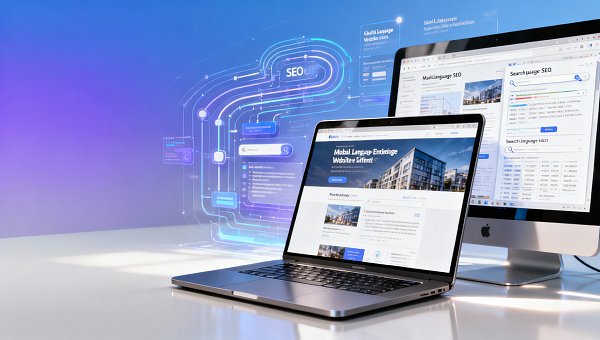
When many companies launch a cross-border website development plan, their first step is often to translate their Chinese website into English, Russian, or Spanish and then launch it directly. However, from a multilingual SEO perspective, this is merely "page duplication" and not true multilingual website development that can generate organic traffic.
Search engines understand site structure, language version relationships, page themes, loading speed, and content relevance. Without standardized directories, regional signals, and keyword stratification, even launching in 3 to 5 languages can lead to issues such as page competition, slow indexing, and scattered inquiries.
For information researchers, the pain point is not being able to find the corresponding product page; for business decision-makers, the pain point is not seeing an increase in leads after budgeting; for project managers, a common challenge is that the launch cycle is repeatedly extended to more than 4 weeks due to translation, development, and SEO; while after-sales and channel teams are more concerned about whether content updates are sustainable.
Therefore, a mature cross-border website building solution must plan website construction, content, technical SEO, and promotion within the same framework, rather than separating website construction from Google SEO optimization services. This is also the core value of the integrated website + marketing service model.
The core of multilingual SEO is not just translation, but "localized search matching".
Search habits for the same product vary across different markets. Taking industrial equipment as an example, users in Europe and America pay more attention to specifications, certifications, delivery times, and application cases, while users in some emerging markets focus more on price range, agency support, and after-sales response. Simply translating the page content literally will hardly capture these true search intents.
Since 2013, Yiyingbao Information Technology (Beijing) Co., Ltd. has been serving global marketing scenarios. Driven by artificial intelligence and big data, it integrates intelligent website building, SEO optimization, social media marketing and advertising, making it suitable for companies that need to build an overseas customer acquisition system from scratch.
Four issues that businesses are most likely to overlook in the early stages
- Focusing only on display effects without considering URL structure, language directories, and page indexing rules makes it difficult for search engines to identify version relationships.
- Keyword research only focuses on one main keyword, without establishing a hierarchical keyword database for the homepage, category pages, product pages, and case study pages.
- Content updates rely on manual intervention, and multilingual maintenance is infrequent. It is common for almost no new pages to be added 2-3 months after launch.
- The separation of website building and marketing providers has resulted in a lack of synchronized progress in technical upgrades, indexing optimization, and advertising landing pages.
If a company wants to generate stable organic traffic from overseas within 6 to 12 months, the importance of early-stage architecture design is usually higher than that of later piecemeal fixes.
How to choose a platform for building a multilingual website that balances SEO and post-launch operations?
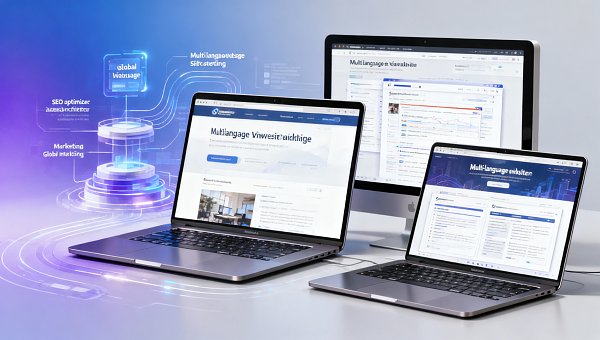
Choosing the right platform for a multilingual website is one of the most common decision-making issues for businesses. Platform selection involves more than just looking at the template; it's crucial to evaluate factors such as secondary development capabilities, language version management, page speed, content permissions, marketing extension interfaces, and ongoing maintenance costs.
If a company is in the overseas market validation phase, it is advisable to prioritize platforms that can be launched quickly, support SEO field configuration, and complete the first version deployment within 2 to 4 weeks. If the product line is complex, the distribution system is multi-layered, and there are many regional sites, then an architecture that supports sub-site management and batch content synchronization is more suitable.
When selecting a platform, project managers are advised to break down its capabilities into three core metrics: technical SEO fundamentals, content operation efficiency, and marketing collaboration capabilities. Only when all three metrics are met can a cross-border website development solution potentially achieve sustained traffic growth.
The table below can serve as a basic evaluation framework for companies when selecting service providers, and is especially suitable for cross-border website projects of manufacturing, equipment, and B2B export-oriented companies.
From a long-term cost perspective, basic website building may have a lower initial price, but the overall investment often increases later if it involves redesigns, adding languages, expanding sections, or Google SEO optimization services. Conversely, an integrated solution is more suitable for unifying website building, content creation, and promotion, reducing repeated rework.
Five key check items when selecting a platform
- Does it support independent language directories or subsite structures to facilitate separate optimization for different markets?
- Can page titles, descriptions, images, alternative text, and structured navigation be configured?
- Does it support mobile adaptation and maintain fast loading in normal network environments?
- Does it have content access control to facilitate collaboration among multiple roles such as marketing, sales, and after-sales?
- Can it form a closed loop with inquiry forms, advertising tracking, and social media channels?
For industries with a large number of product catalogs, vertical scenario approaches such as laser engraving machine industry solutions can be adopted, prioritizing the strengthening of professional website building, intelligent category navigation, and product display logic to help overseas users find their target content within 1-3 clicks.
How to plan content, structure, and Google SEO optimization services for cross-border website building solutions
A truly effective cross-border website building solution typically includes four parallel modules: site architecture, keyword strategy, content creation, and collaborative promotion. Many companies separate these four actions, resulting in the website going live but failing to achieve stable indexing and effective inquiries within 3 to 6 months.
Website architecture determines how search engines understand page hierarchy. It's recommended to divide pages into at least six categories: homepage, core product pages, application scenario pages, case study pages, support pages, and blog pages, and establish corresponding relationships for different language versions. This approach benefits both indexing and user navigation.
Keyword strategy should follow the pattern of "homepage brand keywords + category industry keywords + product long-tail keywords + question keywords". For decision-makers, the focus is not on how many keywords are covered, but on whether people at different stages of the procurement process can find the corresponding pages, including those for price inquiries, parameter confirmation, solution comparison, and delivery evaluation.
Google SEO optimization services should not only focus on backlinks or single-page rankings. More importantly, they should continuously output content that aligns with market intentions, and combine this with page technology optimization, internal link planning, and conversion path design to ensure that traffic leaves inquiries, rather than just focusing on page views.
Recommended implementation process
For most B2B companies, a relatively stable implementation schedule is usually three phases, totaling about 6 to 12 weeks. The specific time depends on the number of languages, product complexity, and the completeness of the documentation.
The value of this type of process lies in transforming the passive model of "build the website first and then fix the SEO" into a continuous optimization model of "planning, launching, and verifying simultaneously," which is especially suitable for companies with rapid product updates and long overseas inquiry chains.
Content layout suggestions: Which pages should different roles view?
- Information researchers: Prioritize reading industry articles, application scenario pages, and frequently asked questions pages to help them gain an initial understanding.
- Enterprise decision-makers are paying more attention to the solution page, delivery capability page, quotation consultation portal, and multi-market operation capabilities.
- Project managers need to review the implementation process, timelines, document lists, and multi-department collaboration methods.
- After-sales and channel partners: They are more focused on the efficiency of support documents, download centers, agency policies, and update notifications.
If a company belongs to the equipment manufacturing, industrial product export, or spare parts industry, it can also learn from the ideas in the laser engraving machine industry solution , and improve the efficiency of multilingual product page management and enhance the display and search experience through intelligent classification navigation and AI editor.
What indicators should companies look at most when making procurement and decision-making decisions?
When procuring cross-border website building solutions, businesses are easily attracted by the "number of pages," "number of templates," or "low-priced packages." However, what truly impacts the outcome is often the website's operability over the subsequent 12 months. For B2B companies, a website is not a one-time delivery but a continuous customer acquisition asset.
When making decisions, it is recommended to focus on five key metrics: language expansion capabilities, basic SEO capabilities, content production efficiency, lead conversion design, and service collaboration depth. If any two of these metrics show significant weaknesses, subsequent promotion costs will be amplified.
YiYingBao Information Technology (Beijing) Co., Ltd. covers intelligent website building, SEO optimization, social media marketing, and advertising, making it suitable for companies looking to reduce communication losses with multiple suppliers. Especially for teams expanding into overseas markets, an integrated approach allows for better control over timelines, quality, and budget.
The table below is more suitable as an internal comparison checklist, helping bosses, marketing managers, and project managers evaluate service providers under the same standards, rather than just looking at the demo page.
If a company has a limited budget, it can start by launching one main language website and 10-20 core pages, and then gradually expand to more countries and content modules. The key is not to go all in at once, but to first establish a verifiable, iterable, and convertible foundation.
Common Misconceptions and FAQs
How long after a multilingual website goes live can you see SEO results?
The process typically involves three stages: indexing, initial sorting, and content enhancement. After the basic pages are completed, the typical observation period is 1-3 months; with continuous updates to industry content and product pages, a stable growth trend is more likely to be observed around 6 months. However, the specific progress is still affected by industry competition, content quality, and technological foundation.
Is it better to have more languages?
Not necessarily. For most companies, focusing on deepening their presence in one or two key markets is more effective than simultaneously launching in five or more languages. Too many languages with insufficient content will dilute maintenance resources and increase the risk of inconsistent page quality.
Which should you prioritize: Google SEO optimization services or advertising?
If a business needs to quickly validate the market, it can test landing pages and inquiry paths with advertising after the website goes live. If the goal is to reduce customer acquisition costs in the long term, then SEO content creation must be promoted simultaneously. The two are not substitutes, but rather a combination of short-term customer acquisition and long-term customer retention.
Why should after-sales and channel teams also be involved in website planning?
Because they understand best the frequently asked questions, installation and maintenance challenges, and agent support needs of users. This information is ideal for creating FAQs, download centers, and support pages, which not only improves user experience but also increases long-tail search coverage.
Why Choose Us: From Website Building to Promotion, Minimize Cross-Team Losses
For companies preparing to expand into overseas markets, the real challenge isn't just creating a multilingual website, but rather establishing a collaborative mechanism between website building, SEO, content, advertising, and social media. If the supply chain is too long, common outcomes include: development completed but content unprepared; content launched but technical optimization lacking; and traffic flowing in but no clear conversion path.
E-Marketing Information Technology (Beijing) Co., Ltd., headquartered in Beijing, has been deeply involved in global digital marketing services for ten years. With a dual strategy of "technological innovation + localized services," it has helped over 100,000 companies drive global growth. For businesses, this means that projects, from planning to execution, are easier to standardize and maintain a consistent pace.
If you are evaluating a cross-border website building solution, please prioritize the following: target market and language combination, number of pages in the initial phase, completeness of product information, standard delivery cycle, whether Google SEO optimization services are needed, and whether advertising landing pages and social media traffic generation should be implemented simultaneously.
If you are still in the early research stage, you can first clarify three things: how many language versions you need to launch, which markets you hope to validate within two months, and whether your existing website has the foundation for further optimization. Clarifying these issues will make subsequent parameter confirmation, solution customization, quotation communication, and launch plan development more efficient and controllable.
Related Articles
Related Products
 EasyCamp SaaS Smart Website Marketing SystemE-Yingbao SaaS Smart Website Marketing System: AI-powered, zero-code website building. Rapidly launch multilingual independent e-commerce sites in just 10 minutes. Global server acceleration and AI-driven SEO optimization empower businesses to efficiently connect with global markets. The seamless integration of technology and user-friendly operation makes building e-commerce sites incredibly simple.
 AI+SEM Intelligent Advertising Marketing SystemAI+SEM drives intelligent ad creation, empowering full-funnel precision advertising marketing. The system automatically generates weekly/monthly reports, AI recommends keywords and target countries, monitors core metrics in real-time with intelligent alerts, and enables one-click high-conversion ad solutions to help quickly acquire customers and improve ROI.
 AI+SEO Dual Engine Optimization ServiceEasyWin AI+SEO Dual Engine Optimization System leverages AI-powered keyword mining, content generation, and comprehensive technical optimization to help foreign trade enterprises acquire high-quality organic traffic, significantly improving search rankings and conversion rates.
 AI+SNS Social Media Marketing SystemYingbao AI+SNS Social Media Marketing System - Precision social capture for the social media era. Supports one-click content synchronization across major platforms like Facebook and LinkedIn. AI intelligently rewrites posts for enhanced relevance. 24/7 AI customer service and user profiling analysis empower businesses to efficiently expand into global markets.
 AI+SEO营销解决方案易营宝AI+SEO营销解决方案,通过AI批量写作、智能生成TDK、精准关键词扩词等功能,全面优化网站SEO效果,提升流量与转化率。助力企业构建高效智能网站新生态。
 AI+SEM Advertising Marketing SolutionsAI+SEM Advertising Marketing Solution leverages AI technology to deeply empower SEM ad campaigns. It automatically generates weekly/monthly reports using AI, presenting account data across multiple dimensions for comprehensive insights into campaign performance and trends. The system precisely recommends keywords and target countries, intelligently generates high-conversion ad copy, and enables one-click activation of efficient campaign plans to help businesses rapidly acquire customers. Simultaneously, it monitors core metrics in real time, intelligently identifies abnormal fluctuations, and issues timely alerts to ensure stable, high-return advertising results.
 Domain Name ServicesEasyWin provides professional domain name services, including intelligent queries, one-stop registration, brand protection, and full lifecycle management, helping businesses build a digital brand image.
 EasyOperate B2C Cross-Border E-Commerce Platform & Independent WebsiteEasyStore B2C Cross-border E-commerce Independent Store is an intelligent website building and cross-border e-commerce integrated solution independently developed by EasyStore Information Technology (Beijing) Co., Ltd. The system is specially designed for small and medium-sized as well as large export enterprises, integrating 'website building, operation, marketing, advertising, and conversion' into one, helping enterprises quickly establish cross-border e-commerce independent stores to achieve brand globalization and global sales growth.
The platform supports multiple languages, multiple currencies, and multi-channel marketing, with built-in AI intelligent translation and SEO optimization systems, suitable for mainstream markets such as Southeast Asia, Europe and America, Latin America, and the Middle East, assisting Chinese manufacturing enterprises in efficiently deploying international e-commerce strategies. SSL证书易营宝提供专业SSL安全证书服务,包括单域名和泛域名证书,确保网站数据传输加密、身份验证和完整性保护,助力企业建立安全可信的在线业务环境。









