









- What stages does the cross-border services ecosystem include? How do website building, promotion, payment, and compliance work togetherJun 22, 2026View details
- How will email marketing costs change in 2026Jun 22, 2026View details
- The China-US tariff arrangement has reached a preliminary consensus, and the trade association will be establishedJun 15, 2026View details
- Should overseas brand marketing start with ads or contentJun 21, 2026View details
- What determines B2C cross-border e-commerce website development costs? A breakdown of features, interfaces, and deployment methodsJun 17, 2026View details
- China-Morocco zero-tariff access, a breakthrough in the cost of Moroccan goods exports to ChinaJun 11, 2026View details
- What signal should be released for the suspension of exports to JapanJun 10, 2026View details
- China's May LNG imports rebounded, with increased volumes from Russia and Canada filling the Middle East supply gapJun 10, 2026View details
Cross-border e-commerce store conversion optimization from page to checkout
Cross-Border Store Conversion Optimization Starts with Why Users Aren’t Placing Orders
Cross-border store conversion optimization is not just about redesigning pages; it is about connecting every key step from product display and trust building to checkout and payment. This article combines real-world scenarios to break down the core methods for improving order conversion rate and transaction efficiency.
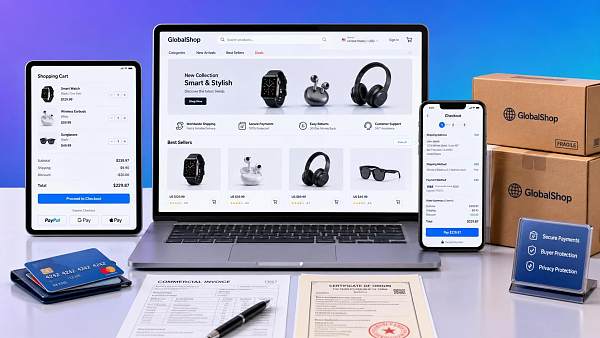
Many stores have plenty of traffic, but the problem occurs at the point of conversion. Users click in, browse, and even add items to the cart, but still do not pay in the end. This is especially common in cross-border business, because language, payment, logistics, taxes, and trust barriers all affect decisions at the same time.
Therefore, cross-border store conversion optimization should not focus only on homepage design, and it should not be limited to changing a button color. The truly effective approach is to examine the user journey step by step: whether the entry point is accurate, whether the product page is clear, whether trust information is complete, whether the checkout flow is smooth, and whether payment methods match local habits.
From a practical business perspective, improving conversion rate is often not achieved through one major redesign, but through a series of small optimizations added together. Improving each stage a little can ultimately create a noticeable gap in transaction efficiency.
Page Stage: Help Users Understand Faster and Keep Them Browsing
The first step in cross-border store conversion optimization is to reduce the user’s cognitive burden. A page is not better just because it is more visually polished; it should let users know within seconds what you sell, who it is for, and why it is worth buying.
The Hero Section Should Answer Three Questions
The hero section should first answer three questions: What is the product? What is the core selling point? Why buy now? The main visual should be clear and authentic, the headline should be direct, and the subheadline should add key benefit points instead of using vague buzzwords.
If it is a functional product, focus on specifications, use cases, and performance results. If it is a consumer product, emphasize experience, reviews, and visual appeal. Different categories require different expressions.
Information Structure Should Follow Decision Logic
High-converting pages are usually not about having more information, but about having the right order. It is recommended to structure the page as “selling points — detailed explanation — proof support — common questions — purchase guidance,” so users can keep reading naturally.
- Make the selling point block highlight differentiation and avoid piling up specifications.
- Use the detail block to answer real questions during use.
- Place reviews, certifications, case studies, and sales volume in the proof block.
- Repeat the purchase block, but do not push too hard.
This type of information arrangement often drives cross-border store conversion optimization more effectively than a simple visual upgrade, because it directly improves decision-making efficiency.
Building Trust: Don’t Let Users Lose Patience While Hesitating
Whether users are willing to pay is often not because the product is bad, but because they do not feel secure enough. Especially in cross-border scenarios, unfamiliar brands need more detailed trust-building signals.
Trust Information Should Be Up Front, Not Hidden in the Footer
Refund policy, shipping time, customs duties, payment security, and after-sales support should not be buried too deep. Once users begin comparing options, they often look first not at the copy, but at the risk cost.
A more obvious signal is that many store cart abandonments are not caused by price, but by extra fees appearing only before checkout, or by unclear shipping instructions. If information appears too late, trust is hard to recover.
Use Real Evidence Instead of Self-Promotion
Brand introductions can be written, but compared with saying “we are very professional,” users trust review screenshots, third-party certifications, KOL testing, customer order screenshots, and after-sales response records more. The closer these proofs are to real usage, the more they drive purchases.
In content operations, professional, material-based content can also be inserted appropriately. For example, some companies combine management and research content in their on-site topic pages to enhance the brand’s professionalism. The way a page like Research on the Construction Path of Internal Control in Public Hospitals from the Perspective of Financial Supervision handles information is worth referencing: clear title, defined theme, and concentrated value points.
Checkout Stage: The Core Battlefield of Cross-Border Store Conversion Optimization
If the page is responsible for generating interest, then the checkout page determines whether the last order can be completed. Many stores do a decent job upfront, but the real drop-off happens at checkout.
Reducing Steps Means Reducing Drop-Off
The longer the checkout process, the easier it is for users to leave. Account registration, address entry, coupon code input, shipping selection, payment confirmation—if these steps keep jumping around, patience will be continuously consumed. Merge steps whenever possible, and prefill default fields whenever possible.
In particular, guest checkout should be preserved. Many overseas consumers do not want to register before purchasing, and forcing login directly increases abandonment rates, which has a very large impact on cross-border store conversion optimization.
Payment Methods Must Match Local Habits
Payment preferences vary greatly by market. North American users are more accustomed to credit cards and installment payments, some European regions prefer local bank transfers, and Southeast Asia and Latin America place more importance on e-wallets and convenient payment methods.
Therefore, cross-border store conversion optimization should not rely on one universal payment channel; it should configure payment combinations according to the target country. Displaying currency, local taxes, and security badges on the payment page can also directly reduce concerns.
Explain Unexpected Costs Clearly
The biggest fear in cross-border orders is the “surprise” of shipping fees, taxes, or customs clearance charges. Users may already be prepared to pay, but seeing the total price suddenly increase makes them very likely to give up. The more transparent the pricing explanation is, the more stable the conversion.
Data-Driven: Don’t Rely on Feelings for Cross-Border Store Conversion Optimization
When many teams do optimization, they easily fall into a trap: thinking that a nicer look means higher conversion. In reality, truly effective cross-border store conversion optimization must be built on data observation and continuous testing.
Start by Focusing on Key Metrics
It is recommended to first pay attention to bounce rate, add-to-cart rate, checkout initiation rate, payment success rate, and mobile conversion rate. Do not look only at total orders; instead, look at which step loses the most users so that optimization has a clear direction.
Small Tests Are More Stable Than One Big Redesign
Button copy, price display format, review placement, timing of shipping prompts, and number of checkout fields are all suitable for small-scale testing. Change only one core variable at a time, so the real impact is easier to identify.
If there is complete platform support behind it, optimization efficiency will be much higher. Solutions like Yiyingbao, which integrate website building and marketing services, usually place intelligent website building, cross-border stores, SEO optimization, ad placement, and data analysis into the same system, making it easier to coordinate traffic quality and conversion performance rather than handling each separately.
This also means that cross-border store conversion optimization is no longer just page work, but a system project from traffic acquisition to on-site conversion and then to payment completion. Front-end experience, content organization, technical performance, and marketing strategy should all move forward together.
Implementation Advice: Progress by Priority to Get the Most Direct Results First
If you are about to start cross-border store conversion optimization now, the recommendation is not to roll out everything at once, but to first address the few actions that have the greatest impact on orders. This makes it easier to see returns in the short term and also supports continuous iteration later.
- First check the mobile product page and confirm whether the hero selling point is clear.
- Then review the checkout page, compress the steps, and keep the guest purchase option.
- Fill in refund, logistics, tax, and payment security explanations.
- Add locally common payment methods based on the target market.
- Use data to record every point of drop-off, then arrange testing cycles.
During execution, do not rush to achieve perfection in one step. First make the core path smooth, then optimize content detail and marketing coordination; the results are usually more stable.
Ultimately, the goal of cross-border store conversion optimization is not to make the page more complex, but to make it easier for users to understand, more willing to trust, and smoother to complete payment. As long as you keep iterating around these three points, conversion efficiency will gradually improve, and growth will become more sustainable.
Related Articles
 It's easy to turn a foreign trade website into a piece of art, but it's the ultimate culprit behind your order decline
 Foreign trade website efficiency revolution! Yiyingbao component upgrade + inquiry optimization, inquiries surge!
 B2B Must-Know | The Difference Between Demand Gen and Legacy Video Ads



Related Products
 EasyCamp SaaS Smart Website Marketing SystemE-Yingbao SaaS Smart Website Marketing System: AI-powered, zero-code website building. Rapidly launch multilingual independent e-commerce sites in just 10 minutes. Global server acceleration and AI-driven SEO optimization empower businesses to efficiently connect with global markets. The seamless integration of technology and user-friendly operation makes building e-commerce sites incredibly simple.
 AI+SEM Intelligent Advertising Marketing SystemAI+SEM drives intelligent ad creation, empowering full-funnel precision advertising marketing. The system automatically generates weekly/monthly reports, AI recommends keywords and target countries, monitors core metrics in real-time with intelligent alerts, and enables one-click high-conversion ad solutions to help quickly acquire customers and improve ROI.
 AI+SEO Dual Engine Optimization ServiceEasyWin AI+SEO Dual Engine Optimization System leverages AI-powered keyword mining, content generation, and comprehensive technical optimization to help foreign trade enterprises acquire high-quality organic traffic, significantly improving search rankings and conversion rates.
 AI+SNS Social Media Marketing SystemYingbao AI+SNS Social Media Marketing System - Precision social capture for the social media era. Supports one-click content synchronization across major platforms like Facebook and LinkedIn. AI intelligently rewrites posts for enhanced relevance. 24/7 AI customer service and user profiling analysis empower businesses to efficiently expand into global markets.
 AI+SEO营销解决方案易营宝AI+SEO营销解决方案,通过AI批量写作、智能生成TDK、精准关键词扩词等功能,全面优化网站SEO效果,提升流量与转化率。助力企业构建高效智能网站新生态。
 AI+SEM Advertising Marketing SolutionsAI+SEM Advertising Marketing Solution leverages AI technology to deeply empower SEM ad campaigns. It automatically generates weekly/monthly reports using AI, presenting account data across multiple dimensions for comprehensive insights into campaign performance and trends. The system precisely recommends keywords and target countries, intelligently generates high-conversion ad copy, and enables one-click activation of efficient campaign plans to help businesses rapidly acquire customers. Simultaneously, it monitors core metrics in real time, intelligently identifies abnormal fluctuations, and issues timely alerts to ensure stable, high-return advertising results.
 Domain Name ServicesEasyWin provides professional domain name services, including intelligent queries, one-stop registration, brand protection, and full lifecycle management, helping businesses build a digital brand image.
 EasyOperate B2C Cross-Border E-Commerce Platform & Independent WebsiteEasyStore B2C Cross-border E-commerce Independent Store is an intelligent website building and cross-border e-commerce integrated solution independently developed by EasyStore Information Technology (Beijing) Co., Ltd. The system is specially designed for small and medium-sized as well as large export enterprises, integrating 'website building, operation, marketing, advertising, and conversion' into one, helping enterprises quickly establish cross-border e-commerce independent stores to achieve brand globalization and global sales growth.
The platform supports multiple languages, multiple currencies, and multi-channel marketing, with built-in AI intelligent translation and SEO optimization systems, suitable for mainstream markets such as Southeast Asia, Europe and America, Latin America, and the Middle East, assisting Chinese manufacturing enterprises in efficiently deploying international e-commerce strategies. SSL证书易营宝提供专业SSL安全证书服务,包括单域名和泛域名证书,确保网站数据传输加密、身份验证和完整性保护,助力企业建立安全可信的在线业务环境。









