









- How to assess foreign trade website development trends?Looking at 2026 changes from multilingual,AI content to conversion pathsJul 04, 2026View details
- What are the new trends in multilingual marketing data analytics tools in 2026? Focus on attribution、automation and complianceJul 04, 2026View details
- Is Brand Globalization Marketing Consulting Worth Buying? At What Stage Should Companies Bring It InJul 01, 2026View details
- Cross-Border Marketing Trend Research: Why More and More Companies Are Starting to Deploy AI Search and GEO OptimizationJun 30, 2026View details
- Cross-Border Marketing Trend Research: How Independent Sites, AI Content, and Short-Video Customer Acquisition Are ChangingJun 30, 2026View details
- How Can a Brand Updates Page Be Made More SEO-Friendly? Analysis of Update Frequency, Content Structure, and Internal Linking StrategyJun 28, 2026View details
- What stages does the cross-border services ecosystem include? How do website building, promotion, payment, and compliance work togetherJun 22, 2026View details
- How will email marketing costs change in 2026Jun 22, 2026View details
Where to start with ad optimization for faster results
Ad campaign optimization is shifting from “increase budget” to “identify key bottlenecks”
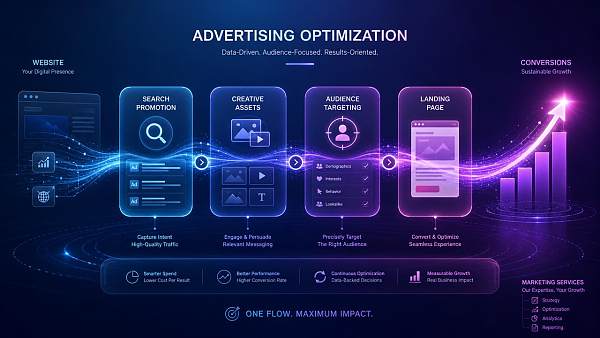
Where should you start with ad campaign optimization to see results faster? For frontline execution teams, identifying the problem first and then deciding on actions is usually more effective than directly scaling up spend.
Under the trend of integrated website and marketing services, campaign performance is no longer measured only by cost per click, but by whether traffic, pages, leads, and conversions truly work together.
Many accounts appear to have impressions and clicks on the surface, but the results are still unsatisfactory. The reason is often not a single ad placement, but a weak point somewhere along the entire conversion chain.
For companies that want faster results, ad campaign optimization should prioritize data analysis, creative testing, audience segmentation, and landing page alignment.
Changes in the traffic environment mean ad campaign optimization must become more refined
In recent years, platform traffic costs have continued to fluctuate, user attention has become more fragmented, and it has become difficult to achieve stable ideal returns by relying solely on broad, extensive ad buying.
At the same time, platform algorithms are placing increasing emphasis on conversion quality. Ads with high clicks but short dwell time, fast bounce rates, and poor form performance often lose competitiveness quickly.
This means that the focus of ad campaign optimization has shifted from “buying traffic” to “making traffic generate value”, with particular attention to downstream performance.
Yiyingbao Information Technology (Beijing) Co., Ltd. has long served global markets. Leveraging artificial intelligence and big data capabilities, it is helping companies improve growth certainty through coordinated websites, SEO, social media, and advertising.
The four main drivers that affect the speed of ad campaign optimization
If you want to determine what to do first in ad campaign optimization, you can first look at the following four categories of factors, which often directly determine whether adjustments can deliver quick results.
In different business stages, the challenges of ad campaign optimization are becoming more differentiated
For businesses that mainly acquire customers through their official website, the common issue is often not insufficient traffic, but inconsistency between landing page content and ad promises, resulting in high clicks but low conversions.
For businesses with multi-channel coordination, the problem more often lies in fragmented attribution. There is a lack of a unified data perspective across social media seeding, search engagement, and ad conversion.
Therefore, ad campaign optimization cannot focus only on the ad account backend. Website structure, page speed, brand credibility, and form design all affect final conversion efficiency.
For example, companies should pay attention to basic domain configuration at the early stage of website building. A site entry point that is easy to recognize, easy to manage, and stable in resolution helps improve access experience and brand trust.
In this regard, domain services can support intelligent search, one-stop registration, automatic resolution, and renewal reminders, making them more suitable for coordinated deployment of websites and marketing.
If you want ad campaign optimization to work faster, prioritize these five points
- First verify whether conversion data is accurate, and avoid making adjustments based on incorrect reports.
- First improve the above-the-fold creative message, prioritizing tests on headlines, value points, and calls to action.
- First split audience segments, and observe different intents, regions, and time periods separately.
- First check whether the landing page is aligned with the ad content, reducing information gaps.
- First look at high-spend units, instead of averaging across all campaigns.
These five points are important because they are directly tied to account efficiency. As long as you identify the main contradiction accurately, ad campaign optimization often shows obvious changes within a short cycle.
Start with data calibration to avoid “optimizing in the wrong direction”
Many accounts seem to have poor conversion performance, but in reality the issue is missing tracking, duplicate counting, or delays in lead data feedback, which distort judgment. Without accurate data, there can be no effective optimization.
It is recommended to review six stages: impression, click, visit, form, inquiry, and transaction, confirm where the actual drop-off occurs, and then decide where to invest resources.
Then run creative tests to restore click-through vitality first
In ad campaign optimization, creative is usually the part where feedback can be seen the fastest. Whether the headline focuses on pain points and whether the visual communicates value often determine first-round click performance.
It is recommended to test only one variable at a time, such as the main headline, image style, offer wording, or button copy, so it is easier to determine exactly what is affecting the results.
Check page follow-through at the same time, and do not let effective clicks go to waste
Many ad campaign optimization efforts fail to show results for a long time not because the ads themselves have problems, but because the landing page loads slowly, the information is cluttered, and the form is too long, causing users to leave quickly.
Above the fold, it is best to directly answer three questions: who you are, what you can solve, and what to do next. The shorter the page path, the lower the conversion friction is usually.
To judge whether follow-up ad campaign optimization is effective, it can be advanced in stages
If a company is simultaneously advancing official website development and campaign growth, it can also incorporate domain management into the basic configuration in advance. Stable entry points, automatic resolution, and status monitoring can reduce technical loss in campaign follow-through.
Truly efficient ad campaign optimization is fundamentally about chain-wide coordination
From a trend perspective, ad campaign optimization is increasingly like systems engineering, no longer a competition of single-point tactics. Data, creative, audience, pages, and brand assets are all indispensable.
The method that truly delivers faster results is not a one-time major overhaul, but checking items one by one according to priority, addressing the most impactful stage first, and then gradually scaling what works.
For integrated website and marketing service scenarios, it is recommended to evaluate ad campaign optimization within the complete growth chain, with particular emphasis on site infrastructure, content alignment, and subsequent data accumulation.
As a next step, you can first conduct an account diagnosis: verify data, test creative, segment audiences, check pages, and simultaneously sort out the official website and brand entry points. This makes it easier to see stable improvement than blindly increasing budget.
Related Articles
 How can video news production be made more efficient?Breaking down the standard process from topic selection to editing
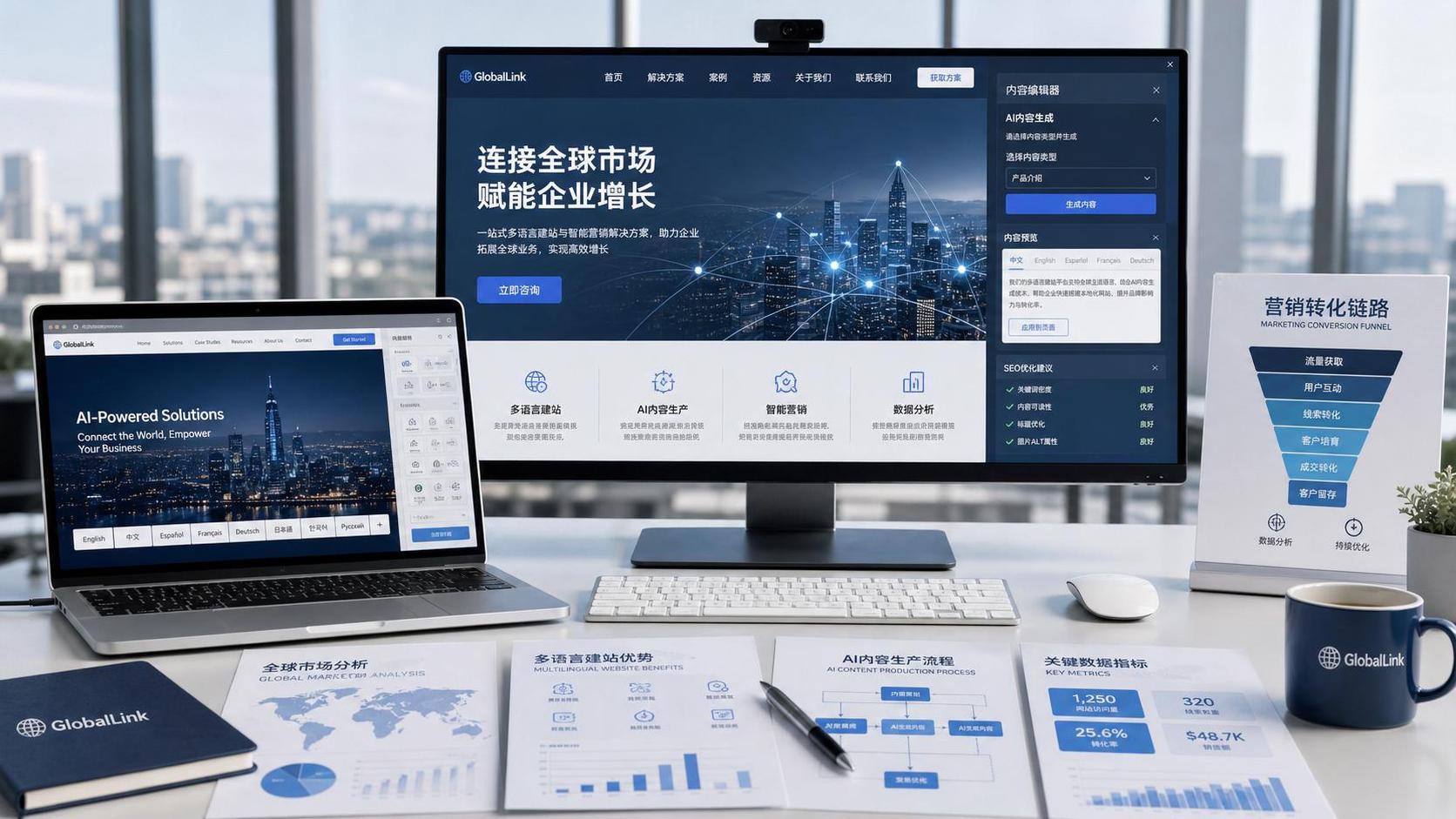
 How to assess foreign trade website development trends?Looking at 2026 changes from multilingual,AI content to conversion paths
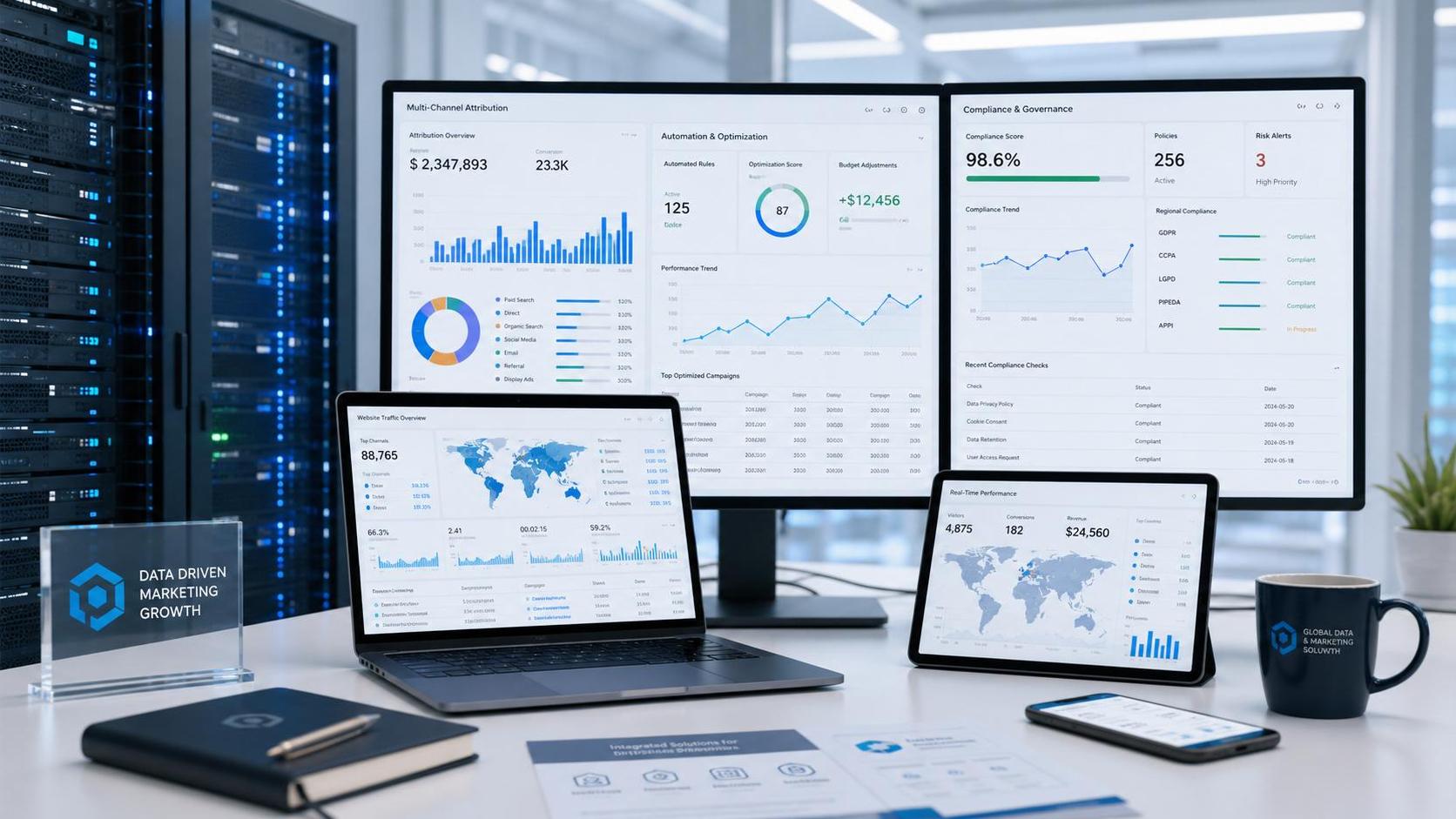
 What are the new trends in multilingual marketing data analytics tools in 2026? Focus on attribution、automation and compliance

Related Products
 EasyCamp SaaS Smart Website Marketing SystemE-Yingbao SaaS Smart Website Marketing System: AI-powered, zero-code website building. Rapidly launch multilingual independent e-commerce sites in just 10 minutes. Global server acceleration and AI-driven SEO optimization empower businesses to efficiently connect with global markets. The seamless integration of technology and user-friendly operation makes building e-commerce sites incredibly simple.
 AI+SEM Intelligent Advertising Marketing SystemAI+SEM drives intelligent ad creation, empowering full-funnel precision advertising marketing. The system automatically generates weekly/monthly reports, AI recommends keywords and target countries, monitors core metrics in real-time with intelligent alerts, and enables one-click high-conversion ad solutions to help quickly acquire customers and improve ROI.
 AI+SEO Dual Engine Optimization ServiceEasyWin AI+SEO Dual Engine Optimization System leverages AI-powered keyword mining, content generation, and comprehensive technical optimization to help foreign trade enterprises acquire high-quality organic traffic, significantly improving search rankings and conversion rates.
 AI+SNS Social Media Marketing SystemYingbao AI+SNS Social Media Marketing System - Precision social capture for the social media era. Supports one-click content synchronization across major platforms like Facebook and LinkedIn. AI intelligently rewrites posts for enhanced relevance. 24/7 AI customer service and user profiling analysis empower businesses to efficiently expand into global markets.
 AI+SEO营销解决方案易营宝AI+SEO营销解决方案,通过AI批量写作、智能生成TDK、精准关键词扩词等功能,全面优化网站SEO效果,提升流量与转化率。助力企业构建高效智能网站新生态。
 AI+SEM Advertising Marketing SolutionsAI+SEM Advertising Marketing Solution leverages AI technology to deeply empower SEM ad campaigns. It automatically generates weekly/monthly reports using AI, presenting account data across multiple dimensions for comprehensive insights into campaign performance and trends. The system precisely recommends keywords and target countries, intelligently generates high-conversion ad copy, and enables one-click activation of efficient campaign plans to help businesses rapidly acquire customers. Simultaneously, it monitors core metrics in real time, intelligently identifies abnormal fluctuations, and issues timely alerts to ensure stable, high-return advertising results.
 Domain Name ServicesEasyWin provides professional domain name services, including intelligent queries, one-stop registration, brand protection, and full lifecycle management, helping businesses build a digital brand image.
 EasyOperate B2C Cross-Border E-Commerce Platform & Independent WebsiteEasyStore B2C Cross-border E-commerce Independent Store is an intelligent website building and cross-border e-commerce integrated solution independently developed by EasyStore Information Technology (Beijing) Co., Ltd. The system is specially designed for small and medium-sized as well as large export enterprises, integrating 'website building, operation, marketing, advertising, and conversion' into one, helping enterprises quickly establish cross-border e-commerce independent stores to achieve brand globalization and global sales growth.
The platform supports multiple languages, multiple currencies, and multi-channel marketing, with built-in AI intelligent translation and SEO optimization systems, suitable for mainstream markets such as Southeast Asia, Europe and America, Latin America, and the Middle East, assisting Chinese manufacturing enterprises in efficiently deploying international e-commerce strategies. SSL证书易营宝提供专业SSL安全证书服务,包括单域名和泛域名证书,确保网站数据传输加密、身份验证和完整性保护,助力企业建立安全可信的在线业务环境。









