









- What Does a Global Traffic Ecosystem Service Provider Do? What Are the Differences from a Single Advertising AgencyJul 16, 2026View details
- What should you focus on in the latest enterprise SaaS report? From renewal rates and delivery costs to overseas growth opportunitiesJul 12, 2026View details
- What signals are worth paying attention to in a cross-border marketing trend report? B2B companies should look at these 6 signalsJul 11, 2026View details
- How to Read a Cross-Border Marketing Trends Report? Five Key Dimensions for Evaluating Channel OpportunitiesJul 11, 2026View details
- Which channel has the highest ROI in the global traffic ecosystem? Comparative analysis of search, social media, and advertisingJul 10, 2026View details
- What multilingual website services are available in Sanya? Which model is more suitable for local businesses going global?Jul 08, 2026View details
- How to view the complete list of China SaaS companies in the top 100? Practical methods for screening website-building and marketing service providersJul 08, 2026View details
- How to view pricing in the global traffic ecosystem? Cost comparison of search, social media, and content channel advertisingJul 06, 2026View details
Which Matters More in YouTube Video Marketing: Titles or Thumbnails
When doing YouTube video marketing, which is ultimately more critical: the title or the thumbnail? This affects not only click-through rate, but also the effectiveness of content marketing on social platforms. This article will combine search engine optimization techniques with practical case examples to help you identify optimization directions that lead to higher conversions.
First, let’s answer the core question: which has a greater impact on clicks and conversions, the title or the thumbnail?
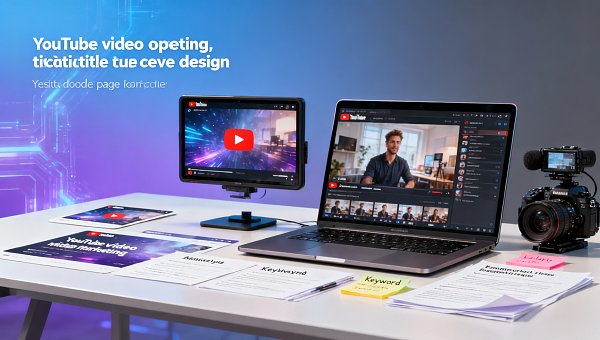
If we are only talking about clicks, the thumbnail is often seen first; if we go further and ask about traffic quality, the title usually determines the platform’s understanding, user expectations, and the match with subsequent viewing behavior. For enterprises doing YouTube video marketing, the two are not an either-or choice, but a combined relationship of front-end attraction and back-end filtering.
In common browsing scenarios, users complete their initial screening within 1–3 seconds. The thumbnail is responsible for making people stop, while the title helps them judge “whether this is the content I want to watch.” If the thumbnail is strong but the title is weak, the click-through rate may rise in the short term, but watch time, engagement rate, and lead quality are often unstable.
For information researchers and technical evaluators, the interrogative terms, solution terms, and comparison terms in the title are more important, because these audiences tend to conduct goal-oriented searches. For end consumers and distribution channels, the visual emotion, contrast imagery, and benefit-point expression of the thumbnail are more likely to trigger clicks.
Therefore, a more accurate judgment is this: in search traffic, the title carries greater weight; in recommended traffic, the thumbnail triggers action faster; but what truly affects inquiries and deals is whether the title, thumbnail, and video content are consistent with each other within the first 30 seconds. If an enterprise optimizes only a single point, it will usually encounter a growth bottleneck after 2–4 weeks.
Under different traffic entry points, the evaluation criteria are not the same
When providing integrated website + marketing services, many companies treat YouTube as a single social media channel, which is a misconception. In fact, YouTube video marketing should work in coordination with official website content, landing pages, and search strategy. The title takes on the function of keyword alignment, while the thumbnail takes on the function of pre-click visual persuasion, and together they serve the conversion chain.
- Search entry: the title needs to cover core keywords, long-tail keywords, and scenario keywords, so that the platform can understand the content theme more easily.
- Recommendation entry: the thumbnail needs to retain a recognizable subject at thumbnail size and avoid overly dense information.
- External traffic entry: the title and landing page theme should be consistent, otherwise it will lead to a high bounce rate.
- B2B decision-making entry: the title should include industry semantics, while the thumbnail should reduce entertainment-style noise.
From the perspective of project management and enterprise decision-making, the most effective approach is not to argue over “which is more important,” but to first clarify the video’s main customer acquisition goal: is it to attract new exposure, collect inquiries, advance sales education, or support channel distribution? Different goals also require different investment ratios in titles and thumbnails.
In which scenarios is the title more important, and in which scenarios is the thumbnail more critical?
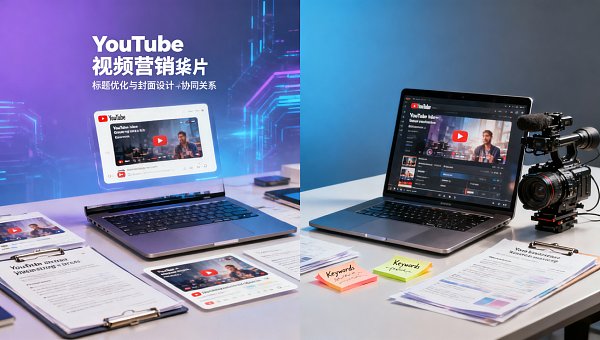
When enterprises are targeting overseas markets, technical products, or complex service solutions, the importance of the title is usually greater. This is because users’ search habits often revolve around questions such as “how to choose,” “which one is better,” “how much does it cost,” and “whether it is suitable for a certain scenario,” so the title needs to respond directly to these decision-making needs.
When the content is more presentation-driven, case-based, design-oriented, or emotion-driven, the thumbnail is more likely to become the first trigger point. For example, in industries with strong visual decision-making such as interior design, renovation, and architecture, users are often first attracted by style within 0.5 seconds, and then decide whether to read the title details.
This is also why many brands adopt a more unified visual strategy when coordinating official website development with video marketing. For example, websites featuring immersive full-screen scrolling interactions, asymmetrical dynamic layouts, and panoramic Banner displays are better able to channel video traffic into conversion pages and improve consistency in brand tone.
If an enterprise is targeting high-end spatial presentation or engineering project negotiations, it can refer to visual solution approaches like interior design, renovation, architecture: use precise grid layouts to highlight material details, and strengthen brand endorsement with dynamic hover sections, so that the official website experience after the video click does not fall flat.
When broken down by business objectives, priorities can be judged quickly
The table below is suitable for information researchers, quality control personnel, and decision-makers to evaluate quickly. It is not an absolute rule, but it can help enterprises invest resources first in the links with greater impact when budgets are limited and delivery timelines are tight.
As the table shows, there are not many scenarios that truly require an “either-or” choice. For most enterprises, the problem is not whether to work on the title or the thumbnail, but that they have not established unified content production standards, resulting in disconnected video style, keywords, and conversion pages within the same channel.
Practical recommendations for 3 common scenarios
- For technical selection: prioritize making the application scenario, parameter range, and target fit clear in the title, while the thumbnail only needs to highlight the core object.
- For consumer decision-making: let the thumbnail establish visual appeal first, then let the title add price range, style differences, or usage results.
- For channel recruitment: the title should clearly state the cooperation model and profit logic, while the thumbnail should highlight brand image and market space.
It is generally recommended that enterprises review performance under different traffic entry points every 4–8 weeks, looking separately at click-through rate, average watch time, first 30-second retention, and landing page conversion, rather than focusing only on a single exposure metric.
When enterprises do YouTube video marketing, how should they optimize titles, thumbnails, and landing pages at the same time?
For the integrated website + marketing service industry, the truly efficient approach is to treat video as one node in the entire customer acquisition chain rather than as isolated content. The title is responsible for being found, the thumbnail is responsible for being clicked, the landing page is responsible for persuading, and the form or inquiry entry point is responsible for converting; all four are indispensable.
Easy-Biz Information Technology (Beijing) Co., Ltd. has been deeply engaged in global digital marketing since 2013. With artificial intelligence and big data as its underlying capabilities, it has formed an integrated collaborative solution covering intelligent website building, SEO optimization, social media marketing, and advertising placement. For enterprises, the value of this integrated capability lies in reducing content fragmentation, improving execution efficiency, and making data feedback more traceable.
If an enterprise is currently facing overseas promotion, official website upgrades, and content conversion issues at the same time, it is recommended to adopt the “3-layer linkage method”: the first layer optimizes channel structure and keyword themes, the second layer optimizes title and thumbnail combinations, and the third layer optimizes the conversion handoff of pages corresponding to the videos. A first round of adjustments can usually be completed within 2–6 weeks for standard projects.
For brands that emphasize a high-end positioning, the visual experience of the official website can also be connected with the style of the video content. For example, browsing experiences like flipping through a premium design magazine, fully responsive smooth interaction, and enhanced display of brand philosophy are often better suited to receiving high-intent visitors from video channels.
An integrated execution process is more stable than single-point optimization
The table below is more suitable for project leaders, after-sales maintenance personnel, and enterprise management to evaluate whether the execution process from video to official website is complete, so as to avoid doing only superficial click optimization while neglecting the transaction path.
From actual projects, problems most often arise in the third step. Front-end video data may still look good, but the official website content fails to continue the value proposition conveyed in the video, resulting in interrupted inquiries. This is especially true in industries such as architecture, renovation, and spatial display. If the site lacks material details, case context, and capability endorsement, potential customers are easily lost.
5 items that must be checked simultaneously
- Whether the core keywords in the title appear again in the first 15 seconds of the video and on the first screen of the landing page.
- Whether the benefit point conveyed by the thumbnail is consistent with the actual content, avoiding “high clicks, low retention.”
- Whether the landing page provides decision-making information such as parameters, case studies, process, and quotation communication entry points.
- Whether both mobile and desktop can be browsed smoothly, especially whether the fully responsive interaction is stable.
- Whether the video description area and official website link point to the most relevant page rather than a generic homepage.
If the enterprise mainly focuses on high-end visual presentation, it can use page structures like interior design, renovation, architecture as a reference direction: this both strengthens the brand’s high-end positioning and clearly organizes concepts and capability endorsements, making it more beneficial for visual persuasion during business negotiations.
What are the common misconceptions? How can you avoid “high clicks, low inquiries”?
Many teams attribute the success or failure of YouTube video marketing to thumbnail design aesthetics, or simply believe that stuffing keywords into the title is enough. In reality, what truly affects results is content matching, user expectation management, and conversion path design. Especially in B2B scenarios, incorrect clicks waste budget more than no clicks at all.
The first type of misconception is overly complex thumbnails. In a mobile thumbnail environment, too much text and too many elements can cause information recognition to fail. The standard recommendation is to keep the core visual within 1 subject, 1 benefit point, and 1 comparison relationship, avoiding overloaded information within a browsing window of only a few seconds.
The second type of misconception is overpromising in the title. For example, writing “ultimate solution” or “most complete guide” while the content does not actually cover the full selection logic. Although this may boost clicks in the short term, it will compress watch time and trust. For technical evaluators and enterprise management, this kind of inconsistency is especially sensitive.
The third type of misconception is ignoring the data review cycle. The strengths and weaknesses of titles and thumbnails should not be judged only by data from the first 24 hours after publishing. Usually, at least 3 checkpoints—7 days, 14 days, and 30 days—should be observed, combined with source channels, retention curves, and conversion page performance, before determining whether the problem lies in the entry point or the handoff.
FAQ: the 4 questions enterprises ask most often
1. When starting a new channel, should you work on the title first or the thumbnail first?
For a new channel, it is recommended to determine the title strategy first, and then design the thumbnail. The reason is that in the early stage, the channel needs to establish content theme clarity more urgently, with at least a keyword framework for 10–20 videos, to avoid each video saying something completely different. Stabilize the channel direction with titles first, and then unify the visuals with thumbnails for greater efficiency.
2. Under what circumstances must the thumbnail be changed first?
If the video already has clear search demand and the title is relatively appropriate, but the click-through rate remains consistently low, then the thumbnail should be checked first. This is especially true when recommended traffic accounts for a high proportion and the content is more case-demo or visual-display oriented, in which case the thumbnail is often the primary bottleneck. You can first test 2–3 thumbnail versions continuously, and then observe changes over 7–14 days.
3. Should B2B enterprise video titles be written in a very “marketing” style?
It is not recommended to be overly emotional. B2B users care more about whether costs can be reduced, whether information is complete, and whether the solution is executable. Titles should ideally balance the question, the target audience, and the result, such as “How to Choose an Overseas Website Building and Social Media Integration Solution” or “Which Metrics Should Engineering Companies Look at When Doing YouTube Promotion”.
4. Why should video marketing and official website development be done together?
Because video solves “attraction and education,” while the official website solves “handoff and conversion.” If the two are executed separately, users who enter the page from a video are likely to see irrelevant content, resulting in bounce. Coordinating intelligent website building, search optimization, social media content, and advertising placement is often more likely to generate stable leads than working on just one single link.
Why choose us: from click optimization to lead growth, giving enterprises one executable solution set
If you are evaluating YouTube video marketing, whether you care about how titles should be written, how thumbnails should be tested, how the official website should receive traffic, or how the overall placement should work together, you should not look only at isolated techniques. A more effective way is to start from business objectives and build a closed loop of content, pages, data, and media placement.
Relying on more than a decade of global digital marketing practice, Easy-Biz Information Technology (Beijing) Co., Ltd. can provide enterprises with integrated services ranging from channel content planning, keyword layout, and video page handoff, to intelligent website building, SEO optimization, social media marketing, and advertising placement. For enterprises with limited budgets but clear delivery requirements, this collaborative model is more conducive to controlling trial-and-error costs.
If you are currently in the technical evaluation or procurement decision-making stage, you may focus your consultation on the following: priority judgment for title and thumbnail optimization, industry keywords and video topic planning, official website landing page structure design, delivery timeline range, customized visual solutions, quotation communication methods, and multi-channel data review processes.
Whether you are an information researcher, project manager, channel partner, or end brand owner, you can start with a diagnosis of your current video-to-website link path. First confirm 3 types of core metrics, 4 execution steps, and actionable tasks that can be implemented within 2–6 weeks, and then decide on the next phase of investment, which is usually more stable than blindly expanding volume.
Related Articles
 What exactly should be the focus of a foreign trade website?!!!
 Attention! Builders' must-see: Yibingbao AI components updated, design efficiency directly doubled!
 China's foreign trade sees a turnaround: imports surge by 22%! Foreign trade professionals should quickly take note of the new trends in the second half of the year

Related Products
 EasyCamp SaaS Smart Website Marketing SystemE-Yingbao SaaS Smart Website Marketing System: AI-powered, zero-code website building. Rapidly launch multilingual independent e-commerce sites in just 10 minutes. Global server acceleration and AI-driven SEO optimization empower businesses to efficiently connect with global markets. The seamless integration of technology and user-friendly operation makes building e-commerce sites incredibly simple.
 AI+SEM Intelligent Advertising Marketing SystemAI+SEM drives intelligent ad creation, empowering full-funnel precision advertising marketing. The system automatically generates weekly/monthly reports, AI recommends keywords and target countries, monitors core metrics in real-time with intelligent alerts, and enables one-click high-conversion ad solutions to help quickly acquire customers and improve ROI.
 AI+SEO Dual Engine Optimization ServiceEasyWin AI+SEO Dual Engine Optimization System leverages AI-powered keyword mining, content generation, and comprehensive technical optimization to help foreign trade enterprises acquire high-quality organic traffic, significantly improving search rankings and conversion rates.
 AI+SNS Social Media Marketing SystemYingbao AI+SNS Social Media Marketing System - Precision social capture for the social media era. Supports one-click content synchronization across major platforms like Facebook and LinkedIn. AI intelligently rewrites posts for enhanced relevance. 24/7 AI customer service and user profiling analysis empower businesses to efficiently expand into global markets.
 AI+SEO营销解决方案易营宝AI+SEO营销解决方案,通过AI批量写作、智能生成TDK、精准关键词扩词等功能,全面优化网站SEO效果,提升流量与转化率。助力企业构建高效智能网站新生态。
 AI+SEM Advertising Marketing SolutionsAI+SEM Advertising Marketing Solution leverages AI technology to deeply empower SEM ad campaigns. It automatically generates weekly/monthly reports using AI, presenting account data across multiple dimensions for comprehensive insights into campaign performance and trends. The system precisely recommends keywords and target countries, intelligently generates high-conversion ad copy, and enables one-click activation of efficient campaign plans to help businesses rapidly acquire customers. Simultaneously, it monitors core metrics in real time, intelligently identifies abnormal fluctuations, and issues timely alerts to ensure stable, high-return advertising results.
 Domain Name ServicesEasyWin provides professional domain name services, including intelligent queries, one-stop registration, brand protection, and full lifecycle management, helping businesses build a digital brand image.
 EasyOperate B2C Cross-Border E-Commerce Platform & Independent WebsiteEasyStore B2C Cross-border E-commerce Independent Store is an intelligent website building and cross-border e-commerce integrated solution independently developed by EasyStore Information Technology (Beijing) Co., Ltd. The system is specially designed for small and medium-sized as well as large export enterprises, integrating 'website building, operation, marketing, advertising, and conversion' into one, helping enterprises quickly establish cross-border e-commerce independent stores to achieve brand globalization and global sales growth.
The platform supports multiple languages, multiple currencies, and multi-channel marketing, with built-in AI intelligent translation and SEO optimization systems, suitable for mainstream markets such as Southeast Asia, Europe and America, Latin America, and the Middle East, assisting Chinese manufacturing enterprises in efficiently deploying international e-commerce strategies. SSL证书易营宝提供专业SSL安全证书服务,包括单域名和泛域名证书,确保网站数据传输加密、身份验证和完整性保护,助力企业建立安全可信的在线业务环境。









