









- What should you focus on in the latest enterprise SaaS report? From renewal rates and delivery costs to overseas growth opportunitiesJul 12, 2026View details
- What signals are worth paying attention to in a cross-border marketing trend report? B2B companies should look at these 6 signalsJul 11, 2026View details
- How to Read a Cross-Border Marketing Trends Report? Five Key Dimensions for Evaluating Channel OpportunitiesJul 11, 2026View details
- Which channel has the highest ROI in the global traffic ecosystem? Comparative analysis of search, social media, and advertisingJul 10, 2026View details
- What multilingual website services are available in Sanya? Which model is more suitable for local businesses going global?Jul 08, 2026View details
- How to view the complete list of China SaaS companies in the top 100? Practical methods for screening website-building and marketing service providersJul 08, 2026View details
- How to view pricing in the global traffic ecosystem? Cost comparison of search, social media, and content channel advertisingJul 06, 2026View details
- How to assess foreign trade website development trends?Looking at 2026 changes from multilingual,AI content to conversion pathsJul 04, 2026View details
Which Is More Suitable for B2B Foreign Trade Lead Generation in the Early Stage, PPC or SEO? Budget and Time-to-Result Comparison
Which is more suitable for B2B foreign trade lead generation in the early stage, PPC or SEO? This question is often placed in the same budget spreadsheet for comparison, but what truly determines the result is often not traffic scale, but investment rhythm, time to results, and lead quality.
For a foreign trade business at the startup stage, the website is not a brochure, and marketing is not single-channel ad placement. Whether you can reach overseas buyers faster with limited resources and turn clicks into effective communication is the core of judging which is more suitable for early-stage B2B foreign trade lead generation: PPC or SEO.
First, clarify the question: PPC delivers speed, SEO builds accumulation
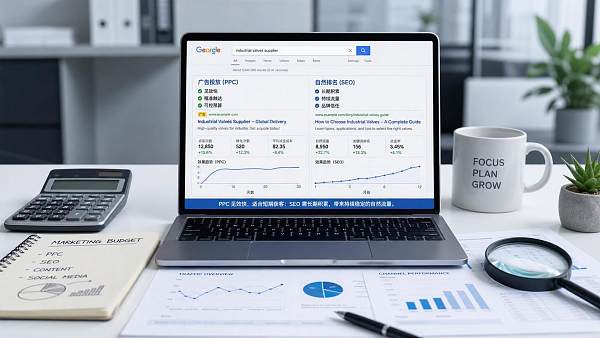
Simply put, PPC is a pay-per-click advertising acquisition method, commonly seen in Google search ads, display ads, and retargeting campaigns. Its features are fast launch, fast testing, and flexible on/off control, but once payment stops, traffic and leads usually decline in sync.
SEO, on the other hand, revolves around website structure, content topics, keyword layout, page experience, and backlink signals to continuously improve organic rankings. Its results will not appear as immediately as ads, but once established, it can create a more stable long-term lead generation capability.
Therefore, there is no absolute answer to which is more suitable for early-stage B2B foreign trade lead generation, PPC or SEO. The key is whether the company currently needs “inquiries now” more, or a “future sustained and controllable lead system.”
Budget and cycle are often more worth comparing than traffic
A common misconception in the early stage of foreign trade is asking which channel is cheaper first. In fact, what is more valuable for judgment is the cost per inquiry, the conversion cycle, and the ability to absorb budget fluctuations.
If the business has just started and samples, quotations, and sales scripts are still being refined, PPC can usually produce the first batch of data more easily. This is because it can quickly validate whether the market, keywords, and landing pages match.
If the product line is clear, industry terminology is mature, and the procurement cycle is long, the value of SEO will gradually become more prominent. Especially in B2B scenarios with high order value and frequent repeated searches, organic traffic is often better able to support subsequent growth.
Why early-stage B2B foreign trade cannot look only at surface-level inquiries
When many teams compare which is more suitable for early-stage B2B foreign trade lead generation, PPC or SEO, they often focus only on form volume. But the real value of foreign trade leads usually depends on the country, purchasing intent, product fit, and room for follow-up.
The inquiries brought by PPC are controllable and scalable. By setting different countries, keywords, devices, and time periods, you can quickly find people with higher intent. But if the website’s receiving capacity is weak, the faster the ad spend increases, the more obvious the waste becomes.
The inquiries brought by SEO often come with stronger active search intent. Users will first look at page content, case studies, technical parameters, and company credibility before deciding whether to contact you. This kind of lead may not be numerous, but the conversion basis is usually more solid.
What truly affects conversion is not only the channel itself
Whether investing in PPC or doing SEO, if the website is only an ordinary corporate homepage, the conversion effect may be overestimated. Early-stage foreign trade lead generation relies more on marketing-oriented independent websites, including multilingual structure, clear product pages, industry scenario pages, trust evidence, and convenient inquiry paths.
This is also why website + marketing service integration is receiving more and more attention. The channel is responsible for bringing traffic, while the website is responsible for screening, persuasion, and conversion. If the two are built separately, it often results in traffic but unstable inquiries.
When should you lean toward PPC first?
If the current goal is to open the market as quickly as possible, PPC is usually more suitable as the starting point, especially in the following scenarios.
- A new website has just launched and there is no organic ranking or indexing foundation yet.
- You need to quickly test a certain country, industry, or product direction.
- There are short-term trade shows, peak seasons, or new product launch cycles.
- The internal team wants to see data first before deciding the scale of subsequent marketing investment.
But there is one premise here: PPC is not effective just because the account is opened. Keyword hierarchy, negative keyword settings, landing page matching, conversion tracking, and lead attribution must all be in place; otherwise, the budget will be swallowed by low-quality clicks.
When should SEO be laid out as early as possible?
If the product has long-term export potential and industry search demand is stable, SEO should not be postponed to “do it later.” Because content, indexing, and authority all require time to accumulate, the later you start, the more you will rely on ad supplementation in the future.
SEO is especially valuable in the following situations.
- The product has many technical parameters and is suitable for detailed keyword pages.
- The procurement decision chain is long, and buyers will repeatedly search and compare.
- The cost per ad click is relatively high, and long-term advertising pressure is significant.
- You want to build brand credibility and sustained organic exposure.
Which is more suitable for early-stage B2B foreign trade lead generation, PPC or SEO? From a three-month perspective, PPC is more direct; from a one-year perspective, SEO is often closer to the company’s own traffic asset.
Integrated setup determines whether the two channels can truly run through
More and more projects in the industry are starting to push websites, SEO, and advertising under the same framework, and the reason is very practical: channel strategy must be built on website structure and a closed data loop.
From Yiyingbao’s service perspective, intelligent website building, Google SEO optimization, ad placement, and multi-channel marketing are not independent modules, but coordinated configurations around an overseas independent website that is “promotable, indexable, and convertible.”
The value of this integrated model is especially obvious in the early stage of foreign trade. From the site’s technical structure, page speed, multilingual layout, to content topics, all directly affect SEO fundamentals; while inquiry forms, landing page logic, and conversion tracking directly affect PPC placement efficiency.
In other words, which is more suitable for early-stage B2B foreign trade lead generation, PPC or SEO, is often not a single-choice question, but a matter of sequence and resource allocation. Channel decisions cannot be separated from website capability, and website capability must also serve the goal of acquiring real leads.
A more stable decision method is to answer these four questions first
Before making a budget plan, you can first sort out the following questions clearly.
- How quickly do you need to see the first batch of valid inquiries, weekly or quarterly?
- How much trial-and-error budget can you afford per month, and is continuous optimization allowed?
- Does the current website already have marketing conversion capability, or is it still only at the display level?
- Is the business goal to verify the market in the short term, or to build a long-term overseas lead generation system?
If the answer leans toward speed, validation, and flexible adjustment, PPC should have the higher priority. If the answer leans toward accumulation, stability, and long-term cost optimization, SEO should be launched as early as possible. A more common approach is to use PPC to find direction in the early stage while using SEO to lay the foundation at the same time.
The final judgment is not about choosing a channel, but choosing the growth rhythm
Back to the original question, which is more suitable for early-stage B2B foreign trade lead generation, PPC or SEO? If you only look at short-term results, PPC is faster; if you look at long-term lead generation efficiency, SEO has more compounding value. What really needs to be compared is whether the company at its current stage needs “immediate inquiries” or “gradual and stable growth.”
The more pragmatic next step is not to rush into a binary choice, but to first evaluate website foundation, keyword direction, target market, and budget cycle on the same map. Putting channel decisions back into the business rhythm makes it easier to find the foreign trade lead generation path that suits you.
Related Articles
 What should we do first for overseas promotion of a factory?
 What should you focus on in the latest enterprise SaaS report? From renewal rates and delivery costs to overseas growth opportunities
 What signals are worth paying attention to in a cross-border marketing trend report? B2B companies should look at these 6 signals

Related Products
 EasyCamp SaaS Smart Website Marketing SystemE-Yingbao SaaS Smart Website Marketing System: AI-powered, zero-code website building. Rapidly launch multilingual independent e-commerce sites in just 10 minutes. Global server acceleration and AI-driven SEO optimization empower businesses to efficiently connect with global markets. The seamless integration of technology and user-friendly operation makes building e-commerce sites incredibly simple.
 AI+SEM Intelligent Advertising Marketing SystemAI+SEM drives intelligent ad creation, empowering full-funnel precision advertising marketing. The system automatically generates weekly/monthly reports, AI recommends keywords and target countries, monitors core metrics in real-time with intelligent alerts, and enables one-click high-conversion ad solutions to help quickly acquire customers and improve ROI.
 AI+SEO Dual Engine Optimization ServiceEasyWin AI+SEO Dual Engine Optimization System leverages AI-powered keyword mining, content generation, and comprehensive technical optimization to help foreign trade enterprises acquire high-quality organic traffic, significantly improving search rankings and conversion rates.
 AI+SNS Social Media Marketing SystemYingbao AI+SNS Social Media Marketing System - Precision social capture for the social media era. Supports one-click content synchronization across major platforms like Facebook and LinkedIn. AI intelligently rewrites posts for enhanced relevance. 24/7 AI customer service and user profiling analysis empower businesses to efficiently expand into global markets.
 AI+SEO营销解决方案易营宝AI+SEO营销解决方案,通过AI批量写作、智能生成TDK、精准关键词扩词等功能,全面优化网站SEO效果,提升流量与转化率。助力企业构建高效智能网站新生态。
 AI+SEM Advertising Marketing SolutionsAI+SEM Advertising Marketing Solution leverages AI technology to deeply empower SEM ad campaigns. It automatically generates weekly/monthly reports using AI, presenting account data across multiple dimensions for comprehensive insights into campaign performance and trends. The system precisely recommends keywords and target countries, intelligently generates high-conversion ad copy, and enables one-click activation of efficient campaign plans to help businesses rapidly acquire customers. Simultaneously, it monitors core metrics in real time, intelligently identifies abnormal fluctuations, and issues timely alerts to ensure stable, high-return advertising results.
 Domain Name ServicesEasyWin provides professional domain name services, including intelligent queries, one-stop registration, brand protection, and full lifecycle management, helping businesses build a digital brand image.
 EasyOperate B2C Cross-Border E-Commerce Platform & Independent WebsiteEasyStore B2C Cross-border E-commerce Independent Store is an intelligent website building and cross-border e-commerce integrated solution independently developed by EasyStore Information Technology (Beijing) Co., Ltd. The system is specially designed for small and medium-sized as well as large export enterprises, integrating 'website building, operation, marketing, advertising, and conversion' into one, helping enterprises quickly establish cross-border e-commerce independent stores to achieve brand globalization and global sales growth.
The platform supports multiple languages, multiple currencies, and multi-channel marketing, with built-in AI intelligent translation and SEO optimization systems, suitable for mainstream markets such as Southeast Asia, Europe and America, Latin America, and the Middle East, assisting Chinese manufacturing enterprises in efficiently deploying international e-commerce strategies. SSL证书易营宝提供专业SSL安全证书服务,包括单域名和泛域名证书,确保网站数据传输加密、身份验证和完整性保护,助力企业建立安全可信的在线业务环境。









