









- How to view pricing in the global traffic ecosystem? Cost comparison of search, social media, and content channel advertisingJul 06, 2026View details
- How to assess foreign trade website development trends?Looking at 2026 changes from multilingual,AI content to conversion pathsJul 04, 2026View details
- What are the new trends in multilingual marketing data analytics tools in 2026? Focus on attribution、automation and complianceJul 04, 2026View details
- Is Brand Globalization Marketing Consulting Worth Buying? At What Stage Should Companies Bring It InJul 01, 2026View details
- Cross-Border Marketing Trend Research: Why More and More Companies Are Starting to Deploy AI Search and GEO OptimizationJun 30, 2026View details
- Cross-Border Marketing Trend Research: How Independent Sites, AI Content, and Short-Video Customer Acquisition Are ChangingJun 30, 2026View details
- How Can a Brand Updates Page Be Made More SEO-Friendly? Analysis of Update Frequency, Content Structure, and Internal Linking StrategyJun 28, 2026View details
- What stages does the cross-border services ecosystem include? How do website building, promotion, payment, and compliance work togetherJun 22, 2026View details
Why Facebook Marketing Strategy Can't Focus Only on Post Volume
Facebook marketing strategy is shifting from “posting more” to “delivering more results”
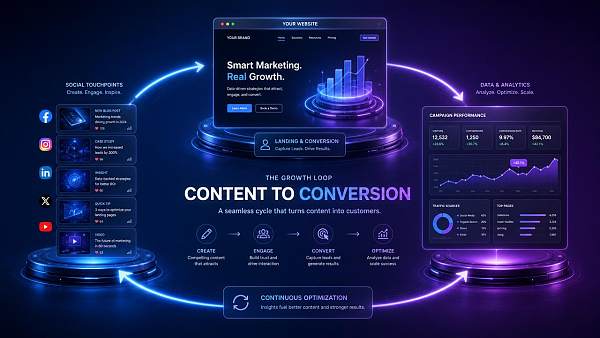
When many companies develop a Facebook marketing strategy, they still treat posting volume as proof of operational diligence. It may seem that denser content makes the account appear more active, but the results are often far from ideal. Exposure does not continue to expand, engagement does not improve significantly, and lead generation does not grow steadily.
A truly effective Facebook marketing strategy is not about who posts more, but about whether each piece of content reaches the right audience more precisely, whether each interaction goes deeper, and whether each campaign gets closer to conversion. For integrated website + marketing service businesses, social media content is only the traffic entry point. What determines whether growth is sustainable is the follow-up website conversion path, data feedback loop, and sales coordination.
Yiyingbao Information Technology (Beijing) Co., Ltd. has long served global marketing scenarios. Relying on artificial intelligence and big data capabilities, it helps enterprises connect website building, SEO optimization, social media marketing, and advertising placement. This trend is already very clear: the era of simply pursuing posting quantity is ending, and a Facebook marketing strategy that emphasizes quality, cadence, and conversion closed-loop is becoming mainstream.
Platform changes are sending a clear signal: content volume no longer equals growth capability
In recent years, Facebook’s distribution logic has continued to evolve. The system places greater emphasis on user dwell time, depth of engagement, relevance judgment, and commercial value, rather than mechanically calculating update frequency. Even if you post every day, if the content is repetitive and the audience is mismatched, a Facebook marketing strategy will still struggle to produce results.
Another obvious change is that traffic competition has shifted from “competing for content slots” to “competing for attention.” Users are exposed to massive amounts of information every day. If a brand lacks a clear value proposition, it is very easy to be quickly skipped. At this point, the more you post, the more likely you are to dilute account positioning and drag down the overall engagement rate.
Therefore, a Facebook marketing strategy must upgrade from “how many posts are produced” to “how to create content around the target audience that is more likely to be seen, clicked, and trusted.” This is also why integrated website and social media operations are becoming increasingly important.
Why focusing only on posting volume often causes a Facebook marketing strategy to lose focus
Looking only at posting volume can easily turn operations into simple content filling. The content team stays busy rushing to meet the schedule, but has no time to analyze what users truly care about, nor can it continuously optimize content structure, landing page paths, and conversion actions. On the surface, it looks very hard-working, but in reality it has drifted away from the core of growth.
- Increasing content repetition leads to engagement fatigue.
- Without audience segmentation, reach efficiency declines.
- After the click, the lack of strong website follow-up causes traffic to be wasted.
- It becomes impossible to distinguish between brand content, conversion content, and remarketing content.
- The team focuses only on execution volume while ignoring data feedback.
For integrated website + marketing service companies, if a Facebook marketing strategy cannot work in coordination with an independent website, form system, search entry points, and advertising remarketing, then no matter how many posts are published, it is still difficult to accumulate reusable assets. The real assets are data, leads, content models, and conversion paths, rather than simple update records.
Several key factors driving the upgrade of Facebook marketing strategy
This upgrade trend also affects content research methods. For example, in some knowledge-based industries, users value structured information and professional judgment more. Topics like Research on Optimization Strategies for the Financial and Accounting Supervision System of Public Institutions are better suited to in-depth interpretation, key-point extraction, and page-based content accumulation, rather than fragmented high-frequency publishing. The same applies to Facebook marketing strategy, which must determine the publishing approach based on the nature of the content.
This change is affecting every stage of content, website, and conversion
Let’s start with the content stage. In the past, the common approach was to keep posting around product information. Today, a more effective Facebook marketing strategy breaks content into categories such as awareness, comparison, case studies, Q&A, and trust proof. Different goals should be matched with different types of content, which is far more efficient than posting at a uniform frequency.
Next is the website stage. The value of social media content is not just in getting likes, but in guiding users to enter the website and complete reading, consultation, downloading, or lead submission. If website pages load slowly, have a confusing structure, or use overly long forms, even the best Facebook marketing strategy will lose points at the final step.
Finally comes the conversion stage. A truly mature Facebook marketing strategy tracks the entire process from post click to page dwell time, from page visit to conversion submission, and from first touchpoint to remarketing conversion. Only by connecting this data can a company know which content is creating value and which is merely “looking busy.”
What deserves more attention is not how much you post, but these five core metrics
- Effective reach rate: Whether the content is truly seen by the target audience.
- Engagement quality: Whether comments, saves, and direct messages reflect genuine interest.
- Click-to-conversion rate: Whether behavior after entering the website meets expectations.
- Content conversion contribution: Which types of posts bring in the most leads and orders.
- Reuse value: Whether the content can be accumulated into landing pages, ad creatives, and SEO assets.
When a Facebook marketing strategy is built around these metrics, the team shifts from “completing publishing tasks” to “managing the growth process.” This is also the integrated mindset emphasized by Yiyingbao Information Technology (Beijing) Co., Ltd.: enabling social media, websites, search, and advertising to work together instead of fighting separate battles.
Companies can start optimizing their Facebook marketing strategy in three steps
- First, redesign content layering. Separate planning for brand exposure, educational guidance, case proof, and conversion promotion.
- Then check website follow-up capability. Ensure that the landing page theme is consistent, the path is clear, the form is concise, and the data is trackable.
- Finally, establish a review mechanism. Review engagement weekly, leads monthly, and deal contribution by stage.
If the content is highly professional, key topics can also be developed into dedicated pages or resource pages, and then continuously driven by Facebook marketing strategy. Content like Research on Optimization Strategies for the Financial and Accounting Supervision System of Public Institutions is suitable for first building an in-depth conversion page, and then using social media to spread the key viewpoints, thereby increasing dwell time and conversion after the click.
The judgment for the next stage is clear: Facebook marketing strategy must be built around the growth closed-loop
In the future, Facebook marketing strategy will no longer be defined by posting volume, but jointly determined by data closed-loop, content quality, website follow-up capability, and commercial conversion. Whoever completes the shift earlier from “content volume stacking” to “systematic operations” will be more likely to achieve stable growth.
For businesses hoping to improve global customer acquisition efficiency, what is more worth doing now is not continuing to increase posting frequency, but reassessing whether audience, content, pages, and the conversion chain are properly aligned. Only by placing Facebook marketing strategy into a complete digital marketing system can the value of every touchpoint truly be amplified.
If you have already found that you post a lot but growth is limited, that means the optimization window has already opened. Only by promptly sorting out the content structure, upgrading website follow-up capability, and establishing analyzable data feedback can Facebook marketing strategy move from “buzz” to “effectiveness,” and truly turn traffic into long-term assets.
Related Articles



Related Products
 EasyCamp SaaS Smart Website Marketing SystemE-Yingbao SaaS Smart Website Marketing System: AI-powered, zero-code website building. Rapidly launch multilingual independent e-commerce sites in just 10 minutes. Global server acceleration and AI-driven SEO optimization empower businesses to efficiently connect with global markets. The seamless integration of technology and user-friendly operation makes building e-commerce sites incredibly simple.
 AI+SEM Intelligent Advertising Marketing SystemAI+SEM drives intelligent ad creation, empowering full-funnel precision advertising marketing. The system automatically generates weekly/monthly reports, AI recommends keywords and target countries, monitors core metrics in real-time with intelligent alerts, and enables one-click high-conversion ad solutions to help quickly acquire customers and improve ROI.
 AI+SEO Dual Engine Optimization ServiceEasyWin AI+SEO Dual Engine Optimization System leverages AI-powered keyword mining, content generation, and comprehensive technical optimization to help foreign trade enterprises acquire high-quality organic traffic, significantly improving search rankings and conversion rates.
 AI+SNS Social Media Marketing SystemYingbao AI+SNS Social Media Marketing System - Precision social capture for the social media era. Supports one-click content synchronization across major platforms like Facebook and LinkedIn. AI intelligently rewrites posts for enhanced relevance. 24/7 AI customer service and user profiling analysis empower businesses to efficiently expand into global markets.
 AI+SEO营销解决方案易营宝AI+SEO营销解决方案,通过AI批量写作、智能生成TDK、精准关键词扩词等功能,全面优化网站SEO效果,提升流量与转化率。助力企业构建高效智能网站新生态。
 AI+SEM Advertising Marketing SolutionsAI+SEM Advertising Marketing Solution leverages AI technology to deeply empower SEM ad campaigns. It automatically generates weekly/monthly reports using AI, presenting account data across multiple dimensions for comprehensive insights into campaign performance and trends. The system precisely recommends keywords and target countries, intelligently generates high-conversion ad copy, and enables one-click activation of efficient campaign plans to help businesses rapidly acquire customers. Simultaneously, it monitors core metrics in real time, intelligently identifies abnormal fluctuations, and issues timely alerts to ensure stable, high-return advertising results.
 Domain Name ServicesEasyWin provides professional domain name services, including intelligent queries, one-stop registration, brand protection, and full lifecycle management, helping businesses build a digital brand image.
 EasyOperate B2C Cross-Border E-Commerce Platform & Independent WebsiteEasyStore B2C Cross-border E-commerce Independent Store is an intelligent website building and cross-border e-commerce integrated solution independently developed by EasyStore Information Technology (Beijing) Co., Ltd. The system is specially designed for small and medium-sized as well as large export enterprises, integrating 'website building, operation, marketing, advertising, and conversion' into one, helping enterprises quickly establish cross-border e-commerce independent stores to achieve brand globalization and global sales growth.
The platform supports multiple languages, multiple currencies, and multi-channel marketing, with built-in AI intelligent translation and SEO optimization systems, suitable for mainstream markets such as Southeast Asia, Europe and America, Latin America, and the Middle East, assisting Chinese manufacturing enterprises in efficiently deploying international e-commerce strategies. SSL证书易营宝提供专业SSL安全证书服务,包括单域名和泛域名证书,确保网站数据传输加密、身份验证和完整性保护,助力企业建立安全可信的在线业务环境。









