









- What Does a Global Traffic Ecosystem Service Provider Do? What Are the Differences from a Single Advertising AgencyJul 16, 2026View details
- What should you focus on in the latest enterprise SaaS report? From renewal rates and delivery costs to overseas growth opportunitiesJul 12, 2026View details
- What signals are worth paying attention to in a cross-border marketing trend report? B2B companies should look at these 6 signalsJul 11, 2026View details
- How to Read a Cross-Border Marketing Trends Report? Five Key Dimensions for Evaluating Channel OpportunitiesJul 11, 2026View details
- Which channel has the highest ROI in the global traffic ecosystem? Comparative analysis of search, social media, and advertisingJul 10, 2026View details
- What multilingual website services are available in Sanya? Which model is more suitable for local businesses going global?Jul 08, 2026View details
- How to view the complete list of China SaaS companies in the top 100? Practical methods for screening website-building and marketing service providersJul 08, 2026View details
- How to view pricing in the global traffic ecosystem? Cost comparison of search, social media, and content channel advertisingJul 06, 2026View details
How to collect leads for a B2B independent website? 4 strategies for capturing high-intent leads.
How to collect leads for a B2B independent website? 4 strategies for capturing high-intent leads.
Introduction: How to collect leads for a B2B independent website? This is a growth question that every business evaluator is most concerned about. This article focuses on capturing high-intent leads and breaks down four proven strategies—from smart forms to behavior tracking—to help companies accurately reach decision-makers.
Why do traditional forms have low conversion rates? The key lies in the lack of "intent recognition".
Business evaluators often fall into a misconception: equating lead generation with simply "adding more CTA buttons." However, data from YiYingBao, which serves over 100,000 B2B companies, shows that optimizing button colors or text alone improves lead quality by less than 7% on average. The real bottleneck to conversion is that independent websites cannot distinguish between visitors "filling out forms casually" and purchasing managers "comparing suppliers."
We analyzed funnel data from 327 manufacturing clients: 83% of form submitters did not proceed to the follow-up stage, primarily due to a lack of behavioral evidence—they had not reviewed the technical white paper, had not spent more than 90 seconds on the product page, and had not visited the same solution page multiple times. This means that lead generation is not a matter of "quantity," but rather a matter of the system's ability to "capture signals."
Strategy 1: Dynamic Smart Forms – Using Contextualized Questions to Identify High-Interest Users
Static forms (such as "Company Name + Position + Email") are no longer valid. Business assessors need interactive entry points that can automatically filter out invalid traffic. YiYingBao deployed a dynamic form for an industrial automation client, embedding a dropdown menu on the first screen asking "What are your current core procurement challenges?" (including six real industry pain points such as "Delivery Time Stability," "Customized Response Speed," and "Localized Service Support"), displaying only the two fields most relevant to the selection.
After the solution was implemented, lead effectiveness jumped from 19% to 64%, and the sales team reported that 72% of leads could accurately articulate their needs during the first communication. The key logic lies in replacing generic fields with business language, making the filling process itself a lightweight needs diagnosis.
Strategy 2: Deep Behavioral Tracking + Clue Scoring Model
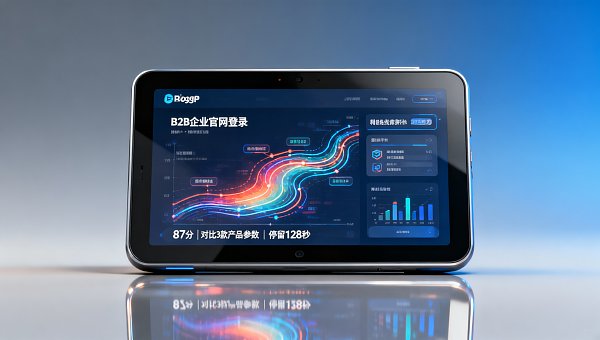
Simply recording "page dwell time" is meaningless. Business evaluators need to pay attention to verifiable decision signals: such as repeatedly comparing the technical parameters of two products, immediately visiting the "Success Stories" page after downloading the "Industry Compliance Guidelines" PDF, and returning to the homepage to search for "custom development process" after spending more than 120 seconds on the competitor comparison page.
YiYingBao's AI lead scoring engine tags 27 types of behavior (including content interaction depth, path complexity, cross-device consistency, etc.) and combines them with enterprise databases (such as Tianyancha API to verify company size/industry) to generate real-time scores. When the score is ≥85 (out of 100), the system automatically triggers a sales reminder, along with a behavior heatmap and screenshots of key nodes—this is more action-oriented than "Manager Zhang of a certain company left his contact information."
Strategy 3: High-Value Content Gateway – Exchanging Decision-Maker Information for Professional Assets
B2B buyers have long decision-making cycles, but the key turning point is clear: when the buyer actively requests a "Template for ROI Calculation of Digital Upgrade in XX Industry" or a "Sample for Cross-border Delivery SLA Agreement," their procurement process has entered the solution evaluation stage. Providing content at this point is more efficient than simply selling products.
We recommend setting white papers, calculators, and compliance checklists to "conditional unlock": visitors should complete a simple verification (such as entering and verifying a company email address), rather than being forced to fill in five pieces of information. One medical device client set the "FDA Registration Process Self-Checklist" as their gateway, and among the leads obtained, medical device distributors accounted for 41%, far exceeding the 9% of leads obtained through regular forms. This is because those who truly need this checklist are themselves key figures in the target decision-making chain.
Strategy 4: Product Information Integration – Let the Solution Speak for Itself
Clue collection should not be divorced from the product context. Taking the construction of an automotive industry portal as an example, we enhance the credibility of technology through "detailed display from a top-down perspective of the car", support parameter-level comparison through the "technical specifications module", and reduce the perceived risk of decision-making through the "real car owner evaluation module" - these designs themselves are continuously collecting user preference signals.
When visitors repeatedly switch between tabbed product galleries with different configurations, or linger on dynamic data monitoring dashboards for extended periods, the system has identified them as being in the "solution refinement" stage. At this point, a lightweight questionnaire (such as "Which performance metric do you value most?") has a conversion rate 3.2 times higher than a generic form. This is because the questions are rooted in the user's current real-world perception, rather than abstract sales pitches.
Three pitfalls that business evaluators must be wary of
First, over-reliance on third-party form tools: 92% of clients reported that embedded forms increased bounce rates for independent websites by 15%-22% because they disrupt page loading speed and visual consistency. It is recommended to use a native integration solution to ensure that forms are completely consistent with the brand's visual identity and interaction logic.
Second, neglecting lead lifecycle management: collection is just the beginning. Data from YiYingBao clients shows that leads not reached within 2 hours have a 68% lower conversion rate; leads not followed up according to behavioral tags have a conversion rate of less than 5% within 30 days. The system needs to automatically prioritize leads and push personalized follow-up messages (e.g., sending corresponding chapter interpretation videos directly to those who download the white paper).
Third, there is a confusion between "lead quantity" and "business value." One SaaS client once aimed for 5,000 new leads per month, but only 12 actually resulted in sales. Later, they shifted their focus to "coverage of the purchasing decision chain" (e.g., whether they simultaneously captured information from the IT director, purchasing director, and finance manager), and the number of effective leads increased by 40% in a single month, while the total number of leads decreased by 27%.
In conclusion, the essence of clue gathering is to construct a predictable decision signal system.
How to collect leads on a B2B independent website? The answer isn't about piling on tools, but about establishing a closed-loop mechanism for identifying, verifying, categorizing, and activating high-intent users. For business evaluators, there are three core criteria: can each lead be clearly attributed to its decision-making stage? Can the contribution of each strategy to the top of the sales funnel be quantified? Can the effectiveness of strategy iterations be quickly verified (A/B testing is recommended every 7 days).
YiYingBao's ten years of service experience shows that a truly efficient lead engine must simultaneously meet the requirements of technical accuracy (AI behavioral modeling), business fit (integration of industry-specific language), and execution agility (rules can be adjusted without development). When your independent website can not only leave visitors' contact information but also tell sales, "This customer has just compared the technical parameters of three suppliers and is focusing on delivery time and local service response," lead collection truly transforms from a cost center into a growth hub.
Related Articles

Related Products
 EasyCamp SaaS Smart Website Marketing SystemE-Yingbao SaaS Smart Website Marketing System: AI-powered, zero-code website building. Rapidly launch multilingual independent e-commerce sites in just 10 minutes. Global server acceleration and AI-driven SEO optimization empower businesses to efficiently connect with global markets. The seamless integration of technology and user-friendly operation makes building e-commerce sites incredibly simple.
 AI+SEM Intelligent Advertising Marketing SystemAI+SEM drives intelligent ad creation, empowering full-funnel precision advertising marketing. The system automatically generates weekly/monthly reports, AI recommends keywords and target countries, monitors core metrics in real-time with intelligent alerts, and enables one-click high-conversion ad solutions to help quickly acquire customers and improve ROI.
 AI+SEO Dual Engine Optimization ServiceEasyWin AI+SEO Dual Engine Optimization System leverages AI-powered keyword mining, content generation, and comprehensive technical optimization to help foreign trade enterprises acquire high-quality organic traffic, significantly improving search rankings and conversion rates.
 AI+SNS Social Media Marketing SystemYingbao AI+SNS Social Media Marketing System - Precision social capture for the social media era. Supports one-click content synchronization across major platforms like Facebook and LinkedIn. AI intelligently rewrites posts for enhanced relevance. 24/7 AI customer service and user profiling analysis empower businesses to efficiently expand into global markets.
 AI+SEO营销解决方案易营宝AI+SEO营销解决方案,通过AI批量写作、智能生成TDK、精准关键词扩词等功能,全面优化网站SEO效果,提升流量与转化率。助力企业构建高效智能网站新生态。
 AI+SEM Advertising Marketing SolutionsAI+SEM Advertising Marketing Solution leverages AI technology to deeply empower SEM ad campaigns. It automatically generates weekly/monthly reports using AI, presenting account data across multiple dimensions for comprehensive insights into campaign performance and trends. The system precisely recommends keywords and target countries, intelligently generates high-conversion ad copy, and enables one-click activation of efficient campaign plans to help businesses rapidly acquire customers. Simultaneously, it monitors core metrics in real time, intelligently identifies abnormal fluctuations, and issues timely alerts to ensure stable, high-return advertising results.
 Domain Name ServicesEasyWin provides professional domain name services, including intelligent queries, one-stop registration, brand protection, and full lifecycle management, helping businesses build a digital brand image.
 EasyOperate B2C Cross-Border E-Commerce Platform & Independent WebsiteEasyStore B2C Cross-border E-commerce Independent Store is an intelligent website building and cross-border e-commerce integrated solution independently developed by EasyStore Information Technology (Beijing) Co., Ltd. The system is specially designed for small and medium-sized as well as large export enterprises, integrating 'website building, operation, marketing, advertising, and conversion' into one, helping enterprises quickly establish cross-border e-commerce independent stores to achieve brand globalization and global sales growth.
The platform supports multiple languages, multiple currencies, and multi-channel marketing, with built-in AI intelligent translation and SEO optimization systems, suitable for mainstream markets such as Southeast Asia, Europe and America, Latin America, and the Middle East, assisting Chinese manufacturing enterprises in efficiently deploying international e-commerce strategies. SSL证书易营宝提供专业SSL安全证书服务,包括单域名和泛域名证书,确保网站数据传输加密、身份验证和完整性保护,助力企业建立安全可信的在线业务环境。









