









- The China-US tariff arrangement has reached a preliminary consensus, and the trade association will be establishedJun 15, 2026View details
- What determines B2C cross-border e-commerce website development costs? A breakdown of features, interfaces, and deployment methodsJun 17, 2026View details
- China-Morocco zero-tariff access, a breakthrough in the cost of Moroccan goods exports to ChinaJun 11, 2026View details
- What signal should be released for the suspension of exports to JapanJun 10, 2026View details
- China's May LNG imports rebounded, with increased volumes from Russia and Canada filling the Middle East supply gapJun 10, 2026View details
- Will GEO change its SEO strategy?Jun 04, 2026View details
EU VAT exemption for small parcels under 150 euros, independent site tax fee display restructuring
On July 1, 2026, the EU Council officially abolishes the customs exemption for cross-border small parcels under 150 euros. Low-cost direct-mail parcels will be uniformly subject to a fixed customs duty of 3 euros by product category. For B2C standalone sites targeting the European market, platform direct-mail sellers, and related supply chain service providers, this is not only a change in tax rules, but will also directly affect front-end pricing, tax display on checkout pages, cost estimates, and customer ordering decisions, making it a dynamic issue that the cross-border e-commerce industry needs to closely monitor at present.

Policy changes effective from July 1
As confirmed, the EU Council has abolished the customs exemption policy for cross-border small parcels under 150 euros, with the effective date set for July 1, 2026. According to this briefing, starting from that date, all low-cost direct-mail parcels will be subject to a fixed customs duty of 3 euros by product category.
It has also been confirmed that this change will directly affect B2C standalone sites in terms of checkout processes, pricing presentation, tax estimate capabilities, and customer conversion paths. The briefing also notes that direct-mail models on platforms such as Temu and SHEIN, as well as self-operated export businesses, will face dual pressure from compliance and user experience.
The impact goes beyond taxes themselves
Standalone sites targeting European sales will bear the brunt first
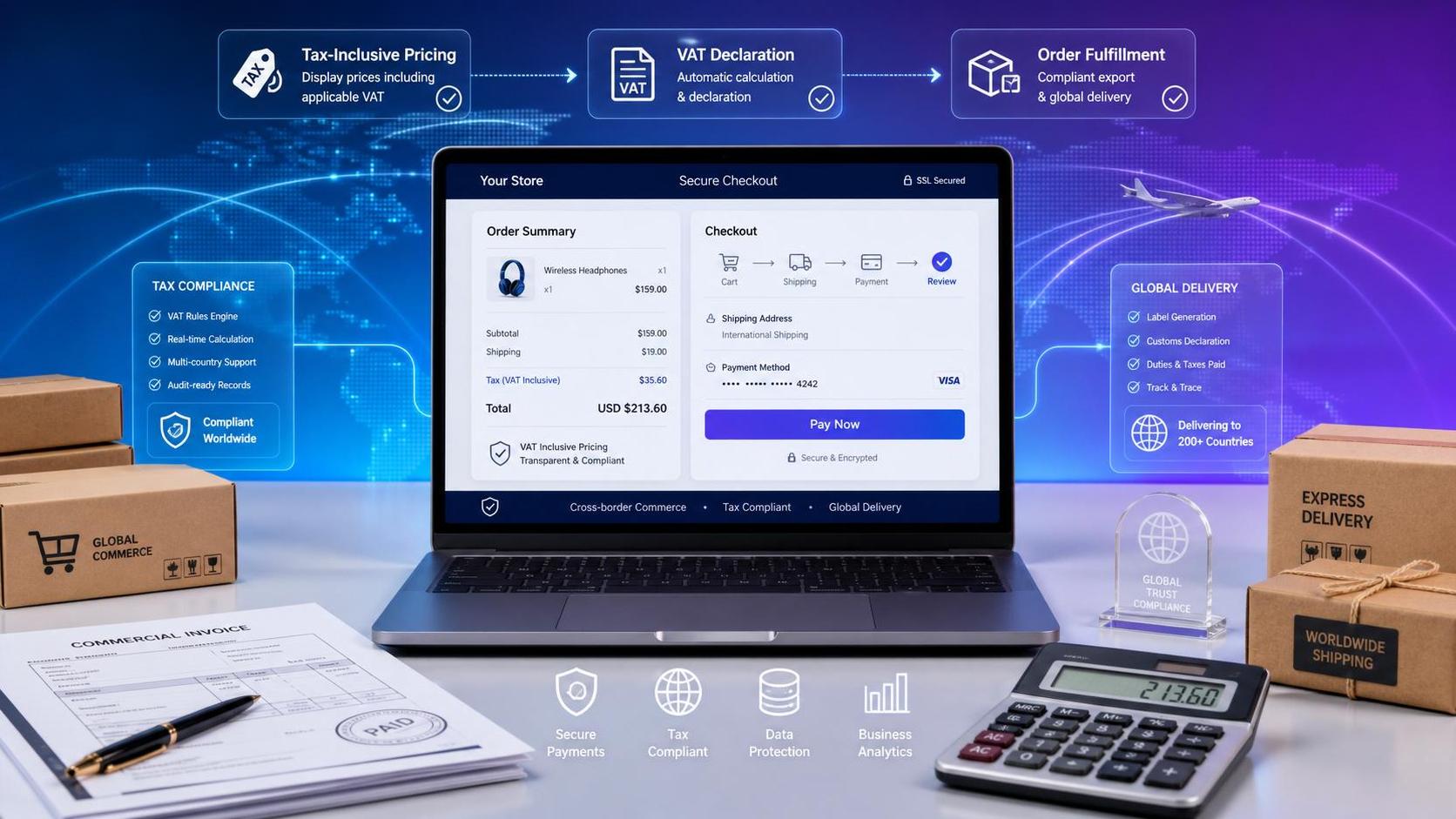
From the perspective of the business chain, the reason standalone-site sellers are affected is that tax changes will directly enter the price perception stage before consumers place an order. The impact is mainly reflected in whether the product page displays tax included or estimated tax, how the checkout page clearly explains the added cost, and whether the order total remains consistent. What is more worth noting at present is that if the price display logic is not adjusted in time, it may bring compliance expression risks and may also affect the smoothness of the conversion path.
Platform direct-mail models need to re-examine the front-end experience
For platform models whose main feature is low-cost direct mail, this change is sensitive because it is directly related to large-volume orders and small-parcel fulfillment models. From an analytical perspective, the impact is not only the change in single-order cost, but more importantly how the platform converts the new tax into settlement information that users can understand and accept. Key points to watch include whether the tax explanation is front-loaded, whether the display approach is unified across product categories, and whether the checkout stage will see increased cart abandonment due to insufficient cost explanation.
Supply chain and service providers will enter an adjustment period
From the perspective of supply chain service companies and supporting service providers, although the briefing does not reveal more execution details, it has already made clear that the change will affect tax estimation and related links in the fulfillment chain. Observationally, customs clearance, order processing, cost calculation, customer notifications, and other coordination points all require greater consistency. For service providers, what needs more attention going forward is whether system interfaces, cost transmission, and business pathways can stay synchronized with the seller front-end presentation.
What issues should enterprises focus on now
First verify the pricing and checkout paths
For a standalone-site operations team, the first task is not simply adjusting the sales price, but verifying whether the cost pathways on the product page, shopping cart, checkout page, and order confirmation flow are consistent. Since the new fixed customs duty has become a confirmed change, if the front-end display still follows the old logic, the actual impact will not only be on profit calculations, but also on consumers' expectations of the final payment amount.
Focus on verifying tax estimates and category mapping
This briefing clearly states that tax estimates will be directly affected, so enterprises need to prioritize checking the mapping relationship between product categories, tax calculations, and order display in their internal systems. From the analysis, the gap between policy statements and actual business implementation is often most likely to appear in the rule configuration and page presentation links.
Prepare customer communication scripts in parallel
For sellers and platforms relying on the direct-mail model, customer communication will become important work in the short term. Once the cost change is reflected at the order stage, whether the new tax can be explained in a concise, accurate, and not overly commitative way will affect pre-sales inquiries, order cancellation rates, and post-sales explanation costs.
Continue tracking subsequent rule statements
Although this briefing has already provided the effective date and the core charging change, from a practical perspective, enterprises should continue to pay attention to subsequent official statements, execution paths, and detailed rules related to the business process. What is currently clear is the policy direction; what remains uncertain is how different enterprises will accurately translate the rules into front-end pages, checkout processes, and customer communication mechanisms.
This is more like a reminder at the operational logic level
From an observational standpoint, the significance of this briefing is not limited to the addition of a fixed customs duty, but also serves as a reminder for cross-border e-commerce companies to re-examine the existing logic of “low-cost direct mail + low-threshold front-end display.” For businesses targeting the EU market, taxes are no longer merely a back-end settlement issue; they have already become a core part of the user ordering experience.
From an industry perspective, this should be understood as a policy change that has already been clearly implemented, and also as a policy signal that requires continued observation of execution details. What is certain is the effective date and the charging change; what is uncertain is how different companies will accurately translate the rules into front-end pages, checkout processes, and customer communication mechanisms.
From short-term adjustments to long-term adaptation
Overall, this change will first appear as short-term pressure to adjust pages, checkout, and cost calculations, but its deeper impact lies in the fact that cross-border sellers need to incorporate tax display, price transparency, and fulfillment coordination into a more stable operational framework. It is more appropriate to understand this as a policy change that has already formed a clear result, and at the same time as a long-term signal urging standalone sites and platform direct-mail models to continue adapting.
Basis of this article and direction for follow-up verification
This article was generated based on the news title, event time, and event summary provided by the user, and it has been confirmed that the facts are limited to the content described in the input information. For such news, it still needs to be continuously verified by combining official announcements, corporate announcements, industry association information, authoritative media reports, and relevant regulatory documents.
It should be noted that the specific official source link was not provided in the input, so content related to execution details still requires ongoing confirmation. Areas worth continued attention include: whether the authorities will release a more detailed rule statement, how enterprises will implement the pricing and tax display, and the actual impact of this change on customer conversion paths in direct-mail models.
Related Articles
 EU VAT exemption for small parcels under 150 euros, independent site tax fee display restructuring
 Russia’s ban on third-party logins enters a new phase, and compliance pressure on Russian-language websites is increasing
 EU low-value package VAT exemption ends, standalone site pricing logic faces adjustments

Related Products
 EasyCamp SaaS Smart Website Marketing SystemE-Yingbao SaaS Smart Website Marketing System: AI-powered, zero-code website building. Rapidly launch multilingual independent e-commerce sites in just 10 minutes. Global server acceleration and AI-driven SEO optimization empower businesses to efficiently connect with global markets. The seamless integration of technology and user-friendly operation makes building e-commerce sites incredibly simple.
 AI+SEM Intelligent Advertising Marketing SystemAI+SEM drives intelligent ad creation, empowering full-funnel precision advertising marketing. The system automatically generates weekly/monthly reports, AI recommends keywords and target countries, monitors core metrics in real-time with intelligent alerts, and enables one-click high-conversion ad solutions to help quickly acquire customers and improve ROI.
 AI+SEO Dual Engine Optimization ServiceEasyWin AI+SEO Dual Engine Optimization System leverages AI-powered keyword mining, content generation, and comprehensive technical optimization to help foreign trade enterprises acquire high-quality organic traffic, significantly improving search rankings and conversion rates.
 AI+SNS Social Media Marketing SystemYingbao AI+SNS Social Media Marketing System - Precision social capture for the social media era. Supports one-click content synchronization across major platforms like Facebook and LinkedIn. AI intelligently rewrites posts for enhanced relevance. 24/7 AI customer service and user profiling analysis empower businesses to efficiently expand into global markets.
 AI+SEO营销解决方案易营宝AI+SEO营销解决方案,通过AI批量写作、智能生成TDK、精准关键词扩词等功能,全面优化网站SEO效果,提升流量与转化率。助力企业构建高效智能网站新生态。
 AI+SEM Advertising Marketing SolutionsAI+SEM Advertising Marketing Solution leverages AI technology to deeply empower SEM ad campaigns. It automatically generates weekly/monthly reports using AI, presenting account data across multiple dimensions for comprehensive insights into campaign performance and trends. The system precisely recommends keywords and target countries, intelligently generates high-conversion ad copy, and enables one-click activation of efficient campaign plans to help businesses rapidly acquire customers. Simultaneously, it monitors core metrics in real time, intelligently identifies abnormal fluctuations, and issues timely alerts to ensure stable, high-return advertising results.
 Domain Name ServicesEasyWin provides professional domain name services, including intelligent queries, one-stop registration, brand protection, and full lifecycle management, helping businesses build a digital brand image.
 EasyOperate B2C Cross-Border E-Commerce Platform & Independent WebsiteEasyStore B2C Cross-border E-commerce Independent Store is an intelligent website building and cross-border e-commerce integrated solution independently developed by EasyStore Information Technology (Beijing) Co., Ltd. The system is specially designed for small and medium-sized as well as large export enterprises, integrating 'website building, operation, marketing, advertising, and conversion' into one, helping enterprises quickly establish cross-border e-commerce independent stores to achieve brand globalization and global sales growth.
The platform supports multiple languages, multiple currencies, and multi-channel marketing, with built-in AI intelligent translation and SEO optimization systems, suitable for mainstream markets such as Southeast Asia, Europe and America, Latin America, and the Middle East, assisting Chinese manufacturing enterprises in efficiently deploying international e-commerce strategies. SSL证书易营宝提供专业SSL安全证书服务,包括单域名和泛域名证书,确保网站数据传输加密、身份验证和完整性保护,助力企业建立安全可信的在线业务环境。









