









- What Does a Global Traffic Ecosystem Service Provider Do? What Are the Differences from a Single Advertising AgencyJul 16, 2026View details
- What should you focus on in the latest enterprise SaaS report? From renewal rates and delivery costs to overseas growth opportunitiesJul 12, 2026View details
- What signals are worth paying attention to in a cross-border marketing trend report? B2B companies should look at these 6 signalsJul 11, 2026View details
- How to Read a Cross-Border Marketing Trends Report? Five Key Dimensions for Evaluating Channel OpportunitiesJul 11, 2026View details
- Which channel has the highest ROI in the global traffic ecosystem? Comparative analysis of search, social media, and advertisingJul 10, 2026View details
- What multilingual website services are available in Sanya? Which model is more suitable for local businesses going global?Jul 08, 2026View details
How should an overseas promotion plan for the building materials industry be defined? From Google Shopping Feed optimization and YouTube installation videos to co-building local distributor pages
How should an overseas promotion plan for the building materials industry be defined? This question may seem to focus on channel selection, but in fact it directly points to the core capability of a company’s globalization implementation—whether it can make its products be “seen, understood, trusted, and available for purchase” in foreign markets. Unlike fast-moving consumer goods or electronics, building materials products have long decision-making cycles, numerous technical parameters, strong installation compatibility requirements, and strict local compliance standards. A generic social media advertising approach or universal SEO strategy is often unable to penetrate the engineering procurement chain. Having served more than 100,000 foreign trade and manufacturing enterprises for ten years, EasyBiz has found that a truly effective overseas promotion plan for the building materials industry must be anchored on three key pillars: machine readability of product data, visual credibility of engineering scenarios, and trust-building capability in local channels.
Google Shopping Feed is not “uploading a spreadsheet,” but the data infrastructure for building materials going global
For building materials companies, Google Shopping Feed is far more than just a carrier of product information. In essence, it is a structured language designed for AI search and shopping engines. When European and American buyers search on Google for “fire-rated gypsum board UK” or “waterproof tile adhesive EU,” the system matches not only keywords, but also whether fields such as EN 13501-1 fire rating, CE certification number, applicable substrate type, and VOC content are marked in the Feed.
EasyBiz’s AI+GEO optimization system automatically verifies Feed data compliance: for example, converting the Chinese specification “2440×1220mm” into “8ft × 4ft,” mapping “A级不燃” to “Class A Fire Rated,” and dynamically supplementing the mandatory attributes required by local regulations. This directly determines whether a product can enter the Google Merchant Center review whitelist, and also affects the exposure weight of Shopping ads during the peak B2B procurement season.
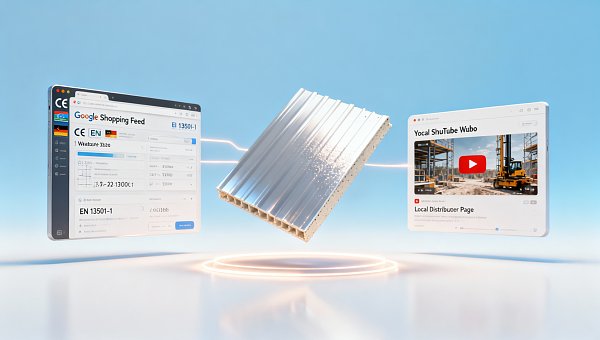
YouTube engineering videos are not “product displays,” but trust assets that reduce customer decision-making risk
The questions building materials buyers ask most often are usually not in inquiry emails, but in the YouTube comment section: “Will this waterproof membrane crack when installed at minus 15°C?” “What spacing of the aluminum gusset keel complies with Germany’s DIN 18182 standard?”——These real concerns are precisely the weakest link in the conversion funnel.
The YouTube content strategy customized by EasyBiz for building materials clients centers on “localization of engineering context”: locally certified engineers appear on camera to explain the installation process, using tools and units of measurement commonly used in the target country, interspersed with footage of third-party testing reports, and embedding download links for multilingual technical documents in the description. This type of video not only enhances brand professionalism, but is also recognized by Google’s algorithm as high-value content, gaining a boost in organic ranking when users search “how to install [product] in [country].”
Co-building pages with local distributors is not “adding a link,” but extending the company’s radius of trust
Many building materials companies have built English official websites, yet still struggle to gain the trust of overseas engineering firms. The reason is that independent websites lack endorsement from local physical entities. Simply placing an “Authorized Distributor” banner on a distributor’s website also fails to convey in-depth product information.
EasyBiz adopts a “joint page co-building” model: developing exclusive subpages jointly for enterprises and core distributors, integrating content from both sides——the enterprise side provides 3D installation diagrams, BIM model downloads, and technical white papers; the distributor side embeds real-time local inventory status, engineering case maps, and introductions to certified installation teams. Through cross-verification of dual domains (such as distributor.com/brand-name + brand.com/en/partners), this page not only satisfies Google’s evaluation of E-A-T (Expertise, Authoritativeness, Trustworthiness), but also strengthens buyers’ perception of supply chain stability.
From strategy to execution: three commonly underestimated evaluation dimensions
When formulating an overseas promotion plan for the building materials industry, it is necessary to move beyond the mindset of “listing functions” and shift to business logic calibration:
- Does regional priority match channel investment? Projects in the Middle East value customs clearance timeliness, so HS codes and country-of-origin declarations in the Feed should be strengthened; Southeast Asia emphasizes cost performance, so YouTube videos should highlight cost calculations per unit area.
- Does content production have the capability for “engineering translation”? Installation videos produced by operators without a technical background are prone to terminology mistranslations or omitted steps, which instead damages the professional image.
- Has a data closed loop been established? Looking only at Google Ads click-through rates is meaningless; it is necessary to track full-chain attribution from Shopping ads → YouTube video completion rate → independent website technical document downloads → inquiry conversion rate on distributor pages.
It is worth noting that the sustainability of a promotion strategy is often deeply tied to the company’s internal collaboration mechanism. For example, when the sales team reports that customers in a certain country frequently ask about environmental certification details, this signal should be synchronized in real time to the Feed optimization and video script iteration process. This agile response capability stems precisely from the cross-functional data integration logic emphasized in the challenges and strategies of broadening the scope of enterprise cost accounting.
Recommended next steps
Rather than looking for a “universal template,” it is better to start with a lightweight diagnosis: among the current overseas site’s product pages, how many have fully presented technical parameters through Schema markup? In the YouTube channel, have there been at least 3 videos published in the past six months that received public citations from engineer accounts in the target country? Do local distributor pages support filtering engineering cases by city? These specific indicators are more capable than abstract discussions of “overseas promotion plans for the building materials industry” in pointing to real optimization paths.
EasyBiz’s integrated AI website building and marketing platform was created precisely to solve such structural problems——using systematic capabilities to replace fragmented execution, allowing technical parameters to automatically adapt to standards in multiple countries, enabling engineering videos to precisely reach procurement decision-makers, and making distributor networks truly become amplifiers of brand trust. Real global competitiveness does not lie in a single-point breakthrough, but in the resonance of trust across every link.
Related Articles
Related Products
 EasyCamp SaaS Smart Website Marketing SystemE-Yingbao SaaS Smart Website Marketing System: AI-powered, zero-code website building. Rapidly launch multilingual independent e-commerce sites in just 10 minutes. Global server acceleration and AI-driven SEO optimization empower businesses to efficiently connect with global markets. The seamless integration of technology and user-friendly operation makes building e-commerce sites incredibly simple.
 AI+SEM Intelligent Advertising Marketing SystemAI+SEM drives intelligent ad creation, empowering full-funnel precision advertising marketing. The system automatically generates weekly/monthly reports, AI recommends keywords and target countries, monitors core metrics in real-time with intelligent alerts, and enables one-click high-conversion ad solutions to help quickly acquire customers and improve ROI.
 AI+SEO Dual Engine Optimization ServiceEasyWin AI+SEO Dual Engine Optimization System leverages AI-powered keyword mining, content generation, and comprehensive technical optimization to help foreign trade enterprises acquire high-quality organic traffic, significantly improving search rankings and conversion rates.
 AI+SNS Social Media Marketing SystemYingbao AI+SNS Social Media Marketing System - Precision social capture for the social media era. Supports one-click content synchronization across major platforms like Facebook and LinkedIn. AI intelligently rewrites posts for enhanced relevance. 24/7 AI customer service and user profiling analysis empower businesses to efficiently expand into global markets.
 AI+SEO营销解决方案易营宝AI+SEO营销解决方案,通过AI批量写作、智能生成TDK、精准关键词扩词等功能,全面优化网站SEO效果,提升流量与转化率。助力企业构建高效智能网站新生态。
 AI+SEM Advertising Marketing SolutionsAI+SEM Advertising Marketing Solution leverages AI technology to deeply empower SEM ad campaigns. It automatically generates weekly/monthly reports using AI, presenting account data across multiple dimensions for comprehensive insights into campaign performance and trends. The system precisely recommends keywords and target countries, intelligently generates high-conversion ad copy, and enables one-click activation of efficient campaign plans to help businesses rapidly acquire customers. Simultaneously, it monitors core metrics in real time, intelligently identifies abnormal fluctuations, and issues timely alerts to ensure stable, high-return advertising results.
 Domain Name ServicesEasyWin provides professional domain name services, including intelligent queries, one-stop registration, brand protection, and full lifecycle management, helping businesses build a digital brand image.
 EasyOperate B2C Cross-Border E-Commerce Platform & Independent WebsiteEasyStore B2C Cross-border E-commerce Independent Store is an intelligent website building and cross-border e-commerce integrated solution independently developed by EasyStore Information Technology (Beijing) Co., Ltd. The system is specially designed for small and medium-sized as well as large export enterprises, integrating 'website building, operation, marketing, advertising, and conversion' into one, helping enterprises quickly establish cross-border e-commerce independent stores to achieve brand globalization and global sales growth.
The platform supports multiple languages, multiple currencies, and multi-channel marketing, with built-in AI intelligent translation and SEO optimization systems, suitable for mainstream markets such as Southeast Asia, Europe and America, Latin America, and the Middle East, assisting Chinese manufacturing enterprises in efficiently deploying international e-commerce strategies. SSL证书易营宝提供专业SSL安全证书服务,包括单域名和泛域名证书,确保网站数据传输加密、身份验证和完整性保护,助力企业建立安全可信的在线业务环境。









