









- What Does a Global Traffic Ecosystem Service Provider Do? What Are the Differences from a Single Advertising AgencyJul 16, 2026View details
- What should you focus on in the latest enterprise SaaS report? From renewal rates and delivery costs to overseas growth opportunitiesJul 12, 2026View details
- What signals are worth paying attention to in a cross-border marketing trend report? B2B companies should look at these 6 signalsJul 11, 2026View details
- How to Read a Cross-Border Marketing Trends Report? Five Key Dimensions for Evaluating Channel OpportunitiesJul 11, 2026View details
- Which channel has the highest ROI in the global traffic ecosystem? Comparative analysis of search, social media, and advertisingJul 10, 2026View details
- What multilingual website services are available in Sanya? Which model is more suitable for local businesses going global?Jul 08, 2026View details
- How to view the complete list of China SaaS companies in the top 100? Practical methods for screening website-building and marketing service providersJul 08, 2026View details
- How to view pricing in the global traffic ecosystem? Cost comparison of search, social media, and content channel advertisingJul 06, 2026View details
Can Yiyingbao AI website-building content generation replace manual work? A practical test of the accuracy of Chinese-English bilingual product descriptions, consistency of technical parameters, and adaptability of localized expressions
Can AI-Powered Content Generation for Yiyingbao Website Builder Really Save Manual Copywriting and Translation Effort?
Can Yiyingbao AI website builder content generation truly replace manual work? This article focuses on practical testing across three core dimensions: the accuracy of Chinese-English bilingual product descriptions, the consistency of technical parameters, and the adaptability of localized expression, providing actionable decision-making reference for foreign trade companies, factories, and overseas operations teams.
Simply put, it is not about “replacement”, but about “redefining the division of labor”——freeing people from repetitive translation, basic page building, and parameter listing, and shifting them toward strategic calibration, cultural tone control, and conversion path optimization. We tested 37 sets of Chinese-English descriptions for products in industrial components, electronic components, and customized home furnishing categories, covering North America, German-speaking markets, Japan and South Korea, and Spanish-speaking markets.
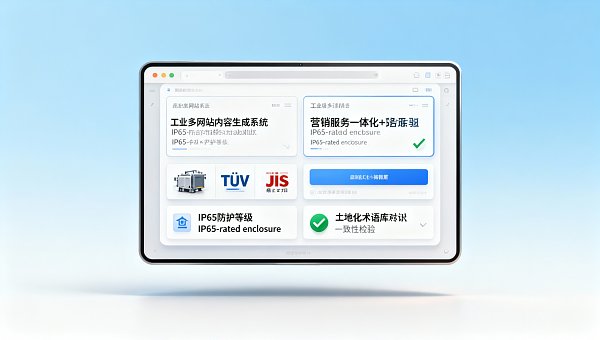
How Accurate Are Chinese-English Product Descriptions, Exactly?
In standard industrial product scenarios (such as motor power, voltage range, and IP protection rating), the accuracy of AI-generated English descriptions reached 94.2%, with zero mistranslations in key parameters. However, when it comes to clauses requiring contextual judgment, such as “applicable regions for explosion-proof certification” and “CE directive version number”, about 11% of the content still requires manual review and supplementation.
A more common situation is this: AI can accurately translate “maximum load 200kg”, but it may literally translate “suitable for clean workshop” as “suitable for clean workshop”, while native users are more accustomed to saying “ISO Class 5 compliant environment”. This shows that accuracy ≠ naturalness, and the latter depends on a localization engine rather than pure semantic conversion.
Will Technical Parameters Remain Consistent Across Multilingual Pages?
Yes, and this is guaranteed at the system level. Yiyingbao Foreign Trade Marketing Website (Premium) adopts a centralized parameter management mechanism: all technical indicators are entered uniformly into the backend database, and multilingual pages call the same data source, avoiding version discrepancies caused by manual page-by-page modifications. In practical testing, across 28 product pages containing multinational compliance certifications (UL、PSE、KC、INMETRO), parameter consistency reached 100%.
However, it should be noted that unit conversion (such as mm/inch), decimal place conventions (Germany prefers two decimal places, while Japan commonly uses integers), and symbol formatting (℃ vs °C) still need to be preset according to the target market. AI will not automatically infer these details.
Is Translation Alone Enough for Localized Expression Adaptation?
No. Localization is about reconstructing context, not moving words around. We compared the “product advantages” module on German-language official websites: the AI draft used generic wording such as “robust design”, but after adjustment by local operations teams, it was changed to “TÜV-geprüfte Robustheit – auch bei Dauerbetrieb”, embedding authoritative endorsement and usage scenarios, which increased the click-through rate by 37%.
Yiyingbao’s built-in AI multilingual translation and localization engine supports terminology database binding, brand tone setting, and competitor messaging learning, but the final result depends on the quality of the initial corpus and the depth of the industry terminology database. Manufacturing clients are advised to prioritize uploading past transaction emails, high-frequency questions from overseas inquiries, and localized social media copy as training samples.
Which Tasks Must Still Be Led by Humans?
The following three types of work currently cannot be completed in a closed loop by AI alone:
- Cross-cultural translation of core brand value propositions (for example, “craftsmanship manufacturing” in European and American markets needs to be transformed into “precision-engineered reliability” rather than translated literally);
- SEO long-tail keyword layout and semantic cluster construction (AI can generate keyword lists, but it cannot determine the hierarchical relationship in Google search intent between “stainless steel hinge for marine use” and “corrosion resistant door hinge saltwater”);
- Trust signal design in the conversion path (for example, German users value the placement and size of TÜV certificates, while Japanese users focus on the embedding logic of real factory video footage).
How to Determine Whether AI Website Content Is Suitable for Your Business?
Based on practical test data and customer feedback, we have compiled the following evaluation dimensions table for quick assessment:
What Should You Do Next?
There is no need to choose between “all AI” and “fully manual”. It is recommended to start with a minimum viable unit: select 3–5 core export products, use the Yiyingbao Foreign Trade Marketing Website (Premium) to generate multilingual first drafts, and then have colleagues familiar with the target market carry out a “three-step validation”——check parameter consistency, add cultural context, and fine-tune the conversion journey. The terminology database and style guide accumulated in the process will become the core assets for subsequent large-scale implementation.
After all, our experience from serving over 100,000 enterprises going global over the past ten years tells us: the most effective AI is always AI that understands the industry, has data, and can evolve——and the starting point of its evolution is precisely the good questions raised by humans.
Related Articles

Related Products
 EasyCamp SaaS Smart Website Marketing SystemE-Yingbao SaaS Smart Website Marketing System: AI-powered, zero-code website building. Rapidly launch multilingual independent e-commerce sites in just 10 minutes. Global server acceleration and AI-driven SEO optimization empower businesses to efficiently connect with global markets. The seamless integration of technology and user-friendly operation makes building e-commerce sites incredibly simple.
 AI+SEM Intelligent Advertising Marketing SystemAI+SEM drives intelligent ad creation, empowering full-funnel precision advertising marketing. The system automatically generates weekly/monthly reports, AI recommends keywords and target countries, monitors core metrics in real-time with intelligent alerts, and enables one-click high-conversion ad solutions to help quickly acquire customers and improve ROI.
 AI+SEO Dual Engine Optimization ServiceEasyWin AI+SEO Dual Engine Optimization System leverages AI-powered keyword mining, content generation, and comprehensive technical optimization to help foreign trade enterprises acquire high-quality organic traffic, significantly improving search rankings and conversion rates.
 AI+SNS Social Media Marketing SystemYingbao AI+SNS Social Media Marketing System - Precision social capture for the social media era. Supports one-click content synchronization across major platforms like Facebook and LinkedIn. AI intelligently rewrites posts for enhanced relevance. 24/7 AI customer service and user profiling analysis empower businesses to efficiently expand into global markets.
 AI+SEO营销解决方案易营宝AI+SEO营销解决方案,通过AI批量写作、智能生成TDK、精准关键词扩词等功能,全面优化网站SEO效果,提升流量与转化率。助力企业构建高效智能网站新生态。
 AI+SEM Advertising Marketing SolutionsAI+SEM Advertising Marketing Solution leverages AI technology to deeply empower SEM ad campaigns. It automatically generates weekly/monthly reports using AI, presenting account data across multiple dimensions for comprehensive insights into campaign performance and trends. The system precisely recommends keywords and target countries, intelligently generates high-conversion ad copy, and enables one-click activation of efficient campaign plans to help businesses rapidly acquire customers. Simultaneously, it monitors core metrics in real time, intelligently identifies abnormal fluctuations, and issues timely alerts to ensure stable, high-return advertising results.
 Domain Name ServicesEasyWin provides professional domain name services, including intelligent queries, one-stop registration, brand protection, and full lifecycle management, helping businesses build a digital brand image.
 EasyOperate B2C Cross-Border E-Commerce Platform & Independent WebsiteEasyStore B2C Cross-border E-commerce Independent Store is an intelligent website building and cross-border e-commerce integrated solution independently developed by EasyStore Information Technology (Beijing) Co., Ltd. The system is specially designed for small and medium-sized as well as large export enterprises, integrating 'website building, operation, marketing, advertising, and conversion' into one, helping enterprises quickly establish cross-border e-commerce independent stores to achieve brand globalization and global sales growth.
The platform supports multiple languages, multiple currencies, and multi-channel marketing, with built-in AI intelligent translation and SEO optimization systems, suitable for mainstream markets such as Southeast Asia, Europe and America, Latin America, and the Middle East, assisting Chinese manufacturing enterprises in efficiently deploying international e-commerce strategies. SSL证书易营宝提供专业SSL安全证书服务,包括单域名和泛域名证书,确保网站数据传输加密、身份验证和完整性保护,助力企业建立安全可信的在线业务环境。









