Breakdown of a B2B Overseas Promotion Execution Plan
An actionable B2B overseas promotion execution plan can help project managers clarify the path, control the pace, and improve lead acquisition and conversion efficiency。
The first thing project leaders should determine: overseas promotion does not mean “running ads first”

When many B2B companies start overseas promotion, their first reaction is to build an English website, open advertising accounts, and publish social media content。 But for project managers, the more critical questions are: whether the target market is clear, whether lead handoff is ready, and whether the budget can be validated in stages。
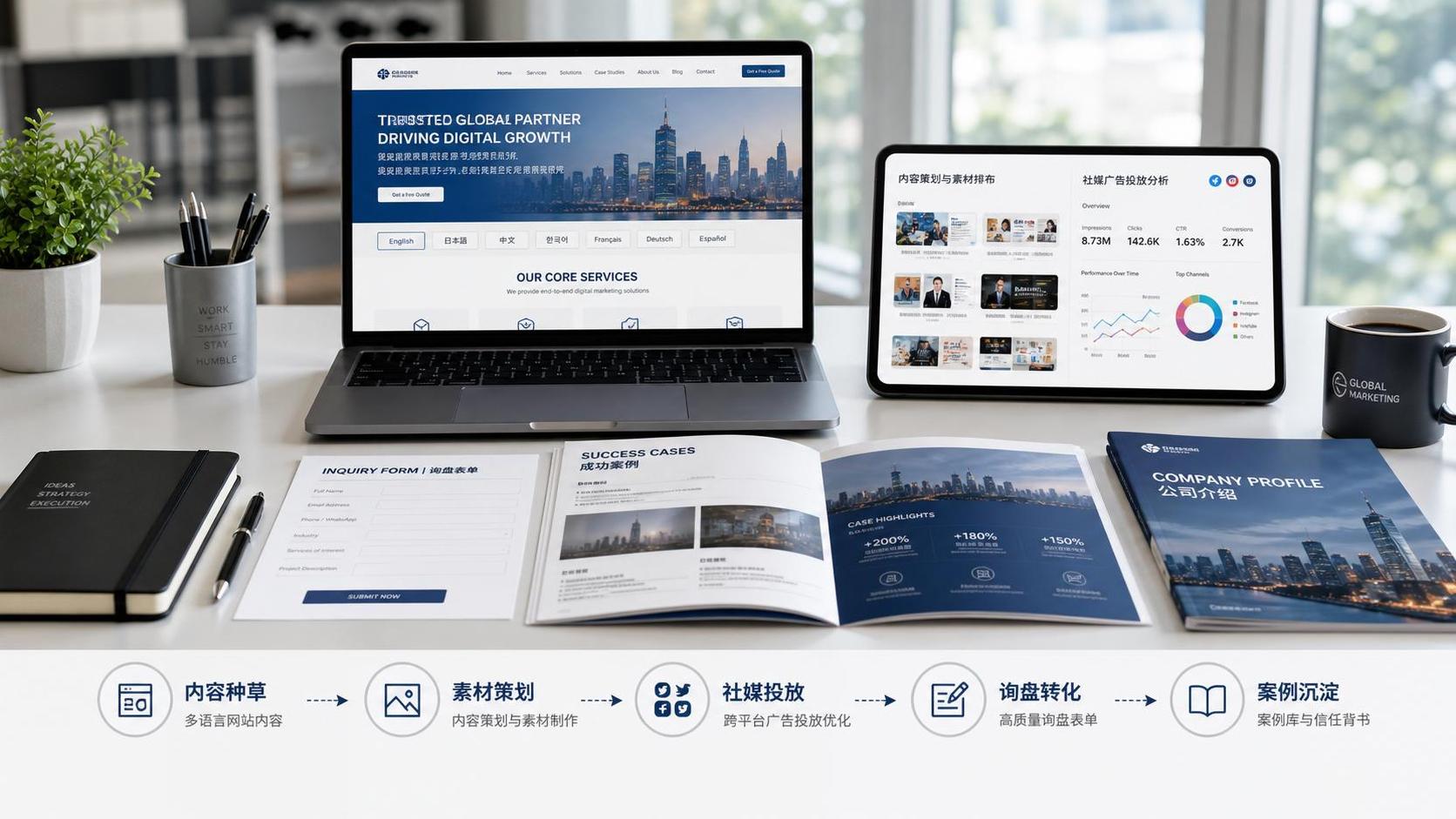
An effective B2B overseas promotion execution plan should solve the path issue first, and then solve the action issue。 It is not a single-point marketing checklist, but a complete project management framework covering market selection, website lead capture, content-based customer acquisition, advertising scale-up, and sales conversion。
This is especially true for B2B businesses such as engineering, manufacturing, equipment, and infrastructure support, where customer decision cycles are long and inquiry quality varies greatly。 If you only look at clicks and impressions, it is easy to end up with “promotion looks busy, but deals make no progress”。
Step 1: Clarify the market, customers, and project objectives
Before executing overseas promotion, the project leader must first define three boundaries: primary target countries or regions, target customer types, and phased business objectives。 For example, whether the goal is to acquire agents, develop end buyers, or win inquiries for engineering projects, the approach will be completely different。
The goal cannot simply be written as “increase overseas inquiries”, but should be broken down into measurable indicators。 It is recommended to set three levels of goals: traffic metrics focus on visits and keyword coverage, lead metrics focus on forms, emails, and WhatsApp inquiries, and business metrics focus on qualified inquiries and opportunity value。
At this stage, the company’s own readiness should also be evaluated, including product materials, case studies, certifications, quotation mechanisms, delivery capabilities, and foreign trade sales response speed。 Promotion is not an isolated action; back-end lead handling capability will directly determine the return on front-end investment。
Step 2: Build an overseas website capable of supporting conversion
For B2B companies, the official website is not a display storefront, but the core entry point for overseas customers to judge credibility and initiate inquiries。 The website must solve three questions: whether customers can understand it, whether they trust you, and whether it is convenient to contact you。
In execution, priority should be given to improving product category pages, solution pages, application scenario pages, project case pages, and inquiry entry points。 Project-based companies can also add content such as delivery processes, quality control, and service regions to reduce communication costs for overseas customers。
Relying on its capabilities in intelligent website building, SEO optimization, social media marketing, and advertising, Yiyingbao Information Technology is well suited to help companies upgrade their websites from “information displays” to “customer acquisition systems”。 This is especially important for project leaders who lack overseas digital teams。
Step 3: Use SEO and content to build long-term customer acquisition capabilities
B2B overseas promotion cannot rely entirely on advertising。 The value of SEO and content development lies in continuously covering customers’ search needs, enabling companies to appear earlier during procurement research, solution comparison, and supplier screening, thereby forming a long-term source of organic inquiries。
Keyword planning should extend from product terms to application terms, problem-based terms, standard-related terms, and project scenario terms。 For example, customers may not only search for equipment names, but also installation solutions, procurement standards, cost comparisons, maintenance methods, or supplier qualifications。
Content formats do not need to pursue broad general education, but should focus on customers’ decision-making barriers。 For example, parameter explanations, selection guides, project cases, FAQ, comparison tables, white papers, and downloadable materials often generate more qualified inquiries than ordinary news。
In vertical industry content planning, the structure of professional research-oriented materials can also be referenced, such as topics like Research on Financial Management of Hospital Infrastructure under the Background of the New Accounting System, emphasizing the logic of institutional background, project management, and risk control。
Step 4: Advertising should be validated in stages, and should not be scaled up all at once
Advertising is suitable for quickly validating markets and supplementing leads, but project leaders should avoid investing a large budget from the very beginning。 A more prudent approach is to first test countries, keywords, landing pages, and inquiry quality on a small scale, and then decide whether to expand the budget。
Google Ads can be used for high-intent search terms, LinkedIn is suitable for reaching specific job titles and company types, and Meta and YouTube can be used for brand exposure or content remarketing。 Different channels have different objectives, and they cannot be simply compared using the same metric。
It is recommended to conduct an advertising review every two weeks, focusing on search term quality, landing page conversion rate, reasons for invalid inquiries, and sales follow-up feedback。 Advertising optimization is not only about adjusting bids, but also about continuously refining copy, audiences, pages, and lead qualification criteria。
Step 5: Establish project cadence and collaboration mechanisms
Whether a B2B overseas promotion execution plan can be implemented depends largely on the project cadence。 It is recommended to use three months as one validation cycle: build the foundation in the first month, review data in the second month, and optimize in the third month while deciding whether to expand or adjust direction。
Project leaders need to establish a fixed meeting mechanism that includes at least four roles: marketing, sales, product, and management。 Marketing is responsible for traffic and content, sales provides feedback on lead quality, product supplements technical materials, and management confirms budgets and market priorities。
At the same time, lead grading criteria should be established。 For example, inquiries can be divided into four categories: high-value opportunities, general procurement inquiries, agency cooperation, and invalid inquiries, with source channels recorded。 Only by clearly attributing lead quality can you determine whether promotional actions are truly effective。
Step 6: Use data to evaluate input and output, instead of only looking at surface-level activity
What project managers care about most is whether the investment is worthwhile。 The ROI of overseas promotion should not only look at deals closed in the current month, because B2B transaction cycles are relatively long; more attention should be paid to the cost of qualified inquiries, opportunity conversion rate, sales follow-up cycle, and potential order value。
If website visits increase but inquiries are few, the issue may be weak page conversion or low keyword intent; if there are many inquiries but poor quality, the ad matching may be too broad; if high-quality leads do not close, quotation, qualifications, and sales follow-up capabilities should be reviewed。
The value of an integrated service provider like Yiyingbao lies in managing website building, SEO, social media, and advertising within the same growth model, reducing repeated communication between multiple vendors, data fragmentation, and unclear responsibility boundaries for companies。
Conclusion: the core of an executable plan is a clear path, clear responsibilities, and clear data
B2B overseas promotion is not a one-time campaign, but a continuously iterative growth project。 Project leaders should manage it as a cross-departmental initiative, advancing step by step from objectives, website, content, advertising, and sales handoff to data review。
A truly effective B2B overseas promotion execution plan does not pursue launching all channels at the same time, but first identifies high-value markets and high-intent customers, and then uses the right channels to steadily acquire leads。 When the path is clear, investment becomes controllable, and growth becomes sustainable。