









- Which channel has the highest ROI in the global traffic ecosystem? Comparative analysis of search, social media, and advertisingJul 10, 2026View details
- What multilingual website services are available in Sanya? Which model is more suitable for local businesses going global?Jul 08, 2026View details
- How to view the complete list of China SaaS companies in the top 100? Practical methods for screening website-building and marketing service providersJul 08, 2026View details
- How to view pricing in the global traffic ecosystem? Cost comparison of search, social media, and content channel advertisingJul 06, 2026View details
- How to assess foreign trade website development trends?Looking at 2026 changes from multilingual,AI content to conversion pathsJul 04, 2026View details
- What are the new trends in multilingual marketing data analytics tools in 2026? Focus on attribution、automation and complianceJul 04, 2026View details
Default content title displayed here
Can YiYingBao SEO optimization improve Google indexing? Don't just focus on keywords.
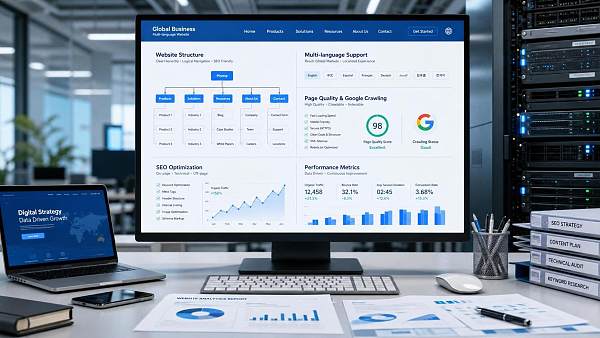
When many people try to determine whether YiYingBao SEO optimization can improve Google indexing, their first reaction is to check if enough keywords have been used. However, this is only a superficial approach. Google's decision to index a page depends more on whether it has genuine content, whether the website can be crawled normally, and whether its overall structure is clear.
Simply put, being indexed isn't something that happens "just submit it," but rather a basic judgment made by search engines based on page quality. A page must be discoverable, accessible, and understandable to have a chance of being indexed. This is why website building systems, content organization, and technical configuration are often more important than simply stuffing keywords.
This issue becomes even more relevant when viewed within the context of an integrated website and marketing services model. A website targeting overseas markets is more than just a display page; it also serves the tasks of customer acquisition, conversion, and brand expression. YiYingBao, specializing in intelligent website building, Google SEO optimization, advertising, and multilingual marketing, derives its core value from handling "promotable, indexable, and convertible" aspects within the same logical framework.
What does Google look for when indexing websites, and why do some websites never get included in its database?
To answer the question of whether YiYingBao SEO optimization can improve Google indexing, we first need to understand the basic Google indexing process. It generally involves discovering links, crawling pages, parsing content, assessing quality, and then deciding whether to include the content in the index. If any step in this process goes wrong, indexing will slow down or even fail completely.
More often than not, it's not that "Google didn't come," but rather that "Google came but didn't want to be included." This could be due to issues like short page content, duplicate titles, confusing navigation, conflicting language versions, or slow server response. These are all fundamental site problems that can't be solved simply by adding a few keywords.
For multilingual websites, B2B foreign trade sites, and cross-border e-commerce platforms, crawling conditions are particularly crucial. Excessively deep page hierarchies, too many parameter links, and too many duplicate pages will dilute crawling resources. For platforms like YiYingBao, configuring the URL structure, sitemap, mobile adaptation, and basic SEO fields during the website building phase is usually more effective than trying to fix it later.
First, use a table to identify the key factors affecting inclusion.
Can YiYingBao SEO optimization improve Google indexing? The answer is usually "yes," but there are prerequisites.
Based on practical experience, can YiYingBao SEO optimization improve Google indexing? The answer is usually yes, but the premise is not "implementation of the system guarantees indexing," but rather that the platform's capabilities must be combined with the quality of the site's execution. The platform is responsible for laying a solid foundation, while the pages are responsible for providing value; both conditions are indispensable.
YiYingBao is an integrated digital marketing platform encompassing intelligent website building, SEO optimization, social media marketing, and advertising. Its advantage lies not only in page creation but also in unifying technical foundations, content delivery, and subsequent promotion. For websites requiring long-term Google SEO optimization, this integrated capability is more suitable for steadily improving indexing and exposure.
Especially for independent e-commerce websites, multilingual websites, and B2B inquiry-based websites, many indexing issues are not due to editors' inability to write content, but rather the lack of SEO structure planning during the website building phase. For example, this might manifest as unscalable categories, limited title fields, generic product page templates, and disorganized language switching logic. If platforms can reduce these obstacles at the source, their indexing efficiency will typically be higher.
Which scenarios are more suitable for improving search engine indexing through YiYingBao SEO optimization?
Not all websites need the same SEO strategies. Those truly interested in whether YiYingBao SEO optimization can improve Google indexing are typically in the following scenarios: newly launched websites, websites with many pages but no indexed pages, websites expanding to multiple languages, or websites where advertising costs are rising and they want to supplement organic traffic.
- For newly established overseas websites: it is necessary to establish Google discoverability as soon as possible to avoid a long period of no indexing after launch.
- B2B product sites: With numerous product pages and complex categories, a clear structure is essential to improve crawling efficiency.
- Cross-border e-commerce platforms: List pages, filter pages, and detail pages are prone to duplication, requiring stronger technical controls.
- Multilingual brand website: Different regional versions need to have a clear hierarchy to reduce content conflicts.
In these applications, SEO is not an isolated task. It often needs to be integrated with website building, content creation, advertising landing pages, and social media marketing. EasyCare has long served global growth scenarios and has extensive operational experience in North America, Europe, Southeast Asia, and the Middle East. This background helps in judging indexing issues within the context of a real overseas marketing process, rather than focusing solely on a single page metric.
Why are my sites still not indexed even after optimization? Common mistakes that waste the most time are actually misconceptions.
Many websites fail to get indexed not because they haven't done SEO, but because they've gone in the wrong direction. The most common misconception is that getting indexed is simply about "publishing articles" and "changing titles." While these two things are important, they only address content presentation, not the fundamental issue of crawling.
It's important to note that the following issues are often more fatal than a lack of keywords:
- The website has too many template pages, resulting in very low page differentiation.
- The product description only includes specifications, without application instructions or information for purchasing decisions.
- Automatic translation without human revision results in poor readability.
- The site contains a large number of isolated pages with no internal links.
- Frequent redesigns and URL changes caused interruptions in crawling history.
So, returning to the question "Can YiYingBao SEO optimization improve Google indexing?", the real questions are: Have the pages been made worthy of being indexed? Has the website provided Google with a stable crawling environment? If these two points aren't addressed, any amount of optimization will likely remain superficial.
How should we assess the situation before and after launch, and are there any feasible solutions to improve indexing?
To ensure a more stable path to indexing, the evaluation process can be divided into two phases: pre-launch and post-launch. Before launch, focus on the site's fundamentals; after launch, focus on data feedback. This approach saves more time than blindly changing keywords.
Confirm these basic conditions before going live
- Does the page have a separate title, description, and clear URL?
- Whether to generate a sitemap and submit it to search engine tools.
- Can the mobile app browse normally? Is the loading speed stable?
- Does the core page have sufficient content depth, rather than just images and a few lines of text?
What signals should be observed after going live?
- Is the discrepancy between the number of discovered pages and the number of indexed pages too large?
- Which pages were crawled but not indexed, and are the reasons for this concentrated?
- The first batch of pages included are homepages, category pages, and high-quality content pages.
- Does inclusion in the index bring exposure, rather than just being indexed without any real visibility?
In practical applications, truly mature SEO work doesn't just answer "Can it be indexed?", but goes on to ask "Can it achieve sustained growth after indexing? Can it support inquiries and conversions?" This is where an integrated website + marketing service solution is more valuable than single-point optimization.
Finally, to determine whether something is worth doing, first look at the site's fundamentals, then consider the growth goals.
In summary, the answer to whether YiYingBao SEO optimization can improve Google indexing is not mysterious. As long as the website's basic architecture, page quality, and crawling conditions meet the requirements, improved indexing is usually achievable. Conversely, if the site itself has empty content, a messy structure, and unstable technology, even the best SEO plan will be slowed down.
A more prudent approach is to first identify existing website issues: which pages are worth indexing, which pages are duplicates, which language versions need to be redesigned, and which sections need stronger internal linking. Then, assess whether the website building system, SEO configuration capabilities, and subsequent promotion strategies are compatible.
If the goal is not only to be seen by Google, but also to achieve long-term organic traffic, inquiries, and brand exposure, then the evaluation criteria cannot solely focus on the number of keywords. A more accurate assessment requires considering page quality, crawling criteria, content planning, and marketing synergy.
Related Articles



Related Products
 EasyCamp SaaS Smart Website Marketing SystemE-Yingbao SaaS Smart Website Marketing System: AI-powered, zero-code website building. Rapidly launch multilingual independent e-commerce sites in just 10 minutes. Global server acceleration and AI-driven SEO optimization empower businesses to efficiently connect with global markets. The seamless integration of technology and user-friendly operation makes building e-commerce sites incredibly simple.
 AI+SEM Intelligent Advertising Marketing SystemAI+SEM drives intelligent ad creation, empowering full-funnel precision advertising marketing. The system automatically generates weekly/monthly reports, AI recommends keywords and target countries, monitors core metrics in real-time with intelligent alerts, and enables one-click high-conversion ad solutions to help quickly acquire customers and improve ROI.
 AI+SEO Dual Engine Optimization ServiceEasyWin AI+SEO Dual Engine Optimization System leverages AI-powered keyword mining, content generation, and comprehensive technical optimization to help foreign trade enterprises acquire high-quality organic traffic, significantly improving search rankings and conversion rates.
 AI+SNS Social Media Marketing SystemYingbao AI+SNS Social Media Marketing System - Precision social capture for the social media era. Supports one-click content synchronization across major platforms like Facebook and LinkedIn. AI intelligently rewrites posts for enhanced relevance. 24/7 AI customer service and user profiling analysis empower businesses to efficiently expand into global markets.
 AI+SEO营销解决方案易营宝AI+SEO营销解决方案,通过AI批量写作、智能生成TDK、精准关键词扩词等功能,全面优化网站SEO效果,提升流量与转化率。助力企业构建高效智能网站新生态。
 AI+SEM Advertising Marketing SolutionsAI+SEM Advertising Marketing Solution leverages AI technology to deeply empower SEM ad campaigns. It automatically generates weekly/monthly reports using AI, presenting account data across multiple dimensions for comprehensive insights into campaign performance and trends. The system precisely recommends keywords and target countries, intelligently generates high-conversion ad copy, and enables one-click activation of efficient campaign plans to help businesses rapidly acquire customers. Simultaneously, it monitors core metrics in real time, intelligently identifies abnormal fluctuations, and issues timely alerts to ensure stable, high-return advertising results.
 Domain Name ServicesEasyWin provides professional domain name services, including intelligent queries, one-stop registration, brand protection, and full lifecycle management, helping businesses build a digital brand image.
 EasyOperate B2C Cross-Border E-Commerce Platform & Independent WebsiteEasyStore B2C Cross-border E-commerce Independent Store is an intelligent website building and cross-border e-commerce integrated solution independently developed by EasyStore Information Technology (Beijing) Co., Ltd. The system is specially designed for small and medium-sized as well as large export enterprises, integrating 'website building, operation, marketing, advertising, and conversion' into one, helping enterprises quickly establish cross-border e-commerce independent stores to achieve brand globalization and global sales growth.
The platform supports multiple languages, multiple currencies, and multi-channel marketing, with built-in AI intelligent translation and SEO optimization systems, suitable for mainstream markets such as Southeast Asia, Europe and America, Latin America, and the Middle East, assisting Chinese manufacturing enterprises in efficiently deploying international e-commerce strategies. SSL证书易营宝提供专业SSL安全证书服务,包括单域名和泛域名证书,确保网站数据传输加密、身份验证和完整性保护,助力企业建立安全可信的在线业务环境。









