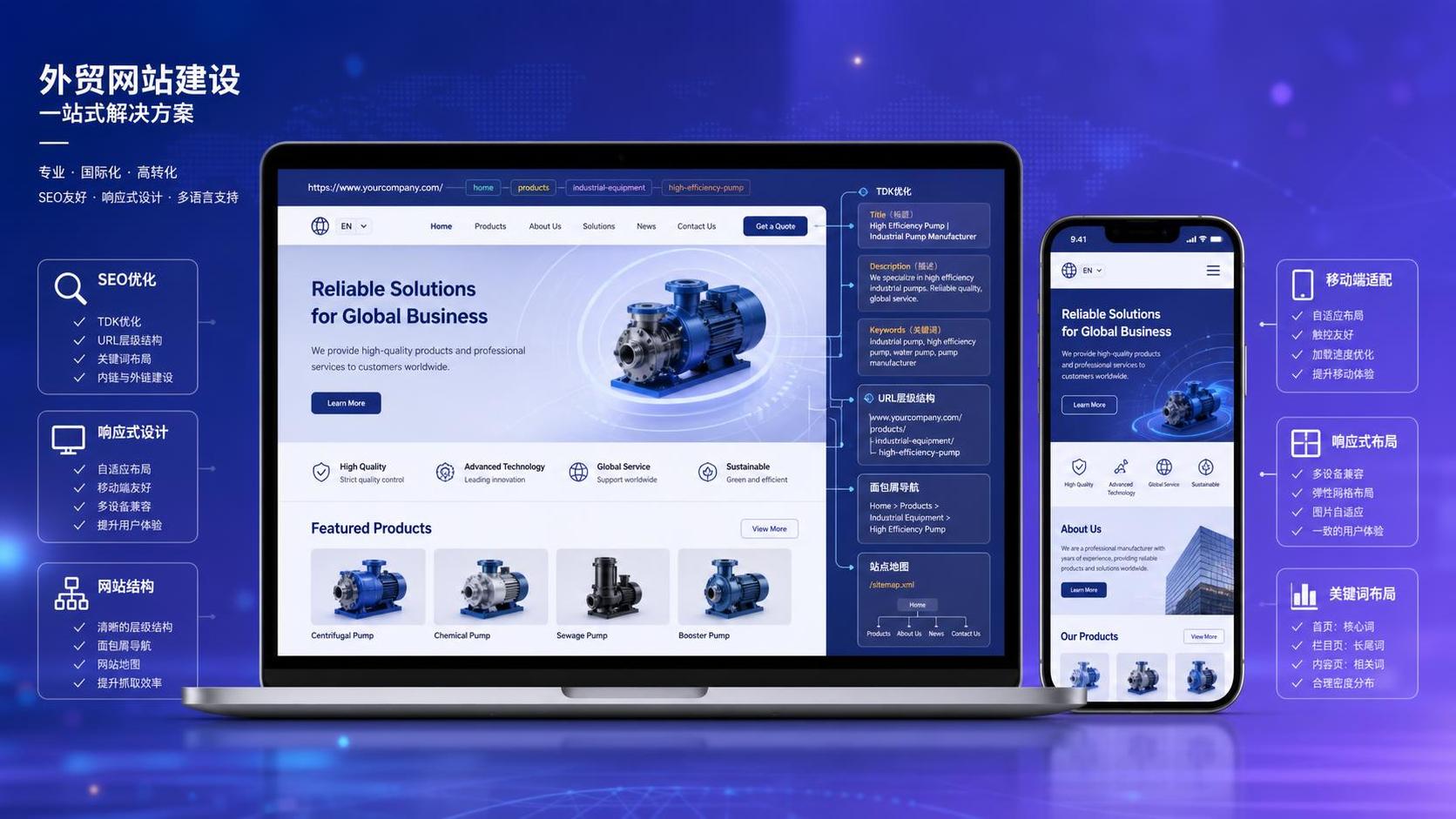
Keyword structure for an international trade website determines the quality of traffic entry points. This article breaks down practical role-division methods that operators can directly apply, from the homepage to category pages and product pages.
Many international trade websites do not lack keywords, but rather place keywords in the wrong positions. The homepage targets long-tail keywords, product pages stuff broad industry terms, and category pages lack transitional logic, resulting in scattered rankings, imprecise inquiries, and pages that are difficult to optimize continuously.
For execution teams, the core of keyword structure for an international trade website is not filling pages with keywords, but making different pages serve different search intents. The homepage addresses brand and core business awareness, category pages connect product directions, and product pages capture specific purchasing needs.
First determine which type of search intent the keyword belongs to

Before structuring, first divide keywords into three categories: brand and core business keywords, category and solution keywords, and specific product and specification keywords. This step is more important than writing titles, because it determines whether pages will compete with each other for traffic.
For example, “custom packaging supplier” is more suitable for the homepage or solution page, “paper box packaging” is suitable for a category page, and “kraft paper gift box with lid” is more suitable for a product page. The more specific the term, the closer it is to a purchasing action.
Operators can use a simple standard to judge: when users search for this term, do they want to learn about a supplier, compare a type of product, or are they already looking for a specific model? If the answer is different, the landing page cannot be the same.
Homepage: take on core business keywords, do not bear all ranking pressure
The homepage is suitable for brand terms, company core business terms, primary industry terms, and high-value commercial terms. Its task is to help search engines quickly understand what the company does, while also helping visitors build trust after entering the website.
The homepage title can be designed around “main product + supplier attribute + market positioning,” for example, “LED Lighting Manufacturer and Exporter”. Do not stuff a dozen product terms into the title, otherwise the theme will become blurred.
The homepage body content should highlight business scope, export experience, certification capabilities, service countries, and production or delivery advantages. Keywords can naturally appear in above-the-fold copy, core product modules, advantage modules, and the footer company profile.
It should be noted that the homepage is not suitable for optimizing overly specific model terms. Putting specific product terms on the homepage may seem to provide broader coverage in the short term, but in the long run it will weaken the ranking opportunities of category pages and product pages, causing internal keyword cannibalization within the site.
Category pages: take on category keywords, the key to stable traffic acquisition for international trade websites

Category pages are often underestimated, but they are usually the most stable entry point for organic traffic on an international trade website. During the early research stage, buyers often search for a type of product, material, application, or industry solution, rather than directly searching for a model.
Category page keywords should be developed around major product categories, application scenarios, materials, processes, functions, and industry needs. For example, a machinery website can build category entry points based on equipment type, application industry, and processing capability.
A qualified category page should not be just a product list. There should be a brief explanation at the top of the page, explaining what applications this type of product is suitable for, what parameter ranges it has, what customization options it supports, and guiding users to continue viewing specific products.
Category page titles are recommended to remain clear and not overly promotional. You can use the structure of “core category keyword + supplier or manufacturer + application scenario” so that both search engines and users can quickly judge the value of the page.
In terms of content structure, category pages can include FAQs, selection suggestions, application cases, and links to related categories. This content not only helps rankings, but also reduces bounce rates and helps users find the next page more quickly.
Product pages: target specific purchasing keywords, focus on clearly describing parameters and differences
Product pages are suitable for long-tail keywords, including product name, model, specification, material, size, use, certification, and customization requirements. The quality of international trade inquiries usually comes from these more specific terms that are closer to the purchasing stage.
Many product pages rank poorly because the page only has images, price buttons, and a few vague lines of description. Search engines cannot determine product differences, and buyers cannot see key parameters, so it is naturally difficult to generate effective inquiries.
Product pages should focus on clearly presenting product name, core selling points, parameter tables, application scenarios, packaging methods, minimum order quantity, lead time, customization capabilities, and certification information. Keywords should naturally appear around this real information.
If multiple products are very similar, do not copy the same paragraph of description. At the very least, differences should be created in specifications, uses, suitable scenarios, advantage descriptions, and FAQs, otherwise duplicate content is likely to occur and affect the overall indexing quality.
How to divide roles between pages and avoid keyword competition with each other
The most common problem in keyword structure is that multiple pages optimize for the same keyword at the same time. For example, the homepage, category page, and three or four product pages may all be competing for “plastic packaging manufacturer”, making it difficult for search engines to determine which one is most relevant.
The solution is to establish a keyword mapping table. Each core keyword should be assigned to only one primary landing page, while other pages only provide supporting mentions and point to the main page through internal links. This concentrates authority instead of dispersing ranking signals.
Internal link anchor text should also have a hierarchy. The homepage links to major category pages, category pages link to representative product pages, and product pages then link back to related category pages. This not only matches the user browsing path, but also aligns with search engine crawling logic.
During execution, you can follow the principle of “one page, one primary keyword, and two to five supporting keywords”. The primary keyword is used for the title, H tags, and core copy, while supporting keywords are used in descriptions, FAQs, image alt text, and natural paragraphs.
A structuring process that operators can directly follow
Step one, organize the keyword pool. Collect real English keywords actually used by buyers through frequently asked customer questions, competitor pages, Google search suggestions, ad keyword reports, and inquiry records.
Step two, group by intent. Divide keywords into homepage keywords, category page keywords, product page keywords, and content article keywords. Do not sort only by search volume; international trade websites should pay more attention to commercial intent and conversion potential.
Step three, create a page mapping table. The table should include at least keywords, target pages, search intent, page titles, internal link sources, and optimization status. This makes it less likely to duplicate structure when adding new pages later.
Step four, optimize page content. First revise the title, description, H tags, and first paragraph, then supplement product parameters, application information, FAQs, and internal links. Do not only change meta tags, otherwise the page’s main-body relevance will still be insufficient.
Step five, continue reviewing. Check rankings, click-through rates, inquiry sources, and page dwell performance every month. Optimize titles for pages that have impressions but no clicks, and optimize content and conversion entry points for pages that have traffic but no inquiries.
Common misunderstandings: these practices will reduce international trade SEO performance
First, blindly pursuing broad keywords. Broad industry keywords have high search volume, but strong competition and broad intent. Small and medium-sized international trade websites should first use category keywords and long-tail keywords to build stable traffic, and then gradually compete for core broad keywords.
Second, translating keywords with Chinese logic. The way overseas buyers express themselves is different from that in China. Keywords should refer to the real search habits of the target market, rather than directly mechanically translating Chinese product names into English.
Third, applying the same template to all product pages. Templates can unify the structure, but the content must reflect differences. In particular, parameters, applications, suitable scenarios, and customization descriptions should be written separately for each product.
Fourth, ignoring localized expression. Keyword structure for international trade websites is not only an SEO action, but also related to user understanding. When targeting Europe, Southeast Asia, or the Middle East, page wording, units, and certification expressions should all match local habits.
Conclusion: the essence of keyword structure is letting each page perform its own role
When keyword structure is done well for an international trade website, visitors will enter the right page through the right entry point. The homepage builds trust, category pages help comparison, and product pages drive inquiries. Only when the roles of the three are clearly divided can SEO results continue to accumulate.
For operators, the most practical method is to first determine search intent, then establish a keyword mapping table, and finally optimize content according to each page’s role. Do not pursue covering all keywords at once; instead, make sure every page has a clear task.
If a company hopes to improve the organic traffic and inquiry quality of its international trade website, it can start by reviewing existing pages: which keywords are placed on the wrong pages, which pages have no primary keywords, and which product pages lack specific searchable information.
EasyBiz has long served international trade enterprises in website building, SEO optimization, and global digital marketing. In practice, it has found that truly effective optimization is not keyword stuffing, but using data, structure, and localized content to accurately connect purchasing intent to pages.