









- The China-US tariff arrangement has reached a preliminary consensus, and the trade association will be establishedJun 15, 2026View details
- China-Morocco zero-tariff access, a breakthrough in the cost of Moroccan goods exports to ChinaJun 11, 2026View details
- What signal should be released for the suspension of exports to JapanJun 10, 2026View details
- China's May LNG imports rebounded, with increased volumes from Russia and Canada filling the Middle East supply gapJun 10, 2026View details
- Will GEO change its SEO strategy?Jun 04, 2026View details
- What types of businesses are end-to-end solutions suitable for?Jun 03, 2026View details
How should foreign trade website keyword layout be done to balance Google rankings and inquiry quality?
Foreign Trade Website Keyword Layout, First Solve the Problem of "Ranking in Front but No Inquiries"
How should foreign trade website keyword layout be done to both compete for Google rankings and improve inquiry quality? The key is not to pile up keywords, but to围绕 user search intent, product scenarios, and conversion paths, establish a clear and sustainable keyword system.
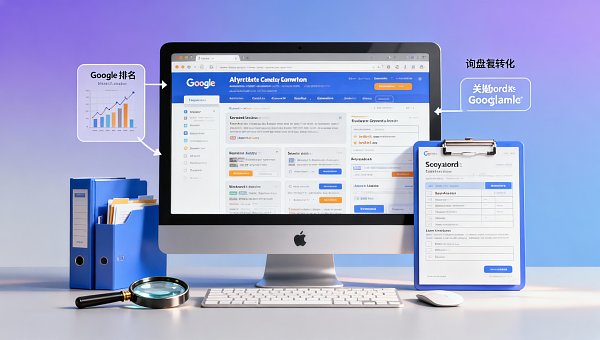
Many companies initially focus on high-search-volume terms, and as a result, traffic comes in but inquiries are few. The problem usually is not that the content is not enough, but that the foreign trade website keyword layout is not aligned with the real customer buying stage.
From recent changes, Google has higher requirements for page topic, content depth, and user satisfaction. A more obvious signal is that if keyword layout only considers indexing and does not consider conversion, the later optimization cost will become higher and higher.
Therefore, the truly effective approach is to treat keywords as a business path. The front end meets search demand, the middle builds trust, and the back end drives inquiry submission. This is the core value of foreign trade website keyword layout.
First build the framework: divide keywords into four layers
If you want to balance ranking and inquiries, the first step is not to write articles, but to first build the keyword library structure. A clear foreign trade website keyword layout is usually divided into at least four layers.
1. Core product terms
These terms determine the main business direction of the website and are usually used for the homepage, core product pages, and key landing pages. They have relatively higher search volume, but the competition is also stronger.
2. Long-tail demand terms
These terms are closer to procurement scenarios, such as specifications, materials, uses, regions, certifications, prices, and supply methods. The traffic brought by long-tail keywords is not necessarily large, but the inquiry quality is often higher.
3. Problem-solving terms
These terms are suitable for blogs, knowledge pages, and solution pages. Users have not fully decided to purchase yet, but they already have a clear problem. At this time, doing a good job of content connection can pave the way for subsequent conversion.
4. Decision-comparison terms
For example, "which supplier is more suitable", "how to choose a solution", "how to control costs". These terms are often in the final stage and are very suitable for placement on solution pages or topic pages.
If these four layers are not separated, the foreign trade website keyword layout will easily become chaotic. The homepage competes for blog terms, the blog then goes to compete for product terms, and in the end each page is not focused enough.
Distribute keywords by page to avoid internal competition
After the keywords are selected, the next step is page assignment. This step is very critical, because Google ranking does not only look at the words, but also whether the page has taken on the correct topic task.
- Homepage: takes on brand terms, core business terms, and regional main terms.
- Product category pages: take on product category terms and series terms.
- Product detail pages: take on model terms, specification terms, and parameter terms.
- Solution pages: take on industry scenario terms and application demand terms.
- Blog articles: take on problem terms, tutorial terms, and comparison terms.
A simple example: if a page mainly targets "industrial equipment supplier", then it should not simultaneously force coverage of "equipment installation tutorial", "purchase notes", and "after-sales problem guide". Too many words dilute the page theme.
In actual business, many corporate websites have not seen obvious improvements in optimization for a long time because the foreign trade website keyword layout has not formed a logic of "one page, one topic". Pages compete with each other for keywords, and authority is naturally dispersed.
Build around search intent, and inquiry quality will be more stable
The same keyword may look relevant, but the search intent behind it can be completely different. If the foreign trade website keyword layout ignores this point, even if rankings are achieved, conversion will still be difficult to idealize.
This also means that keywords are not better the more popular they are, but better the more they match. Words that can bring transaction opportunities usually have clearer scenario restrictions and selection tendencies.
For example, the searches commonly seen by manufacturing customers often include materials, processes, standards, export countries, and certification requirements. Such words may not necessarily bring large traffic, but they are more likely to bring visits with real purchasing intent.
How content should be written to make keyword layout more natural
Keyword layout is not about stuffing words into paragraphs, but about letting words naturally appear in the problems users truly care about. Doing this is beneficial both for Google to understand the page topic and for reading.
- Put core words in the title, but they should be accompanied by a question or result direction.
- Clearly state the topic in the first paragraph and quickly answer user questions.
- Use subheadings to cover synonyms, scenario terms, and application terms.
- Add parameters, cases, processes, and risk points in the body text.
- Add action guidance at the end, and do not just shout "Contact us".
If the website itself承担 website building, SEO, advertising, and content coordination tasks, then the keyword layout should be incorporated into system design from the very beginning. A platform like 易营宝, which integrates website building and marketing, will consider website structure, content layering, multilingual optimization, and conversion paths together, reducing repeated rework later.
What is interesting is that this idea of "building the structure first and then doing the content" is also common in other professional content systems. For example, when some topic pages organize complex themes, they also emphasize the framework first, such asProblems and Countermeasures in Enterprise Group Consolidated Financial Statements这种标题, which in essence also focuses on the problem first and then expands the countermeasures, with a very clear logic.
Common misconceptions in foreign trade website keyword layout
Many websites rank slowly not because they are not updated, but because their direction is wrong. The following problems are the most common.
Only look at tools for keywords, not the business
High search volume does not equal suitability for you. A truly valuable foreign trade website keyword layout must combine product profit, delivery capability, and target market.
Put too many target keywords on one page
Once the page topic is diluted, Google will find it difficult to judge which word you actually want to rank for. The result is that several words are touched on, but none can rank well.
Have traffic, but no conversion design
No matter how much content there is, if there are no sample downloads, form guidance, case support, and trust elements, inquiries will not naturally happen.
Ignore multilingual and regional differences
Search expressions in North America, Europe, the Middle East, and Southeast Asia are not completely the same. Foreign trade website keyword layout must consider regional habits and cannot be simply translated literally.
A practical execution process
If you want to get started quickly, you can directly follow the sequence below, and the efficiency will be higher.
- First sort out the product line, application industries, export regions, and high-profit categories.
- Then build the four-layer keyword library of core terms, long-tail terms, problem terms, and decision terms.
- Assign each type of keyword to the corresponding page to avoid repeated competition.
- Supplement content according to the purchasing path, especially the solution pages and case pages.
- Regularly review rankings, click-through rate, dwell time, and inquiry sources.
- Eliminate low-quality words every month and add high-conversion long-tail terms.
When the website architecture, SEO content, and conversion components can advance in sync, the effect of foreign trade website keyword layout will be more stable. Especially for companies that hope to achieve long-term Google organic traffic, this method is more reliable than simply chasing hot spots.
In the final analysis, foreign trade website keyword layout is not a one-time action, but a continuous calibration process. First let each page bear a clear task, then let each keyword truly serve inquiries, and only then can rankings and conversions improve together.
If you are planning a new independent website, you may wish to start first from keyword layering, page division of labor, and search intent mapping. Make these three steps solid, and the later content production, SEO optimization, and inquiry growth will usually go much more smoothly.
Related Articles

Related Products
 EasyCamp SaaS Smart Website Marketing SystemE-Yingbao SaaS Smart Website Marketing System: AI-powered, zero-code website building. Rapidly launch multilingual independent e-commerce sites in just 10 minutes. Global server acceleration and AI-driven SEO optimization empower businesses to efficiently connect with global markets. The seamless integration of technology and user-friendly operation makes building e-commerce sites incredibly simple.
 AI+SEM Intelligent Advertising Marketing SystemAI+SEM drives intelligent ad creation, empowering full-funnel precision advertising marketing. The system automatically generates weekly/monthly reports, AI recommends keywords and target countries, monitors core metrics in real-time with intelligent alerts, and enables one-click high-conversion ad solutions to help quickly acquire customers and improve ROI.
 AI+SEO Dual Engine Optimization ServiceEasyWin AI+SEO Dual Engine Optimization System leverages AI-powered keyword mining, content generation, and comprehensive technical optimization to help foreign trade enterprises acquire high-quality organic traffic, significantly improving search rankings and conversion rates.
 AI+SNS Social Media Marketing SystemYingbao AI+SNS Social Media Marketing System - Precision social capture for the social media era. Supports one-click content synchronization across major platforms like Facebook and LinkedIn. AI intelligently rewrites posts for enhanced relevance. 24/7 AI customer service and user profiling analysis empower businesses to efficiently expand into global markets.
 AI+SEO营销解决方案易营宝AI+SEO营销解决方案,通过AI批量写作、智能生成TDK、精准关键词扩词等功能,全面优化网站SEO效果,提升流量与转化率。助力企业构建高效智能网站新生态。
 AI+SEM Advertising Marketing SolutionsAI+SEM Advertising Marketing Solution leverages AI technology to deeply empower SEM ad campaigns. It automatically generates weekly/monthly reports using AI, presenting account data across multiple dimensions for comprehensive insights into campaign performance and trends. The system precisely recommends keywords and target countries, intelligently generates high-conversion ad copy, and enables one-click activation of efficient campaign plans to help businesses rapidly acquire customers. Simultaneously, it monitors core metrics in real time, intelligently identifies abnormal fluctuations, and issues timely alerts to ensure stable, high-return advertising results.
 Domain Name ServicesEasyWin provides professional domain name services, including intelligent queries, one-stop registration, brand protection, and full lifecycle management, helping businesses build a digital brand image.
 EasyOperate B2C Cross-Border E-Commerce Platform & Independent WebsiteEasyStore B2C Cross-border E-commerce Independent Store is an intelligent website building and cross-border e-commerce integrated solution independently developed by EasyStore Information Technology (Beijing) Co., Ltd. The system is specially designed for small and medium-sized as well as large export enterprises, integrating 'website building, operation, marketing, advertising, and conversion' into one, helping enterprises quickly establish cross-border e-commerce independent stores to achieve brand globalization and global sales growth.
The platform supports multiple languages, multiple currencies, and multi-channel marketing, with built-in AI intelligent translation and SEO optimization systems, suitable for mainstream markets such as Southeast Asia, Europe and America, Latin America, and the Middle East, assisting Chinese manufacturing enterprises in efficiently deploying international e-commerce strategies. SSL证书易营宝提供专业SSL安全证书服务,包括单域名和泛域名证书,确保网站数据传输加密、身份验证和完整性保护,助力企业建立安全可信的在线业务环境。









