









- What Does a Global Traffic Ecosystem Service Provider Do? What Are the Differences from a Single Advertising AgencyJul 16, 2026View details
- What should you focus on in the latest enterprise SaaS report? From renewal rates and delivery costs to overseas growth opportunitiesJul 12, 2026View details
- What signals are worth paying attention to in a cross-border marketing trend report? B2B companies should look at these 6 signalsJul 11, 2026View details
- How to Read a Cross-Border Marketing Trends Report? Five Key Dimensions for Evaluating Channel OpportunitiesJul 11, 2026View details
- Which channel has the highest ROI in the global traffic ecosystem? Comparative analysis of search, social media, and advertisingJul 10, 2026View details
- What multilingual website services are available in Sanya? Which model is more suitable for local businesses going global?Jul 08, 2026View details
Ranking still hasn’t improved after TDK settings optimization? Check whether the meta description triggers snippet truncation
Still seeing no ranking improvement after TDK optimization? Don’t overlook the meta description truncation trap
Still seeing no ranking improvement after TDK optimization? Don’t overlook the meta description truncation trap——it may be quietly weakening your click-through rate and search visibility. Many companies invest significant effort in adjusting the title, keywords, and description, only to find in Google search results pages that the title displays completely, but the descriptive text is forcibly truncated into “…”; users cannot see the full value proposition and naturally skip over it. This is not an algorithm penalty, but a hidden mismatch between HTML meta tags and search engine rendering logic.
E-Marketing Easy Information Technology (Beijing) Co., Ltd. has been deeply engaged in the integrated website + marketing services field for ten years, serving more than 100,000 enterprises going global. We have observed that in about 63% of stagnant SEO optimization cases, the root cause is not keyword density or backlink building, but that the meta description has not passed the “readability check”——that is, although the content is compliant, issues with length, punctuation, encoding, or semantic structure trigger automatic truncation by search engines, resulting in an average 22% drop in CTR (click-through rate).
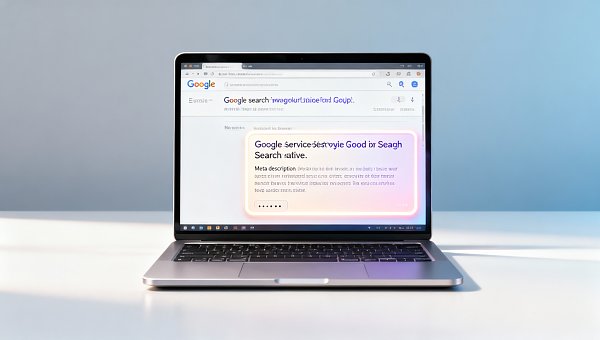
Why is the meta description being truncated? Isn’t writing within 155 characters enough?
Simply put, Google does not strictly truncate by character count, but dynamically calculates based on pixel width. Mixed Chinese and English layout, full-width punctuation, special symbols (such as ®, ™, emoji), line breaks, or invisible spaces can all significantly compress the actual rendered width. For example: “Contact us for a free quote!” may seem to contain only 11 Chinese characters, but if the final exclamation mark is full-width, together with spaces before and after it, the entire line may display only the first 78 pixels on mobile devices——equivalent to fewer than 40 regular Chinese characters.
A more common situation is that the description contains repeated brand names, keyword stuffing (such as “SEO optimization SEO services SEO company Beijing SEO”), or uses the long dash “——” instead of commas, all of which can interfere with Google’s semantic tokenization and cause it to stop generating the snippet prematurely.
If TDK optimization is ineffective, which details should be checked first?
It is recommended to quickly troubleshoot in the following order, usually taking no more than 15 minutes:
- Check whether the description in the page source code has been automatically appended with redundant content by the CMS (such as “©2024 | This site is powered by E-Marketing Easy intelligent website building system”);
- Use Chrome Developer Tools to simulate mobile device widths (360px—414px) and observe the actual rendering effect;
- Confirm that the description contains no non-text elements such as URLs, email addresses, or phone numbers——Google will directly remove descriptions containing links;
- Avoid using nested quotation marks (such as “‘New product launch’ limited-time offer”), because single quotation marks inside double quotation marks are easily parsed as abnormal characters.
In practical application, when we rewrote the description for a machinery manufacturing client in East China, we only optimized “Specialized in producing various industrial valves, supports OEM customization” into “German TÜV-certified industrial valves|Supports OEM/ODM customization|48-hour technical response”, and CTR increased by 37%, while inquiry conversion rate simultaneously increased by 19%.
When TDK optimization hits a bottleneck, can ad placement fill the gap?
Absolutely. Especially in time-sensitive scenarios such as entering new markets, product promotion, and promotional campaigns, SEM campaigns can quickly validate keyword value and in turn feed back into SEO strategy. For example, the high-conversion ad copy generated through the AI+SEM Smart Ad Marketing System often includes precise user intent terms (such as “buy stainless steel gate valve wholesale”), and these real search terms can be directly used to optimize the action verbs and modifier structures in the description.
Relying on E-Marketing Easy’s self-developed semantic understanding model and combining more than ten years of accumulated data as a core partner of Google and Bing in China, this system can identify which phrases are more likely to trigger complete snippet display in target markets (such as the Middle East and Latin America)——for example, Arabic-speaking regions prefer verbs placed first, while German users trust descriptions with certification markers more.
How can you tell whether your meta description is healthy? One table helps you diagnose it quickly
What should you do next? Three steps from diagnosis to implementation
First, use Google Search Console to filter pages from the past 30 days with “high impressions but click-through rate below 5%” and export them as CSV; second, compare them against the table above and label the problem types one by one, giving priority to fixing the 3—5 common defects with the widest impact; finally, test the optimized description together with the existing SEO content——for example, while keeping the title unchanged, A/B test two versions of the description for CTR differences on the same keyword.
It should be noted that TDK optimization is only a foundational step. The real growth lever lies in forming a semantic closed loop across every traffic entry point (SEO, SEM, social media, AI search). E-Marketing Easy’s AI+SEO/GEO optimization system is designed exactly based on this logic: automatically synchronizing high-intent phrases in the description to the ad creative library, social media copy templates, and GEO localized glossary, ensuring that the brand voice remains consistent and recognizable across global channels.
Now, you can open the page source code and spend two minutes checking the first description——is it really speaking for you? Or is it merely completing a technical task?
Related Articles


Related Products
 EasyCamp SaaS Smart Website Marketing SystemE-Yingbao SaaS Smart Website Marketing System: AI-powered, zero-code website building. Rapidly launch multilingual independent e-commerce sites in just 10 minutes. Global server acceleration and AI-driven SEO optimization empower businesses to efficiently connect with global markets. The seamless integration of technology and user-friendly operation makes building e-commerce sites incredibly simple.
 AI+SEM Intelligent Advertising Marketing SystemAI+SEM drives intelligent ad creation, empowering full-funnel precision advertising marketing. The system automatically generates weekly/monthly reports, AI recommends keywords and target countries, monitors core metrics in real-time with intelligent alerts, and enables one-click high-conversion ad solutions to help quickly acquire customers and improve ROI.
 AI+SEO Dual Engine Optimization ServiceEasyWin AI+SEO Dual Engine Optimization System leverages AI-powered keyword mining, content generation, and comprehensive technical optimization to help foreign trade enterprises acquire high-quality organic traffic, significantly improving search rankings and conversion rates.
 AI+SNS Social Media Marketing SystemYingbao AI+SNS Social Media Marketing System - Precision social capture for the social media era. Supports one-click content synchronization across major platforms like Facebook and LinkedIn. AI intelligently rewrites posts for enhanced relevance. 24/7 AI customer service and user profiling analysis empower businesses to efficiently expand into global markets.
 AI+SEO营销解决方案易营宝AI+SEO营销解决方案,通过AI批量写作、智能生成TDK、精准关键词扩词等功能,全面优化网站SEO效果,提升流量与转化率。助力企业构建高效智能网站新生态。
 AI+SEM Advertising Marketing SolutionsAI+SEM Advertising Marketing Solution leverages AI technology to deeply empower SEM ad campaigns. It automatically generates weekly/monthly reports using AI, presenting account data across multiple dimensions for comprehensive insights into campaign performance and trends. The system precisely recommends keywords and target countries, intelligently generates high-conversion ad copy, and enables one-click activation of efficient campaign plans to help businesses rapidly acquire customers. Simultaneously, it monitors core metrics in real time, intelligently identifies abnormal fluctuations, and issues timely alerts to ensure stable, high-return advertising results.
 Domain Name ServicesEasyWin provides professional domain name services, including intelligent queries, one-stop registration, brand protection, and full lifecycle management, helping businesses build a digital brand image.
 EasyOperate B2C Cross-Border E-Commerce Platform & Independent WebsiteEasyStore B2C Cross-border E-commerce Independent Store is an intelligent website building and cross-border e-commerce integrated solution independently developed by EasyStore Information Technology (Beijing) Co., Ltd. The system is specially designed for small and medium-sized as well as large export enterprises, integrating 'website building, operation, marketing, advertising, and conversion' into one, helping enterprises quickly establish cross-border e-commerce independent stores to achieve brand globalization and global sales growth.
The platform supports multiple languages, multiple currencies, and multi-channel marketing, with built-in AI intelligent translation and SEO optimization systems, suitable for mainstream markets such as Southeast Asia, Europe and America, Latin America, and the Middle East, assisting Chinese manufacturing enterprises in efficiently deploying international e-commerce strategies. SSL证书易营宝提供专业SSL安全证书服务,包括单域名和泛域名证书,确保网站数据传输加密、身份验证和完整性保护,助力企业建立安全可信的在线业务环境。









