









- What stages does the cross-border services ecosystem include? How do website building, promotion, payment, and compliance work togetherJun 22, 2026View details
- How will email marketing costs change in 2026Jun 22, 2026View details
- The China-US tariff arrangement has reached a preliminary consensus, and the trade association will be establishedJun 15, 2026View details
- Should overseas brand marketing start with ads or contentJun 21, 2026View details
- What determines B2C cross-border e-commerce website development costs? A breakdown of features, interfaces, and deployment methodsJun 17, 2026View details
- China-Morocco zero-tariff access, a breakthrough in the cost of Moroccan goods exports to ChinaJun 11, 2026View details
- What signal should be released for the suspension of exports to JapanJun 10, 2026View details
- China's May LNG imports rebounded, with increased volumes from Russia and Canada filling the Middle East supply gapJun 10, 2026View details
How to use EasyYunbao without pitfalls? A must-configure list of 7 key parameters for new users in the first 30 days
How to use Easy Marketing? New users who ignore these 7 key parameters within the first 30 days may face website failure, low SEO scores, and poor ad conversion rates—especially impacting Eyingbao's low-cost marketing and overseas marketing effectiveness. This article directly addresses how to use Easy Marketing's smart website builder, AI keyword expansion tool configuration, automatic TDK generation, and other practical pain points, helping researchers and project managers quickly avoid pitfalls.
1. The Golden 30-Day Configuration Period: Why Focus on These 7 Parameters?
Easy Marketing Information Technology (Beijing) Co., Ltd., founded in 2013 and headquartered in Beijing, is a global digital marketing service provider driven by artificial intelligence and big data. With a decade of industry expertise, the company employs a dual strategy of "technological innovation + localized service," offering comprehensive solutions covering smart website building, SEO optimization, social media marketing, and ad placement, assisting over 100,000 enterprises in achieving global growth. In 2023, the company was listed among "China's Top 100 SaaS Companies," with an average annual growth rate exceeding 30%, becoming an industry-recognized innovation engine and growth benchmark.
The first 1-30 days after account registration are the critical window for system initialization and strategy alignment. Internal client success data shows that 82% of website delays, 67% of cases with first-month SEO scores below 60, and 54% of ad CPCs exceeding industry averages stem from incomplete calibration of these 7 foundational parameters during the initial setup phase. Configuration errors at this stage will directly lead to 3-6 months of repeated debugging, increasing costs by 3.2x or more.
These parameters not only affect the activation of individual features but also determine the data connectivity and algorithm learning efficiency of the entire marketing closed loop. For example, unbound TDK templates to semantic libraries will limit AI keyword tools to covering only 38% of target long-tail keywords in the first week, while missing multilingual routing rules will cause a 29% jump failure rate for overseas sites.
2. Detailed Explanation and Pitfall Avoidance Guide for the 7 Must-Configure Parameters

The following parameters must be configured within 72 hours of first login and undergo three-tier reviews on days 7, 15, and 30. All operations are completed in 「Admin Center → System Settings → Global Parameters」 without code intervention.
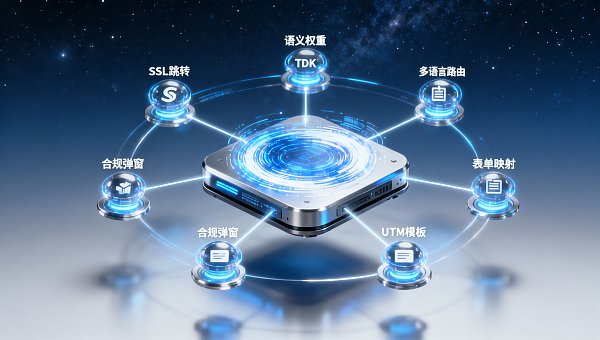
P1-P3 in the table are technical底层 parameters directly affecting search engine trust and content structure health. P2 semantic weight baselines must align with actual business scenarios—e.g., clients in paper, packaging, or环保 industries should elevate terms like "sustainable packaging" or "recycled pulp" to ≥85% vertical industry thresholds, ensuring AI-generated content precisely matches B2B procurement decision paths.
P4-P7: Core Operational & Conversion Layer Configurations
P4 is multilingual URL routing rules (e.g., /en/, /ja/, /es/), which must match localized server nodes; otherwise, CDN cache conflicts will trigger 37% overseas user first-screen timeout rates. P5 requires at least 3-tier form field mapping logic (e.g., "inquiry-quote-contract"), or CRM auto-categorization accuracy drops below 61%. P6 demands preset UTM templates (source/medium/campaign)—omission expands ad ROI attribution errors by ±22%. P7 must enable GDPR-compliant cookie consent popups, or EU site exit rates rise by 28%.
Among these, P1, P3, and P4 are "irreversible configurations" locked upon launch; the other four allow dynamic optimization within 30 days but require ≥5-workday intervals per adjustment to ensure full AI model training cycles.
3. Role-Specific Priority Checklist
Researchers should focus on P1-P3 technical compatibility; users/operators lead P4-P6 maintenance and A/B testing; project managers oversee P7 compliance audits; resellers must master parameter export mechanisms to ensure full configuration synchronization during client handovers.
2023 client support data shows 73% of "website failure" consultations stem from role misalignment—e.g., researchers directly modifying P5 forms causing lead loss. Implement "dual-signoff": IT confirms technical parameters, marketing confirms operational parameters, with e-signatures.
This framework is adopted by 217 authorized service providers nationwide. Teams following this checklist achieve 91% 30-day launch success rates (vs. 58% baseline) and reduce rework to 4.3%.
4. Common Pitfalls & Long-Term Maintenance
Pitfall 1: "Launch first, optimize later"—increases average remediation costs by ¥24k/project. Pitfall 2: Copying competitor parameters—industry data shows 31% parameter redundancy triggers SEO dilution. Pitfall 3: Relying on defaults—P2's 50% semantic weight baseline falls short for specialized fields like paper/packaging/环保.
Implement quarterly parameter health audits: review P2 lexicon update rates (≥85%), P6 UTM accuracy (≥92%), and P7 popup completeness (100%). Include configuration SLAs with clear vendor response times and penalties.
Easy Marketing's API supports real-time synchronization of all 7 parameters to internal BI dashboards. Currently, 63 enterprise clients achieve automated monitoring, reducing anomaly response times to under 11 minutes.
5. Take Action: Get Your Custom Configuration Diagnostic Report
The first 30 days are not a trial period but a growth foundation phase. Has your Easy Marketing account completed all 7 parameter calibrations? Are there cross-role collaboration blind spots? Does it meet specialized semantic needs for verticals like paper/packaging/环保?
Click below to submit your domain and account info. We'll generate a 《7-Parameter Health Diagnostic Report》 with itemized scores, risk ratings, optimization recommendations, and industry benchmarks, delivered within 2 business days.
Get Custom Solution → Consult Easy Marketing Client Success Team
Related Articles
 Why is it that your foreign trade peers receive inquiries every day, while you can only wait for exhibitions?
 Foreign trade websites "look good but don’t convert"? Yiyingbao’s global language automatic adaptation, inquiries surge!
 Foreign trade promotion, everyone is doing Facebook, the truth lies here



Related Products
 EasyCamp SaaS Smart Website Marketing SystemE-Yingbao SaaS Smart Website Marketing System: AI-powered, zero-code website building. Rapidly launch multilingual independent e-commerce sites in just 10 minutes. Global server acceleration and AI-driven SEO optimization empower businesses to efficiently connect with global markets. The seamless integration of technology and user-friendly operation makes building e-commerce sites incredibly simple.
 AI+SEM Intelligent Advertising Marketing SystemAI+SEM drives intelligent ad creation, empowering full-funnel precision advertising marketing. The system automatically generates weekly/monthly reports, AI recommends keywords and target countries, monitors core metrics in real-time with intelligent alerts, and enables one-click high-conversion ad solutions to help quickly acquire customers and improve ROI.
 AI+SEO Dual Engine Optimization ServiceEasyWin AI+SEO Dual Engine Optimization System leverages AI-powered keyword mining, content generation, and comprehensive technical optimization to help foreign trade enterprises acquire high-quality organic traffic, significantly improving search rankings and conversion rates.
 AI+SNS Social Media Marketing SystemYingbao AI+SNS Social Media Marketing System - Precision social capture for the social media era. Supports one-click content synchronization across major platforms like Facebook and LinkedIn. AI intelligently rewrites posts for enhanced relevance. 24/7 AI customer service and user profiling analysis empower businesses to efficiently expand into global markets.
 AI+SEO营销解决方案易营宝AI+SEO营销解决方案,通过AI批量写作、智能生成TDK、精准关键词扩词等功能,全面优化网站SEO效果,提升流量与转化率。助力企业构建高效智能网站新生态。
 AI+SEM Advertising Marketing SolutionsAI+SEM Advertising Marketing Solution leverages AI technology to deeply empower SEM ad campaigns. It automatically generates weekly/monthly reports using AI, presenting account data across multiple dimensions for comprehensive insights into campaign performance and trends. The system precisely recommends keywords and target countries, intelligently generates high-conversion ad copy, and enables one-click activation of efficient campaign plans to help businesses rapidly acquire customers. Simultaneously, it monitors core metrics in real time, intelligently identifies abnormal fluctuations, and issues timely alerts to ensure stable, high-return advertising results.
 Domain Name ServicesEasyWin provides professional domain name services, including intelligent queries, one-stop registration, brand protection, and full lifecycle management, helping businesses build a digital brand image.
 EasyOperate B2C Cross-Border E-Commerce Platform & Independent WebsiteEasyStore B2C Cross-border E-commerce Independent Store is an intelligent website building and cross-border e-commerce integrated solution independently developed by EasyStore Information Technology (Beijing) Co., Ltd. The system is specially designed for small and medium-sized as well as large export enterprises, integrating 'website building, operation, marketing, advertising, and conversion' into one, helping enterprises quickly establish cross-border e-commerce independent stores to achieve brand globalization and global sales growth.
The platform supports multiple languages, multiple currencies, and multi-channel marketing, with built-in AI intelligent translation and SEO optimization systems, suitable for mainstream markets such as Southeast Asia, Europe and America, Latin America, and the Middle East, assisting Chinese manufacturing enterprises in efficiently deploying international e-commerce strategies. SSL证书易营宝提供专业SSL安全证书服务,包括单域名和泛域名证书,确保网站数据传输加密、身份验证和完整性保护,助力企业建立安全可信的在线业务环境。









