









- What should you focus on in the latest enterprise SaaS report? From renewal rates and delivery costs to overseas growth opportunitiesJul 12, 2026View details
- What signals are worth paying attention to in a cross-border marketing trend report? B2B companies should look at these 6 signalsJul 11, 2026View details
- How to Read a Cross-Border Marketing Trends Report? Five Key Dimensions for Evaluating Channel OpportunitiesJul 11, 2026View details
- Which channel has the highest ROI in the global traffic ecosystem? Comparative analysis of search, social media, and advertisingJul 10, 2026View details
- What multilingual website services are available in Sanya? Which model is more suitable for local businesses going global?Jul 08, 2026View details
- How to view the complete list of China SaaS companies in the top 100? Practical methods for screening website-building and marketing service providersJul 08, 2026View details
- How to view pricing in the global traffic ecosystem? Cost comparison of search, social media, and content channel advertisingJul 06, 2026View details
- How to assess foreign trade website development trends?Looking at 2026 changes from multilingual,AI content to conversion pathsJul 04, 2026View details
How to Negotiate the Price of a Responsive Corporate Website Building System
The pricing of responsive enterprise website building systems is shifting from "website quote" to "growth investment"
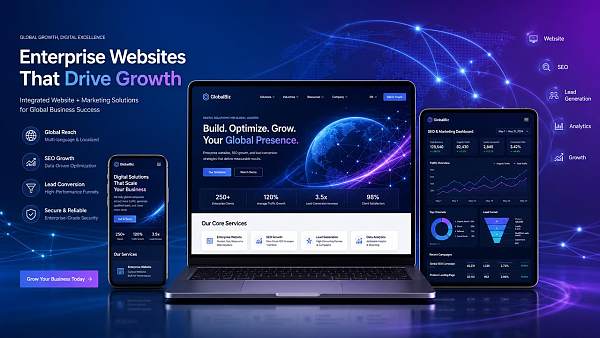
When discussing the pricing of responsive enterprise website building systems, you cannot focus only on the homepage quotation sheet. What truly influences decision-making are often the functional boundaries, delivery efficiency, follow-up operational support, and whether it can bring sustained value to customer acquisition and conversion.
Under the integrated trend of website + marketing services, a corporate website is no longer just a display window, but a core hub for traffic acquisition, brand building, lead management, and data analysis. Therefore, the pricing of responsive enterprise website building systems is also gradually evolving from a one-time cost into a long-term operational investment.
Yiyingbao Information Technology (Beijing) Co., Ltd. has long been deeply engaged in coordinated services covering intelligent website building, SEO optimization, social media marketing, and advertising placement. With artificial intelligence and big data at its core, the company focuses more on "whether sustainable growth can be achieved after launch," which is also an important criterion for judging whether current website building pricing is reasonable.
Behind pricing changes, the market is sending three clear signals
In the past, discussions about the pricing of responsive enterprise website building systems were mainly based on the number of pages, design style, and development cycle. Today, the variables affecting quotations have clearly increased, and the pricing structure has become more complex as well.
First, competition for search traffic is intensifying. A website that merely "can be opened" is no longer enough to support customer acquisition goals. Page structure, loading speed, mobile adaptation, and basic SEO capabilities all directly affect the level of website building investment.
Second, content and data requirements are increasing. More and more websites require form tracking, visitor analysis, lead distribution, and coordination with advertising landing pages, which means the pricing of responsive enterprise website building systems is no longer just a template fee.
Third, service standards are becoming layered. Even for the same website building project, differences among service providers in planning, design, SEO deployment, content support, and operation and maintenance responsiveness will directly widen the price range.
Core factors driving changes in the pricing of responsive enterprise website building systems
- Technical factors: continuous upgrades in responsive frameworks, page performance optimization, security protection, and backend scalability.
- Marketing factors: basic SEO setup, conversion path design, content layout, and data tracking have become standard configurations.
- Service factors: shifting from website delivery to a combined service model of "website building + operations + promotion".
- Management factors: cross-department collaboration is increasing, and the official website needs to connect with sales leads, customer management, and the brand system.
- Competitive factors: low-cost template websites exist in large numbers, but high-quality websites place greater emphasis on sustainable customer acquisition capabilities.
When discussing the pricing of responsive enterprise website building systems, the impact felt at different business stages is not the same
If the website mainly serves brand presentation, the pricing judgment will focus more on visual consistency, content architecture, and mobile experience. Such projects are more likely to show "large quotation differences" because design depth and copywriting strategy often determine the upper limit of value.
If the website is responsible for promotional conversion tasks, then the pricing of responsive enterprise website building systems must be evaluated in combination with customer acquisition goals. The number of landing pages, keyword layout, consultation entry points, form design, and data tracking capabilities will all change the final budget.
If the website requires long-term operations, later-stage maintenance cannot be ignored. A project that appears inexpensive may actually have a higher total cost if every subsequent change is charged separately. Price negotiations should not focus only on the initial order amount, but also on the full-year investment structure.
This logic is similar to that of many digitalization projects. For example, when studying Research on the Industry-Finance Integration Strategy for Full Life Cycle Management of Fixed Assets in Universities, it can also be found that a single-point procurement price does not equal overall efficiency, and system collaboration and continuous management are more critical.
What truly affects negotiation outcomes is not price cutting, but first clarifying these five key points
1. Clarify the budget boundaries first
Budget boundaries determine negotiation space. Without a clear upper limit and phased goals, it is easy to lose control amid added functions, and also easy to be attracted by a low price only to have costs raised later through additional items.
2. Define required functions and optional functions clearly
Dividing functions into "required for launch" "phase optimization" and "future expansion" helps reduce initial investment. In this way, when negotiating the pricing of responsive enterprise website building systems, it becomes easier to secure a reasonable solution instead of being sold a bundled package.
3. Put service content into the quotation
If the quotation only includes a total price, without design rounds, delivery cycle, number of revisions, launch training, and after-sales duration, there will be many disputes later. Price can be negotiated, but service boundaries must be clarified even more clearly.
4. Use marketing results to assess price reasonableness in reverse
If a website can improve indexing, reduce bounce rate, and increase inquiries, its price is usually more worth accepting. When judging the pricing of responsive enterprise website building systems, it is better to look more at the conversion path rather than only at construction costs.
5. Pay attention to sustainable later-stage operations
A website going online is only the beginning. Content updates, new topic pages, SEO adjustments, and event page creation all require ongoing support. Whether operations can be carried out conveniently will directly affect long-term cost performance.
For subsequent evaluation, it is recommended to use this method to assess whether the price is worthwhile
- First compare the structure: check whether the quotation is broken down into modules such as design, development, content, SEO, and maintenance.
- Then compare capabilities: check whether there is real integrated experience in website + marketing services.
- Then compare cases: focus on projects in the same industry, especially mobile experience and conversion performance.
- Then compare services: confirm whether post-launch support is provided, rather than ending at delivery.
- Finally compare total cost: calculate domain name, server, certificate, maintenance, and redesign costs together.
Looking ahead to the next step, this is a more worthwhile way to discuss the pricing of responsive enterprise website building systems
From a trend perspective, the pricing of responsive enterprise website building systems will continue to differentiate. Basic template websites will become cheaper, but websites that can support marketing, accumulate data, and drive brand growth will remain steadily in the value-oriented price range.
Therefore, when discussing price, it is better to center the conversation around three outcomes: whether the website can go online faster, whether it is easier to operate, and whether it is more helpful for acquiring leads. As long as these three outcomes are clear, it becomes much easier to judge whether a quotation is high or low.
For enterprises hoping to balance website building and growth, choosing a service team with coordinated capabilities in technology, content, SEO, and promotion is often more meaningful than simply pushing down the pricing of responsive enterprise website building systems. When necessary, you can also draw on the systematic perspective of Research on the Industry-Finance Integration Strategy for Full Life Cycle Management of Fixed Assets in Universities, first looking at overall efficiency, and then at individual costs.
If you are currently advancing an official website upgrade or planning a new website, it is recommended to first list target keywords, core pages, conversion paths, and maintenance expectations, and then move into quotation discussions. The pricing of responsive enterprise website building systems negotiated in this way will be closer to truly high cost performance.
Related Articles
 What should we do first for overseas promotion of a factory?
 What should you focus on in the latest enterprise SaaS report? From renewal rates and delivery costs to overseas growth opportunities
 What signals are worth paying attention to in a cross-border marketing trend report? B2B companies should look at these 6 signals



Related Products
 EasyCamp SaaS Smart Website Marketing SystemE-Yingbao SaaS Smart Website Marketing System: AI-powered, zero-code website building. Rapidly launch multilingual independent e-commerce sites in just 10 minutes. Global server acceleration and AI-driven SEO optimization empower businesses to efficiently connect with global markets. The seamless integration of technology and user-friendly operation makes building e-commerce sites incredibly simple.
 AI+SEM Intelligent Advertising Marketing SystemAI+SEM drives intelligent ad creation, empowering full-funnel precision advertising marketing. The system automatically generates weekly/monthly reports, AI recommends keywords and target countries, monitors core metrics in real-time with intelligent alerts, and enables one-click high-conversion ad solutions to help quickly acquire customers and improve ROI.
 AI+SEO Dual Engine Optimization ServiceEasyWin AI+SEO Dual Engine Optimization System leverages AI-powered keyword mining, content generation, and comprehensive technical optimization to help foreign trade enterprises acquire high-quality organic traffic, significantly improving search rankings and conversion rates.
 AI+SNS Social Media Marketing SystemYingbao AI+SNS Social Media Marketing System - Precision social capture for the social media era. Supports one-click content synchronization across major platforms like Facebook and LinkedIn. AI intelligently rewrites posts for enhanced relevance. 24/7 AI customer service and user profiling analysis empower businesses to efficiently expand into global markets.
 AI+SEO营销解决方案易营宝AI+SEO营销解决方案,通过AI批量写作、智能生成TDK、精准关键词扩词等功能,全面优化网站SEO效果,提升流量与转化率。助力企业构建高效智能网站新生态。
 AI+SEM Advertising Marketing SolutionsAI+SEM Advertising Marketing Solution leverages AI technology to deeply empower SEM ad campaigns. It automatically generates weekly/monthly reports using AI, presenting account data across multiple dimensions for comprehensive insights into campaign performance and trends. The system precisely recommends keywords and target countries, intelligently generates high-conversion ad copy, and enables one-click activation of efficient campaign plans to help businesses rapidly acquire customers. Simultaneously, it monitors core metrics in real time, intelligently identifies abnormal fluctuations, and issues timely alerts to ensure stable, high-return advertising results.
 Domain Name ServicesEasyWin provides professional domain name services, including intelligent queries, one-stop registration, brand protection, and full lifecycle management, helping businesses build a digital brand image.
 EasyOperate B2C Cross-Border E-Commerce Platform & Independent WebsiteEasyStore B2C Cross-border E-commerce Independent Store is an intelligent website building and cross-border e-commerce integrated solution independently developed by EasyStore Information Technology (Beijing) Co., Ltd. The system is specially designed for small and medium-sized as well as large export enterprises, integrating 'website building, operation, marketing, advertising, and conversion' into one, helping enterprises quickly establish cross-border e-commerce independent stores to achieve brand globalization and global sales growth.
The platform supports multiple languages, multiple currencies, and multi-channel marketing, with built-in AI intelligent translation and SEO optimization systems, suitable for mainstream markets such as Southeast Asia, Europe and America, Latin America, and the Middle East, assisting Chinese manufacturing enterprises in efficiently deploying international e-commerce strategies. SSL证书易营宝提供专业SSL安全证书服务,包括单域名和泛域名证书,确保网站数据传输加密、身份验证和完整性保护,助力企业建立安全可信的在线业务环境。









