









- The China-US tariff arrangement has reached a preliminary consensus, and the trade association will be establishedJun 15, 2026View details
- China-Morocco zero-tariff access, a breakthrough in the cost of Moroccan goods exports to ChinaJun 11, 2026View details
- What signal should be released for the suspension of exports to JapanJun 10, 2026View details
- China's May LNG imports rebounded, with increased volumes from Russia and Canada filling the Middle East supply gapJun 10, 2026View details
- Will GEO change its SEO strategy?Jun 04, 2026View details
- What types of businesses are end-to-end solutions suitable for?Jun 03, 2026View details
- 2026 Global Growth Channel TrendsJun 02, 2026View details
- Changes in Search Engine Ranking Factors in 2026Jun 06, 2026View details
Why does the SEO company you hired always say ‘the algorithm has been updated’, yet never tell you exactly which rules have changed?
Are you also confused: why do search engine optimization companies always explain ranking fluctuations by saying ‘the algorithm has been updated’, yet never specify which rule has actually changed? In the face of the continuous iteration of search engine ranking algorithms, true search engine ranking optimization requires transparent, verifiable website SEO optimization solutions——Easyyimabao, focused on Google SEO optimization services and AI-driven SEO keyword research, leverages ten years of hands-on experience to help enterprises improve search engine rankings.
Why should “algorithm updates” not be a black-box excuse?
When companies find that their official website has disappeared from Google’s first page and inquiry volume has plunged by more than 30%, while the service provider only responds with “Google has recently rolled out a core algorithm update,” this is no longer a technical explanation, but a service breakdown. The reality is: Google releases more than 500 algorithm adjustments every year, of which only about 12–15 are core updates (such as Helpful Content and Product Reviews), while the rest are mostly minor adjustments to indexing, crawling, or local search. The key difference lies in whether the specific affected module can be identified: was it insufficient content depth that triggered a downgrade in E-A-T evaluation? Or missing structured data that caused the loss of rich snippets? Or delayed mobile adaptation that caused the Core Web Vitals score to fall below the threshold?
Easyyimabao adopts a “three-stage attribution method”: the first stage is crawl log analysis (covering a 7–15 day cycle), the second stage is page-level Lighthouse + Search Console cross-comparison (identifying 3 typical categories of issues: CLS shift, INP delay, and Schema markup errors), and the third stage is competitor keyword-root fluctuation matrix modeling. This process has been validated among more than 8600 enterprise clients served in 2023, producing an actionable rectification checklist within an average of 72 hours rather than vague attribution.
What is even more alarming is that some service providers use “algorithm updates” as a shield to cover up flaws in basic operations and maintenance. Data shows that more than 63% of ranking declines actually stem from low-level errors such as server response timeouts (>2s), expired HTTPS certificates, and XML Sitemap not being updated. Truly professional service must first eliminate controllable variables before assessing uncontrollable variables.
The 3 types of algorithm change signals business decision-makers should focus on most

Not all algorithm adjustments require the same level of response. According to Easyyimabao’s 2023 monitoring data from more than 100,000 sites, the following three categories of signals have the highest decision-making value:
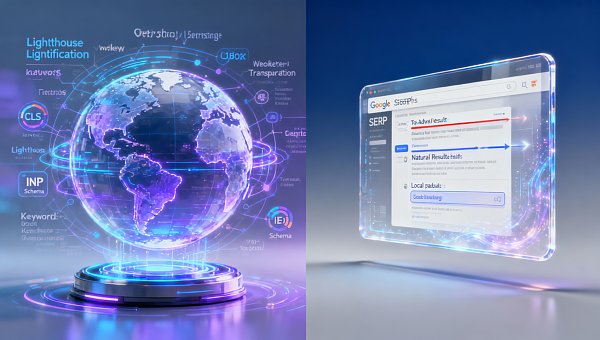
- Sudden structural changes on the SERP: such as the number of organic results shrinking to 3, top ad slots increasing to 5, and mandatory display of the Local Pack——indicating increased weighting of local SEO, requiring GBP information calibration and NAP consistency checks to be completed within 72 hours;
- Cliff-like decline in keyword click-through rate (CTR): if the organic ranking of a keyword remains unchanged but CTR drops by more than 40%, it is highly likely that a “content relevance reassessment” has been triggered, and AI semantic clustering analysis should be launched to rematch user search intent layers (informational → comparative → transactional);
- The proportion of long-tail keyword traffic rises by more than 25% for 3 consecutive weeks: this reflects that the algorithm is strengthening its preference for in-depth content, and a “Topic Cluster” restructuring should be launched immediately, breaking a single high-authority article into 3–5 scenario-based sub-content pieces and establishing bidirectional semantic links.
These signals can all be captured in real time through the Easyyimabao SEO intelligent dashboard. Based on an intent recognition engine trained on the BERT model, the system can automatically label the algorithm attribution probability behind each traffic fluctuation (such as “Helpful Content update impact confidence: 82%”), upgrading decision-making from experience-based judgment to data-driven action.
Compared with traditional SEO services: how does transparency translate into certain growth?
The table below presents the substantial differences between Easyyimabao and common SEO service models in the industry across key dimensions:
This difference is directly reflected in growth certainty. Enterprises using the Easyyimabao solution achieved an average increase of 142% in organic search traffic within 6 months (2023 client data), and 91% of clients also reduced inquiry costs by the 3rd month (CPL down 22%–37%). Especially in industries with high decision-making thresholds such as automotive, automotive clients, through the precise matching of immersive visual storytelling and technical specification modules, extended the average product page dwell time to 3 minutes 18 seconds, significantly increasing conversion intent.
Why choose Easyyimabao: more than optimization, it is growth infrastructure
Easyyimabao Information Technology (Beijing) Co., Ltd. was established in 2013 and is headquartered in Beijing, China. It is a global digital marketing service provider driven by artificial intelligence and big data at its core. With ten years of deep industry experience, the company has adopted a dual-engine strategy of “technological innovation + localized service” to build full-chain solutions covering intelligent website building, SEO optimization, social media marketing, and advertising placement, helping more than 100,000 enterprises achieve global growth. In 2023, the company was selected as one of the “Top 100 SaaS Companies in China,” maintained an average annual growth rate of more than 30%, and became an industry-recognized engine of innovation and benchmark for growth.
We provide three irreplaceable values:
- Algorithm interpretability assurance: all SEO strategies are accompanied by an “Algorithm Impact Explanation Report,” clearly marking the specific algorithm mechanisms being avoided/adapted to (such as “avoiding the threshold for ‘subjective evaluation density’ in the December 2023 Product Reviews update”);
- Growth closed-loop verification: not only improving rankings, but also tracking in real time through a dynamic data monitoring dashboard the complete path from search engine exposure → official website visit → product gallery browsing → owner review reading → form submission;
- Cross-platform collaboration capability: SEO optimization works in real time with intelligent website building, social media content libraries, and advertising keyword libraries to ensure semantic consistency and visual unity of brand information across all touchpoints.
If you are evaluating SEO service providers, we recommend immediately confirming three key capabilities: can they provide an attribution report for any algorithm update within the past 30 days? Do they support customized keyword-root strategies by product line (such as automotive)? Can they open GA4 and Search Console data interfaces for cross-verification? Only those that meet all three are growth partners worth entrusting.
Related Articles



Related Products
 EasyCamp SaaS Smart Website Marketing SystemE-Yingbao SaaS Smart Website Marketing System: AI-powered, zero-code website building. Rapidly launch multilingual independent e-commerce sites in just 10 minutes. Global server acceleration and AI-driven SEO optimization empower businesses to efficiently connect with global markets. The seamless integration of technology and user-friendly operation makes building e-commerce sites incredibly simple.
 AI+SEM Intelligent Advertising Marketing SystemAI+SEM drives intelligent ad creation, empowering full-funnel precision advertising marketing. The system automatically generates weekly/monthly reports, AI recommends keywords and target countries, monitors core metrics in real-time with intelligent alerts, and enables one-click high-conversion ad solutions to help quickly acquire customers and improve ROI.
 AI+SEO Dual Engine Optimization ServiceEasyWin AI+SEO Dual Engine Optimization System leverages AI-powered keyword mining, content generation, and comprehensive technical optimization to help foreign trade enterprises acquire high-quality organic traffic, significantly improving search rankings and conversion rates.
 AI+SNS Social Media Marketing SystemYingbao AI+SNS Social Media Marketing System - Precision social capture for the social media era. Supports one-click content synchronization across major platforms like Facebook and LinkedIn. AI intelligently rewrites posts for enhanced relevance. 24/7 AI customer service and user profiling analysis empower businesses to efficiently expand into global markets.
 AI+SEO营销解决方案易营宝AI+SEO营销解决方案,通过AI批量写作、智能生成TDK、精准关键词扩词等功能,全面优化网站SEO效果,提升流量与转化率。助力企业构建高效智能网站新生态。
 AI+SEM Advertising Marketing SolutionsAI+SEM Advertising Marketing Solution leverages AI technology to deeply empower SEM ad campaigns. It automatically generates weekly/monthly reports using AI, presenting account data across multiple dimensions for comprehensive insights into campaign performance and trends. The system precisely recommends keywords and target countries, intelligently generates high-conversion ad copy, and enables one-click activation of efficient campaign plans to help businesses rapidly acquire customers. Simultaneously, it monitors core metrics in real time, intelligently identifies abnormal fluctuations, and issues timely alerts to ensure stable, high-return advertising results.
 Domain Name ServicesEasyWin provides professional domain name services, including intelligent queries, one-stop registration, brand protection, and full lifecycle management, helping businesses build a digital brand image.
 EasyOperate B2C Cross-Border E-Commerce Platform & Independent WebsiteEasyStore B2C Cross-border E-commerce Independent Store is an intelligent website building and cross-border e-commerce integrated solution independently developed by EasyStore Information Technology (Beijing) Co., Ltd. The system is specially designed for small and medium-sized as well as large export enterprises, integrating 'website building, operation, marketing, advertising, and conversion' into one, helping enterprises quickly establish cross-border e-commerce independent stores to achieve brand globalization and global sales growth.
The platform supports multiple languages, multiple currencies, and multi-channel marketing, with built-in AI intelligent translation and SEO optimization systems, suitable for mainstream markets such as Southeast Asia, Europe and America, Latin America, and the Middle East, assisting Chinese manufacturing enterprises in efficiently deploying international e-commerce strategies. SSL证书易营宝提供专业SSL安全证书服务,包括单域名和泛域名证书,确保网站数据传输加密、身份验证和完整性保护,助力企业建立安全可信的在线业务环境。









