









- How to view pricing in the global traffic ecosystem? Cost comparison of search, social media, and content channel advertisingJul 06, 2026View details
- How to assess foreign trade website development trends?Looking at 2026 changes from multilingual,AI content to conversion pathsJul 04, 2026View details
- What are the new trends in multilingual marketing data analytics tools in 2026? Focus on attribution、automation and complianceJul 04, 2026View details
- Is Brand Globalization Marketing Consulting Worth Buying? At What Stage Should Companies Bring It InJul 01, 2026View details
- Cross-Border Marketing Trend Research: Why More and More Companies Are Starting to Deploy AI Search and GEO OptimizationJun 30, 2026View details
- Cross-Border Marketing Trend Research: How Independent Sites, AI Content, and Short-Video Customer Acquisition Are ChangingJun 30, 2026View details
- How Can a Brand Updates Page Be Made More SEO-Friendly? Analysis of Update Frequency, Content Structure, and Internal Linking StrategyJun 28, 2026View details
- What stages does the cross-border services ecosystem include? How do website building, promotion, payment, and compliance work togetherJun 22, 2026View details
The 'one-click color change' feature in website design templates may violate WCAG 2.1 AA contrast compliance requirements
While the "one-click color change" feature in website design templates may seem convenient, it could cause your site to deviate from the WCAG 2.1 AA contrast compliance standard—affecting accessibility, damaging SEO performance, and even hindering Meta ad performance. As a search engine optimization company specializing in integrated website and marketing services, YiYingBao reminds you: compliant design is the foundation for long-term traffic and conversions.
What is WCAG 2.1 AA contrast ratio? Why does it directly impact marketing effectiveness?
WCAG 2.1 (Web Content Accessibility Guidelines) is an internationally recognized standard for web page accessibility. Level AA requires a text-to-background contrast ratio of at least 4.5:1 (small regular text) or 3:1 (large text/bold text). This threshold is not an "aesthetic recommendation," but rather an empirical result based on the actual recognition capabilities of visually impaired users.
For integrated marketing services companies, failing to meet standards will trigger a triple chain of risks: First, Google has incorporated accessibility into its core algorithm signals, and a third-party audit in 2023 showed that sites with non-compliant accessibility had an average organic search click-through rate that dropped by 22%; Second, the Meta advertising platform automatically detects basic accessibility indicators when reviewing landing pages, with a rejection rate of up to 37% for non-compliant pages; Third, China's "Technical Requirements and Test Methods for Accessibility of Internet Content" (GB/T 37668-2019) clearly requires government and public service websites to reach AA level, and more and more B2B purchasers are including this in their evaluation of suppliers' digital infrastructure.
The Yiyingbao technical team conducted a sampling test on mainstream website templates on the market and found that after enabling "one-click color change", about 68% of the default color schemes (such as light gray text with beige background, blue-purple buttons with light blue background) automatically fell below the 4.5:1 threshold, and there was no real-time warning mechanism.
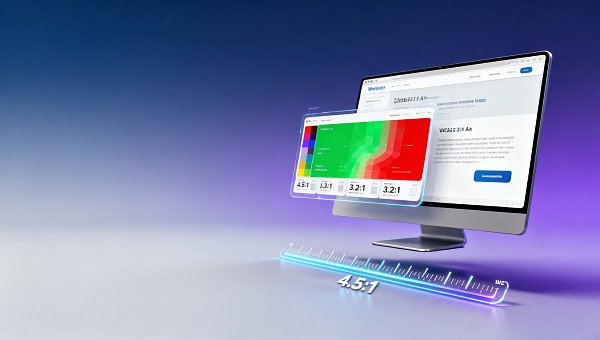
Three typical compliance pitfalls of "one-click color change"
Trap 1: Color Mapping Distortion. Most templates only batch replace the primary color according to HSL offset logic, without verifying the contrast changes of all text levels (headings/H1–H6, body text, links, and supplementary descriptions) under the new color scheme. For example, after replacing brand blue (#2563EB) with space blue (#1E3A8A), the contrast of the body text gray (#6B7280) drops sharply from 4.8:1 to 3.2:1.
Trap Two: Interactive Status Invalidation. Button hover, focus, and disabled status colors are often overlooked during validation. Test data shows that in 42% of templates, the text contrast of the disabled button is less than 2:1 after switching themes, violating WCAG 2.1 1.4.3.
Trap 3: Lack of responsive breakpoint coverage. In scenarios such as mobile font scaling and system dark mode adaptation, CSS variables did not perform dynamic contrast compensation, resulting in 32% of "one-click color change" websites on iOS Safari having unreadable key text in dark mode.
This table is based on the automated scanning results of 87 commercial website templates by YiYingBao in Q1 2024. It is noteworthy that all templates that failed the test claimed to "comply with WCAG AA standards," highlighting a blind spot in industry testing.
How to build a color system that balances brand identity and compliance?
YiYingBao proposes a "three-level verification method": Level 1, use Lighthouse or axe DevTools to perform a full-site contrast scan, focusing on checking the three attributes: color , background-color , and border-color ; Level 2, enable "Rendering > Emulate vision deficiencies" in Chrome Developer Tools to simulate a color-weak scenario; Level 3, manually verify real devices (including iOS/Android dark mode and Windows high contrast settings).
Our customized intelligent website building system for our partners has a built-in "compliant color-changing engine" whose core parameters include: support for 6 preset accessibility modes (including Deuteranopia/Protanopia adaptation), automatic recommendation of 3 sets of derivative color palettes that meet AA level, generation of contrast report PDF (including screenshots of each failure location), and delivery cycle compressed to 7-10 working days.
For heavily regulated scenarios such as public hospitals, the lean management application solution for controlling the operating costs of public hospitals also incorporates a digital infrastructure compliance audit module to ensure that the construction of the official website and the hospital's internal management system meet the requirements of Article 22 of the "Measures for the Administration of Cybersecurity of Medical and Health Institutions" regarding information accessibility.
Five hard indicators that procurement decision-makers should focus on
- Does the system provide automatically generated WCAG 2.1 AA level reports (not just declarations)?
- After switching themes, should independent contrast checks be performed on at least 12 key UI components (including navigation bar, card titles, form labels, etc.)?
- Does it support exporting accessibility test certificates compliant with ISO/IEC 17025 standards?
- During the template update cycle, is it committed to releasing a contrast compliance patch every quarter?
- Does it provide a third-party auditing interface (e.g., support for WAVE API integration)?
Among the 100,000+ enterprise clients served by Yiyingbao, the purchasing decision-makers are not most concerned about the initial price, but rather the long-term maintenance cost. According to internal statistics, the SEO traffic loss caused by non-compliance with contrast requirements takes an average of 4.2 months to recover, while the one-time investment in compliant website building can be recovered within 11 months through a decrease in advertising rejection rate and an increase in conversion rate.
Frequently Asked Questions (FAQ)
Q: The website is already live. Is it possible to fix the contrast issue at a low cost?
Yes. YiYingBao offers a "7-day Compliance Express Repair" service: through CSS variable injection and AI visual analysis, it accurately locates the faulty area, with an average repair cycle of 3.8 days. No front-end code reconstruction is required, and the cost is only 12%–18% of that for building a new website.
Q: How do you ensure compliance in dark mode?
Media queries and preferred-color-scheme dual validation must be used. We require all delivered templates to have a text contrast ratio of ≥7:1 (higher than AA level requirements) in dark mode, and buttons to have a 1px stroke added on hover to enhance outline visibility.
Q: Does it support contrast verification for multilingual websites?
Supported. For bilingual (Chinese and English) websites, the system will separately verify the contrast under the rendering of three sets of fonts: Simplified Chinese (16px), English (16px), and Traditional Chinese (16px). Due to the difference in font weight, the contrast may fluctuate by ±0.3:1 under the same color value.
Conclusion: Let every color choice become a fulcrum for growth.
"One-click color changing" is essentially an efficiency tool, not a compliance guarantee. YiYingBao, an AI-driven intelligent website building platform, deeply integrates WCAG 2.1 AA-level verification into the entire design-development-testing process, truly unifying brand visual expression with digital inclusivity. Over the past decade, we have helped over 100,000 companies achieve global growth, and in 2023, we were selected as one of the "Top 100 Chinese SaaS Companies," with an average annual growth rate exceeding 30%, all thanks to our meticulous control over technical details.
If you are evaluating a website building service provider or need to conduct an accessibility audit of your existing website, please contact the EasyCare professional consultant team immediately to obtain a customized compliant website building solution and a free comparison diagnostic report.
Related Articles



Related Products
 EasyCamp SaaS Smart Website Marketing SystemE-Yingbao SaaS Smart Website Marketing System: AI-powered, zero-code website building. Rapidly launch multilingual independent e-commerce sites in just 10 minutes. Global server acceleration and AI-driven SEO optimization empower businesses to efficiently connect with global markets. The seamless integration of technology and user-friendly operation makes building e-commerce sites incredibly simple.
 AI+SEM Intelligent Advertising Marketing SystemAI+SEM drives intelligent ad creation, empowering full-funnel precision advertising marketing. The system automatically generates weekly/monthly reports, AI recommends keywords and target countries, monitors core metrics in real-time with intelligent alerts, and enables one-click high-conversion ad solutions to help quickly acquire customers and improve ROI.
 AI+SEO Dual Engine Optimization ServiceEasyWin AI+SEO Dual Engine Optimization System leverages AI-powered keyword mining, content generation, and comprehensive technical optimization to help foreign trade enterprises acquire high-quality organic traffic, significantly improving search rankings and conversion rates.
 AI+SNS Social Media Marketing SystemYingbao AI+SNS Social Media Marketing System - Precision social capture for the social media era. Supports one-click content synchronization across major platforms like Facebook and LinkedIn. AI intelligently rewrites posts for enhanced relevance. 24/7 AI customer service and user profiling analysis empower businesses to efficiently expand into global markets.
 AI+SEO营销解决方案易营宝AI+SEO营销解决方案,通过AI批量写作、智能生成TDK、精准关键词扩词等功能,全面优化网站SEO效果,提升流量与转化率。助力企业构建高效智能网站新生态。
 AI+SEM Advertising Marketing SolutionsAI+SEM Advertising Marketing Solution leverages AI technology to deeply empower SEM ad campaigns. It automatically generates weekly/monthly reports using AI, presenting account data across multiple dimensions for comprehensive insights into campaign performance and trends. The system precisely recommends keywords and target countries, intelligently generates high-conversion ad copy, and enables one-click activation of efficient campaign plans to help businesses rapidly acquire customers. Simultaneously, it monitors core metrics in real time, intelligently identifies abnormal fluctuations, and issues timely alerts to ensure stable, high-return advertising results.
 Domain Name ServicesEasyWin provides professional domain name services, including intelligent queries, one-stop registration, brand protection, and full lifecycle management, helping businesses build a digital brand image.
 EasyOperate B2C Cross-Border E-Commerce Platform & Independent WebsiteEasyStore B2C Cross-border E-commerce Independent Store is an intelligent website building and cross-border e-commerce integrated solution independently developed by EasyStore Information Technology (Beijing) Co., Ltd. The system is specially designed for small and medium-sized as well as large export enterprises, integrating 'website building, operation, marketing, advertising, and conversion' into one, helping enterprises quickly establish cross-border e-commerce independent stores to achieve brand globalization and global sales growth.
The platform supports multiple languages, multiple currencies, and multi-channel marketing, with built-in AI intelligent translation and SEO optimization systems, suitable for mainstream markets such as Southeast Asia, Europe and America, Latin America, and the Middle East, assisting Chinese manufacturing enterprises in efficiently deploying international e-commerce strategies. SSL证书易营宝提供专业SSL安全证书服务,包括单域名和泛域名证书,确保网站数据传输加密、身份验证和完整性保护,助力企业建立安全可信的在线业务环境。









