









- Is Brand Globalization Marketing Consulting Worth Buying? At What Stage Should Companies Bring It InJul 01, 2026View details
- Cross-Border Marketing Trend Research: Why More and More Companies Are Starting to Deploy AI Search and GEO OptimizationJun 30, 2026View details
- Cross-Border Marketing Trend Research: How Independent Sites, AI Content, and Short-Video Customer Acquisition Are ChangingJun 30, 2026View details
- How Can a Brand Updates Page Be Made More SEO-Friendly? Analysis of Update Frequency, Content Structure, and Internal Linking StrategyJun 28, 2026View details
- What stages does the cross-border services ecosystem include? How do website building, promotion, payment, and compliance work togetherJun 22, 2026View details
- How will email marketing costs change in 2026Jun 22, 2026View details
- The China-US tariff arrangement has reached a preliminary consensus, and the trade association will be establishedJun 15, 2026View details
- Should overseas brand marketing start with ads or contentJun 21, 2026View details
How Long Does It Usually Take to Launch Localized Content for Overseas Markets
How long does it usually take to launch localized content for overseas markets? It typically depends on the number of languages, industry compliance requirements, website development technology, and review process. For companies expanding globally, planning content, translation, and SEO collaboration in advance often determines both launch speed and subsequent conversion performance.
For foreign trade companies, manufacturing factories, cross-border e-commerce sellers, and brands expanding overseas, localized content is not simply about “translating Chinese into a foreign language.” A truly promotable, indexable, and conversion-oriented overseas website usually involves content planning, multilingual page development, keyword layout, technical deployment, legal review, and continuous optimization after launch.
Under an integrated website + marketing service model, what companies care about most is often not the speed of translation alone, but whether the overall delivery cycle can be controlled within 2 weeks, 4 weeks, or 8 weeks, and whether the website can simultaneously enter the Google indexing, advertising, and social media traffic acquisition stages after launch. For procurement decision-makers, understanding the key variables that affect the timeline is more important than simply pursuing “the faster, the better.”
What Are the Common Categories of Launch Timelines for Overseas Localized Content
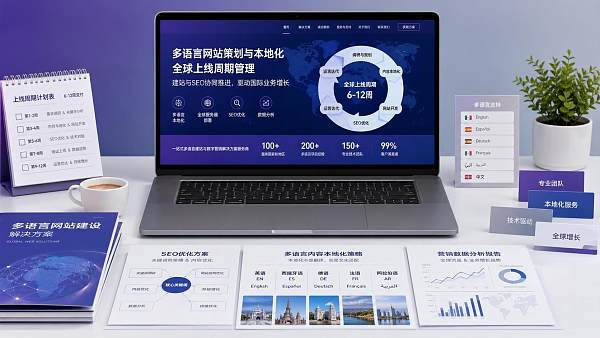
Based on common industry projects, the launch timeline for localized content in overseas markets can generally be divided into 3 categories according to project complexity: lightweight page projects, standard marketing website projects, and multi-country, multilingual growth projects. Different types vary significantly in the number of pages, language versions, functional modules, and review requirements, so the timeline may range from 7 days to more than 8 weeks.
Lightweight Projects: 7 Days to 15 Days
If a company only needs 1 language, 5 to 15 pages, and mainly focuses on product display, inquiry forms, and basic SEO settings, the launch timeline is usually 7 days to 15 days. This type of project is suitable for new product testing, advertising landing pages, trade show traffic acquisition pages, or single-market trials. The focus is to launch quickly, validate quickly, and obtain the first batch of inquiries quickly.
Standard Projects: 2 Weeks to 4 Weeks
If the project includes 2 to 4 languages, 20 to 50 pages, and requires simultaneous configuration of the basic Google SEO framework, conversion forms, on-site data tracking, and basic content localization, the regular timeline is generally 2 weeks to 4 weeks. This is also the most common delivery range for most B2B foreign trade marketing websites.
Complex Projects: 4 Weeks to More Than 8 Weeks
When a company launches simultaneously across multiple regions such as North America, Europe, the Middle East, Japan and South Korea, and Latin America, and the project involves more than 5 languages, cross-border e-commerce store functions, GDPR privacy compliance, payment and logistics interfaces, content review, and country-specific SEO strategies, the project timeline usually requires 4 weeks to 8 weeks. Some large-scale websites may even adopt a phased launch model lasting up to 12 weeks.
To help companies quickly estimate their own project timeline, the following table can be used as a preliminary assessment reference.
As the table shows, there is no single answer to how long it usually takes to launch localized content for overseas markets. What truly determines delivery speed is not the language itself, but content depth, page scale, system complexity, and the efficiency of cross-team collaboration.
5 Core Factors That Affect the Launch Timeline
When companies evaluate project schedules, the easiest factor to underestimate is the “hidden time cost.” Many projects appear to involve only two steps: website development and translation. In reality, material collection, version confirmation, technical adaptation, and market review may extend the timeline by 7 days to 20 days. Therefore, breaking down the key factors that affect the timeline before project kickoff can significantly reduce the probability of delays.
1. Number of Languages and Content Volume
The workload of 1 language and 5 languages is not simply a 1-to-5 relationship. For each additional language version, in addition to translation, page proofreading, keyword adaptation, URL planning, hreflang configuration, and visual checks are also required. If a website has 30 pages of content, 3 languages mean that at least 90 page units must be processed.
2. Industry Compliance and Market Review
Industries such as medical devices, chemicals, electronics, food, and children’s products often involve reviews of compliant wording, disclaimers, certification information, and privacy terms in European and American markets. Legal or brand review alone may add 3 days to 10 days. If the content also needs to meet advertising review standards, the timeline will be further extended.
3. Website Building System and Technical Implementation Efficiency
If a mature SaaS intelligent website building system is used, page creation, template application, form creation, site deployment, and mobile adaptation are usually faster, and the framework of a basic website can be completed within 3 days to 7 days. If custom development is used, involving front-end and back-end integration, plugin compatibility, and multilingual program modifications, the timeline often increases by 1 to 3 weeks.
4. Whether SEO and Content Are Advanced Simultaneously
Many companies build the website first and add SEO later, resulting in rework. In practice, title structure, keyword layout, internal links, page descriptions, image Alt text, and indexing submission are best completed simultaneously during the website development stage. This can not only save 20% to 30% of rework time, but also help pages enter the search engine crawling stage within 1 to 2 weeks after launch.
5. Length of the Company’s Internal Decision-Making Chain
If the content needs to be confirmed by multiple parties such as the business owner, foreign trade team, brand department, legal team, and overseas agents, each round of feedback may take 2 days to 5 days. A seemingly simple homepage copy may passively delay the overall launch plan if it goes through 4 rounds of revisions. Therefore, efficient projects usually define 1 overall person in charge and 1 final approval authority before kickoff.
Checklist of Common Delay Points
- Incomplete product materials, with first-round organization taking 3-7 days
- Multilingual terminology not unified, causing 1-2 rounds of translation rework
- Temporary additions to page functions, such as online payment, inquiry assignment, or CRM integration
- Privacy policy, Cookie notice, and data tracking configuration are only added before launch
- Insufficient preparation of domain, DNS, and server permissions, affecting final deployment
How Integrated Website and Marketing Projects Can Shorten Launch Time
If a company wants to launch quickly without sacrificing later promotion results, the key is not to compress the workload of one role, but to enable website development, translation, SEO, advertising landing page planning, and data tracking to collaborate in parallel from the very beginning. For projects aimed at inquiry acquisition and independent website conversion, this integrated model usually saves 1 week to 3 weeks compared with outsourced work split across multiple vendors.
A 4-Stage Implementation Method Is Recommended
- Requirement clarification stage: 1-3 days, confirming target countries, languages, page scope, key products, and conversion goals.
- Content and structure stage: 3-7 days, completing site architecture, keyword grouping, page copywriting, and translation strategy.
- Website development and optimization stage: 5-10 days, building pages, handling mobile adaptation, configuring SEO tags, and setting up form tracking.
- Testing and launch stage: 2-5 days, completing proofreading, device testing, indexing submission, and advertising preparation.
Different service models have a major impact on delivery speed. The following comparison table helps companies understand why integrated website + marketing services are more suitable for teams that need to quickly launch overseas growth initiatives.
From the perspective of execution results, the advantage of an integrated solution is not only a shorter timeline, but also the ability to enter the promotion stage faster after the pages go live. Especially when Google SEO, Google Ads, Facebook Ads, and overseas social media traffic acquisition are launched in parallel, a unified early-stage architecture can significantly reduce duplicate production and data silos.
Types of Companies Suitable for Shortening the Timeline
If a company falls into the following 3 categories, it is usually more suitable to adopt a standardized platform combined with marketing collaboration: first, it plans to start overseas customer acquisition within 30 days; second, it needs to launch more than 2 languages simultaneously; third, it wants the website to immediately support SEO, advertising, or social media traffic after launch, rather than simply building a static display website.
What Timeline Assurance Capabilities Should Companies Focus on When Choosing a Service Provider
To judge whether a service provider can deliver consistently, companies should not only look at the quotation and promised number of days, but also assess whether the provider has integrated capabilities across content, technology, and operations. Especially for multilingual official websites, B2B foreign trade marketing websites, and cross-border e-commerce store projects, the maturity of the service provider’s process directly affects whether the final delivery can be completed according to a 2-week, 4-week, or 6-week plan.
Focus on 3 Key Capabilities
First: Standardized Website Building Capability
Whether the provider has a mature cloud website building system, multilingual page management, mobile adaptation, and basic SEO configuration capabilities determines the speed of front-end implementation. The higher the level of standardization, the more repetitive work can be compressed into 3 days to 5 days.
Second: Content Localization Capability
Truly efficient localization is not word-for-word translation, but adaptation based on search habits in the target country, industry terminology, and conversion-oriented messaging. If the service provider understands B2B inquiry logic and overseas users’ reading habits, it can usually reduce 1 to 2 rounds of copy rework.
Third: Marketing Implementation Capability
If the service provider is only responsible for the website, but not SEO, advertising, social media, or GEO optimization, the company often needs to find another team to take over later. A sustainable overseas growth project should consider indexing, advertising, lead tracking, and AI search visibility before launch, rather than trying to fix them afterward.
6 Questions Recommended for Confirmation Before Procurement
- Is the project delivered based on the number of pages, number of languages, or as a whole-site package
- Does the multilingual content include keyword adaptation and manual proofreading
- Does it support basic Google SEO settings and indexing submission
- Does it provide forms, tracking points, conversion tracking, and advertising landing page capabilities
- What items are included in pre-launch testing, and does it cover mobile devices and multiple browsers
- How are delay responsibilities defined, and what materials must the company and service provider each provide
Taking an AI-driven enterprise-level SaaS intelligent website building and overseas marketing platform such as 易营宝 as an example, its value lies in advancing website development, SEO, advertising, social media, and multilingual operations within the same digital process. For companies that want to quickly build an overseas independent website and acquire global customers at the same time, this model is more conducive to aligning the launch timeline with the subsequent growth rhythm.
FAQ: Why Do Some Projects Launch Quickly but Still Fail to Produce Results
While many companies ask “how long does it usually take to launch localized content for overseas markets,” they may also overlook another question: why some websites go live in 10 days but still have no traffic or inquiries after 30 days. The reason is usually not speed, but the fact that only page publishing was completed, without building marketing usability.
Fast Launch Does Not Equal Fast Customer Acquisition
If the pages have no keyword structure, no conversion form optimization, no content hierarchy, and no search engine submission or data tracking, then even if the site goes live in 7 days, it is merely “launching a web address.” Truly valuable timeline control means delivering an overseas website within a reasonable timeframe that can be seen, visited, and generate inquiries.
It Is Recommended to Divide Launch Goals into 3 Levels
- Level 1: The website is accessible, pages display properly, and content is accurate.
- Level 2: The website is indexable, with qualified technical SEO, tags, speed, and structure.
- Level 3: The website is conversion-ready, with inquiry paths, trust signals, and the ability to support promotion.
If companies include Level 2 and Level 3 in their launch standards, they may need to invest an additional 3 days to 7 days in the early stage, but later they can often save several weeks of rework and promotion trial-and-error costs.
How long it usually takes to launch localized content for overseas markets is not mainly about a fixed number of days, but about project complexity, language scale, compliance requirements, technical solutions, and the depth of marketing collaboration. For companies expanding globally that want to balance launch efficiency, search visibility, and customer conversion, an integrated service model covering website development, content localization, SEO, advertising, and social media operations is more suitable.
With capabilities such as AI intelligent website building, multilingual website development, Google SEO optimization, advertising, and GEO generative engine optimization, 易营宝 can help companies build overseas independent websites that are promotable, indexable, and conversion-oriented more efficiently. If you are evaluating a project schedule, launch solution, or multilingual official website development path, feel free to contact us now to obtain a customized solution and implementation recommendations that better match your business goals.
Related Articles
 Is Brand Globalization Marketing Consulting Worth Buying? At What Stage Should Companies Bring It In
 4 Major Reasons Behind WhatsApp Account Bans, A Quick Self-Check for Foreign Trade Professionals
 Cross-Border Marketing Trend Research: Why More and More Companies Are Starting to Deploy AI Search and GEO Optimization

Related Products
 EasyCamp SaaS Smart Website Marketing SystemE-Yingbao SaaS Smart Website Marketing System: AI-powered, zero-code website building. Rapidly launch multilingual independent e-commerce sites in just 10 minutes. Global server acceleration and AI-driven SEO optimization empower businesses to efficiently connect with global markets. The seamless integration of technology and user-friendly operation makes building e-commerce sites incredibly simple.
 AI+SEM Intelligent Advertising Marketing SystemAI+SEM drives intelligent ad creation, empowering full-funnel precision advertising marketing. The system automatically generates weekly/monthly reports, AI recommends keywords and target countries, monitors core metrics in real-time with intelligent alerts, and enables one-click high-conversion ad solutions to help quickly acquire customers and improve ROI.
 AI+SEO Dual Engine Optimization ServiceEasyWin AI+SEO Dual Engine Optimization System leverages AI-powered keyword mining, content generation, and comprehensive technical optimization to help foreign trade enterprises acquire high-quality organic traffic, significantly improving search rankings and conversion rates.
 AI+SNS Social Media Marketing SystemYingbao AI+SNS Social Media Marketing System - Precision social capture for the social media era. Supports one-click content synchronization across major platforms like Facebook and LinkedIn. AI intelligently rewrites posts for enhanced relevance. 24/7 AI customer service and user profiling analysis empower businesses to efficiently expand into global markets.
 AI+SEO营销解决方案易营宝AI+SEO营销解决方案,通过AI批量写作、智能生成TDK、精准关键词扩词等功能,全面优化网站SEO效果,提升流量与转化率。助力企业构建高效智能网站新生态。
 AI+SEM Advertising Marketing SolutionsAI+SEM Advertising Marketing Solution leverages AI technology to deeply empower SEM ad campaigns. It automatically generates weekly/monthly reports using AI, presenting account data across multiple dimensions for comprehensive insights into campaign performance and trends. The system precisely recommends keywords and target countries, intelligently generates high-conversion ad copy, and enables one-click activation of efficient campaign plans to help businesses rapidly acquire customers. Simultaneously, it monitors core metrics in real time, intelligently identifies abnormal fluctuations, and issues timely alerts to ensure stable, high-return advertising results.
 Domain Name ServicesEasyWin provides professional domain name services, including intelligent queries, one-stop registration, brand protection, and full lifecycle management, helping businesses build a digital brand image.
 EasyOperate B2C Cross-Border E-Commerce Platform & Independent WebsiteEasyStore B2C Cross-border E-commerce Independent Store is an intelligent website building and cross-border e-commerce integrated solution independently developed by EasyStore Information Technology (Beijing) Co., Ltd. The system is specially designed for small and medium-sized as well as large export enterprises, integrating 'website building, operation, marketing, advertising, and conversion' into one, helping enterprises quickly establish cross-border e-commerce independent stores to achieve brand globalization and global sales growth.
The platform supports multiple languages, multiple currencies, and multi-channel marketing, with built-in AI intelligent translation and SEO optimization systems, suitable for mainstream markets such as Southeast Asia, Europe and America, Latin America, and the Middle East, assisting Chinese manufacturing enterprises in efficiently deploying international e-commerce strategies. SSL证书易营宝提供专业SSL安全证书服务,包括单域名和泛域名证书,确保网站数据传输加密、身份验证和完整性保护,助力企业建立安全可信的在线业务环境。









