









- What multilingual website services are available in Sanya? Which model is more suitable for local businesses going global?Jul 08, 2026View details
- How to view the complete list of China SaaS companies in the top 100? Practical methods for screening website-building and marketing service providersJul 08, 2026View details
- How to view pricing in the global traffic ecosystem? Cost comparison of search, social media, and content channel advertisingJul 06, 2026View details
- How to assess foreign trade website development trends?Looking at 2026 changes from multilingual,AI content to conversion pathsJul 04, 2026View details
- What are the new trends in multilingual marketing data analytics tools in 2026? Focus on attribution、automation and complianceJul 04, 2026View details
- Is Brand Globalization Marketing Consulting Worth Buying? At What Stage Should Companies Bring It InJul 01, 2026View details
- Cross-Border Marketing Trend Research: Why More and More Companies Are Starting to Deploy AI Search and GEO OptimizationJun 30, 2026View details
- Cross-Border Marketing Trend Research: How Independent Sites, AI Content, and Short-Video Customer Acquisition Are ChangingJun 30, 2026View details
How to Evaluate SEO Optimization Case Studies, Don’t Just Look at Ranking Screenshots
When many companies showcase SEO optimization case studies, their favorite visuals are screenshots like “keywords on the first page” and “ranking improved from No. 50 to No. 3”. But if you are screening SEO service providers, evaluating project value, or preparing to push your company to invest in SEO, looking only at ranking screenshots is far from enough. SEO optimization case studies that are truly worth referencing must be able to answer several more critical questions: How much qualified traffic did they bring? Were there inquiries and conversions? Is the website foundation solid? Is the optimization approach sustainable? Especially for foreign trade website SEO, B2B corporate website lead generation, and brand-oriented websites, rankings are only part of the result, not the whole story.
In other words, a reliable SEO optimization case study should demonstrate “rankings, traffic, page quality, user experience, and conversion results” together, rather than creating an illusion of effectiveness with just a few partial screenshots. Next, we will start from the evaluation dimensions companies care about most and explain clearly how SEO optimization case studies should actually be assessed.
Conclusion first: Looking only at ranking screenshots is the easiest way to misjudge the value of an SEO case study
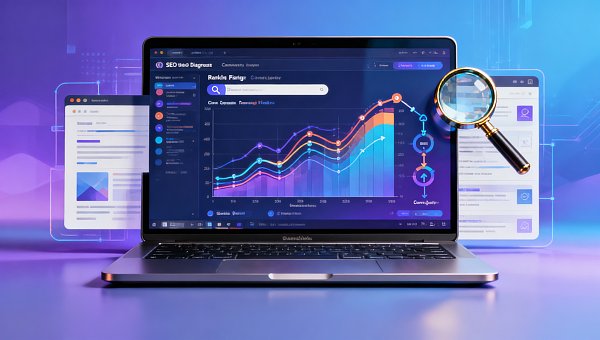
When many companies first encounter SEO, they are often impressed by “keyword ranking improvements” because they are the most intuitive, the easiest to present, and the most suitable for sales communication. But from a business perspective, ranking screenshots have at least four obvious limitations:
- Screenshots can only show a partial picture and cannot explain the overall traffic structure. The rise of just a few keywords does not mean the site’s overall search visibility has improved.
- Rankings do not equal effective clicks. Some keywords may rank high, but have very low search volume, or the users may have no purchasing intent at all.
- Rankings do not equal conversions. If page content, trust signals, form design, and loading speed are not up to standard, traffic will still be difficult to turn into inquiries.
- Screenshots cannot prove whether the methods are compliant. If a case relies on short-term aggressive tactics, later keyword loss, traffic drops, or even penalties can cause even greater losses for the company.
Therefore, when companies review SEO optimization case studies, they should start from “whether this project truly drove business growth” rather than “whether there are a few nice-looking keywords.”
When evaluating SEO optimization case studies, companies should verify these 5 core metrics most carefully
If you are a business decision-maker, project owner, or execution team member, it is recommended to standardize your case evaluation criteria around the following 5 items. They reflect real performance better than rankings alone.
1. Keyword quality, not keyword quantity
If a case study only emphasizes “hundreds of keywords optimized” or “thousands of keywords ranked,” its value is actually limited. What matters more is whether those keywords are the terms target customers would actually search for and whether they carry commercial value.
For example, for B2B companies, product keywords, solution keywords, application scenario keywords, and procurement-related long-tail keywords are usually more valuable than broad traffic keywords. A truly professional SEO case study will tell you:
- What the core keywords are
- How the long-tail keywords are structured
- What roles branded and non-branded keywords each play
- How search intent differs across countries or regions
2. Whether organic traffic is growing consistently
When reviewing a case study, do not look only at the result at a single point in time; look at the trend. An ideal SEO optimization case study should show sustained growth in organic traffic, not just a sudden spike over one or two weeks.
Focus on:
- Whether the traffic growth cycle is reasonable
- Whether the growth is stable
- Whether there are dramatic ups and downs
- Whether the pages generating traffic are becoming more diverse
Sustained growth indicates that the website’s content assets and page authority are accumulating, which has greater long-term value than a one-time ranking increase.
3. Whether it generated inquiries, leads, or sales opportunities
This is the part most often avoided, but it is precisely the most important. SEO projects must ultimately serve business goals. Especially for corporate websites, foreign trade websites, and brand websites, the core is not “someone viewed it,” but “the right people took action after viewing it.”
So a high-quality case study should present as much as possible:
- Changes in inquiry volume
- Changes in form submission rate
- Growth in conversion actions such as phone calls, WhatsApp clicks, and email clicks
- Conversion performance of high-value pages
If a case study contains no conversion-related information at all, the company should ask one more question: Is there no tracking, or are the results simply not ideal?
4. Whether the website’s foundational optimization is in place
SEO is not just about publishing articles or building backlinks. A truly reliable SEO optimization case study should clearly show the completeness of the website’s foundational work, including:
- Whether TDK has been systematically planned
- Whether the page structure is clear
- Whether URLs, internal links, and breadcrumbs are standardized
- Whether the mobile experience is good
- Whether page loading speed has been optimized
- Whether technical issues such as indexing, crawling, broken links, and duplicate pages have been addressed
If a case study only talks about how much content was published and how many backlinks were built, but says nothing about the site’s underlying architecture, then its replicability and stability usually deserve cautious evaluation.
5. Whether the optimization strategy matches the industry and business stage
SEO strategies vary greatly across industries, website foundations, and market regions. For example, a new site needs indexing and foundational content development more urgently, while a mature site needs deeper topic page development and conversion path optimization. Foreign trade websites also need to consider multilingual requirements, localized search habits, and international search engine rules.
Therefore, a good SEO optimization case study is not one that “uses the same pitch for every client,” but one where you can clearly see the match between the strategy and the industry scenario.
Why website TDK, foreign trade website SEO, and user experience should be evaluated together
Many companies understand SEO as “publishing content + improving rankings,” but modern search optimization is no longer a single-point task. Whether a case study truly has value often depends on whether it connects website TDK, foreign trade website SEO, and user experience optimization into a complete closed loop.
Website TDK: Determines how search engines understand you
TDK refers to title, description, and keyword structure. Although SEO today no longer relies solely on keyword tags, TDK is still the foundation of the foundation. If a case study cannot even show clear page title logic, it suggests the optimization work may still be superficial.
When reviewing a case study, companies can focus on:
- Whether the titles of the homepage, category pages, and detail pages are clearly differentiated
- Whether page naming is built around different search intents
- Whether the description copy balances click-through rate and topic expression
Foreign trade website SEO: It does not end with simply translating into English
Foreign trade website SEO is especially prone to being misleading through “ranking screenshots.” This is because in different countries and language environments, many keywords have completely different search volume, expressions, and purchasing intent. A truly professional foreign trade website SEO case study should reflect localized thinking, not just language conversion.
For example, page structure, product categorization, application scenario descriptions, regional keyword layout, and the way technical documents are presented all affect how overseas users understand the site and whether they convert.
For fragrance and lifestyle companies, the official website not only needs to be understood by search engines, but also needs to quickly build trust with buyers, distributors, and end users. For website solutions such as Fragrance, Personal Care, Beauty, greater emphasis is placed on premium visual presentation, clear hierarchy, grid-based product matrices, OEM process display, and a fully responsive experience. Such site structures are not just “visually appealing”; more importantly, they reduce B2B communication costs and lay the groundwork for SEO page engagement and business conversion.
User experience: Determines whether traffic can turn into customers
If an SEO case study does not discuss user experience, it is basically only half complete. That is because visits generated by search are only the beginning; whether users continue browsing and whether they are willing to inquire depends on whether the page experience is smooth.
Key points include:
- Whether the above-the-fold information is clear
- Whether the product or service can be understood at a glance
- Whether case studies, qualifications, and advantages are easy to find
- Whether the inquiry entry points are clear
- Whether the page visuals enhance trust
Especially in industries with strong brand tonality, if a website is too cluttered, it will not only hurt conversions, but also drag down SEO page performance. Search optimization and website experience are essentially two sides of the same growth system.
When reviewing SEO case studies, the “hidden issues” companies most easily overlook
In addition to the explicit metrics mentioned above, many companies also overlook the following key risk points when evaluating SEO service providers.
Whether the case study is close enough to your industry
Education, machinery, industrial products, consumer goods, foreign trade B2B, and local services all require different SEO approaches. No matter how impressive a case study looks, if the industry logic is completely different, its reference value is still limited.
Whether the results shown include a time dimension
If a case study only shows “reached the first page on a certain date in a certain month,” but does not explain how long the project ran, how long the results remained stable, or whether there was continued growth afterward, then it is difficult to judge the quality of the results. SEO is inherently a medium- to long-term effort, and the absence of a time dimension often means the information is incomplete.
Whether it clearly explains how the pages and content were created
A truly experienced team will not attribute all SEO achievements to “strong technical capability.” Instead, it will explain the key actions behind the results, such as content strategy, page planning, category structure, and conversion path design. These are the methods that are practical, reusable, and sustainable.
Whether it distinguishes between brand exposure and sales leads
Some case studies are suitable for brand communication, while others are suitable for customer acquisition and conversion. Companies should first be clear about what they want, and then evaluate whether the case matches that goal. If your goal is to generate inquiries, do not be persuaded only by “exposure volume.”
What a trustworthy SEO optimization case study usually looks like
If you break down an excellent case study, it generally has a relatively complete narrative chain:
- Project background: industry, website foundation, target market, current issues
- Optimization diagnosis: technical issues, content gaps, keyword opportunities, conversion barriers
- Execution actions: TDK adjustments, structural optimization, content development, topic page layout, backlink and indexing strategies
- Results presentation: rankings, traffic, core page performance, inquiry changes
- Phase review: which actions worked, and how to sustain growth afterward
The value of this kind of case study lies in the fact that you can not only see the results, but also understand the process and judge whether it fits your company’s current situation.
If you are screening SEO service providers, it is recommended to directly ask these 6 questions
Instead of passively reviewing case studies, it is better to ask questions proactively. The following 6 questions are often more revealing than “Which clients have you worked with?”
- For the case studies you present, can you provide data showing traffic or inquiry growth?
- How were the keywords in this case selected and mapped to pages?
- Did you carry out systematic optimization for website TDK, structure, and page experience?
- If it is foreign trade website SEO, did you take localized search habits and language differences into account?
- How long does it usually take to see trend changes in a project? Which results are short-term, and which are long-term?
- How do you measure SEO project performance? Do you look only at rankings, or at business conversion as well?
When the other party can explain these questions clearly and the logic forms a complete closed loop, the credibility of the case study is usually higher.
Summary: The focus of SEO optimization case studies is not “getting ranked,” but “driving conversions”
When reviewing SEO optimization case studies, do not look only at ranking screenshots. This is not just a reminder, but an important principle for companies to avoid choosing the wrong direction or the wrong service provider. A case study that is truly worth referencing must stand up to evaluation across several dimensions at the same time: whether the keywords have business value, whether organic traffic is growing consistently, whether website TDK and the technical foundation are solid, whether foreign trade website SEO has been properly localized, and whether the user experience can support conversion.
For companies, SEO has never been about ranking a few keywords. It is about building a sustainable digital asset system for customer acquisition. Whoever can truly connect rankings, content, website experience, and business conversion is the one whose case studies deserve more trust and are more worthy of investment.
Related Articles
 What multilingual website services are available in Sanya? Which model is more suitable for local businesses going global?
 How to view the complete list of China SaaS companies in the top 100? Practical methods for screening website-building and marketing service providers
 There are so many used heavy-duty construction machines for foreign trade. How exactly should we acquire customers?

Related Products
 EasyCamp SaaS Smart Website Marketing SystemE-Yingbao SaaS Smart Website Marketing System: AI-powered, zero-code website building. Rapidly launch multilingual independent e-commerce sites in just 10 minutes. Global server acceleration and AI-driven SEO optimization empower businesses to efficiently connect with global markets. The seamless integration of technology and user-friendly operation makes building e-commerce sites incredibly simple.
 AI+SEM Intelligent Advertising Marketing SystemAI+SEM drives intelligent ad creation, empowering full-funnel precision advertising marketing. The system automatically generates weekly/monthly reports, AI recommends keywords and target countries, monitors core metrics in real-time with intelligent alerts, and enables one-click high-conversion ad solutions to help quickly acquire customers and improve ROI.
 AI+SEO Dual Engine Optimization ServiceEasyWin AI+SEO Dual Engine Optimization System leverages AI-powered keyword mining, content generation, and comprehensive technical optimization to help foreign trade enterprises acquire high-quality organic traffic, significantly improving search rankings and conversion rates.
 AI+SNS Social Media Marketing SystemYingbao AI+SNS Social Media Marketing System - Precision social capture for the social media era. Supports one-click content synchronization across major platforms like Facebook and LinkedIn. AI intelligently rewrites posts for enhanced relevance. 24/7 AI customer service and user profiling analysis empower businesses to efficiently expand into global markets.
 AI+SEO营销解决方案易营宝AI+SEO营销解决方案,通过AI批量写作、智能生成TDK、精准关键词扩词等功能,全面优化网站SEO效果,提升流量与转化率。助力企业构建高效智能网站新生态。
 AI+SEM Advertising Marketing SolutionsAI+SEM Advertising Marketing Solution leverages AI technology to deeply empower SEM ad campaigns. It automatically generates weekly/monthly reports using AI, presenting account data across multiple dimensions for comprehensive insights into campaign performance and trends. The system precisely recommends keywords and target countries, intelligently generates high-conversion ad copy, and enables one-click activation of efficient campaign plans to help businesses rapidly acquire customers. Simultaneously, it monitors core metrics in real time, intelligently identifies abnormal fluctuations, and issues timely alerts to ensure stable, high-return advertising results.
 Domain Name ServicesEasyWin provides professional domain name services, including intelligent queries, one-stop registration, brand protection, and full lifecycle management, helping businesses build a digital brand image.
 EasyOperate B2C Cross-Border E-Commerce Platform & Independent WebsiteEasyStore B2C Cross-border E-commerce Independent Store is an intelligent website building and cross-border e-commerce integrated solution independently developed by EasyStore Information Technology (Beijing) Co., Ltd. The system is specially designed for small and medium-sized as well as large export enterprises, integrating 'website building, operation, marketing, advertising, and conversion' into one, helping enterprises quickly establish cross-border e-commerce independent stores to achieve brand globalization and global sales growth.
The platform supports multiple languages, multiple currencies, and multi-channel marketing, with built-in AI intelligent translation and SEO optimization systems, suitable for mainstream markets such as Southeast Asia, Europe and America, Latin America, and the Middle East, assisting Chinese manufacturing enterprises in efficiently deploying international e-commerce strategies. SSL证书易营宝提供专业SSL安全证书服务,包括单域名和泛域名证书,确保网站数据传输加密、身份验证和完整性保护,助力企业建立安全可信的在线业务环境。









