









- Can Zhejiang foreign trade independent websites still be developed today? Look at changes in traffic and lead generationJul 28, 2026View details
- What New Signals Are Emerging in Enterprise Services SaaS Marketing ReportsJul 27, 2026View details
- What Does a Global Traffic Ecosystem Service Provider Do? What Are the Differences from a Single Advertising AgencyJul 16, 2026View details
- What should you focus on in the latest enterprise SaaS report? From renewal rates and delivery costs to overseas growth opportunitiesJul 12, 2026View details
- What signals are worth paying attention to in a cross-border marketing trend report? B2B companies should look at these 6 signalsJul 11, 2026View details
- How to Read a Cross-Border Marketing Trends Report? Five Key Dimensions for Evaluating Channel OpportunitiesJul 11, 2026View details
- Which channel has the highest ROI in the global traffic ecosystem? Comparative analysis of search, social media, and advertisingJul 10, 2026View details
- What multilingual website services are available in Sanya? Which model is more suitable for local businesses going global?Jul 08, 2026View details
What is the difference between a B2B corporate website and an independent website?
When many companies expand into overseas markets, they pay close attention to the differences between B2B corporate websites and independent websites. Choosing the right website development model affects not only brand presentation, but also customer acquisition efficiency, SEO performance, and subsequent conversion growth.
First, understand the differences between B2B corporate websites and independent websites
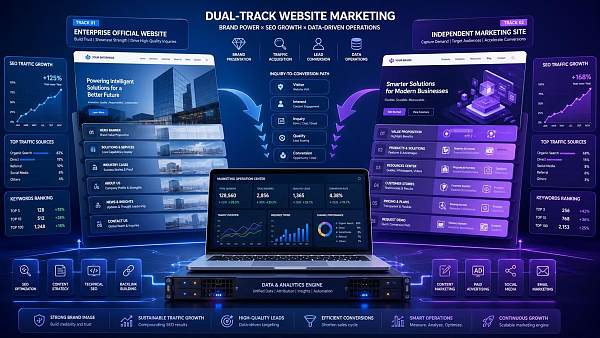
Many companies treat corporate websites and independent websites as the same concept. In reality, they overlap in some ways but also have clear differences. If a website is viewed merely as an “online business card,” companies may miss opportunities for overseas inquiries, search traffic, and advertising conversions.
Generally speaking, B2B corporate websites place greater emphasis on corporate image, credentials, product introductions, and contact information, forming the foundation for building brand trust. Independent websites place greater emphasis on autonomous traffic operations, search visibility, advertising landing, data tracking, and the conversion journey.
For foreign trade companies, manufacturing factories, and brands expanding overseas, understanding the differences between B2B corporate websites and independent websites is not primarily about terminology. The key is whether the website has customer acquisition capabilities, content expansion capabilities, and sustainable growth capabilities.
- If a website is used only for company introductions, trade show presentations, and customer background checks, it has stronger corporate website characteristics.
- If a website needs to receive traffic from Google Search, advertising, social media, and AI search exposure, it has stronger independent website characteristics.
- If a company needs both brand endorsement and inquiry conversion, it often needs a marketing-oriented website that combines the capabilities of both a corporate website and an independent website.
To provide a clearer view of the differences between B2B corporate websites and independent websites, the table below summarizes the core dimensions that companies are most concerned about.
This comparison shows that the difference between B2B corporate websites and independent websites does not lie in the form of the domain name, but in their strategic positioning. Corporate websites focus more on brand assets, while independent websites focus more on growth assets. Mature companies often need to combine the two rather than choose one over the other.
Which overseas business scenarios are better suited to corporate websites or independent websites?
Determining the differences between B2B corporate websites and independent websites cannot be separated from the business scenario. Different stages, levels of product complexity, and market objectives have completely different requirements for website models.
Typical scenarios suited to corporate websites
- The business relies mainly on repeat purchases from existing customers, offline trade show deals, and channel partnerships, with the website primarily serving as an endorsement.
- Products are highly customized, purchasing decisions take a long time, and customers first need to evaluate factory capabilities, certification information, and delivery capabilities.
- The company is just beginning its overseas marketing efforts and plans to establish a basic brand image before gradually expanding its traffic channels.
Typical scenarios suited to independent websites
- The company hopes to continuously acquire new customers through Google SEO, Google Ads, Facebook Ads, or social media content.
- The company needs to build independent landing pages for different countries, languages, and product lines to improve inquiry quality.
- The company has clear data growth objectives and wants to track traffic sources, form submissions, lead costs, and conversion paths.
In the website and marketing integration industry, it is more common to build an integrated platform with brand presentation, content marketing, lead conversion, and data tracking capabilities than to “only build a corporate website” or “only build an independent website.”
If a company is still unsure how to choose, it can refer to the scenario assessment table below to better understand how the differences between B2B corporate websites and independent websites apply in practice.
The key conclusion of this table is that whether continuous customer acquisition is needed is the most practical dividing line when evaluating the differences between B2B corporate websites and independent websites. Focusing only on website development costs often means overlooking subsequent promotion efficiency and lead quality.
Four key issues companies most often overlook when selecting a website solution
1. Focusing only on design while neglecting search structure
Many websites have attractive homepage visuals, but their category structures, URL logic, page titles, and internal linking systems have not been planned. Such websites may look like corporate websites, but in practice they struggle to undertake the promotional tasks of an independent website.
2. Translating only, without localization
If multilingual pages are created through mechanical translation alone, they cannot match the search habits, industry terminology, and conversion preferences of local buyers. Overseas markets place greater emphasis on local-language logic, page trust elements, and form processes.
3. Building a website without considering subsequent marketing
Without a content update mechanism, SEO planning, advertising tracking, and data analysis, even an excellent website is merely a static page. Understanding the differences between B2B corporate websites and independent websites is essentially about understanding the difference between “presentation-oriented assets” and “growth-oriented assets.”
4. Focusing only on upfront costs instead of long-term return on investment
Low-cost website development may solve the launch problem, but it may not support subsequent expansion, content growth, performance optimization, and marketing integration. For companies expanding overseas, what should really be evaluated is the customer acquisition cycle, optimization potential, and maintenance efficiency after the website goes live.
What should be prioritized during procurement and implementation?
When preparing to implement a project, companies should not simply ask whether to “build a corporate website” or “build an independent website.” Instead, they should work backward from their business objectives to determine the development plan. The following checklist is more suitable for practical procurement decisions.
- First, confirm the objectives: brand presentation, inquiry acquisition, advertising landing, or multiple objectives in parallel.
- Then assess the regions: whether multilingual content, multiple sites, or separately deployed content for different countries is needed.
- Evaluate technical capabilities: whether page loading speed, mobile responsiveness, form tracking, and data statistics are all in place.
- Confirm subsequent operations: whether someone will continuously update content, optimize keywords, support advertising, and drive traffic from social media.
- Calculate delivery efficiency: template-based website development, custom development, and AI-assisted content generation can have significantly different timelines.
For companies with limited budgets but long-term growth ambitions, choosing an expandable marketing-oriented architecture is often more prudent. Build core product pages, industry solution pages, and inquiry forms first, then gradually expand the content matrix.
Why are more companies choosing integrated website and marketing solutions?
In the past, corporate website development and overseas marketing were usually handled separately by different teams. As a result, the website might go live without generating search traffic, while advertising might be launched without the landing page converting. Today, companies need a closed-loop solution covering everything from website development to customer acquisition.
Yiyingbao has long served foreign trade companies, manufacturing factories, cross-border e-commerce sellers, and brands expanding overseas. It provides one-stop support for AI-powered website development, multilingual website development, B2B foreign trade marketing websites, cross-border e-commerce stores, Google SEO optimization, advertising, and GEO generative engine optimization.
Based on an understanding of the differences between B2B corporate websites and independent websites, the true value lies not in delivering a single website, but in developing a site structure and promotion strategy suited to the company’s current stage according to its industry, region, products, and budget.
- Its self-developed cloud-based intelligent website development system shortens the launch cycle and facilitates subsequent page expansion and content management.
- Its AI+SEO/GEO optimization system helps companies improve visibility in search engines and AI search scenarios.
- Combined with its advertising marketing system and social media operation capabilities, it enables websites not only to present information but also to continuously receive traffic.
Frequently asked questions: What else do companies ask before making a decision?
Does having a corporate website mean it is unsuitable for promotion?
No. A corporate website can also be used for promotion, provided that its structure, content layout, and conversion path have marketing capabilities. The problem for many companies is not that “corporate websites cannot be promoted,” but that their websites were not built around customer acquisition logic from the beginning.
Are independent websites necessarily more expensive than corporate websites?
Not necessarily. If an independent website uses a mature SaaS architecture, modular pages, and phased deployment, its initial investment may not be higher than that of a traditional custom website. The real differences lie in multilingual content, operational depth, and supporting promotion investment.
Do the differences between B2B corporate websites and independent websites affect SEO?
Yes. Presentation-oriented corporate websites generally have narrower keyword coverage, fewer pages, and lower update frequency. Independent websites are better suited to continuously expanding content around product keywords, industry keywords, scenario keywords, and regional keywords, making them more conducive to long-term organic traffic accumulation.
How is the launch timeline generally evaluated?
It depends on the number of languages, page scale, whether custom functions are required, and whether SEO and advertising tracking are deployed simultaneously. Generally speaking, basic presentation websites have shorter timelines, while marketing-oriented independent websites take longer if content planning and multilingual configuration are included, but they offer greater room for subsequent growth.
Why choose us?
If you are evaluating the differences between B2B corporate websites and independent websites, Yiyingbao can help determine whether a basic corporate website, a marketing-oriented independent website, or an integrated corporate and independent website solution is more suitable based on your industry, target market, budget, and customer acquisition methods.
You can focus on the following topics: how to plan a multilingual site architecture, how to arrange product and industry pages, how to coordinate Google SEO with advertising landing pages, how to schedule delivery, whether subsequent content operations and data tracking are supported, and how to implement the project in phases under different budgets.
If you want to clarify your selection direction more quickly, you can also discuss your target market, product categories, existing traffic channels, and inquiry objectives with Yiyingbao to customize solution proposals, function lists, implementation schedules, and quotation recommendations, reducing trial-and-error costs and making your website a true foundation for overseas growth.
Related Articles
 Can Zhejiang foreign trade independent websites still be developed today? Look at changes in traffic and lead generation
 What New Signals Are Emerging in Enterprise Services SaaS Marketing Reports
 Google Bidding Has Undergone a Major Overhaul at 8.17! Your Customer Acquisition Costs Are Going Up—Part 1

Related Products
 EasyCamp SaaS Smart Website Marketing SystemE-Yingbao SaaS Smart Website Marketing System: AI-powered, zero-code website building. Rapidly launch multilingual independent e-commerce sites in just 10 minutes. Global server acceleration and AI-driven SEO optimization empower businesses to efficiently connect with global markets. The seamless integration of technology and user-friendly operation makes building e-commerce sites incredibly simple.
 AI+SEM Intelligent Advertising Marketing SystemAI+SEM drives intelligent ad creation, empowering full-funnel precision advertising marketing. The system automatically generates weekly/monthly reports, AI recommends keywords and target countries, monitors core metrics in real-time with intelligent alerts, and enables one-click high-conversion ad solutions to help quickly acquire customers and improve ROI.
 AI+SEO Dual Engine Optimization ServiceEasyWin AI+SEO Dual Engine Optimization System leverages AI-powered keyword mining, content generation, and comprehensive technical optimization to help foreign trade enterprises acquire high-quality organic traffic, significantly improving search rankings and conversion rates.
 AI+SNS Social Media Marketing SystemYingbao AI+SNS Social Media Marketing System - Precision social capture for the social media era. Supports one-click content synchronization across major platforms like Facebook and LinkedIn. AI intelligently rewrites posts for enhanced relevance. 24/7 AI customer service and user profiling analysis empower businesses to efficiently expand into global markets.
 AI+SEO营销解决方案易营宝AI+SEO营销解决方案,通过AI批量写作、智能生成TDK、精准关键词扩词等功能,全面优化网站SEO效果,提升流量与转化率。助力企业构建高效智能网站新生态。
 AI+SEM Advertising Marketing SolutionsAI+SEM Advertising Marketing Solution leverages AI technology to deeply empower SEM ad campaigns. It automatically generates weekly/monthly reports using AI, presenting account data across multiple dimensions for comprehensive insights into campaign performance and trends. The system precisely recommends keywords and target countries, intelligently generates high-conversion ad copy, and enables one-click activation of efficient campaign plans to help businesses rapidly acquire customers. Simultaneously, it monitors core metrics in real time, intelligently identifies abnormal fluctuations, and issues timely alerts to ensure stable, high-return advertising results.
 Domain Name ServicesEasyWin provides professional domain name services, including intelligent queries, one-stop registration, brand protection, and full lifecycle management, helping businesses build a digital brand image.
 EasyOperate B2C Cross-Border E-Commerce Platform & Independent WebsiteEasyStore B2C Cross-border E-commerce Independent Store is an intelligent website building and cross-border e-commerce integrated solution independently developed by EasyStore Information Technology (Beijing) Co., Ltd. The system is specially designed for small and medium-sized as well as large export enterprises, integrating 'website building, operation, marketing, advertising, and conversion' into one, helping enterprises quickly establish cross-border e-commerce independent stores to achieve brand globalization and global sales growth.
The platform supports multiple languages, multiple currencies, and multi-channel marketing, with built-in AI intelligent translation and SEO optimization systems, suitable for mainstream markets such as Southeast Asia, Europe and America, Latin America, and the Middle East, assisting Chinese manufacturing enterprises in efficiently deploying international e-commerce strategies. SSL证书易营宝提供专业SSL安全证书服务,包括单域名和泛域名证书,确保网站数据传输加密、身份验证和完整性保护,助力企业建立安全可信的在线业务环境。









