









- What Does a Global Traffic Ecosystem Service Provider Do? What Are the Differences from a Single Advertising AgencyJul 16, 2026View details
- What should you focus on in the latest enterprise SaaS report? From renewal rates and delivery costs to overseas growth opportunitiesJul 12, 2026View details
- What signals are worth paying attention to in a cross-border marketing trend report? B2B companies should look at these 6 signalsJul 11, 2026View details
- How to Read a Cross-Border Marketing Trends Report? Five Key Dimensions for Evaluating Channel OpportunitiesJul 11, 2026View details
- Which channel has the highest ROI in the global traffic ecosystem? Comparative analysis of search, social media, and advertisingJul 10, 2026View details
- What multilingual website services are available in Sanya? Which model is more suitable for local businesses going global?Jul 08, 2026View details
How Can AI-Powered Multilingual Translation Support Global Marketing
AI multilingual translation is no longer simply about “translating content into a foreign language”
When many companies first discuss global marketing, their understanding of translation remains at the level of language conversion: translating a Chinese website into English and a product manual into Spanish, as if that were enough to prepare for going global. However, once they enter the stage of acquiring customers overseas, problems quickly emerge. The page has an English version, yet Google does not index it; the ads receive a fair number of clicks, but the quality of inquiries is not high; social media content is published continuously, but local users still feel that “this is not speaking to me.” This shows that companies are not facing a simple translation task, but a content adaptation challenge closely connected with search, conversion, advertising, and the establishment of local trust. This is also where the core value of AI multilingual translation, which has been frequently discussed over the past two years, lies.
In the context of integrated website and marketing services, AI multilingual translation generally refers to using large language models, terminology databases, contextual understanding, and automated workflows to quickly convert corporate content into multilingual assets suitable for different markets, while directly integrating them into independent websites, advertising landing pages, SEO pages, e-commerce product pages, and social media content systems. It does not solve the question of “whether content can be translated,” but rather whether it can be seen, understood, and encourage the next action. These three levels determine the role of translation in global marketing.
This is especially important for manufacturers, foreign trade companies, cross-border sellers, and brands expanding overseas. As the volume of content continues to grow and update frequency increases, maintaining multilingual websites entirely through manual methods often leads to long cycles, high costs, and inconsistent versions. A change to one product parameter may require simultaneous updates to the corporate website, online store, advertising pages, social media copy, and customer outreach emails. When a dozen or more languages are involved, manual processes can easily become unmanageable. AI is introduced into this process not to replace all human judgment, but to automate high-frequency, repetitive, and context-dependent translation work in advance, leaving human resources for more important tasks such as proofreading, compliance review, and refinement of local expressions.
Why it is becoming a foundational capability for global marketing
In the past, when companies entered overseas markets, they often selected one primary language version, such as an English website, and then considered whether other languages were necessary. This logic is now changing. The reasons are not mysterious. On the one hand, more and more overseas users do not actively use English when they begin making purchasing decisions. On the other hand, search engines, social platforms, and AI search tools are becoming increasingly sophisticated in recognizing content semantics and user intent. Multilingual content is no longer merely an “add-on,” but a prerequisite that affects exposure reach and traffic quality.
Companies seeking to cover markets in North America, Europe, Southeast Asia, Japan and South Korea, the Middle East, Russian-speaking regions, and Latin America will quickly discover that different regions have different sensitivities regarding information. Some markets look at specifications first, while others focus first on delivery capabilities. Some place greater emphasis on certification and compliance statements, while others care more about price ranges, after-sales service, and local support. The practical significance of AI multilingual translation is helping companies break down original Chinese content into adaptable, combinable, and continuously updatable marketing assets, rather than mechanically reproducing a Chinese promotional article in multiple languages.
This is why truly mature application scenarios are often not standalone translation software, but solutions used together with website-building systems, SEO systems, advertising systems, and content management workflows. Platforms such as 易营宝, an AI-driven enterprise-level SaaS platform, place multilingual processing directly into website construction, page generation, search optimization, and overseas advertising workflows. For companies, this is closer to actual business needs than “uploading the content manually after translation,” because marketing has never been an isolated text-based task. It is essentially a coordinated system for traffic acquisition and conversion.
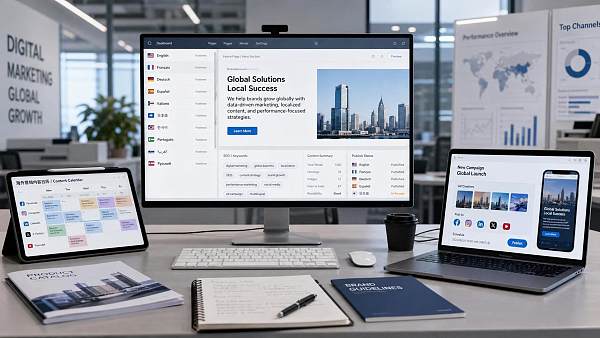
What truly creates a gap is not translation speed, but localization depth
Many people understand AI multilingual translation as a “faster translation tool.” This is not wrong, but it only describes the surface. In global marketing, the more important question is whether the content has been localized. Translation focuses on linguistic equivalence, while localization focuses on whether the information aligns with local users’ habits of understanding, searching, and making decisions.
A common example is that B2B manufacturers often emphasize “direct supply from the manufacturer,” “source factory,” and “customization available” on their Chinese websites. These expressions can readily build trust in a Chinese-language context. However, when they appear on English or German pages, a literal translation may not produce the same persuasive effect. Overseas buyers may care more about production capacity, lead times, quality control processes, industry certifications, service regions, and minimum order quantities. If an AI system only translates sentence by sentence, the content may read smoothly while producing weak marketing results. If it can combine industry terminology, page type, and target market characteristics to adjust the headline structure, key points in product descriptions, and FAQ phrasing, it will be much closer to genuinely usable multilingual marketing content.
Therefore, when evaluating whether an AI multilingual solution is valuable, it is not enough to look only at how many languages it supports or whether the translation is fluent. More practical criteria usually include three aspects: first, whether it can maintain consistency in industry terminology and brand messaging; second, whether it can adapt to different page scenarios, such as corporate website category pages, product detail pages, advertising landing pages, blog articles, and e-commerce SKU pages; and third, whether it can support subsequent promotion, including search engine indexing, keyword placement, page structure, and conversion copy optimization.
It is closely connected with SEO, advertising, and social media operations
When companies conduct global marketing, one thing they are most likely to underestimate is that different channels have different requirements for language quality. SEO requires content to be indexable, searchable, and aligned with search intent. Advertising emphasizes concise wording, clear value propositions, and consistency with the landing page. Social media relies more on tone, interaction methods, and cultural relevance. If AI multilingual translation is separated from the channels where it is used, it will be difficult to realize its full value.
Take an independent website as an example. Whether multilingual pages truly support SEO depends not only on whether foreign-language versions exist, but also on whether the URL structure, title tags, description information, internal links, semantic keywords, and on-site content hierarchy are aligned. Many companies translate Chinese pages and publish them directly. As a result, the page text becomes a foreign language, but its search performance does not improve. The reason is often not the translation itself, but the failure to build the content as a search asset for the target market.
The same applies to advertising. If the landing pages associated with Google Ads and Facebook Ads merely translate Chinese sales messaging, clicks and conversions often become disconnected. Users see a clear promise in the ad, but after entering the page, they encounter lengthy, unfamiliar content that lacks the logic of local expression. Naturally, the bounce rate increases. The value of AI here is not merely producing multilingual copy, but maintaining a consistent narrative chain across advertising materials, landing page messaging, and subsequent form guidance.
This is why more and more service providers are beginning to view AI translation, AI+SEO, advertising automation, content generation, and GEO generative engine optimization as part of one system. Overseas traffic sources are becoming more diversified, and traditional search, social media recommendations, and AI search answers all influence brand visibility. If multilingual content cannot remain consistent across different channels and be understood by machines, it will be difficult for companies to build stable overseas content assets.
Several common misconceptions worth avoiding in advance
The first misconception is that AI translation can completely replace human translators. In actual business operations, this judgment is overly optimistic. When content involves compliance statements, technical parameters, medical and healthcare topics, special industry certifications, legal clauses, or after-sales commitments, human review remains necessary. AI is good at improving speed and consistency, but for high-risk content, companies still need to define clear review boundaries.
The second misconception is that broader language coverage is always better. For many companies, the truly effective approach is not to launch a dozen or more languages from the outset, but to first establish high-quality websites and content libraries around priority regions. As the number of languages increases, maintenance costs, version management, and the difficulty of local adaptation also increase. Without clear market priorities, multilingual content may instead spread resources too thinly.
Another, more subtle misconception is that connecting translation to a website is equivalent to having global marketing capabilities. In reality, translation is only the entry point. What follows also includes page architecture, content update mechanisms, keyword research, advertising strategies, social media outreach, and data feedback. What companies ultimately need is not a tool that can translate, but an operating system that can continuously generate, distribute, and optimize multilingual content.
What companies should evaluate when assessing this capability
From a decision-maker’s perspective, when evaluating whether AI multilingual translation is worth the investment, it is usually unnecessary to first ask how advanced the model is. Instead, companies should first examine whether it is embedded in their business processes. A more valuable order of evaluation is:
- Is the content source unified? Can product information, brand messaging, frequently asked questions, and SEO articles be consolidated within the same content system?
- Can translation results be directly integrated into the publishing workflows for websites, online stores, advertising pages, and social media, rather than requiring extensive manual handling after generation?
- Does it support terminology management, version updates, and differentiated maintenance across regions, preventing conflicting expressions for the same product on different pages?
- Can post-launch data be fed back into the system to determine which language pages have been indexed, which content has generated inquiries, and which markets require further localization?
This is also why integrated platforms have attracted more attention in recent years. For foreign trade companies and brands expanding overseas, what is truly scarce is not finding a translation entry point, but placing website building, multilingual content, SEO optimization, advertising, and social media operations within the same growth framework. The value of teams such as 易营宝, which has long provided overseas marketing services, lies in connecting these stages from beginning to end: from AI-powered website building and multilingual website development to Google SEO, advertising, social media operations, and content optimization for AI search. Companies do not need to repeatedly split and reorganize workflows across multiple systems.
AI multilingual translation is becoming a foundational capability for global marketing not because it is new, but because the complexity of content involved in acquiring customers overseas has become too great to manage through manual assembly alone. For companies, the more practical question is no longer “Should we provide multilingual content?” but “Can multilingual content truly become a traffic asset and a sales asset?” Once this question is clearly understood, translation can move from a cost item to a measurable part of the growth system.
Related Articles

Related Products
 EasyCamp SaaS Smart Website Marketing SystemE-Yingbao SaaS Smart Website Marketing System: AI-powered, zero-code website building. Rapidly launch multilingual independent e-commerce sites in just 10 minutes. Global server acceleration and AI-driven SEO optimization empower businesses to efficiently connect with global markets. The seamless integration of technology and user-friendly operation makes building e-commerce sites incredibly simple.
 AI+SEM Intelligent Advertising Marketing SystemAI+SEM drives intelligent ad creation, empowering full-funnel precision advertising marketing. The system automatically generates weekly/monthly reports, AI recommends keywords and target countries, monitors core metrics in real-time with intelligent alerts, and enables one-click high-conversion ad solutions to help quickly acquire customers and improve ROI.
 AI+SEO Dual Engine Optimization ServiceEasyWin AI+SEO Dual Engine Optimization System leverages AI-powered keyword mining, content generation, and comprehensive technical optimization to help foreign trade enterprises acquire high-quality organic traffic, significantly improving search rankings and conversion rates.
 AI+SNS Social Media Marketing SystemYingbao AI+SNS Social Media Marketing System - Precision social capture for the social media era. Supports one-click content synchronization across major platforms like Facebook and LinkedIn. AI intelligently rewrites posts for enhanced relevance. 24/7 AI customer service and user profiling analysis empower businesses to efficiently expand into global markets.
 AI+SEO营销解决方案易营宝AI+SEO营销解决方案,通过AI批量写作、智能生成TDK、精准关键词扩词等功能,全面优化网站SEO效果,提升流量与转化率。助力企业构建高效智能网站新生态。
 AI+SEM Advertising Marketing SolutionsAI+SEM Advertising Marketing Solution leverages AI technology to deeply empower SEM ad campaigns. It automatically generates weekly/monthly reports using AI, presenting account data across multiple dimensions for comprehensive insights into campaign performance and trends. The system precisely recommends keywords and target countries, intelligently generates high-conversion ad copy, and enables one-click activation of efficient campaign plans to help businesses rapidly acquire customers. Simultaneously, it monitors core metrics in real time, intelligently identifies abnormal fluctuations, and issues timely alerts to ensure stable, high-return advertising results.
 Domain Name ServicesEasyWin provides professional domain name services, including intelligent queries, one-stop registration, brand protection, and full lifecycle management, helping businesses build a digital brand image.
 EasyOperate B2C Cross-Border E-Commerce Platform & Independent WebsiteEasyStore B2C Cross-border E-commerce Independent Store is an intelligent website building and cross-border e-commerce integrated solution independently developed by EasyStore Information Technology (Beijing) Co., Ltd. The system is specially designed for small and medium-sized as well as large export enterprises, integrating 'website building, operation, marketing, advertising, and conversion' into one, helping enterprises quickly establish cross-border e-commerce independent stores to achieve brand globalization and global sales growth.
The platform supports multiple languages, multiple currencies, and multi-channel marketing, with built-in AI intelligent translation and SEO optimization systems, suitable for mainstream markets such as Southeast Asia, Europe and America, Latin America, and the Middle East, assisting Chinese manufacturing enterprises in efficiently deploying international e-commerce strategies. SSL证书易营宝提供专业SSL安全证书服务,包括单域名和泛域名证书,确保网站数据传输加密、身份验证和完整性保护,助力企业建立安全可信的在线业务环境。









