









- What stages does the cross-border services ecosystem include? How do website building, promotion, payment, and compliance work togetherJun 22, 2026View details
- How will email marketing costs change in 2026Jun 22, 2026View details
- The China-US tariff arrangement has reached a preliminary consensus, and the trade association will be establishedJun 15, 2026View details
- Should overseas brand marketing start with ads or contentJun 21, 2026View details
- What determines B2C cross-border e-commerce website development costs? A breakdown of features, interfaces, and deployment methodsJun 17, 2026View details
- China-Morocco zero-tariff access, a breakthrough in the cost of Moroccan goods exports to ChinaJun 11, 2026View details
Yiyingbao vs. WordPress: Should foreign trade companies choose SaaS or open source for website building
Compared with WordPress, Yiyingbao’s core difference is not just website development cost, but more about deployment efficiency, SEO capabilities, multilingual expansion, and the long-term operational burden for foreign trade businesses. For technical evaluators, SaaS and open source each have their own advantages; the key is whether business goals and team capabilities are aligned.
In foreign trade website construction decisions, technical evaluation should not only ask whether it can go live, but also focus on three more practical questions: how long it will stay live, who will maintain it afterward, and whether the customer acquisition path is complete. Especially when a company targets multiple regions such as North America, Europe, and Southeast Asia, the website system itself directly affects SEO execution, multilingual management, ad landing page iteration, and the efficiency of sales lead handoff.
For companies with in-house development teams and strong customization needs, WordPress remains a common choice; for teams that want to complete deployment within 7–30 days and integrate SEO, advertising, social media, and AI search visibility at the same time, the integrated advantages of a SaaS solution become more obvious. In an integrated website + marketing services scenario, the comparison between Yiyingbao and WordPress must be evaluated from a broader perspective than just a “website building tool”; it should be viewed as a “growth system”.
What Technical Evaluation Looks at First: Foreign Trade Websites Are Not a Standalone System, but Growth Infrastructure
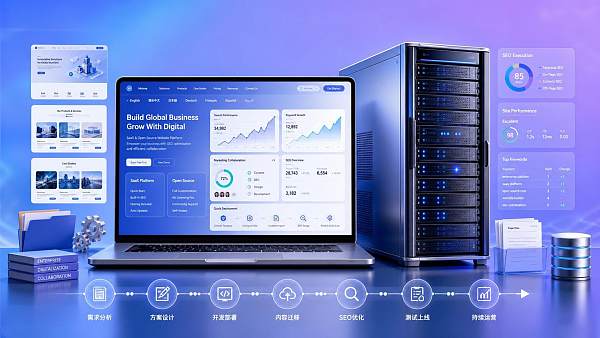
Technical evaluators usually look at architecture first, then features. But in foreign trade business, a website must actually handle at least four tasks: brand presentation, SEO indexing, ad handoff, and inquiry conversion. Therefore, when comparing Yiyingbao and WordPress, you cannot just discuss the number of templates or the plugin ecosystem; the judgment should be made within the complete business chain.
Why the Difference Between SaaS and Open Source Is Amplified
The website lifecycle of a foreign trade business is usually 2–5 years, during which it must go through multilingual expansion, page additions, server adjustments, SEO optimization, form management, and the linkage of ad campaigns. Maintenance items overlooked in the early selection stage are often exposed in the 6th to 18th month, causing technical costs and operational costs to rise in parallel.
The advantage of WordPress lies in its openness, with a rich ecosystem of themes, plugins, and secondary development resources, making it suitable for teams with front-end and back-end support as well as server and security management capabilities. The advantage of a SaaS solution is that hosting, deployment, updates, backups, permissions, and some marketing capabilities are standardized as services, reducing the repeated coordination cost between IT and operations.
The 6 Dimensions That Technical Evaluators Should Review First
- Deployment cycle: Can it go live in 3–7 days, or does it require 2–6 weeks of development and debugging?
- Security maintenance: Does it require in-house handling of plugin vulnerabilities, server patching, and backups/restoration?
- SEO foundation: Are URL rules, sitemaps, structured data, and page speed easy to manage?
- Multilingual mechanism: How many languages are supported, is the translation process centralized, and is hreflang easy to configure?
- Marketing linkage: Can landing pages, forms, inquiry tracking, and dashboards be created quickly?
- Total cost of ownership: In addition to website construction fees, does it also include operations, manpower, and troubleshooting costs?
The table below is more suitable for technical evaluators to quickly screen options at the project initiation stage. It does not only compare feature differences, but focuses on deployment efficiency, long-term burden, and support for marketing growth.
Based on the evaluation results, WordPress is not unsuitable for foreign trade, but is more suitable for companies that have technical resources and can accept higher operational flexibility. If the team size is 3–10 people and the goal is to launch the website and customer acquisition system simultaneously, a SaaS solution is more likely to fit the decision logic that prioritizes efficiency.
Yiyingbao vs. WordPress: The 5 Deployment Concerns Foreign Trade Companies Care About Most
In real projects, the question technical evaluators most often ask is not “which one is better,” but “which one is more suitable for the current stage.” This is especially true for B2B lead-generation websites, multilingual corporate sites, ad landing pages, and cross-border independent sites, where the following five issues most directly affect the final choice.
1. Deployment Speed and Collaboration Efficiency
If a company plans to complete a brand website upgrade, launch Google Ads, and roll out SEO within one quarter, the website project cannot drag on for more than 8 weeks. Relying on its self-developed cloud intelligent website-building system, Yiyingbao can usually plan page creation, form setup, basic SEO, and multilingual structure in a unified way, reducing repetitive revisions across development, design, and operations.
WordPress can also go live relatively quickly, but the premise is that the theme is mature, the plugin combination is stable, and the server environment is ready. If compatibility issues arise among caching, forms, translation, and SEO plugins, the project cycle can easily stretch from 2 weeks to more than 5 weeks.
2. SEO Capability Is Not About Having or Not Having Plugins, but Whether It Can Be Sustained
Many teams mistakenly believe that more WordPress plugins automatically means stronger SEO. In reality, SEO performance depends on page structure, content update frequency, speed optimization, indexing quality, and internal linking strategy. For foreign trade companies that update 50–300 pages per year, execution efficiency is more important than theoretical scalability.
As an AI-driven enterprise SaaS platform, Yiyingbao itself integrates intelligent website building, Google SEO optimization, ad delivery, social media operations, and GEO visibility improvement into one workflow, making it more suitable for scenarios where the goal is to “promote immediately after website launch.” For technical evaluators, this means SEO is no longer an add-on after the website is completed; it is incorporated into the architecture from the website planning stage.
A Page Logic That Is Easy to Overlook
Foreign trade websites are not limited to product detail pages; they may also need case pages, download pages, FAQ pages, regional pages, and advertising pages. For example, when a manufacturing website showcases high-ticket products, the page must not only meet technical specifications, but also have stronger visual storytelling and lead-generation logic. Showcase pages for businesses like car companies often use large minimalistic banner images, technical specification modules, card-style product galleries, and real owner review modules to complete the conversion from brand awareness to business inquiry through a shorter path.
3. Multilingual Expansion and Overseas Region Management
When a company needs to support 3, 5, or even 10 languages, system complexity rises quickly. Technical evaluation should not only look at whether translation is possible, but also at the URL structure for language versions, metadata management, page synchronization rules, and control over regional content differences.
When Yiyingbao serves markets such as North America, Europe, Japan and South Korea, the Middle East, Russian-speaking regions, and Latin America, it is more oriented toward designing multilingual websites and independent site logic based on foreign trade marketing needs. WordPress is more flexible, but coordinating multilingual support, SEO tags, form routing, CDN, and page caching usually requires a more mature technical stack.
If a company has already entered the multi-region advertising stage, the table below is more suitable for assessing “maintainability over the next 1–2 years” rather than just short-term launch performance.
The key conclusion from this table is: if the company’s growth goals are clear but technical team resources are limited, prioritizing lower system complexity is often more valuable than pursuing extreme freedom. This is especially true when the foreign trade customer acquisition cycle is usually 3–12 months, where stable and continuous performance matters more than short-term feature stacking.
4. Maintenance Costs Are Often Higher Than Initial Website Construction Costs
During technical evaluation, many teams focus their budget on upfront construction costs, but what really affects ROI is often the maintenance intensity over the following 12 months. WordPress websites may require plugin updates monthly or even weekly, and once core themes, caching plugins, or form systems conflict, troubleshooting time can stretch from 2 hours to 2 days.
The SaaS model is more suitable for companies that want to control hidden costs. Since its establishment in 2013, Yiyingbao has built integrated service capabilities around intelligent websites, SEO, social media, and ad delivery. For foreign trade companies oriented toward business growth, this means more manpower can be allocated to content, inquiries, and campaign strategy rather than underlying operations and maintenance.
5. Whether It Fits the Company’s Future Marketing Organization Structure
If the future organizational structure will evolve from “one website administrator” to collaborative teams of “marketing + sales + regional operations,” then the system must support multi-user collaboration, rapid page duplication, marketing data tracking, and version management. A foreign trade website is not a one-time deliverable; it is a continuously iterated marketing front line.
For example, some enterprise portals with higher visual requirements will integrate immersive visual storytelling, asymmetric dynamic layouts, real-time data dashboards, and social media interaction areas into the homepage structure. If such pages frequently adjust campaign banners, product selling points, or technical parameters, backend operational convenience directly affects the response speed of marketing.
How Technical Evaluators Make the Final Choice: Decisions Based on Team Capability, Business Stage, and Risk Preference
When comparing Yiyingbao and WordPress, the truly effective decision method is not to look at a single feature checklist, but to make a three-layer match: first, the business stage; second, the team capability; third, the operational goals for the next 12–24 months. As long as these three layers are aligned, the selection usually won’t deviate too much.
Companies That Should Prioritize Yiyingbao
- Need to launch an official website or independent site within 1 month, and start SEO or advertising as soon as possible.
- No stable internal development or operations positions; technical resources are mainly used for core systems such as ERP and CRM.
- Target markets span 3 or more regions, requiring a multilingual website, regional pages, and coordinated overseas promotion.
- Care more about inquiry conversion, search visibility, and operational efficiency than complete control over the underlying code.
Companies That Are Better Suited to Continue Using WordPress
- Already have a mature technical team capable of handling server deployment, plugin compatibility, security policies, and performance optimization.
- The website has complex business logic and requires a large amount of custom fields, interfaces, and functional modules.
- The company can accept a longer debugging cycle and is willing to invest a continuous budget in long-term maintenance.
- Existing content and template assets are already highly accumulated, and migration costs are clearly higher than continued maintenance costs.
A More Practical Decision Recommendation
If a company’s annual inquiry goals, ad pacing, and SEO plan are already clear, but the website system is still fragmented, slow to update, and difficult to collaborate on, then the priority should be to solve “launch and promotion efficiency” rather than pursue “full open-source freedom.” Conversely, if a company has strong R&D investment and the website itself carries complex business processes, WordPress can still leverage its advantages.
From the perspective of an integrated website + marketing services model, choosing a foreign trade website is essentially choosing a future operating model. Yiyingbao is more oriented toward a standardized, highly collaborative, and fast-deployment growth system, suitable for companies that want to unify website building, SEO, advertising, and overseas marketing; WordPress is more oriented toward a highly flexible and highly controllable technical path, suitable for teams with stronger development and maintenance capabilities.
If you are currently evaluating the technology stack for a foreign trade official website, independent site, or multilingual marketing site, it is recommended to first sort out these 3 internal conditions: launch timeline, available manpower, and the promotion plan for the next 12 months. Based on these conditions, the comparison between Yiyingbao and WordPress will be clearer. If you want customized recommendations tailored to your industry, market region, and website goals, feel free to contact us now to get a more business-stage-appropriate website-building and overseas marketing solution.
Related Articles
Related Products
 EasyCamp SaaS Smart Website Marketing SystemE-Yingbao SaaS Smart Website Marketing System: AI-powered, zero-code website building. Rapidly launch multilingual independent e-commerce sites in just 10 minutes. Global server acceleration and AI-driven SEO optimization empower businesses to efficiently connect with global markets. The seamless integration of technology and user-friendly operation makes building e-commerce sites incredibly simple.
 AI+SEM Intelligent Advertising Marketing SystemAI+SEM drives intelligent ad creation, empowering full-funnel precision advertising marketing. The system automatically generates weekly/monthly reports, AI recommends keywords and target countries, monitors core metrics in real-time with intelligent alerts, and enables one-click high-conversion ad solutions to help quickly acquire customers and improve ROI.
 AI+SEO Dual Engine Optimization ServiceEasyWin AI+SEO Dual Engine Optimization System leverages AI-powered keyword mining, content generation, and comprehensive technical optimization to help foreign trade enterprises acquire high-quality organic traffic, significantly improving search rankings and conversion rates.
 AI+SNS Social Media Marketing SystemYingbao AI+SNS Social Media Marketing System - Precision social capture for the social media era. Supports one-click content synchronization across major platforms like Facebook and LinkedIn. AI intelligently rewrites posts for enhanced relevance. 24/7 AI customer service and user profiling analysis empower businesses to efficiently expand into global markets.
 AI+SEO营销解决方案易营宝AI+SEO营销解决方案,通过AI批量写作、智能生成TDK、精准关键词扩词等功能,全面优化网站SEO效果,提升流量与转化率。助力企业构建高效智能网站新生态。
 AI+SEM Advertising Marketing SolutionsAI+SEM Advertising Marketing Solution leverages AI technology to deeply empower SEM ad campaigns. It automatically generates weekly/monthly reports using AI, presenting account data across multiple dimensions for comprehensive insights into campaign performance and trends. The system precisely recommends keywords and target countries, intelligently generates high-conversion ad copy, and enables one-click activation of efficient campaign plans to help businesses rapidly acquire customers. Simultaneously, it monitors core metrics in real time, intelligently identifies abnormal fluctuations, and issues timely alerts to ensure stable, high-return advertising results.
 Domain Name ServicesEasyWin provides professional domain name services, including intelligent queries, one-stop registration, brand protection, and full lifecycle management, helping businesses build a digital brand image.
 EasyOperate B2C Cross-Border E-Commerce Platform & Independent WebsiteEasyStore B2C Cross-border E-commerce Independent Store is an intelligent website building and cross-border e-commerce integrated solution independently developed by EasyStore Information Technology (Beijing) Co., Ltd. The system is specially designed for small and medium-sized as well as large export enterprises, integrating 'website building, operation, marketing, advertising, and conversion' into one, helping enterprises quickly establish cross-border e-commerce independent stores to achieve brand globalization and global sales growth.
The platform supports multiple languages, multiple currencies, and multi-channel marketing, with built-in AI intelligent translation and SEO optimization systems, suitable for mainstream markets such as Southeast Asia, Europe and America, Latin America, and the Middle East, assisting Chinese manufacturing enterprises in efficiently deploying international e-commerce strategies. SSL证书易营宝提供专业SSL安全证书服务,包括单域名和泛域名证书,确保网站数据传输加密、身份验证和完整性保护,助力企业建立安全可信的在线业务环境。









