









- What Does a Global Traffic Ecosystem Service Provider Do? What Are the Differences from a Single Advertising AgencyJul 16, 2026View details
- What should you focus on in the latest enterprise SaaS report? From renewal rates and delivery costs to overseas growth opportunitiesJul 12, 2026View details
- What signals are worth paying attention to in a cross-border marketing trend report? B2B companies should look at these 6 signalsJul 11, 2026View details
- How to Read a Cross-Border Marketing Trends Report? Five Key Dimensions for Evaluating Channel OpportunitiesJul 11, 2026View details
- Which channel has the highest ROI in the global traffic ecosystem? Comparative analysis of search, social media, and advertisingJul 10, 2026View details
- What multilingual website services are available in Sanya? Which model is more suitable for local businesses going global?Jul 08, 2026View details
How to Choose a Smart Website Builder? 5 Key ROI Evaluation Dimensions for Business Decision-Makers
How to choose an intelligent website system? Business decision-makers no longer focus solely on feature abundance but prioritize real ROI—page loading speed, SEO efficiency, multilingual conversion rates, AI content output ratio, and ad cost reduction. These five dimensions determine whether website investments can truly drive growth.
In the integrated race of website + marketing services, "building a website is marketing" has become an industry consensus. Traditional website tools merely address "existence" issues, while intelligent systems must shoulder full responsibility for traffic acquisition, user nurturing, and conversion closure. For enterprise decision-makers with annual revenues exceeding tens of millions, a single website investment can cost hundreds of thousands with a cycle of 3-6 months. If verifiable customer acquisition cost reduction or lead volume improvement cannot be achieved within six months, the system will struggle to pass financial review. Thus, the essence of "how to choose an intelligent website system" lies in evaluating its deterministic path for transforming technical capabilities into commercial outcomes.
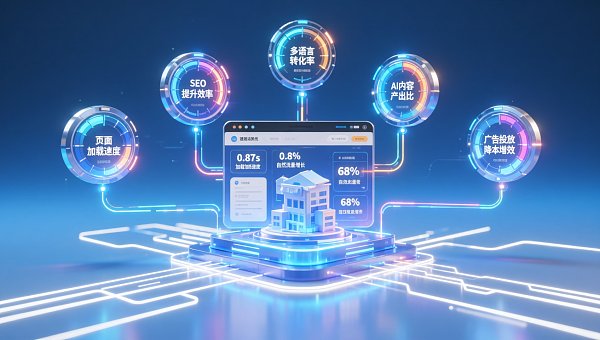
1. Page Loading Speed: Not an Experience Metric, but the First Gateway to Conversion Leakage
Google data shows: for every 1-second delay in mobile page loading, bounce rates increase by 32%, and average order value drops by 4.42%. For export businesses, global user distribution introduces more complex network environments—Southeast Asian users often face high-latency CDN nodes, while European users are 37% more sensitive to TTFB (Time To First Byte) than North America. Relying solely on "responsive templates" or "static resource compression" is far from sufficient.
EasyWin's intelligent system employs "edge computing + dynamic caching," leveraging 23 AWS and Alibaba Cloud hybrid CDN nodes across 7 continents to automatically identify visitor IPs and deliver static resources locally. It also features an LCP (Largest Contentful Paint) optimization engine, WebP adaptive image conversion, lazy + pre-loading for videos, and sandbox isolation for third-party scripts. Tests show: under equivalent configurations, its median homepage load time is 0.87s (industry average: 2.1s), with a 92.6% LCP compliance rate (Google Core Web Vitals standard), outperforming traditional SaaS platforms by 40%.
Crucially, this speed advantage isn’t a one-time setup but a continuously verifiable operational asset. The backend provides a "global node performance heatmap," allowing country/region-level analysis of TTFB, FCP, and CLS fluctuations, with automated optimization suggestions (e.g., switching to localized DNS providers for latency caused by slow resolution). This closed-loop design, linking technical parameters to business outcomes, transforms "page speed" from an IT KPI into a market-trackable conversion driver.
2. SEO Efficiency: From Keyword Rankings to Natural Traffic Growth Conversion
Many mistakenly equate "auto-generated TDK" with SEO completion. In reality, Ahrefs' 2023 global audit reveals 83% of SaaS platforms suffer from semantic duplication, missing geo-terms, and intent mismatches. True SEO improvement should manifest as "natural traffic growth under equal manpower" and "keyword first-page coverage acceleration."
EasyWin's AI marketing engine builds a three-tier SEO enhancement system: (1) "AI keyword mining" integrates Google Keyword Planner, SE Ranking, and localized long-tail databases (e.g., Russian e-commerce terms), using NLP to identify true search intent, outputting 2,100+ high-potential phrases daily; (2) "TDK smart generator" not only creates titles/descriptions but auto-matches Schema types (Product, FAQ, HowTo) and embeds geo-modifiers (e.g., "Germany warehouse direct"); (3) "real-time SEO dashboard" scans all URLs every 24 hours, flagging H1 gaps, broken links, and mobile errors, with one-click fixes.
One Shenzhen cross-border client saw 68% natural search growth in 3 weeks, with "multilingual independent site" terms claiming 41% of Google.de first-page results—far exceeding the 12% industry average. This validates a key logic: SEO isn’t a post-build add-on but a system-native growth engine.
3. Multilingual Conversion: Beyond Accurate Translation to Cultural Trust-Building
Multilingual sites’ ultimate goal isn’t "understandability" but "purchase willingness." EasyWin upgrades language services to "localization growth modules": detecting French IPs triggers EU compliance clauses and CB bank logos; Brazilian sites default to Boleto payments with local tax calculations. This deep integration helped a Zhejiang SME achieve 29.7% Mercado Libre add-to-cart rates (vs. 14.2% industry average).
4. AI Content ROI: The Golden Ratio of Quality to Commercial Value Per Unit Time
Businesses often mistake "more AI content" for better outcomes. Real ROI depends on per-piece engagement time, form submissions, and deep-page indexing. EasyWin’s "AI visuals + AI copy" dual-engine prioritizes intent: inputting "industrial bearings B2B site" yields high-value titles like "SKF vs FAG Selection Guide" and "2024 German Procurement Pitfalls," complete with parameter comparison charts and multilingual versions.
Data shows: clients achieve 5.3x content output efficiency, with 61% of first-month traffic from long-tail content. AI doesn’t replace humans but elevates teams from "content porters" to "strategists"—auditing commercial logic over grammar.
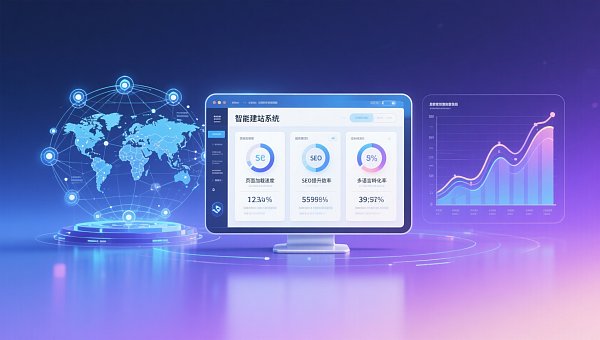
5. Ad Cost Reduction: The Data Integration Between Websites and Ad Accounts
Siloed sites and ad accounts are enterprises’ largest hidden cost. EasyWin’s AI ad manager integrates Google Ads, Meta, and Yandex APIs for triple synergy: (1) "landing page health feedback" auto-suggests optimizations when bounce rates exceed 75%; (2) "conversion attribution" tracks "Facebook click → site browse → WhatsApp consult → offline close"; (3) "creative factory sync" ensures 100% ad-to-landing page visual consistency.
One Ningbo auto parts client reduced Google Ads CPA by 38% and doubled Meta CTR. The core insight: websites aren’t ad endpoints but the data hub and execution terminal of entire digital ecosystems.
In summary, "how to choose an intelligent website system" has evolved from feature checklists to five ROI dimensions. With 10 years of industry expertise, 10,000 client cases, and 15 patents, EasyWin anchors AI capabilities to commercial outcomes: speed equals conversion, SEO equals traffic, multilingual equals revenue, AI content equals sales triggers, and ad synergy equals CAC. We’re not a website vendor but a superconnector for global growth.
Contact us now for a customized ROI assessment and industry-tailored solutions—making every website investment a measurable, replicable, and sustainable growth starting point.
Related Articles

Related Products
 EasyCamp SaaS Smart Website Marketing SystemE-Yingbao SaaS Smart Website Marketing System: AI-powered, zero-code website building. Rapidly launch multilingual independent e-commerce sites in just 10 minutes. Global server acceleration and AI-driven SEO optimization empower businesses to efficiently connect with global markets. The seamless integration of technology and user-friendly operation makes building e-commerce sites incredibly simple.
 AI+SEM Intelligent Advertising Marketing SystemAI+SEM drives intelligent ad creation, empowering full-funnel precision advertising marketing. The system automatically generates weekly/monthly reports, AI recommends keywords and target countries, monitors core metrics in real-time with intelligent alerts, and enables one-click high-conversion ad solutions to help quickly acquire customers and improve ROI.
 AI+SEO Dual Engine Optimization ServiceEasyWin AI+SEO Dual Engine Optimization System leverages AI-powered keyword mining, content generation, and comprehensive technical optimization to help foreign trade enterprises acquire high-quality organic traffic, significantly improving search rankings and conversion rates.
 AI+SNS Social Media Marketing SystemYingbao AI+SNS Social Media Marketing System - Precision social capture for the social media era. Supports one-click content synchronization across major platforms like Facebook and LinkedIn. AI intelligently rewrites posts for enhanced relevance. 24/7 AI customer service and user profiling analysis empower businesses to efficiently expand into global markets.
 AI+SEO营销解决方案易营宝AI+SEO营销解决方案,通过AI批量写作、智能生成TDK、精准关键词扩词等功能,全面优化网站SEO效果,提升流量与转化率。助力企业构建高效智能网站新生态。
 AI+SEM Advertising Marketing SolutionsAI+SEM Advertising Marketing Solution leverages AI technology to deeply empower SEM ad campaigns. It automatically generates weekly/monthly reports using AI, presenting account data across multiple dimensions for comprehensive insights into campaign performance and trends. The system precisely recommends keywords and target countries, intelligently generates high-conversion ad copy, and enables one-click activation of efficient campaign plans to help businesses rapidly acquire customers. Simultaneously, it monitors core metrics in real time, intelligently identifies abnormal fluctuations, and issues timely alerts to ensure stable, high-return advertising results.
 Domain Name ServicesEasyWin provides professional domain name services, including intelligent queries, one-stop registration, brand protection, and full lifecycle management, helping businesses build a digital brand image.
 EasyOperate B2C Cross-Border E-Commerce Platform & Independent WebsiteEasyStore B2C Cross-border E-commerce Independent Store is an intelligent website building and cross-border e-commerce integrated solution independently developed by EasyStore Information Technology (Beijing) Co., Ltd. The system is specially designed for small and medium-sized as well as large export enterprises, integrating 'website building, operation, marketing, advertising, and conversion' into one, helping enterprises quickly establish cross-border e-commerce independent stores to achieve brand globalization and global sales growth.
The platform supports multiple languages, multiple currencies, and multi-channel marketing, with built-in AI intelligent translation and SEO optimization systems, suitable for mainstream markets such as Southeast Asia, Europe and America, Latin America, and the Middle East, assisting Chinese manufacturing enterprises in efficiently deploying international e-commerce strategies. SSL证书易营宝提供专业SSL安全证书服务,包括单域名和泛域名证书,确保网站数据传输加密、身份验证和完整性保护,助力企业建立安全可信的在线业务环境。









