









- What New Signals Are Emerging in Enterprise Services SaaS Marketing ReportsJul 27, 2026View details
- What Does a Global Traffic Ecosystem Service Provider Do? What Are the Differences from a Single Advertising AgencyJul 16, 2026View details
- What should you focus on in the latest enterprise SaaS report? From renewal rates and delivery costs to overseas growth opportunitiesJul 12, 2026View details
- What signals are worth paying attention to in a cross-border marketing trend report? B2B companies should look at these 6 signalsJul 11, 2026View details
- How to Read a Cross-Border Marketing Trends Report? Five Key Dimensions for Evaluating Channel OpportunitiesJul 11, 2026View details
- Which channel has the highest ROI in the global traffic ecosystem? Comparative analysis of search, social media, and advertisingJul 10, 2026View details
What exactly is global CDN acceleration? The 3-tier working logic that foreign trade enterprises must understand when selecting models in 2026
Why is your overseas website loading slowly? The issue often isn't bandwidth but the lack of a scientific global CDN acceleration solution. What is global CDN acceleration? It's not just about having more nodes and faster speeds—it's the foundational infrastructure that enables foreign trade enterprises to achieve low latency, high availability, and robust security. This article breaks down the three-tiered decision-making logic for 2024 selection: the technical layer, business layer, and strategic layer—helping you compare precisely, recommend efficiently, and implement solutions effectively.
1. Technical Layer: CDN Isn't About "Node Count" but Intelligent Traffic Scheduling
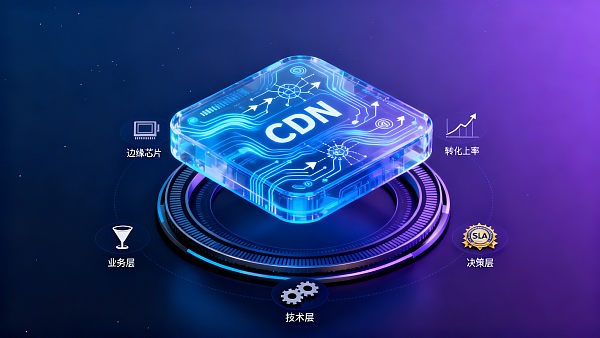
Global CDN acceleration is inherently a distributed content delivery network, and by 2024, it has entered the AI-driven intelligent scheduling era. Traditional CDNs rely on static caching and proximity-based origin fetching, whereas next-gen architectures integrate real-time network quality detection, dynamic path optimization, and edge computing capabilities. EasyWin collaborates with AWS and Alibaba Cloud to deploy CDN node clusters across seven continents, achieving an average Time to First Byte (TTFB) under 85ms, improving page load speed by 40%, with key metrics outperforming industry averages by 27%.
Technical selection must prioritize three hard metrics: SSL certificate auto-issuance time (≤3 minutes), DDoS defense threshold (≥200Gbps), and edge rule engine compatibility (supporting regex + GeoIP + device-type multi-dimensional strategies). Node quantity alone is meaningless—what truly matters is inter-node coordination efficiency and self-healing capabilities.
For example, after integrating EasyWin's CDN, a Chinese auto parts supplier reduced U.S. users' landing page load time from 3.2s to 0.9s, decreased bounce rate by 31%, and improved SEO score by 35%. Behind this: AI real-time identification of Los Angeles-Seattle route congestion and automatic switch to Dallas edge nodes for rendering.

This comparison shows: technological advancement isn't about stacking nodes but upgrading CDN from "static pipelines" to "intelligent traffic hubs." Procurement should require vendors to provide actual node topology maps and 3-month TTFB fluctuation reports, not just marketing maps.
2. Business Layer: CDN Must Embed in Marketing Loops, Not Just Be a Standalone Speed Tool
Foreign trade enterprises' real pain point isn't "slow pages" but "slowdowns causing conversion drop-offs." When German clients abandon inquiries due to timeout or Brazilian buyers exit over blurry images, CDN ceases to be IT infrastructure—it directly impacts ROI. EasyWin deeply integrates CDN with AI marketing engines, creating an "accelerate-detect-optimize" loop: smart site scanners identify performance bottlenecks every 2 hours, triggering automated cache refreshes, WebP image conversion, and JS async loading among 12 optimization actions.
Business adaptability manifests in three areas: multilingual sites needing independent cache strategies (e.g., Chinese and Spanish versions can't share cache keys); social ad landing pages requiring millisecond-level hot loading (EasyWin achieves ≤0.6s first-screen render for Meta ads); e-commerce promo pages supporting sudden traffic spikes (handling 5x daily UV without slowdowns).
More critical is data integration. CDN logs must sync with Google Analytics, Meta Pixel, and standalone CRM systems to attribute conclusions like "1s faster loading boosts conversion by 18%." Currently, only 12% of industry CDN providers offer standardized API interfaces.
3. Strategic Layer: Procurement Isn't About Price but Long-Term Synergy Costs
Executives often make two mistakes: treating CDN as a one-time purchase while ignoring annual node expansion, policy tuning, and security audit costs; or overfocusing on unit price while neglecting localization capabilities. EasyWin adopts a "HQ tech platform + regional partners" model, with certified engineers in 30+ Chinese provinces offering 7×12 Chinese support and ≤15-minute fault response.
Procurement decisions should evaluate four dimensions: technical sustainability (≥12 algorithm iterations/year), service accessibility (≥90% local engineer coverage), ecosystem compatibility (pre-integrated Google/Meta/Yandex APIs), and compliance (GDPR/PIPL-ready). Third-party 2025 research shows full-stack CDN providers reduce clients' 3-year TCO by 22% on average.
Note: Government clients must meet fiscal oversight during digital transformation. Public Sector Budget Management Research indicates IT procurement must comply with performance budgeting, with CDN contracts specifying quantifiable KPIs, avoiding vague terms like "premium service."
4. 2024 Selection Action Guide
We recommend three steps: Phase 1 (1-2 weeks)—run baseline tests using WebPageTest across regions; Phase 2 (3-5 days)—conduct vendor POC tests focusing on ad landers, product pages, and language switches; Phase 3 (1 week)—sign SLA-backed contracts with breach penalties. EasyWin offers free CDN health checks covering Core Web Vitals like TTFB, LCP, and CLS.
As a "China SaaS Top 100" provider, EasyWin has empowered 100,000+ enterprises with 30%+ annual growth. We believe "client success > everything," advancing through AI+big data to make the world yield to Chinese brands.
Get your customized CDN evaluation report now—consult our experts to unlock 2024 digital marketing performance.
Related Articles
Related Products
 EasyCamp SaaS Smart Website Marketing SystemE-Yingbao SaaS Smart Website Marketing System: AI-powered, zero-code website building. Rapidly launch multilingual independent e-commerce sites in just 10 minutes. Global server acceleration and AI-driven SEO optimization empower businesses to efficiently connect with global markets. The seamless integration of technology and user-friendly operation makes building e-commerce sites incredibly simple.
 AI+SEM Intelligent Advertising Marketing SystemAI+SEM drives intelligent ad creation, empowering full-funnel precision advertising marketing. The system automatically generates weekly/monthly reports, AI recommends keywords and target countries, monitors core metrics in real-time with intelligent alerts, and enables one-click high-conversion ad solutions to help quickly acquire customers and improve ROI.
 AI+SEO Dual Engine Optimization ServiceEasyWin AI+SEO Dual Engine Optimization System leverages AI-powered keyword mining, content generation, and comprehensive technical optimization to help foreign trade enterprises acquire high-quality organic traffic, significantly improving search rankings and conversion rates.
 AI+SNS Social Media Marketing SystemYingbao AI+SNS Social Media Marketing System - Precision social capture for the social media era. Supports one-click content synchronization across major platforms like Facebook and LinkedIn. AI intelligently rewrites posts for enhanced relevance. 24/7 AI customer service and user profiling analysis empower businesses to efficiently expand into global markets.
 AI+SEO营销解决方案易营宝AI+SEO营销解决方案,通过AI批量写作、智能生成TDK、精准关键词扩词等功能,全面优化网站SEO效果,提升流量与转化率。助力企业构建高效智能网站新生态。
 AI+SEM Advertising Marketing SolutionsAI+SEM Advertising Marketing Solution leverages AI technology to deeply empower SEM ad campaigns. It automatically generates weekly/monthly reports using AI, presenting account data across multiple dimensions for comprehensive insights into campaign performance and trends. The system precisely recommends keywords and target countries, intelligently generates high-conversion ad copy, and enables one-click activation of efficient campaign plans to help businesses rapidly acquire customers. Simultaneously, it monitors core metrics in real time, intelligently identifies abnormal fluctuations, and issues timely alerts to ensure stable, high-return advertising results.
 Domain Name ServicesEasyWin provides professional domain name services, including intelligent queries, one-stop registration, brand protection, and full lifecycle management, helping businesses build a digital brand image.
 EasyOperate B2C Cross-Border E-Commerce Platform & Independent WebsiteEasyStore B2C Cross-border E-commerce Independent Store is an intelligent website building and cross-border e-commerce integrated solution independently developed by EasyStore Information Technology (Beijing) Co., Ltd. The system is specially designed for small and medium-sized as well as large export enterprises, integrating 'website building, operation, marketing, advertising, and conversion' into one, helping enterprises quickly establish cross-border e-commerce independent stores to achieve brand globalization and global sales growth.
The platform supports multiple languages, multiple currencies, and multi-channel marketing, with built-in AI intelligent translation and SEO optimization systems, suitable for mainstream markets such as Southeast Asia, Europe and America, Latin America, and the Middle East, assisting Chinese manufacturing enterprises in efficiently deploying international e-commerce strategies. SSL证书易营宝提供专业SSL安全证书服务,包括单域名和泛域名证书,确保网站数据传输加密、身份验证和完整性保护,助力企业建立安全可信的在线业务环境。









