









- What should you focus on in the latest enterprise SaaS report? From renewal rates and delivery costs to overseas growth opportunitiesJul 12, 2026View details
- What signals are worth paying attention to in a cross-border marketing trend report? B2B companies should look at these 6 signalsJul 11, 2026View details
- How to Read a Cross-Border Marketing Trends Report? Five Key Dimensions for Evaluating Channel OpportunitiesJul 11, 2026View details
- Which channel has the highest ROI in the global traffic ecosystem? Comparative analysis of search, social media, and advertisingJul 10, 2026View details
- What multilingual website services are available in Sanya? Which model is more suitable for local businesses going global?Jul 08, 2026View details
- How to view the complete list of China SaaS companies in the top 100? Practical methods for screening website-building and marketing service providersJul 08, 2026View details
- How to view pricing in the global traffic ecosystem? Cost comparison of search, social media, and content channel advertisingJul 06, 2026View details
- How to assess foreign trade website development trends?Looking at 2026 changes from multilingual,AI content to conversion pathsJul 04, 2026View details
Are the features of an enterprise self-service website builder enough? First, look at business needs
Whether the functions of an enterprise self-service website building system are sufficient depends not on “whether it can go live,” but on “whether it can support sustained business growth.” In the integrated scenario of website + marketing services, corporate website building is no longer just about creating page displays, but an important infrastructure for brand communication, lead conversion, data accumulation, and campaign coordination. To judge whether the functions of an enterprise self-service website building system are sufficient, you must first return to the business needs themselves, and then examine the system’s scalability, marketing fit, and subsequent operating costs.
Basic Understanding of Enterprise Self-Service Website Building System Functions
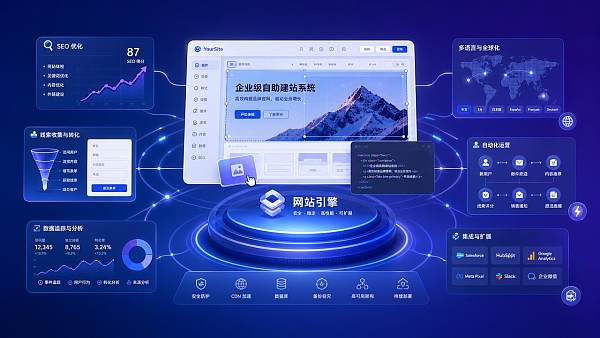
When selecting a system, many companies first look at the number of templates, page aesthetics, and pricing level. This way of judging is incomplete. The functions of an enterprise self-service website building system should usually cover content management, page creation, form collection, data statistics, permission allocation, search optimization, and multi-channel access.
If a company is in the growth stage, it should further focus on multilingual support, bulk landing page management, ad tracking, lead attribution, API integration, and security and stability. Only when these capabilities match the actual workflow can the system be considered “sufficient.”
Yiyingbao Information Technology (Beijing) Co., Ltd. has long served global digital marketing scenarios. Relying on artificial intelligence and big data capabilities, it has built a complete service chain from intelligent website building to SEO optimization, social media marketing, and advertising. For enterprises, a website building system should not be an isolated tool, but should become a core node in the marketing growth system.
Industry Evaluation Standards Are Shifting from Website Building to Growth Coordination
At present, enterprises’ focus on the functions of enterprise self-service website building systems has changed significantly. In the past, more emphasis was placed on the speed of getting pages online; now, more emphasis is placed on customer acquisition efficiency, campaign handoff capability, and operational reuse efficiency. This change directly determines the selection criteria.
- Whether the website supports basic SEO settings and technical optimization.
- Whether it can quickly build topic pages, campaign pages, and product pages.
- Whether it can connect with forms, customer service, and advertising platforms.
- Whether it supports collaboration among different teams and permission management.
- Whether it is convenient for subsequent expansion into new businesses and new markets.
From industry practice, truly valuable enterprise self-service website building system functions are not about stacking every possible module, but about forming a closed loop around enterprise growth goals. A website must not only look good, but also be manageable, deployable, trackable, and capable of accumulating value.
Comparison of Common Focus Points
Business Needs Determine Whether the Functions of an Enterprise Self-Service Website Building System Are Sufficient
Different business models have very different requirements for the functions of enterprise self-service website building systems. Showcase websites, lead generation websites, overseas branding websites, and campaign landing websites do not require the same capabilities. Discussing functions apart from business scenarios can easily lead to choosing the wrong system.
Common Scenario Categories
- Brand showcase: focus on visual consistency, content management, and SEO fundamentals.
- Lead generation: focus on forms, customer service, attribution statistics, and landing page efficiency.
- Multi-region operations: focus on multilingual support, multi-site management, and hierarchical permissions.
- Content marketing: focus on column expansion, article publishing, and search indexing capabilities.
- Advertising handoff: focus on loading speed, conversion components, and data linkage.
For example, if a website undertakes a large number of advertising handoff tasks, then among the functions of an enterprise self-service website building system, page duplication, A/B testing support, conversion component configuration, and analytics tagging capabilities are more important than template aesthetics.
If an enterprise also involves the digitization of management processes, it may also refer to Optimization Paths for Financial Management Information Systems of State-Owned Enterprises in the Context of Digital Transformation for this type of thinking, to understand that system construction cannot be judged only by isolated functions, but should be evaluated based on process coordination and long-term governance capabilities.
The Practical Business Value of Enterprise Self-Service Website Building System Functions
In the integrated scenario of website + marketing services, the value of enterprise self-service website building system functions is mainly reflected in three aspects: cost reduction, efficiency improvement, and revenue growth. If the right system is chosen, the website will become a digital asset that continuously generates value.
- Reduce repeated development costs and lower the investment required for each redesign and new page creation.
- Improve launch efficiency, allowing campaigns and promotions to go live faster.
- Strengthen the SEO foundation, helping long-term accumulation of organic traffic.
- Enhance conversion handoff capability, making advertising more rewarding.
- Accumulate user data to provide a basis for subsequent operations and remarketing.
Especially for businesses that continuously engage in content marketing and overseas promotion, if the functions of an enterprise self-service website building system cannot support on-site optimization, content structure adjustment, and data analysis, it will slow down the entire marketing chain. A system being “usable” does not mean it is “suitable for growth.”
The reason Yiyingbao Information Technology (Beijing) Co., Ltd. has been able to serve more than 100,000 enterprises lies in coordinating website building, SEO, social media, and advertising to help websites upgrade from static display tools into growth entry points for global markets.
Functional Modules That Should Be Prioritized During Selection
To evaluate whether the functions of an enterprise self-service website building system are sufficient, you can examine them from the dual dimensions of “current needs + future expansion.” The following modules are usually more worthy of priority review.
If the business will further extend to multi-system coordination in the future, then API openness cannot be ignored either. This is highly consistent with the system coordination logic emphasized in Optimization Paths for Financial Management Information Systems of State-Owned Enterprises in the Context of Digital Transformation.
Common Misunderstandings in Practice and Optimization Suggestions
When judging the functions of an enterprise self-service website building system, there are mainly three common misunderstandings. First, looking only at the price and not at subsequent operating costs. Second, looking only at the pages and not at the marketing chain. Third, looking only at the present and not at future expansion.
A more prudent approach is to first sort out business goals, and then list must-have functions, bonus functions, and functions reserved for the future. This can avoid insufficient functionality at the beginning and also reduce over-purchasing.
- First clarify the website goal: is it for display, customer acquisition, or advertising handoff.
- Sort out the content update frequency and determine whether the backend is easy to use.
- Confirm whether long-term SEO operation capabilities are needed.
- Evaluate whether advertising, customer service, and data tools need to be integrated.
- Estimate the future number of sites and multilingual expansion needs.
Next-Step Implementation Ideas Oriented Toward Growth Goals
Whether the functions of an enterprise self-service website building system are sufficient ultimately comes down to one sentence: whether they truly serve business growth. If the system can only complete launch, but cannot support content operations, SEO optimization, advertising handoff, and data review, then what seems to save money may often cost more later.
A more effective path is to conduct a functional inventory around business needs, clarify the core scenarios, and then choose a website building system that can support long-term operations. For enterprises that value the integrated coordination of website and marketing, balancing website building efficiency, search performance, advertising handoff, and data management is the correct way to evaluate the functions of an enterprise self-service website building system.
If you hope to upgrade the website from a “display window” to a “growth engine,” the next step should be to advance simultaneously from three levels: needs analysis, function checklist, and marketing closed loop, avoiding a disconnect between website building and operations, and making every investment closer to actual conversion results.
Related Articles



Related Products
 EasyCamp SaaS Smart Website Marketing SystemE-Yingbao SaaS Smart Website Marketing System: AI-powered, zero-code website building. Rapidly launch multilingual independent e-commerce sites in just 10 minutes. Global server acceleration and AI-driven SEO optimization empower businesses to efficiently connect with global markets. The seamless integration of technology and user-friendly operation makes building e-commerce sites incredibly simple.
 AI+SEM Intelligent Advertising Marketing SystemAI+SEM drives intelligent ad creation, empowering full-funnel precision advertising marketing. The system automatically generates weekly/monthly reports, AI recommends keywords and target countries, monitors core metrics in real-time with intelligent alerts, and enables one-click high-conversion ad solutions to help quickly acquire customers and improve ROI.
 AI+SEO Dual Engine Optimization ServiceEasyWin AI+SEO Dual Engine Optimization System leverages AI-powered keyword mining, content generation, and comprehensive technical optimization to help foreign trade enterprises acquire high-quality organic traffic, significantly improving search rankings and conversion rates.
 AI+SNS Social Media Marketing SystemYingbao AI+SNS Social Media Marketing System - Precision social capture for the social media era. Supports one-click content synchronization across major platforms like Facebook and LinkedIn. AI intelligently rewrites posts for enhanced relevance. 24/7 AI customer service and user profiling analysis empower businesses to efficiently expand into global markets.
 AI+SEO营销解决方案易营宝AI+SEO营销解决方案,通过AI批量写作、智能生成TDK、精准关键词扩词等功能,全面优化网站SEO效果,提升流量与转化率。助力企业构建高效智能网站新生态。
 AI+SEM Advertising Marketing SolutionsAI+SEM Advertising Marketing Solution leverages AI technology to deeply empower SEM ad campaigns. It automatically generates weekly/monthly reports using AI, presenting account data across multiple dimensions for comprehensive insights into campaign performance and trends. The system precisely recommends keywords and target countries, intelligently generates high-conversion ad copy, and enables one-click activation of efficient campaign plans to help businesses rapidly acquire customers. Simultaneously, it monitors core metrics in real time, intelligently identifies abnormal fluctuations, and issues timely alerts to ensure stable, high-return advertising results.
 Domain Name ServicesEasyWin provides professional domain name services, including intelligent queries, one-stop registration, brand protection, and full lifecycle management, helping businesses build a digital brand image.
 EasyOperate B2C Cross-Border E-Commerce Platform & Independent WebsiteEasyStore B2C Cross-border E-commerce Independent Store is an intelligent website building and cross-border e-commerce integrated solution independently developed by EasyStore Information Technology (Beijing) Co., Ltd. The system is specially designed for small and medium-sized as well as large export enterprises, integrating 'website building, operation, marketing, advertising, and conversion' into one, helping enterprises quickly establish cross-border e-commerce independent stores to achieve brand globalization and global sales growth.
The platform supports multiple languages, multiple currencies, and multi-channel marketing, with built-in AI intelligent translation and SEO optimization systems, suitable for mainstream markets such as Southeast Asia, Europe and America, Latin America, and the Middle East, assisting Chinese manufacturing enterprises in efficiently deploying international e-commerce strategies. SSL证书易营宝提供专业SSL安全证书服务,包括单域名和泛域名证书,确保网站数据传输加密、身份验证和完整性保护,助力企业建立安全可信的在线业务环境。









