









- Can Zhejiang foreign trade independent websites still be developed today? Look at changes in traffic and lead generationJul 28, 2026View details
- What New Signals Are Emerging in Enterprise Services SaaS Marketing ReportsJul 27, 2026View details
- What Does a Global Traffic Ecosystem Service Provider Do? What Are the Differences from a Single Advertising AgencyJul 16, 2026View details
- What should you focus on in the latest enterprise SaaS report? From renewal rates and delivery costs to overseas growth opportunitiesJul 12, 2026View details
- What signals are worth paying attention to in a cross-border marketing trend report? B2B companies should look at these 6 signalsJul 11, 2026View details
- How to Read a Cross-Border Marketing Trends Report? Five Key Dimensions for Evaluating Channel OpportunitiesJul 11, 2026View details
- Which channel has the highest ROI in the global traffic ecosystem? Comparative analysis of search, social media, and advertisingJul 10, 2026View details
- What multilingual website services are available in Sanya? Which model is more suitable for local businesses going global?Jul 08, 2026View details
Can AI-Powered Content Generation Replace Day-to-Day Content Teams
Can AI writing and content generation replace daily content teams?For enterprise decision-makers,the core answer is no:it is difficult for it to fully replace them,but it is already powerful enough to restructure how content teams divide their work。What is truly worth focusing on is not “whether to use AI”,but “which content should be handed over to AI,and which stages must be controlled by humans”。The criteria are not only efficiency,but also brand consistency,lead quality,search performance,and long-term asset accumulation。
From the perspective of search intent,users are not concerned with technical principles,but whether enterprises can use AI writing and content generation to reduce costs,increase output,and support business growth without sacrificing quality。For enterprise decision-makers,the more practical questions are:will the content team be downsized,will input-output efficiency improve,will AI-generated content affect SEO and brand credibility,and how can a controllable collaboration mechanism be established。
Therefore,this article will focus on answering four questions:which daily content tasks AI can replace,and which key responsibilities it cannot replace;how the cost structure will change after enterprises adopt AI;how content quality and conversion results can be ensured;and how management should build an “AI+human” content production system to avoid low quality,homogeneity,and loss of control。
1、Conclusion First:AI Can Replace Part of Production Capacity,But It Cannot Replace the Business Judgment of Content Teams
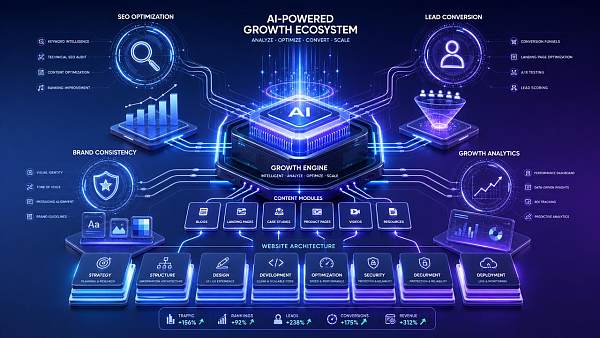
If we break down the work of a daily content team,AI is best suited to replace content production that is standardized,highly repetitive,and clearly structured,such as news rewriting,first drafts of event copy,product selling point summaries,FAQ,short social media copy,and basic SEO page drafts。These tasks require high speed and relatively low depth of insight,and AI can indeed significantly improve efficiency。
However,the truly scarce value of a content team does not lie in “writing words”,but in understanding customers,understanding the industry,and understanding the conversion path。For example,brand tone setting,target user insights,content topic strategy,sales scenario adaptation,unified cross-channel messaging,and conversion design for high-value pages all require business experience and marketing judgment,and cannot be solved by simply generating text。
For enterprise managers,the most dangerous misconception is to understand content work as “text handling”。Once AI writing and content generation are equated with complete content capability,it is easy to see a situation that appears highly productive but is actually ineffective:many articles,but unstable traffic;fast publishing,but no increase in leads;pages full of content,but the brand becomes increasingly blurred。This is also the fundamental reason why many enterprises fail to achieve ideal results after trying AI。
2、The Cost Issue Enterprises Care About Most:AI Does Reduce Costs,But It Will Not Reduce the Content Budget to Zero
In the short term,the greatest appeal of AI is the reduction in the cost per unit of content output。Basic content that originally required several hours of planning,writing,and initial review may now be drafted in a shorter time,allowing teams to cover more keywords,more channels,and more frequent updates。This is especially valuable for enterprises that need to continuously work on SEO,social media operations,and product launches。
But from a management perspective,costs have not disappeared;they have shifted。In the past,costs were mainly spent on manual writing;now,more costs are spent on prompt design,fact-checking,brand language consistency,content review,compliance checks,and performance optimization。If an enterprise lacks standard processes,AI may increase output while also increasing rework costs,or even bring misinformation and brand risks。
A more practical way to judge is not to only look at “how much cheaper each piece of content has become”,but to look at “whether the overall cost of each lead,each conversion,and each ranking page has been optimized”。If AI allows the team to free time from low-value writing and invest it in high-value planning and page optimization,then what it brings is not simple cost reduction,but better resource allocation and higher marketing leverage。
3、Quality and Brand Consistency Are the Watershed for Whether AI Can Be Implemented
After trying AI,many enterprises will find that the content “can be written”,but “does not sound like it was written by us”。The reason behind this is not insufficient model capability,but that the brand expression itself has not been clearly defined。Without clear brand tone,industry terminology,value propositions,and content templates,AI-generated copy easily tends to become generic,and may even cause inconsistent messaging across different channels。
For decision-makers,content quality cannot be measured only by grammar and fluency,but should be evaluated on three levels:first,whether the information is accurate and aligned with industry understanding;second,whether the expression reflects brand positioning rather than being formulaic;third,whether the content can drive the user’s next action,such as inquiry,lead submission,trial,or transaction。These three levels determine whether AI content is an asset or noise。
Especially in website content development,a page is not simply an information display,but a key touchpoint in an enterprise’s digital marketing。Taking website solutions for fragrance and lifestyle enterprises as an example,solutions such as Fragrance,Personal Care,Beauty emphasize not only copy output,but also the overall synergy of premium visual design,vertical hierarchy,product matrix display,OEM process breakdown,and responsive experience。AI can assist with content filling,but it cannot independently complete this kind of systematic expression that balances brand aesthetics and business conversion。
4、Will AI Affect SEO?The Key Is Not Whether It Is Written by AI,But Whether the Content Has Value
One common concern among enterprises is whether AI writing and content generation will cause search engines to downgrade rankings。In fact,search engines are increasingly concerned not with who wrote the content,but whether the content is helpful,whether it satisfies search intent,whether it has original value,and whether it solves problems。In other words,low-quality human-written content is equally ineffective,while high-quality AI-assisted content also has a chance to rank。
What truly harms SEO is not “using AI”,but mass-producing content with no differentiation,no experiential information,and no structural optimization。If the same topic is repeatedly rewritten in different wording,it can neither build site authority nor gain stable rankings。Especially for B2B enterprises,decision cycles are long and users have deeper concerns,so pure volume is often less effective than fewer but better pieces。
A more ideal approach is to use AI for keyword expansion,content framework building,long-tail question organization,and basic draft generation,then have humans add industry cases,customer scenarios,business data,and decision-making recommendations。Content produced this way is more likely to balance search demand and business value,and better aligns with the positioning of an enterprise website as a “customer acquisition asset” rather than a “content warehouse”。
5、Will Content Teams Be Replaced?What Is More Likely to Happen Is Role Upgrading and Capability Reorganization
From the perspective of organizational evolution,AI will not simply make content teams disappear,but it will eliminate roles that are purely executional,low value-added,and lack business understanding。More valuable content professionals in the future will not only be writers,but content operators who understand growth,channels,customers,and data。Their responsibilities will shift from “producing words” to “designing content systems”。
This means that the evaluation methods for enterprise content teams should also be adjusted。In the past,the focus may have been on publishing volume and update frequency;in the future,more attention should be paid to keyword coverage quality,page dwell performance,lead conversion rate,brand consistency,and cross-department collaboration efficiency。AI is responsible for increasing speed,the team is responsible for improving quality,and management is responsible for establishing standards。This is a more sustainable organizational model。
For enterprises with complex businesses,multiple product lines,or global markets,the value of this reorganization is even more obvious。Especially when websites,SEO,social media,and advertising need to work together,content is no longer an isolated function,but a central node in the marketing chain。After incorporating AI into the process,teams can test different content directions faster,then focus limited human resources on the pages and projects that can drive the most growth。
6、How Should Enterprises Decide:Which Content Is Suitable for AI,and Which Must Be Human-Led
A practical criterion is to look at the content’s risk level and business value。Low-risk,standardized,frequently updated content is suitable to be prioritized for AI,such as news briefs,basic Q&A,regular product descriptions,and daily social media copy。High-value,high-risk,strong-conversion content is more suitable to be led by humans,such as the official website homepage,core service pages,industry white papers,case stories,and executive thought leadership content。
In addition,enterprises can also evaluate whether the content depends on proprietary company information。For any content that requires real project experience,customer feedback,industry insights,sales objection handling,and brand attitude expression,AI can usually only assist in organizing it,but cannot replace source-level judgment。Conversely,if the content is essentially a reorganization of public information,AI’s efficiency advantage is very clear。
When many enterprises undergo digital upgrades,they also optimize website presentation logic and content structure at the same time。For example,for industry pages that emphasize aesthetics and conversion efficiency,solutions such as Fragrance,Personal Care,Beauty can significantly reduce B-side communication costs through the combination of white space,Banner,product matrix,timeline,and data dashboard。Here,AI is more suitable for assisting with content hierarchy organization,rather than independently defining the expression strategy for the entire website。
7、Implementation Advice for Enterprise Decision-Makers:Do Not Ask “Whether It Replaces”,Ask “How Collaboration Can Make More Money”
If an enterprise is considering introducing AI writing and content generation,it is recommended to start with three actions。First,establish brand content guidelines,including tone,terminology,prohibited words,page structure,and review standards,so that AI has boundaries to follow。Second,classify content by type and clearly define which content can be generated automatically and which must undergo final human review。Third,manage by outcome metrics,rather than only looking at output volume。
At the execution level,enterprises can first choose a clear scenario for a pilot,such as SEO blog updates,product knowledge base construction,or ad landing page material expansion。By validating content quality,collaboration efficiency,and conversion results on a small scale,they can then decide whether to expand the application。Compared with fully replacing the team from the beginning,progressive transformation is easier to control risks and is more aligned with the real operating rhythm of enterprises。
Ultimately,the greatest value AI brings is not “hiring a few fewer people”,but enabling enterprises to complete content experiments faster,cover more search demand,and support more complex marketing collaboration。Whoever can first incorporate AI into a standardized content production system and connect it with websites,SEO,social media,and advertising will have a greater opportunity to turn content from a cost center into a growth engine。
Conclusion:AI Is an Amplifier for Content Teams,Not Autopilot for Enterprise Growth
Returning to the original question,can AI writing and content generation replace daily content teams?The answer is:it can replace part of execution-level production capacity,but it cannot replace content strategy,brand judgment,and business conversion design。For enterprise decision-makers,what really matters is not whether to cut the content team,but how to use AI to restructure the team so that people and tools can each deliver their maximum value。
When enterprises treat AI as an efficiency tool and treat the content team as the designer of a growth system,content production is no longer just “writing articles”,but a complete project serving brand building,search-based customer acquisition,and business conversion。Such a content system is more worthy of long-term investment and can better form a sustainable advantage in competition。
Related Articles
 Promoting chemical products on Google is essential—otherwise, you are effectively handing your customers over to competitors
 Can Zhejiang foreign trade independent websites still be developed today? Look at changes in traffic and lead generation
 What New Signals Are Emerging in Enterprise Services SaaS Marketing Reports


Related Products
 EasyCamp SaaS Smart Website Marketing SystemE-Yingbao SaaS Smart Website Marketing System: AI-powered, zero-code website building. Rapidly launch multilingual independent e-commerce sites in just 10 minutes. Global server acceleration and AI-driven SEO optimization empower businesses to efficiently connect with global markets. The seamless integration of technology and user-friendly operation makes building e-commerce sites incredibly simple.
 AI+SEM Intelligent Advertising Marketing SystemAI+SEM drives intelligent ad creation, empowering full-funnel precision advertising marketing. The system automatically generates weekly/monthly reports, AI recommends keywords and target countries, monitors core metrics in real-time with intelligent alerts, and enables one-click high-conversion ad solutions to help quickly acquire customers and improve ROI.
 AI+SEO Dual Engine Optimization ServiceEasyWin AI+SEO Dual Engine Optimization System leverages AI-powered keyword mining, content generation, and comprehensive technical optimization to help foreign trade enterprises acquire high-quality organic traffic, significantly improving search rankings and conversion rates.
 AI+SNS Social Media Marketing SystemYingbao AI+SNS Social Media Marketing System - Precision social capture for the social media era. Supports one-click content synchronization across major platforms like Facebook and LinkedIn. AI intelligently rewrites posts for enhanced relevance. 24/7 AI customer service and user profiling analysis empower businesses to efficiently expand into global markets.
 AI+SEO营销解决方案易营宝AI+SEO营销解决方案,通过AI批量写作、智能生成TDK、精准关键词扩词等功能,全面优化网站SEO效果,提升流量与转化率。助力企业构建高效智能网站新生态。
 AI+SEM Advertising Marketing SolutionsAI+SEM Advertising Marketing Solution leverages AI technology to deeply empower SEM ad campaigns. It automatically generates weekly/monthly reports using AI, presenting account data across multiple dimensions for comprehensive insights into campaign performance and trends. The system precisely recommends keywords and target countries, intelligently generates high-conversion ad copy, and enables one-click activation of efficient campaign plans to help businesses rapidly acquire customers. Simultaneously, it monitors core metrics in real time, intelligently identifies abnormal fluctuations, and issues timely alerts to ensure stable, high-return advertising results.
 Domain Name ServicesEasyWin provides professional domain name services, including intelligent queries, one-stop registration, brand protection, and full lifecycle management, helping businesses build a digital brand image.
 EasyOperate B2C Cross-Border E-Commerce Platform & Independent WebsiteEasyStore B2C Cross-border E-commerce Independent Store is an intelligent website building and cross-border e-commerce integrated solution independently developed by EasyStore Information Technology (Beijing) Co., Ltd. The system is specially designed for small and medium-sized as well as large export enterprises, integrating 'website building, operation, marketing, advertising, and conversion' into one, helping enterprises quickly establish cross-border e-commerce independent stores to achieve brand globalization and global sales growth.
The platform supports multiple languages, multiple currencies, and multi-channel marketing, with built-in AI intelligent translation and SEO optimization systems, suitable for mainstream markets such as Southeast Asia, Europe and America, Latin America, and the Middle East, assisting Chinese manufacturing enterprises in efficiently deploying international e-commerce strategies. SSL证书易营宝提供专业SSL安全证书服务,包括单域名和泛域名证书,确保网站数据传输加密、身份验证和完整性保护,助力企业建立安全可信的在线业务环境。









