









- The China-US tariff arrangement has reached a preliminary consensus, and the trade association will be establishedJun 15, 2026View details
- What determines B2C cross-border e-commerce website development costs? A breakdown of features, interfaces, and deployment methodsJun 17, 2026View details
- China-Morocco zero-tariff access, a breakthrough in the cost of Moroccan goods exports to ChinaJun 11, 2026View details
- What signal should be released for the suspension of exports to JapanJun 10, 2026View details
- China's May LNG imports rebounded, with increased volumes from Russia and Canada filling the Middle East supply gapJun 10, 2026View details
- Will GEO change its SEO strategy?Jun 04, 2026View details
- What types of businesses are end-to-end solutions suitable for?Jun 03, 2026View details
- 2026 Global Growth Channel TrendsJun 02, 2026View details
What is the difference between AI website building and template website building? Features, efficiency, and SEO comparison
The difference between AI website building and template-based website building lies not only in the page generation method, but more importantly in underlying flexibility, content production efficiency, post-launch SEO capabilities, and long-term iteration costs. For technical evaluators, if the website only needs to go live quickly, template-based website building is sufficient for basic display; but if the goal is continuous customer acquisition, support for multilingual expansion, and consideration of both marketing and search performance, AI website building usually delivers greater long-term value.
Many companies, when choosing a solution, tend to focus on whether the front end looks “advanced” and whether it can go live “quickly,” but what actually affects subsequent operational results is often whether the page structure is scalable, whether content can be generated in batches, whether the SEO foundation is complete, and whether future revisions will affect the whole site.
What technical evaluators should really focus on is not the website-building method, but whether the system can support growth
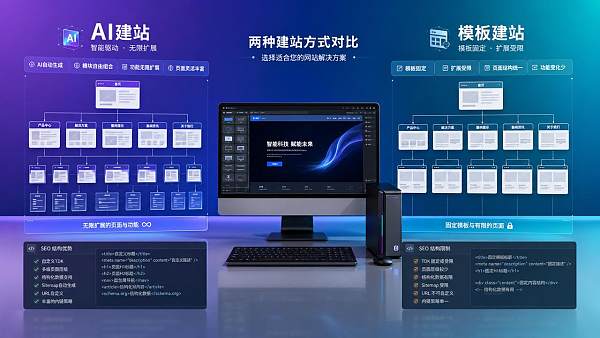
Users searching for “AI website building vs. template-based website building” are usually not simply trying to understand the concept, but want to determine the practical suitability of the two in real projects. For technical evaluators in particular, the core task is not to choose a solution that merely “looks more advanced,” but to assess its deployability, maintainability, and long-term growth potential.
From a decision-making perspective, such readers are most concerned about four questions: first, whether functional expansion is limited; second, whether launch efficiency can meet business pacing; third, whether the SEO foundation is reliable; and fourth, whether later maintenance and marketing coordination can save costs. These four points are what truly distinguish the two types of solutions.
Therefore, this article will not stop at the superficial comparison of “AI is smarter, templates are simpler,” but will instead examine three dimensions: functionality, efficiency, and post-launch SEO, helping technical evaluators build a clearer decision framework.
First, look at the essence: the underlying logic of AI website building and template-based website building is not the same
The core logic of template-based website building is to fill content into a predefined page framework. Its advantage lies in standardized paths: users only need to replace images, text, and basic modules to quickly generate a usable website. For businesses with limited budgets, fixed content, and low update frequency, this approach is simple and direct.
AI website building is different. It is not just about “automatically generating pages,” but uses content understanding, industry semantic recognition, and structural recommendations to help complete site framework construction, category planning, copy generation, multilingual adaptation, and marketing page configuration. It is more like a website system with strategic capabilities, rather than merely a template calling tool.
In other words, template-based website building is suitable for “getting a website built,” while AI website building is more suitable for “turning a website into a promotable, indexable, and convertible asset.” The difference is not at the visual layer, but in whether the system can support subsequent growth.
When comparing features, the key is not how many modules there are, but whether the expansion is flexible enough
Many solutions showcase a large number of components during demonstrations, but what technical evaluators really need to see is the system’s adaptability to complex business scenarios. A common issue with template-based website building is fixed modules and preset structures; it may seem sufficient in the early stage, but once multilingual, multi-region, multi-product-line, or lead-generation path adjustments are involved, problems such as inability to modify, poor layout compatibility, and weak reuse often emerge.
The advantage of AI website building usually lies in the flexibility of content structure and marketing logic. For example, when facing foreign trade businesses, the system can more quickly generate a website framework suitable for B2B lead generation; when facing cross-border brands, it can reorganize product categories, landing pages, and conversion paths. This capability is something traditional templates can hardly match.
For technical evaluators, several dimensions can be checked with priority: whether the URLs are customizable, whether page modules can be freely combined, whether product data can be imported in batches, whether different language pages can be optimized independently, and whether forms and conversion components support expansion. What truly affects later costs is often not “whether it can be built,” but “whether it will be easy to modify later.”
If a company still needs to coordinate with advertising, SEO content development, and overseas social media traffic generation later on, then the website should not merely be a display container, but should become the marketing hub. At that point, the system’s ability to link with data, content, and distribution becomes more important than the page style.
Launch efficiency should not be judged only by first-release speed, but also by later iteration efficiency
Template-based website building is usually faster for the initial launch, because the framework is fixed and the operating path is clear, making it suitable for short-cycle projects or temporary page needs. But this kind of efficiency often only exists at the “first launch” stage. Once new categories, language versions, landing page restructuring, or market-specific versioning are needed later, the efficiency advantage quickly declines.
The efficiency value of AI website building is more reflected in continuous iteration. The system can generate page drafts based on existing business information, produce initial copy in batches, adapt to different country-language versions, and help establish a more reasonable page structure. This not only saves design and editing time, but also reduces cross-department communication costs.
For enterprises that need long-term overseas promotion, this efficiency difference is very real. Website building is not a one-time delivery, but a continuous optimization process. Today you add content pages for SEO, tomorrow you add campaign pages for advertising, and the day after you need support for new market languages. If every change depends heavily on manual adjustments, the overall progress will be significantly constrained.
This is also why many companies, after building a website, place greater emphasis on advertising and site coordination. For example, in new market entry or long-term customer acquisition scenarios, if the site can work in tandem with tools such as AI+SEM advertising intelligent marketing system, it becomes much easier to manage keyword strategy, landing page content, and conversion data within the same growth loop.
Post-launch SEO performance is often where the biggest difference lies between AI website building and template-based website building
From an SEO perspective, the shortcoming of template-based website building is usually not that “it cannot be indexed,” but that it is “hard to optimize continuously.” Many template systems do support title, description, and category settings, but they impose many limitations in URL rules, tag systems, page hierarchy, internal link structure, and independent content page expansion, making SEO limited to basic operations and difficult to push further.
The SEO value of AI website building is first reflected in being structure-friendly. It is easier to build a clear information architecture according to search requirements, such as the hierarchical relationship between product pages, solution pages, case pages, industry pages, and FAQ pages, which is more aligned with how search engines understand content and also facilitates future keyword expansion.
Second is content production capability. Technical evaluators know that long-term SEO results depend not only on technical settings, but more importantly on the stable output of highly relevant content. Template-based website building usually relies on manual writing and manual publishing, while AI website building can assist in generating initial copy, multilingual pages, and topic content frameworks, significantly improving content production efficiency.
Third is maintainability. SEO is not a one-time configuration, but a long-term iteration process. If the system supports independent adjustment of titles, descriptions, H tags, image attributes, structured content, and internal linking strategies, it is better suited for ongoing optimization. Conversely, if every modification is constrained by the template, the SEO team will quickly run into operational bottlenecks.
For technical evaluators, the most important thing is not whether the system advertises “SEO support,” but whether it supports fine-grained control, batch page management, and long-term content expansion. These capabilities directly determine the website’s future organic traffic potential.
How to determine whether a business is more suitable for AI website building or template-based website building
If a business only needs a basic official website, has few content pages, and does not have an obvious need for multilingual support, SEO, or advertising plans in the short term, template-based website building is still the lower-cost choice. It is suitable for low-complexity, low-update-frequency, presentation-oriented lightweight scenarios.
But if the business targets foreign trade lead generation, cross-border advertising, or brand globalization, the website needs to take on responsibilities such as search indexing, ad landing, lead conversion, and content expansion, then AI website building is usually more appropriate. In such scenarios, the concern is not just building cost, but whether the website can become the foundation for long-term growth.
In particular, when technical evaluators are making a choice, the question should be reframed into three sentences: Will new languages and markets be added within the next year? Will SEO and advertising continue to be carried out? Will the page structure and content strategy need frequent adjustments? If two or more of these three answers are “yes,” then priority should be given to a more flexible AI website system.
In addition, it is necessary to see whether the service provider has comprehensive marketing collaboration capabilities. A tool that merely “generates pages” does not equal a solution truly suited to business growth. If the platform can also extend support for SEO, advertising, and data analysis, its overall value will be far higher than that of a single-purpose website-building tool. For example, in overseas promotion, the coordination between multilingual sites and advertising strategies is often more important than saving a bit of website-building time.
Conclusion: In the short term, templates save effort; in the long term, AI website building offers greater growth value
Taken as a whole, the difference between AI website building and template-based website building is not simply “one is smart, one is fixed.” The real difference is that template-based website building is oriented toward rapid delivery, while AI website building is oriented toward long-term operations; template-based systems are suitable for static display, while AI is more suitable for marketing growth; templates control page appearance, while AI optimizes website-building efficiency, content capabilities, and future SEO space.
For technical evaluators, the most reliable judgment method is not to look only at demo results, but to conduct a reverse evaluation based on the business growth needs of the next six months to one year. For any website project involving multilingual support, SEO expansion, advertising delivery, and continuous iteration, the comprehensive value of AI website building is usually higher.
If a business wants its website not only to go live, but also to be searched, clicked, and converted, then when choosing a solution, it should not focus only on first-release cost, but on whether the system truly supports subsequent growth. This is also the core to grasp when understanding the difference between AI website building and template-based website building.
Related Articles



Related Products
 EasyCamp SaaS Smart Website Marketing SystemE-Yingbao SaaS Smart Website Marketing System: AI-powered, zero-code website building. Rapidly launch multilingual independent e-commerce sites in just 10 minutes. Global server acceleration and AI-driven SEO optimization empower businesses to efficiently connect with global markets. The seamless integration of technology and user-friendly operation makes building e-commerce sites incredibly simple.
 AI+SEM Intelligent Advertising Marketing SystemAI+SEM drives intelligent ad creation, empowering full-funnel precision advertising marketing. The system automatically generates weekly/monthly reports, AI recommends keywords and target countries, monitors core metrics in real-time with intelligent alerts, and enables one-click high-conversion ad solutions to help quickly acquire customers and improve ROI.
 AI+SEO Dual Engine Optimization ServiceEasyWin AI+SEO Dual Engine Optimization System leverages AI-powered keyword mining, content generation, and comprehensive technical optimization to help foreign trade enterprises acquire high-quality organic traffic, significantly improving search rankings and conversion rates.
 AI+SNS Social Media Marketing SystemYingbao AI+SNS Social Media Marketing System - Precision social capture for the social media era. Supports one-click content synchronization across major platforms like Facebook and LinkedIn. AI intelligently rewrites posts for enhanced relevance. 24/7 AI customer service and user profiling analysis empower businesses to efficiently expand into global markets.
 AI+SEO营销解决方案易营宝AI+SEO营销解决方案,通过AI批量写作、智能生成TDK、精准关键词扩词等功能,全面优化网站SEO效果,提升流量与转化率。助力企业构建高效智能网站新生态。
 AI+SEM Advertising Marketing SolutionsAI+SEM Advertising Marketing Solution leverages AI technology to deeply empower SEM ad campaigns. It automatically generates weekly/monthly reports using AI, presenting account data across multiple dimensions for comprehensive insights into campaign performance and trends. The system precisely recommends keywords and target countries, intelligently generates high-conversion ad copy, and enables one-click activation of efficient campaign plans to help businesses rapidly acquire customers. Simultaneously, it monitors core metrics in real time, intelligently identifies abnormal fluctuations, and issues timely alerts to ensure stable, high-return advertising results.
 Domain Name ServicesEasyWin provides professional domain name services, including intelligent queries, one-stop registration, brand protection, and full lifecycle management, helping businesses build a digital brand image.
 EasyOperate B2C Cross-Border E-Commerce Platform & Independent WebsiteEasyStore B2C Cross-border E-commerce Independent Store is an intelligent website building and cross-border e-commerce integrated solution independently developed by EasyStore Information Technology (Beijing) Co., Ltd. The system is specially designed for small and medium-sized as well as large export enterprises, integrating 'website building, operation, marketing, advertising, and conversion' into one, helping enterprises quickly establish cross-border e-commerce independent stores to achieve brand globalization and global sales growth.
The platform supports multiple languages, multiple currencies, and multi-channel marketing, with built-in AI intelligent translation and SEO optimization systems, suitable for mainstream markets such as Southeast Asia, Europe and America, Latin America, and the Middle East, assisting Chinese manufacturing enterprises in efficiently deploying international e-commerce strategies. SSL证书易营宝提供专业SSL安全证书服务,包括单域名和泛域名证书,确保网站数据传输加密、身份验证和完整性保护,助力企业建立安全可信的在线业务环境。









