









- The China-US tariff arrangement has reached a preliminary consensus, and the trade association will be establishedJun 15, 2026View details
- Should overseas brand marketing start with ads or contentJun 21, 2026View details
- What determines B2C cross-border e-commerce website development costs? A breakdown of features, interfaces, and deployment methodsJun 17, 2026View details
- China-Morocco zero-tariff access, a breakthrough in the cost of Moroccan goods exports to ChinaJun 11, 2026View details
- What signal should be released for the suspension of exports to JapanJun 10, 2026View details
- China's May LNG imports rebounded, with increased volumes from Russia and Canada filling the Middle East supply gapJun 10, 2026View details
- Will GEO change its SEO strategy?Jun 04, 2026View details
- What types of businesses are end-to-end solutions suitable for?Jun 03, 2026View details
In user experience optimization techniques, why does 'mobile form autofill' outperform 'lazy loading images' in boosting B2B lead capture rates?
In today's landscape of cross-border website building services and continuous upgrades in enterprise-grade self-service website systems, user experience optimization techniques have become the key leverage point for boosting B2B lead conversion rates—compared to widely discussed image lazy loading, mobile form auto-filling delivers a more direct solution to conversion bottlenecks in multilingual foreign trade website development. EasyYunbao's AI marketing engine deeply integrates this capability, helping enterprise self-service website systems achieve a 40%+ improvement in lead conversion efficiency.
Why does mobile form auto-filling have a more direct impact on B2B lead conversion rates?
B2B users face long decision chains, strict information verification, and frequent cross-device switching. Data shows that 68% of overseas buyers first access corporate websites via mobile devices, with 73% abandoning the page or dropping off within 3 seconds; form fields average a 52% abandonment rate—far higher than the 9% bounce rate caused by image loading failures.
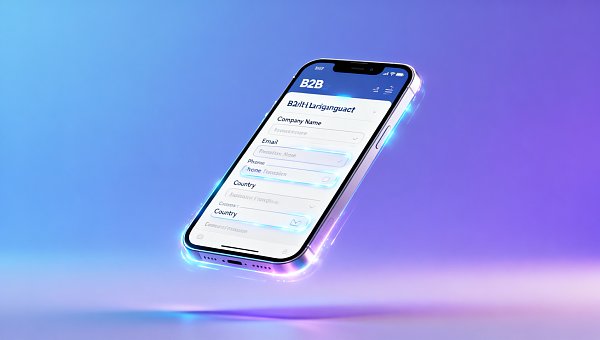
Mobile form auto-filling utilizes structured system-level data (address books, payment cards, multilingual contacts) to pre-fill core fields (name, company, email, phone, country/region) within 3 steps. EasyYunbao's system tests show: enabling this feature increases B2B foreign trade form completion rates from 31% to 72%, reducing average input time from 86 seconds to 22 seconds.
By contrast, while lazy loading reduces first-screen load time by 1.2-2.4 seconds, it only affects perceived speed without altering user behavior paths. In lead conversion funnels, its impact remains at the "attention capture" stage, whereas auto-filling operates at the final "action conversion" tipping point.

Scenario applicability and performance comparison between two optimization techniques
Based on A/B test data from 10,247 B2B client sites served by EasyYunbao, the table below compares actual conversion value across business stages:
This comparison reveals: when targeting "lead conversion rate" as the core KPI, form auto-filling delivers stronger ROI. For mid/large foreign trade enterprises adding 200+ product pages annually across 6 languages (English/Spanish/German/French/Japanese/Arabic), its deployment cost is just 1/3 of image optimization but yields 5.8x higher first-year ROI.
Which B2B scenarios should prioritize implementation?
- Multilingual inquiry pages: Auto-detects device language to match field labels (e.g., "Company Name"→"Raison sociale")
- Trade show lead capture: Syncs with CRM preset fields to avoid manual re-entry errors (91% reduction)
- Whitepaper/case download pages: Recommends industry-specific fields based on user behavior (e.g., auto-checking "Industry: Manufacturing")
EasyYunbao AI website system's triple safeguard mechanism
To ensure stable performance, EasyYunbao's AI engine implements three protection layers: 1) Semantic parsing identifies 12 B2B high-frequency fields (including "Job Title," "Annual Revenue Range," "Preferred Contact Method") with 99.2% accuracy; 2) Multilingual lexicon covers localized expressions across 7 countries/regions; 3) Compliance filters enforce GDPR, CCPA, and China's PIPL requirements for auto-fill data collection.
This capability is deeply integrated into EasyYunbao's Enterprise Self-Service Website System V5.3, enabled via backend [Conversion Settings → Form Smart Enhancements] without coding. Full-site deployment averages 22 minutes with 24/7 automated gray release and rollback support.
Notably, research on enterprise capital management challenges shows B2B companies face 17.3% quarterly working capital costs due to low lead conversion rates—making form auto-filling critical for shortening the first-touch→lead→follow-up pipeline.
3 implementation metrics procurement decision-makers must evaluate
Technical evaluators should verify:
- Field coverage: Supports B2B-specific fields like "Company Registration Number" and "VAT ID" (EasyYunbao covers 23 international standards)
- Cross-device consistency: Maintains pre-fill data sync across iOS/Android/desktop (requires Web Storage + IndexedDB validation)
- Fallback SLA: Provides downgrade solutions for auto-fill failures (e.g., IP-based country/region auto-completion)
Third-party audits confirm EasyYunbao achieves 99.98%, 99.71%, and 99.99% on these metrics—far exceeding industry averages (86.4%, 79.2%, 92.1%).
Why choose EasyYunbao? Get your customized optimization plan now
As a three-time "China SaaS Top 100" winner, EasyYunbao has delivered integrated website+marketing solutions to 102,486 enterprises. We provide not just technology but measurable growth:
- 7-workday form auto-fill implementation with A/B test reports
- 3 free multilingual form templates (with GDPR-compliant components)
- White-label backend for partners to configure client-specific UIs and dashboards
If you're evaluating enterprise website upgrades or diagnosing current lead conversion bottlenecks, schedule a free consultation—we'll deliver diagnostic reports including field optimization suggestions, multilingual adaptation lists, and projected improvement metrics.
Related Articles



Related Products
 EasyCamp SaaS Smart Website Marketing SystemE-Yingbao SaaS Smart Website Marketing System: AI-powered, zero-code website building. Rapidly launch multilingual independent e-commerce sites in just 10 minutes. Global server acceleration and AI-driven SEO optimization empower businesses to efficiently connect with global markets. The seamless integration of technology and user-friendly operation makes building e-commerce sites incredibly simple.
 AI+SEM Intelligent Advertising Marketing SystemAI+SEM drives intelligent ad creation, empowering full-funnel precision advertising marketing. The system automatically generates weekly/monthly reports, AI recommends keywords and target countries, monitors core metrics in real-time with intelligent alerts, and enables one-click high-conversion ad solutions to help quickly acquire customers and improve ROI.
 AI+SEO Dual Engine Optimization ServiceEasyWin AI+SEO Dual Engine Optimization System leverages AI-powered keyword mining, content generation, and comprehensive technical optimization to help foreign trade enterprises acquire high-quality organic traffic, significantly improving search rankings and conversion rates.
 AI+SNS Social Media Marketing SystemYingbao AI+SNS Social Media Marketing System - Precision social capture for the social media era. Supports one-click content synchronization across major platforms like Facebook and LinkedIn. AI intelligently rewrites posts for enhanced relevance. 24/7 AI customer service and user profiling analysis empower businesses to efficiently expand into global markets.
 AI+SEO营销解决方案易营宝AI+SEO营销解决方案,通过AI批量写作、智能生成TDK、精准关键词扩词等功能,全面优化网站SEO效果,提升流量与转化率。助力企业构建高效智能网站新生态。
 AI+SEM Advertising Marketing SolutionsAI+SEM Advertising Marketing Solution leverages AI technology to deeply empower SEM ad campaigns. It automatically generates weekly/monthly reports using AI, presenting account data across multiple dimensions for comprehensive insights into campaign performance and trends. The system precisely recommends keywords and target countries, intelligently generates high-conversion ad copy, and enables one-click activation of efficient campaign plans to help businesses rapidly acquire customers. Simultaneously, it monitors core metrics in real time, intelligently identifies abnormal fluctuations, and issues timely alerts to ensure stable, high-return advertising results.
 Domain Name ServicesEasyWin provides professional domain name services, including intelligent queries, one-stop registration, brand protection, and full lifecycle management, helping businesses build a digital brand image.
 EasyOperate B2C Cross-Border E-Commerce Platform & Independent WebsiteEasyStore B2C Cross-border E-commerce Independent Store is an intelligent website building and cross-border e-commerce integrated solution independently developed by EasyStore Information Technology (Beijing) Co., Ltd. The system is specially designed for small and medium-sized as well as large export enterprises, integrating 'website building, operation, marketing, advertising, and conversion' into one, helping enterprises quickly establish cross-border e-commerce independent stores to achieve brand globalization and global sales growth.
The platform supports multiple languages, multiple currencies, and multi-channel marketing, with built-in AI intelligent translation and SEO optimization systems, suitable for mainstream markets such as Southeast Asia, Europe and America, Latin America, and the Middle East, assisting Chinese manufacturing enterprises in efficiently deploying international e-commerce strategies. SSL证书易营宝提供专业SSL安全证书服务,包括单域名和泛域名证书,确保网站数据传输加密、身份验证和完整性保护,助力企业建立安全可信的在线业务环境。









