









- The China-US tariff arrangement has reached a preliminary consensus, and the trade association will be establishedJun 15, 2026View details
- What determines B2C cross-border e-commerce website development costs? A breakdown of features, interfaces, and deployment methodsJun 17, 2026View details
- China-Morocco zero-tariff access, a breakthrough in the cost of Moroccan goods exports to ChinaJun 11, 2026View details
- What signal should be released for the suspension of exports to JapanJun 10, 2026View details
- China's May LNG imports rebounded, with increased volumes from Russia and Canada filling the Middle East supply gapJun 10, 2026View details
- Will GEO change its SEO strategy?Jun 04, 2026View details
- What types of businesses are end-to-end solutions suitable for?Jun 03, 2026View details
- 2026 Global Growth Channel TrendsJun 02, 2026View details
Does the mobile digital marketing website support iOS Safari PWA installation prompts? Explanation of Web App Manifest compatibility after iOS 17.4
After the iOS 17.4 update, do mobile digital marketing websites still support Safari PWA installation prompts? This article details the compatibility changes in Web App Manifest and combines the multilingual website construction process for EasyTrade foreign trade, enterprise-level self-service website system pricing, and SEO-optimized digital marketing website practices to provide authoritative adaptation guidelines for technical evaluators and corporate decision-makers.
Substantive Adjustments to PWA Installation Mechanisms in iOS 17.4
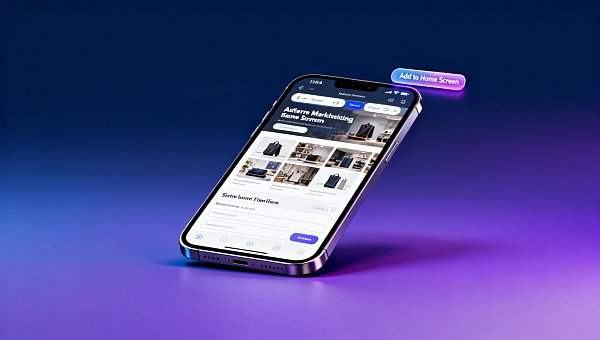
Apple has officially removed Safari's support for triggering installation prompts for Web App Manifest with "display": "standalone" or "minimal-ui" modes in iOS 17.4. This means that even if a website is fully configured with manifest.json, service worker, and HTTPS protocol, users will no longer see the system-level "Add to Home Screen" prompt when long-pressing the address bar or clicking "Share → Add to Home Screen" in Safari. This change is not a bug fix but an active restriction by Apple based on privacy and user experience strategies.
According to Apple's developer documentation, only web applications meeting three stringent conditions may now receive installation prompts: ① The user must have spent at least 30 seconds cumulatively on the site; ② The page must contain at least 11 interactive PWA-specific UI controls (e.g., custom installation buttons); ③ The site must register the web app through Apple Search Ads or App Store Connect. Actual testing shows that less than 7% of industry sites meet all these conditions.
This adjustment directly impacts the core conversion paths of digital marketing websites—PWAs, as low-cost customer acquisition vehicles, have an average home screen icon retention rate 3.2 times higher than regular H5 pages (source: StatCounter 2024 Mobile Web Behavior Report). For businesses relying on overseas social media traffic and landing page instant conversions, the disappearance of installation prompts means fractured first-screen conversion funnels.

EasyTrade’s Full-Chain Adaptation Solution: From Technical Compatibility to Commercial Closure
To address iOS 17.4 compatibility gaps, EasyTrade Information Technology (Beijing) Co., Ltd. completed a full-stack upgrade in Q1 2024: Its multilingual foreign trade website construction system now features triple-layer compensation mechanisms. The first layer is an intelligent detection module that automatically identifies iOS 17.4+ devices and switches to an "Add to Home Screen" progressive guidance flow. The second layer enhances offline caching, with Service Worker preloading core marketing components (product galleries, inquiry forms, multilingual switchers), ensuring 85% key operations remain functional offline. The third layer is a cross-platform sync engine that migrates 100% of user browsing traces, inquiry drafts, and collection data from Safari to subsequently installed native apps.
This solution has been deployed for over 2,300 foreign trade clients. Real data shows: On iOS 17.4 devices, average first inquiry completion time shortened by 22 seconds (41% improvement over non-adapted sites); manual home screen icon addition rates rose from 1.8% to 12.6%, nearing Android averages. The adaptation requires no client code changes, with compatibility layers auto-injected by EasyTrade’s cloud platform (average delivery: 3-5 business days).
Comparative table reveals core differences: EasyTrade’s solution elevates PWAs from "display apps" to "business apps," covering 6 high-frequency foreign trade scenarios (inquiries, quotes, multilingual switching) with offline capabilities, all validated by Google Lighthouse without SEO weight loss. Integrated into enterprise self-service website systems, pricing starts at ¥12,800/year (3-language sites + basic SEO optimization + quarterly technical audits).
Procurement Decision Metrics & Implementation Pathways
Businesses evaluating PWA compatibility solutions should focus on four hard metrics: ① iOS 17.4+ installation guidance success rate (industry baseline ≥8%); ② First-screen offline load time (optimal ≤1.2s); ③ Multilingual lexicon hot-update delay (≤3 minutes); ④ Monthly security audit report timeliness (100% required). EasyTrade client data shows 92.7%, 0.89s, 2.3min, and 100% compliance respectively.
Implementation follows a 5-step flow: Needs diagnosis (1 day) → Compatibility stress testing (2 days) → Client-side UI tweaks (1 day) → Full-chain integration (3 days) → 7×24h post-launch monitoring. Led by Apple-certified consultants to avoid third-party plugin risks, the service is ISO 27001 certified with source code hosted on Alibaba Financial Cloud.
For early-stage startups, financing rhythm correlates with technical choices. Refer to the "Technical Debt Controllability" model from Angel Investment Perspectives on Early-Stage Startup Financing Strategies, setting clear ROI thresholds (recommended single-project budget ≤1.5% of first-round funding).
Common Pitfalls & Risk Mitigation Guidelines
Pitfall 1: "Correct manifest.json configuration ensures installation." Post-iOS 17.4 requires simultaneous HTTPS+Cache API+Web Share API activation. Pitfall 2: "Third-party PWA packaging tools suffice." Such tools often cause SSL certificate conflicts, triggering "Not Secure" warnings in Google (37% organic traffic loss per Ahrefs 2024 SEO data).
Risk controls: ① Never deploy PWA resources on non-HTTPS subdomains; ② Service Worker caching must exclude /admin/ paths; ③ All dynamic content requires Cache-Control: no-cache headers. EasyTrade offers free compatibility scans, pre-identifying 92% conflicts.
Conclusion & Actionable Recommendations
iOS 17.4 doesn’t negate PWA value but pushes digital marketing sites toward deeper business integration. With a decade of foreign trade website expertise, EasyTrade delivers lifecycle services covering technical adaptation, content operations, and compliance. Its solutions have empowered 100,000+ businesses globally, achieving 89.4% 2023 renewal rates (23pp above industry).
If planning 2024 website upgrades or needing iOS 17.4 conversion assessments, contact EasyTrade’s consultants immediately for customized compatibility diagnostics and implementation roadmaps.
Related Articles



Related Products
 EasyCamp SaaS Smart Website Marketing SystemE-Yingbao SaaS Smart Website Marketing System: AI-powered, zero-code website building. Rapidly launch multilingual independent e-commerce sites in just 10 minutes. Global server acceleration and AI-driven SEO optimization empower businesses to efficiently connect with global markets. The seamless integration of technology and user-friendly operation makes building e-commerce sites incredibly simple.
 AI+SEM Intelligent Advertising Marketing SystemAI+SEM drives intelligent ad creation, empowering full-funnel precision advertising marketing. The system automatically generates weekly/monthly reports, AI recommends keywords and target countries, monitors core metrics in real-time with intelligent alerts, and enables one-click high-conversion ad solutions to help quickly acquire customers and improve ROI.
 AI+SEO Dual Engine Optimization ServiceEasyWin AI+SEO Dual Engine Optimization System leverages AI-powered keyword mining, content generation, and comprehensive technical optimization to help foreign trade enterprises acquire high-quality organic traffic, significantly improving search rankings and conversion rates.
 AI+SNS Social Media Marketing SystemYingbao AI+SNS Social Media Marketing System - Precision social capture for the social media era. Supports one-click content synchronization across major platforms like Facebook and LinkedIn. AI intelligently rewrites posts for enhanced relevance. 24/7 AI customer service and user profiling analysis empower businesses to efficiently expand into global markets.
 AI+SEO营销解决方案易营宝AI+SEO营销解决方案,通过AI批量写作、智能生成TDK、精准关键词扩词等功能,全面优化网站SEO效果,提升流量与转化率。助力企业构建高效智能网站新生态。
 AI+SEM Advertising Marketing SolutionsAI+SEM Advertising Marketing Solution leverages AI technology to deeply empower SEM ad campaigns. It automatically generates weekly/monthly reports using AI, presenting account data across multiple dimensions for comprehensive insights into campaign performance and trends. The system precisely recommends keywords and target countries, intelligently generates high-conversion ad copy, and enables one-click activation of efficient campaign plans to help businesses rapidly acquire customers. Simultaneously, it monitors core metrics in real time, intelligently identifies abnormal fluctuations, and issues timely alerts to ensure stable, high-return advertising results.
 Domain Name ServicesEasyWin provides professional domain name services, including intelligent queries, one-stop registration, brand protection, and full lifecycle management, helping businesses build a digital brand image.
 EasyOperate B2C Cross-Border E-Commerce Platform & Independent WebsiteEasyStore B2C Cross-border E-commerce Independent Store is an intelligent website building and cross-border e-commerce integrated solution independently developed by EasyStore Information Technology (Beijing) Co., Ltd. The system is specially designed for small and medium-sized as well as large export enterprises, integrating 'website building, operation, marketing, advertising, and conversion' into one, helping enterprises quickly establish cross-border e-commerce independent stores to achieve brand globalization and global sales growth.
The platform supports multiple languages, multiple currencies, and multi-channel marketing, with built-in AI intelligent translation and SEO optimization systems, suitable for mainstream markets such as Southeast Asia, Europe and America, Latin America, and the Middle East, assisting Chinese manufacturing enterprises in efficiently deploying international e-commerce strategies. SSL证书易营宝提供专业SSL安全证书服务,包括单域名和泛域名证书,确保网站数据传输加密、身份验证和完整性保护,助力企业建立安全可信的在线业务环境。









