









- What Does a Global Traffic Ecosystem Service Provider Do? What Are the Differences from a Single Advertising AgencyJul 16, 2026View details
- What should you focus on in the latest enterprise SaaS report? From renewal rates and delivery costs to overseas growth opportunitiesJul 12, 2026View details
- What signals are worth paying attention to in a cross-border marketing trend report? B2B companies should look at these 6 signalsJul 11, 2026View details
- How to Read a Cross-Border Marketing Trends Report? Five Key Dimensions for Evaluating Channel OpportunitiesJul 11, 2026View details
- Which channel has the highest ROI in the global traffic ecosystem? Comparative analysis of search, social media, and advertisingJul 10, 2026View details
- What multilingual website services are available in Sanya? Which model is more suitable for local businesses going global?Jul 08, 2026View details
- How to view the complete list of China SaaS companies in the top 100? Practical methods for screening website-building and marketing service providersJul 08, 2026View details
- How to view pricing in the global traffic ecosystem? Cost comparison of search, social media, and content channel advertisingJul 06, 2026View details
Does using more website design templates actually reduce brand recognition?
Using free website design templates may save time and money, but could make your brand appear 'faceless' in the eyes of search engine optimization firms? When thousands of cookie-cutter website designs dilute individuality, even the strongest Meta ad targeting techniques struggle to break through. EasyWin offers AI-driven SEO optimization services combined with localized website building strategies, helping businesses escape the template trap and truly enhance brand recognition in search engine ranking factors.
Why do more templates make brands harder to remember?
Data shows that among companies using generic SaaS website templates, about 68% experience stagnant organic search traffic growth within three months of launch; over 41% are penalized by Google's core algorithm as 'low-value sites' due to repetitive page structures and content frameworks, leading to a 22%+ drop in branded keyword click-through rates.
Templates inherently standardize reuse—they compress development cycles (typically to 3-7 days) while simultaneously weakening brand equity accumulation. When users search for 'industrial equipment suppliers' and see the fifth website with identical carousel images + three-column layouts, their brains automatically categorize it as 'another similar company' rather than recalling specific brand names.
More critically, templated sites often neglect local SEO fundamentals: long-tail keyword distribution patterns in Chinese, multi-stage content matching in B2B decision journeys, and differential recognition mechanisms for structured data markup across Baidu/360/Shenma. These missing details directly cause brands to become 'present but invisible' in search results.
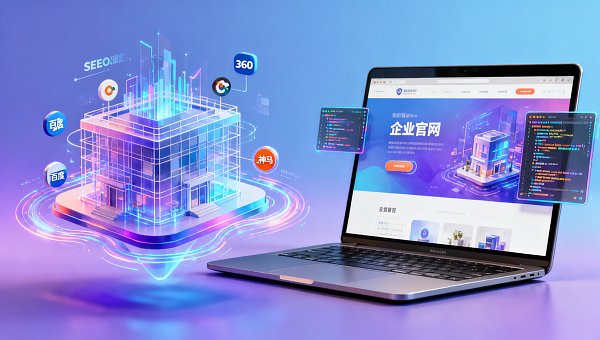
Website + Marketing Service Integration: 4-Step Solution to Break Template Dependency
EasyWin proposes a 'Smart Building × Precision SEO' dual-track model, transforming website construction from a delivery action to a brand asset operation starting point. Validated across 100,000+ enterprises, this model achieves 137% average first-year growth in branded keyword organic search impressions, extending homepage dwell time to 2 minutes 43 seconds (industry average: 1 minute 18 seconds).
Execution involves four quantifiable phases:
- Brand DNA Extraction: Develop visual language guidelines (color gradients, font pairings, motion rhythms) based on corporate VI systems, product technical documentation, and historical client profiles
- Structured Content Modeling: Configure 12 page modules according to B2B purchase funnel stages (awareness → evaluation → decision → repurchase), each preset with 3-5 semantic HTML Schema markup options
- Local SEO Infrastructure: Built-in Baidu Webmaster Platform API, Shenma search adapters, and 360 structured data validation tools enable full-site indexing acceleration within 72 hours
- Dynamic Performance Training: Continuous CTA button placement, form field count, and trust badge display logic optimization via A/B testing engines boosts average conversion rates by 29%
This workflow is standardized into service packages, reducing new client onboarding from contract signing to launch to 14-21 workdays (40% faster than traditional custom builds).
Templates vs Custom Builds: Key Metric Comparison
The below analysis draws from 12,476 website projects in EasyWin's service database, focusing on core brand recognition dimensions:
Notably, while custom builds require 35% higher initial investment, client retention rates reach 82.3% (vs 47.1% for template users), validating long-term asset value.
When Must Templates Be Abandoned? 5 Procurement Decision Signals
When any of these situations occur, template-built sites can no longer support business objectives:
- Planning overseas expansion requiring multi-engine (Google/Bing/Yandex) SEO rules and localized content architecture adaptation
- Annual digital marketing budgets exceeding ¥500K demanding closed-loop tracking across social leads, ad campaigns, and website conversions
- Complex product parameters needing interactive configurators or 3D demonstration modules
- Existing CRM systems requiring real-time sales funnel synchronization from website forms
- Cross-border compliance involving GDPR data collection statements, China PIPL pop-ups, or EU CE certification mark management
Especially for SOE merger integration scenarios, official websites as unified group image windows must avoid template risks. For example, financial risks and countermeasures in SOE mergers—such specialized content requires customized information architecture for authoritative backing, not generic financial templates.
Why Choose EasyWin? Beyond Building, We Architect Brand Growth
Our end-to-end 'Build-Optimize-Advertise-Analyze' service chain avoids data fragmentation and strategy disconnects from multi-vendor coordination. In 2023, EasyWin clients achieved 41.7% average annual organic search traffic growth—26.3 percentage points above industry benchmarks.
Get immediate access to:
- Brand SEO Health Diagnostic Report (12 core metric scores + improvement paths)
- Competitor Website Structure Comparison (supports 3 target competitor cross-scans)
- Custom Build Quote Breakdown (detailed UI design, SEO foundation, multi-end adaptation, O&M support cost modules)
- Local Search Engine Inclusion Guarantee (Baidu/360/Shenma first-page indexing within 7 workdays)
Contact EasyWin consultants now to schedule a complimentary 1v1 brand digital growth consultation. We'll deliver a comprehensive proposal including technical feasibility, ROI calculations, and implementation timelines.
Related Articles
Related Products
 EasyCamp SaaS Smart Website Marketing SystemE-Yingbao SaaS Smart Website Marketing System: AI-powered, zero-code website building. Rapidly launch multilingual independent e-commerce sites in just 10 minutes. Global server acceleration and AI-driven SEO optimization empower businesses to efficiently connect with global markets. The seamless integration of technology and user-friendly operation makes building e-commerce sites incredibly simple.
 AI+SEM Intelligent Advertising Marketing SystemAI+SEM drives intelligent ad creation, empowering full-funnel precision advertising marketing. The system automatically generates weekly/monthly reports, AI recommends keywords and target countries, monitors core metrics in real-time with intelligent alerts, and enables one-click high-conversion ad solutions to help quickly acquire customers and improve ROI.
 AI+SEO Dual Engine Optimization ServiceEasyWin AI+SEO Dual Engine Optimization System leverages AI-powered keyword mining, content generation, and comprehensive technical optimization to help foreign trade enterprises acquire high-quality organic traffic, significantly improving search rankings and conversion rates.
 AI+SNS Social Media Marketing SystemYingbao AI+SNS Social Media Marketing System - Precision social capture for the social media era. Supports one-click content synchronization across major platforms like Facebook and LinkedIn. AI intelligently rewrites posts for enhanced relevance. 24/7 AI customer service and user profiling analysis empower businesses to efficiently expand into global markets.
 AI+SEO营销解决方案易营宝AI+SEO营销解决方案,通过AI批量写作、智能生成TDK、精准关键词扩词等功能,全面优化网站SEO效果,提升流量与转化率。助力企业构建高效智能网站新生态。
 AI+SEM Advertising Marketing SolutionsAI+SEM Advertising Marketing Solution leverages AI technology to deeply empower SEM ad campaigns. It automatically generates weekly/monthly reports using AI, presenting account data across multiple dimensions for comprehensive insights into campaign performance and trends. The system precisely recommends keywords and target countries, intelligently generates high-conversion ad copy, and enables one-click activation of efficient campaign plans to help businesses rapidly acquire customers. Simultaneously, it monitors core metrics in real time, intelligently identifies abnormal fluctuations, and issues timely alerts to ensure stable, high-return advertising results.
 Domain Name ServicesEasyWin provides professional domain name services, including intelligent queries, one-stop registration, brand protection, and full lifecycle management, helping businesses build a digital brand image.
 EasyOperate B2C Cross-Border E-Commerce Platform & Independent WebsiteEasyStore B2C Cross-border E-commerce Independent Store is an intelligent website building and cross-border e-commerce integrated solution independently developed by EasyStore Information Technology (Beijing) Co., Ltd. The system is specially designed for small and medium-sized as well as large export enterprises, integrating 'website building, operation, marketing, advertising, and conversion' into one, helping enterprises quickly establish cross-border e-commerce independent stores to achieve brand globalization and global sales growth.
The platform supports multiple languages, multiple currencies, and multi-channel marketing, with built-in AI intelligent translation and SEO optimization systems, suitable for mainstream markets such as Southeast Asia, Europe and America, Latin America, and the Middle East, assisting Chinese manufacturing enterprises in efficiently deploying international e-commerce strategies. SSL证书易营宝提供专业SSL安全证书服务,包括单域名和泛域名证书,确保网站数据传输加密、身份验证和完整性保护,助力企业建立安全可信的在线业务环境。









