









- What Does a Global Traffic Ecosystem Service Provider Do? What Are the Differences from a Single Advertising AgencyJul 16, 2026View details
- What should you focus on in the latest enterprise SaaS report? From renewal rates and delivery costs to overseas growth opportunitiesJul 12, 2026View details
- What signals are worth paying attention to in a cross-border marketing trend report? B2B companies should look at these 6 signalsJul 11, 2026View details
- How to Read a Cross-Border Marketing Trends Report? Five Key Dimensions for Evaluating Channel OpportunitiesJul 11, 2026View details
- Which channel has the highest ROI in the global traffic ecosystem? Comparative analysis of search, social media, and advertisingJul 10, 2026View details
- What multilingual website services are available in Sanya? Which model is more suitable for local businesses going global?Jul 08, 2026View details
- How to view the complete list of China SaaS companies in the top 100? Practical methods for screening website-building and marketing service providersJul 08, 2026View details
- How to view pricing in the global traffic ecosystem? Cost comparison of search, social media, and content channel advertisingJul 06, 2026View details
How to Choose a Website Traffic Analytics Tool More Efficiently
When facing challenges such as fragmented data, complex attribution, and low collaboration efficiency, technical evaluators should pay more attention to accuracy, scalability, and practical value when selecting website traffic analytics tools. This article combines real-world scenarios to help you efficiently identify a solution that is better suited to business growth.
Why technical evaluators always make costly mistakes when choosing website traffic analytics tools
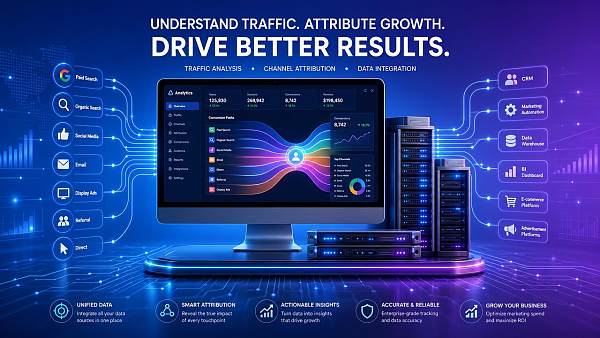
In the integrated website + marketing service scenario, a website traffic analytics tool is not merely a simple visitor statistics software. It needs to simultaneously serve website building, SEO optimization, social media marketing, advertising, and lead conversion, requiring visibility not only into traffic volume, but also source quality, behavior paths, and conversion results.
The reason many technical evaluators struggle with selection is not the sheer number of tools, but the lack of unified evaluation criteria. Business departments look at campaign performance, technical departments focus on deployment difficulty, and management looks at return on cost, which ultimately easily leads to the problem of “many features, but few that are truly usable”.
Common misjudgments are mainly concentrated in three areas
- Only focusing on whether the reporting interface is intuitive, while ignoring tagging rules, cross-domain tracking, and the depth of event collection, resulting in distorted data later on.
- Only comparing purchase price, without evaluating the integration costs with existing website systems, advertising platforms, and customer management systems.
- Only looking at short-term traffic monitoring, without considering long-term attribution, channel optimization, and growth analysis capabilities, making it difficult for the tool to support continuous decision-making after launch.
For companies that need to support global marketing, website traffic analytics tools must also take into account multi-region access quality, data compliance, page performance monitoring, and team collaboration permission management, which is also why many basic tools are not up to the task.
How to choose a website traffic analytics tool: first look at these five core dimensions
If technical evaluators want to improve decision-making efficiency, it is recommended to first establish a unified evaluation framework. The table below is suitable for the initial screening of website traffic analytics tools and can directly correspond to the concerns of technical, operations, and management teams.
Among these five items, data accuracy and scalable integration capabilities usually determine first whether a tool is worth further evaluation. Because once the underlying collection logic of a website traffic analytics tool is unstable, no matter how many attribution models and operational analyses are done later, the conclusions may still deviate from the real business situation.
Recommended evaluation sequence
- First sort out existing data sources, including websites, landing pages, advertising accounts, forms, customer service, and CRM.
- Then confirm key conversion events, such as inquiry submissions, material downloads, demo bookings, phone clicks, etc.
- Finally, let shortlisted tools undergo small-scale validation, prioritizing the testing of cross-channel attribution and event collection stability.
In different business scenarios, the requirements for website traffic analytics tools are not the same
One point that technical evaluators easily overlook is that there is no single best solution for website traffic analytics tools, only solutions that better match the current business. Integrated website + marketing service projects often simultaneously face brand presentation, customer acquisition conversion, and multi-channel advertising, so the requirements are naturally more complex.
The scenario table below can help teams quickly determine which capabilities should be prioritized, rather than spreading effort evenly across all functions.
If a company handles both brand presentation and customer acquisition, then the website traffic analytics tool must support closed-loop judgment from page experience to lead conversion. When serving global growth projects over the long term, EasyABM usually places website structure, content entry points, advertising paths, and conversion actions under the same analytical framework, making evaluation results closer to actual business performance.
What to focus on during procurement: beyond technical parameters, implementation matters more
When evaluating website traffic analytics tools, many teams are used to first asking, “Does it have this feature?” But what technical evaluation really needs to ask is: “How is this feature deployed, who maintains it, how long before it delivers results, and how are errors corrected?” This determines whether the tool can be put into stable use.
Recommended implementation points to review重点核查的实施要点
- Whether the tagging method is flexible. Pure code-based tagging is suitable for complex scenarios, but the maintenance threshold is relatively high; visual tagging is quick to get started with, but it is necessary to confirm whether it covers key events.
- Whether hierarchical permission settings are supported. Marketing, operations, technical teams, and management need to see different data, and confusing permissions will affect collaboration and security.
- Whether reports can be customized. A unified template may not suit all teams, especially lead-generation businesses that need customized funnels and conversion grouping.
- Whether anomaly monitoring is timely. The earlier issues such as sudden traffic drops, lost channel tagging, and failed form events are flagged, the lower the cost of repair.
If a corporate website carries the task of premium brand presentation, it is also necessary to evaluate whether the analytics tool can support experience optimization based on page performance. For example, on websites related to design, decoration, and architecture, visual hierarchy, full-screen browsing, and content rhythm directly affect inquiry conversion. For site solutions such as interior design, decoration, architecture, which emphasize immersive full-screen page-flipping interactions, panoramic Banners, and precise grid layouts, technical evaluation should pay special attention to scroll depth, hover behavior, asset loading, and mobile interaction data, rather than only looking at PV and UV.
How to evaluate cost so you do not just save on procurement fees while increasing long-term costs
The real cost of a website traffic analytics tool usually goes beyond software fees. If technical evaluators only focus on the annual fee, they are very likely to overlook expenses for integration, maintenance, training, data cleansing, and secondary development. Especially in a multi-channel marketing environment, hidden costs are often higher than the purchase price.
The table below is suitable for assessing total cost of ownership and can help companies compare the difference between “cheap but hard to use” and “higher investment but capable of building long-term capabilities”.
In the long run, a truly cost-effective website traffic analytics tool should reduce manual reconciliation, shorten troubleshooting time, and help optimize advertising and page conversions. As long as it can continuously reduce invalid traffic and wrong decisions, the overall investment is often more controllable.
Why integrated services are more suitable for complex business environments
For a single website project, independently deploying a website traffic analytics tool may be enough. But when a company is simultaneously involved in website building, SEO, social media, advertising, and overseas promotion, isolated tools often cannot answer one key question: which type of investment is actually bringing high-quality growth.
Since its establishment in 2013, EasyABM Information Technology (Beijing) Co., Ltd. has continuously built global digital marketing service capabilities around artificial intelligence and big data. Its advantage lies not only in deploying tools, but in reviewing intelligent website building, SEO optimization, social media marketing, advertising, and data analytics within the same chain, making technical evaluation results closer to business execution outcomes.
Integrated solutions usually bring three types of practical benefits
- Reducing data breakpoints. Website structure, content entry points, advertising sources, and form conversions can be uniformly tagged and uniformly interpreted.
- Improving execution efficiency. Technical teams do not need to repeatedly deploy and verify across multiple platforms, and marketing teams can more easily read reports based on the same criteria.
- Supporting growth optimization. Analysis no longer stops at “what traffic was seen,” but goes further to answer “why conversions are good” and “what to improve next”.
This is especially important for websites that focus on brand quality. For example, presentation-oriented websites involving multiple visual styles such as brown, black, and white, and emphasizing asymmetrical dynamic layouts, dynamic hover modules, and fully responsive interactions, require an analytics system that can turn “visual experience” into “behavioral data”; otherwise, design investment is difficult to validate effectively.
FAQ: the four most common questions before purchasing website traffic analytics tools
1. Which companies should prioritize deploying website traffic analytics tools?
Any company that relies on its official website for customer acquisition, content marketing, advertising, or multi-channel traffic generation should deploy website traffic analytics tools as early as possible. Especially for teams that need to measure SEO value, lead sources, and page conversion performance, it is difficult to make accurate budget decisions without a stable data system.
2. During procurement, should the focus be on the number of features or data quality?
Prioritize data quality, then evaluate feature fit. If there are many features but inaccurate collection, it will only increase management complexity in the end. It is recommended to first verify whether core events, cross-channel attribution, and conversion feedback are stable, and then assess advanced reporting and automation capabilities.
3. How long does it usually take to launch a website traffic analytics tool?
The timeline depends on the number of websites, page complexity, and data objectives. A simple corporate website may complete basic deployment relatively quickly, but if it involves multiple websites, overseas pages, advertising platform linkage, and CRM integration, then more complete event planning, testing, and acceptance processes are required. During the technical evaluation stage, delivery boundaries should be confirmed in advance.
4. What are the common misconceptions?
The most common misconceptions include only looking at traffic volume without looking at valid leads; only buying the tool without implementing rules; only doing one-time deployment without long-term validation. For complex business environments, website traffic analytics tools must be designed together with website strategy, content planning, and marketing campaigns so that results can be released steadily.
Why choose us
If you are evaluating website traffic analytics tools and want to balance website-building efficiency, marketing collaboration, and growth results, EasyABM can provide integrated support that is closer to actual business implementation. We can help organize indicator systems, confirm tagging solutions, optimize attribution logic, and evaluate integration difficulty with existing systems around corporate websites, landing pages, SEO, social media, and advertising paths.
You can focus your consultation on the following: whether parameters meet the existing website structure, how product selection matches budget and expansion plans, how delivery timelines should be arranged, whether customized reports and permission systems are needed, data management requirements in overseas business scenarios, and how to ensure analytical continuity after page revamps.
If you also need to simultaneously optimize the performance of presentation-oriented websites, you can further learn about the adaptation approach of interior design, decoration, architecture related solutions in premium visual expression and interaction analytics. By linking website construction and data analytics in advance, technical evaluation is no longer just about choosing a tool, but about establishing executable, verifiable, and iterative foundational capabilities for subsequent growth.
Related Articles



Related Products
 EasyCamp SaaS Smart Website Marketing SystemE-Yingbao SaaS Smart Website Marketing System: AI-powered, zero-code website building. Rapidly launch multilingual independent e-commerce sites in just 10 minutes. Global server acceleration and AI-driven SEO optimization empower businesses to efficiently connect with global markets. The seamless integration of technology and user-friendly operation makes building e-commerce sites incredibly simple.
 AI+SEM Intelligent Advertising Marketing SystemAI+SEM drives intelligent ad creation, empowering full-funnel precision advertising marketing. The system automatically generates weekly/monthly reports, AI recommends keywords and target countries, monitors core metrics in real-time with intelligent alerts, and enables one-click high-conversion ad solutions to help quickly acquire customers and improve ROI.
 AI+SEO Dual Engine Optimization ServiceEasyWin AI+SEO Dual Engine Optimization System leverages AI-powered keyword mining, content generation, and comprehensive technical optimization to help foreign trade enterprises acquire high-quality organic traffic, significantly improving search rankings and conversion rates.
 AI+SNS Social Media Marketing SystemYingbao AI+SNS Social Media Marketing System - Precision social capture for the social media era. Supports one-click content synchronization across major platforms like Facebook and LinkedIn. AI intelligently rewrites posts for enhanced relevance. 24/7 AI customer service and user profiling analysis empower businesses to efficiently expand into global markets.
 AI+SEO营销解决方案易营宝AI+SEO营销解决方案,通过AI批量写作、智能生成TDK、精准关键词扩词等功能,全面优化网站SEO效果,提升流量与转化率。助力企业构建高效智能网站新生态。
 AI+SEM Advertising Marketing SolutionsAI+SEM Advertising Marketing Solution leverages AI technology to deeply empower SEM ad campaigns. It automatically generates weekly/monthly reports using AI, presenting account data across multiple dimensions for comprehensive insights into campaign performance and trends. The system precisely recommends keywords and target countries, intelligently generates high-conversion ad copy, and enables one-click activation of efficient campaign plans to help businesses rapidly acquire customers. Simultaneously, it monitors core metrics in real time, intelligently identifies abnormal fluctuations, and issues timely alerts to ensure stable, high-return advertising results.
 Domain Name ServicesEasyWin provides professional domain name services, including intelligent queries, one-stop registration, brand protection, and full lifecycle management, helping businesses build a digital brand image.
 EasyOperate B2C Cross-Border E-Commerce Platform & Independent WebsiteEasyStore B2C Cross-border E-commerce Independent Store is an intelligent website building and cross-border e-commerce integrated solution independently developed by EasyStore Information Technology (Beijing) Co., Ltd. The system is specially designed for small and medium-sized as well as large export enterprises, integrating 'website building, operation, marketing, advertising, and conversion' into one, helping enterprises quickly establish cross-border e-commerce independent stores to achieve brand globalization and global sales growth.
The platform supports multiple languages, multiple currencies, and multi-channel marketing, with built-in AI intelligent translation and SEO optimization systems, suitable for mainstream markets such as Southeast Asia, Europe and America, Latin America, and the Middle East, assisting Chinese manufacturing enterprises in efficiently deploying international e-commerce strategies. SSL证书易营宝提供专业SSL安全证书服务,包括单域名和泛域名证书,确保网站数据传输加密、身份验证和完整性保护,助力企业建立安全可信的在线业务环境。









