









- What signals are worth paying attention to in a cross-border marketing trend report? B2B companies should look at these 6 signalsJul 11, 2026View details
- How to Read a Cross-Border Marketing Trends Report? Five Key Dimensions for Evaluating Channel OpportunitiesJul 11, 2026View details
- Which channel has the highest ROI in the global traffic ecosystem? Comparative analysis of search, social media, and advertisingJul 10, 2026View details
- What multilingual website services are available in Sanya? Which model is more suitable for local businesses going global?Jul 08, 2026View details
- How to view the complete list of China SaaS companies in the top 100? Practical methods for screening website-building and marketing service providersJul 08, 2026View details
- How to view pricing in the global traffic ecosystem? Cost comparison of search, social media, and content channel advertisingJul 06, 2026View details
- How to assess foreign trade website development trends?Looking at 2026 changes from multilingual,AI content to conversion pathsJul 04, 2026View details
- What are the new trends in multilingual marketing data analytics tools in 2026? Focus on attribution、automation and complianceJul 04, 2026View details
Website SEO Optimization Tutorial: From Indexing to Ranking
This website SEO optimization tutorial will help you systematically understand the core logic from indexing to ranking, enabling operations personnel to quickly master keyword placement, content optimization, and technical details, thereby improving the website's visibility and conversion performance in search engines.
When many operations personnel work on SEO, the most common issue is not that they do not know how to publish content, but that they do not understand why pages are not indexed, why they do not rank after being indexed, and why there are still no inquiries after ranking.
If you search for “website SEO optimization tutorial”, the core intent is usually not to understand concepts, but to find a practical path that can be executed, troubleshot, and deliver visible results.
For execution-level readers, the three things they often care about most are: whether search engines can crawl the page, whether the page matches user needs, and whether the website as a whole has the foundation to continuously improve rankings.
Therefore, this article will not explain all SEO concepts evenly, but will focus on the main line of “indexing—optimization—ranking” to help you build a truly practical methodological framework.
First, clarify this: why is the website not being indexed, or why is indexing very slow?
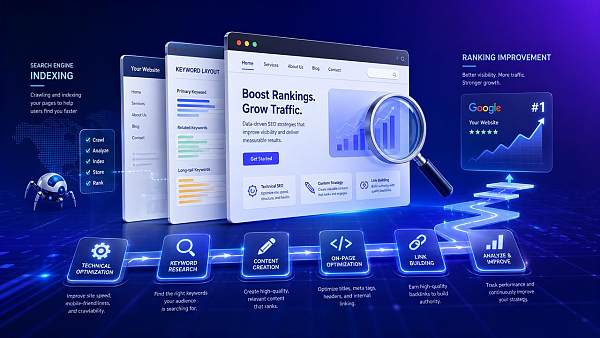
The first step of SEO is not ranking, but first letting search engines discover you, crawl you, and understand you. Without indexing, there is basically no point in discussing the subsequent keyword placement and backlink building.
When a website is not indexed, the reasons usually focus on several areas: the page is inaccessible, the structure is too deep, the content is highly duplicated, the page value is weak, internal links are insufficient, or the robots settings are incorrect.
In practice, it is recommended to first check whether the website can open stably, then confirm whether a sitemap has been submitted, and at the same time verify whether important pages have been blocked by nofollow, noindex, or incorrect restrictions.
If it is a new website, slow indexing is not necessarily abnormal. Common problems with new websites are limited content volume, unclear themes, and low update frequency, which make it difficult for search engines to quickly assess the site's quality.
For corporate websites, having the homepage indexed does not mean inner pages are healthy. What truly affects SEO performance is often whether product pages, service pages, case pages, and article pages can steadily enter the index database.
In practical execution, you can prioritize three things: improve the website navigation structure, add internal links between category pages and content pages, and continuously publish original content centered around business-related topics.
From indexing to ranking, how exactly should keyword placement be done?
When many people create a website SEO optimization tutorial, they tend to focus on “how many times a keyword appears”, but what truly affects rankings is whether the page fully responds to the corresponding search demand.
The core of keyword placement is not keyword stuffing, but establishing the page topic. A page is best centered around one primary keyword, while expanding the content with several related long-tail keywords.
For example, the primary keyword can be “website SEO optimization tutorial”, while related terms can extend to directions such as “what to do if website indexing is slow”, “methods to improve SEO rankings”, and “on-page optimization process”.
The benefit of doing this is that search engines can understand the page topic more accurately, and users can also obtain more complete answers within a single piece of content after entering the page, thereby reducing bounce rate.
In terms of page layout, keywords should be placed with priority in the title, opening paragraph, subheadings, image alt descriptions, key positions in the body text, and the concluding summary, but they must all appear naturally.
If one page tries to target too many keywords at the same time, the result is usually a scattered topic and unfocused content, which affects both search engine judgment and user reading experience and conversion efficiency.
Execution teams can create a simple keyword list, dividing keywords into brand terms, business terms, question terms, and regional terms, and then mapping them respectively to the homepage, category pages, topic pages, and article pages.
Content optimization is not about publishing more articles, but about solving users' real problems
Many websites update for a long time but still do not rank. The essential reason is not insufficient quantity, but that the content provides no incremental information, or merely rewrites surface-level concepts repeatedly.
An effective SEO content piece should at least answer what users most want to know at the moment: what it is, why it matters, how to do it, common mistakes, and how to judge whether it is effective.
Taking a corporate website as an example, articles should not just say “SEO is very important”, but should instead address topics such as “why a page is not indexed”, “how to write titles that are more likely to get clicks”, and “how to build internal links for category pages”.
When content can directly solve execution problems, page dwell time, engagement data, and conversion probability will all improve, and this is also an important reference for search engines to judge page value.
In terms of content structure, it is recommended to present the conclusion first, then explain the method, and finally supplement the details. This better matches the reading habits of search users and also helps improve page readability.
If you are responsible for an integrated website and marketing project, you can also combine SEO content with business knowledge to enhance the professionalism and scenario value of the article.
For example, when enterprises are advancing digital operations, it is not only the marketing department that needs content capabilities; finance, HR, and management roles are also being reshaped by AI, and this type of trend content is equally worth paying attention to.
For related extended reading, you may refer to The Reconstruction of Core Competencies of Corporate Finance Personnel Driven by Artificial Intelligence, which helps in understanding the relationship between job capability upgrading in the AI era and enterprise digital collaboration.
What technical SEO details should be checked, and what do execution personnel most easily overlook?
Technical SEO is not necessarily complicated, but it often determines whether your previous efforts can be fully received by search engines. Many websites have decent content, yet get stuck at the technical foundation level.
First, check whether the URL is concise and clear. Too many dynamic parameters, overly deep hierarchy, and multiple addresses for the same content may all cause crawl waste and duplicate indexing issues.
Second, check mobile adaptation. A large amount of search traffic now comes from mobile devices, and if pages load slowly, have messy layouts, or have buttons that are hard to click, both rankings and conversions will be affected.
Page speed is also a core factor. Oversized images, redundant scripts, and slow server response will all affect crawl efficiency and user experience, and new websites are especially vulnerable to this.
Then there is structured layout, including standardized title, description, H tag hierarchy, breadcrumb navigation, related article recommendations, and a clear internal linking system.
Many execution personnel tend to overlook orphan pages, dead links, redirect chains, and duplicate title issues. Although these details are not obvious, they can continuously drag down overall SEO performance.
If the website has many pages, it is recommended to conduct a regular site health check, form a problem list, and handle issues in the order of “accessibility—crawlability—understandability—rankability”.
Why is it that there is indexing and content, but rankings still do not improve?
A page being indexed only means it has entered the search engine's index database; it does not mean it is high enough in quality, or more worthy of ranking ahead of competitors.
Common reasons rankings do not improve include excessively high keyword competition, unfocused page topics, insufficient content depth, weak user behavior data, and a relatively low site authority foundation.
At this time, do not rush to frequently change titles. A more effective approach is to first look at what problems the pages currently ranking ahead are solving, and then compare the gaps in your own content.
If others provide steps, cases, diagrams, and tool lists, while your page only contains conceptual introductions, then even with the same keywords, it will still be difficult for your ranking to truly catch up.
Another key point is internal link voting. If a high-value page does not have enough internal entry points, it is difficult for search engines to judge its importance within the entire website.
External links also play a role, but corporate websites do not need to pursue a large number of backlinks from the very beginning. First solidify the website structure, content quality, and page conversion logic, and the results are usually more stable.
For websites under long-term operation, you can review keyword ranking changes quarterly and focus optimization on pages that “have impressions but no clicks” and “have clicks but no conversions”.
A set of SEO workflows suitable for execution teams is recommended to be implemented like this
If you hope to truly turn this website SEO optimization tutorial into daily work, you can break SEO into fixed processes instead of doing whatever comes to mind.
The first step is to conduct a page inventory. Clearly define what keyword goals are undertaken by the homepage, service pages, product pages, case pages, and information pages respectively, and whether there is duplicate positioning.
The second step is to build a keyword and content mapping table. Each page should target only one core topic, avoiding multiple pages competing for the same keyword and causing internal competition within the site.
The third step is to optimize pages by priority. Prioritize high-conversion pages, high-impression low-click pages, and content that has been indexed but has shown no ranking improvement for a long time.
The fourth step is to establish an update mechanism. Compared with publishing many articles at one time, it is more important to continuously output content that is helpful to target users and highly relevant to the business.
The fifth step is to track data. At a minimum, pay attention to indexing volume, keyword rankings, organic traffic, page dwell time, bounce rate, and conversion behavior, rather than focusing only on a single ranking.
When you view SEO as a systematic project of “search demand matching + website foundation optimization + continuous content operation”, the results are often more stable than fragmented optimization.
Summary: SEO is not a pile of tricks, but about making a website easier to be found, understood, and chosen
From indexing to ranking, truly effective SEO is not about one particular trick suddenly taking effect, but the result of long-term alignment among content, structure, technology, and user needs.
For operators, what matters most is not memorizing many terms, but learning how to judge: why a page is not indexed, why users do not click, and why content does not convert.
As long as you first solve the website's crawlability issues, and then properly handle keyword placement, content optimization, and technical detail checks, SEO results will usually accumulate gradually.
This is also the most worthwhile core logic to master in a website SEO optimization tutorial: first get the page into the search engine's field of view, then make the content truly match search intent, and finally strive for stable rankings and business growth.
Related Articles
 What signals are worth paying attention to in a cross-border marketing trend report? B2B companies should look at these 6 signals
 How to Read a Cross-Border Marketing Trends Report? Five Key Dimensions for Evaluating Channel Opportunities
 Which channel has the highest ROI in the global traffic ecosystem? Comparative analysis of search, social media, and advertising



Related Products
 EasyCamp SaaS Smart Website Marketing SystemE-Yingbao SaaS Smart Website Marketing System: AI-powered, zero-code website building. Rapidly launch multilingual independent e-commerce sites in just 10 minutes. Global server acceleration and AI-driven SEO optimization empower businesses to efficiently connect with global markets. The seamless integration of technology and user-friendly operation makes building e-commerce sites incredibly simple.
 AI+SEM Intelligent Advertising Marketing SystemAI+SEM drives intelligent ad creation, empowering full-funnel precision advertising marketing. The system automatically generates weekly/monthly reports, AI recommends keywords and target countries, monitors core metrics in real-time with intelligent alerts, and enables one-click high-conversion ad solutions to help quickly acquire customers and improve ROI.
 AI+SEO Dual Engine Optimization ServiceEasyWin AI+SEO Dual Engine Optimization System leverages AI-powered keyword mining, content generation, and comprehensive technical optimization to help foreign trade enterprises acquire high-quality organic traffic, significantly improving search rankings and conversion rates.
 AI+SNS Social Media Marketing SystemYingbao AI+SNS Social Media Marketing System - Precision social capture for the social media era. Supports one-click content synchronization across major platforms like Facebook and LinkedIn. AI intelligently rewrites posts for enhanced relevance. 24/7 AI customer service and user profiling analysis empower businesses to efficiently expand into global markets.
 AI+SEO营销解决方案易营宝AI+SEO营销解决方案,通过AI批量写作、智能生成TDK、精准关键词扩词等功能,全面优化网站SEO效果,提升流量与转化率。助力企业构建高效智能网站新生态。
 AI+SEM Advertising Marketing SolutionsAI+SEM Advertising Marketing Solution leverages AI technology to deeply empower SEM ad campaigns. It automatically generates weekly/monthly reports using AI, presenting account data across multiple dimensions for comprehensive insights into campaign performance and trends. The system precisely recommends keywords and target countries, intelligently generates high-conversion ad copy, and enables one-click activation of efficient campaign plans to help businesses rapidly acquire customers. Simultaneously, it monitors core metrics in real time, intelligently identifies abnormal fluctuations, and issues timely alerts to ensure stable, high-return advertising results.
 Domain Name ServicesEasyWin provides professional domain name services, including intelligent queries, one-stop registration, brand protection, and full lifecycle management, helping businesses build a digital brand image.
 EasyOperate B2C Cross-Border E-Commerce Platform & Independent WebsiteEasyStore B2C Cross-border E-commerce Independent Store is an intelligent website building and cross-border e-commerce integrated solution independently developed by EasyStore Information Technology (Beijing) Co., Ltd. The system is specially designed for small and medium-sized as well as large export enterprises, integrating 'website building, operation, marketing, advertising, and conversion' into one, helping enterprises quickly establish cross-border e-commerce independent stores to achieve brand globalization and global sales growth.
The platform supports multiple languages, multiple currencies, and multi-channel marketing, with built-in AI intelligent translation and SEO optimization systems, suitable for mainstream markets such as Southeast Asia, Europe and America, Latin America, and the Middle East, assisting Chinese manufacturing enterprises in efficiently deploying international e-commerce strategies. SSL证书易营宝提供专业SSL安全证书服务,包括单域名和泛域名证书,确保网站数据传输加密、身份验证和完整性保护,助力企业建立安全可信的在线业务环境。









