









- The China-US tariff arrangement has reached a preliminary consensus, and the trade association will be establishedJun 15, 2026View details
- What determines B2C cross-border e-commerce website development costs? A breakdown of features, interfaces, and deployment methodsJun 17, 2026View details
- China-Morocco zero-tariff access, a breakthrough in the cost of Moroccan goods exports to ChinaJun 11, 2026View details
- What signal should be released for the suspension of exports to JapanJun 10, 2026View details
- China's May LNG imports rebounded, with increased volumes from Russia and Canada filling the Middle East supply gapJun 10, 2026View details
- Will GEO change its SEO strategy?Jun 04, 2026View details
- What types of businesses are end-to-end solutions suitable for?Jun 03, 2026View details
- 2026 Global Growth Channel TrendsJun 02, 2026View details
How much does a foreign trade website cost? Cost structure, quotation differences, and budget allocation methods
How much does a foreign trade website cost? Don’t just look at the quotation sheet first
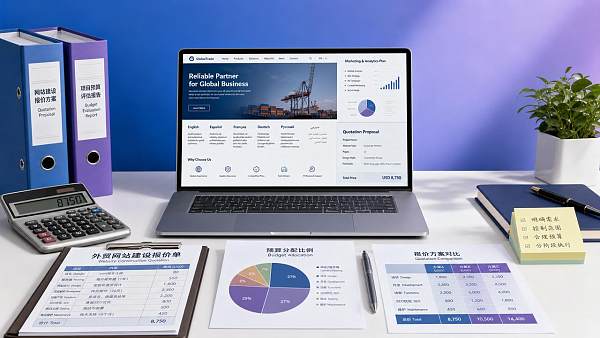
How much does a foreign trade website cost? This is the first question many companies ask before starting a project. But once you truly enter the procurement stage, you will quickly find that quotations can range from a few thousand to tens of thousands, or even over one hundred thousand, with a huge gap.
The reason is not complicated. A foreign trade website is not a single-page product, but a business tool that integrates website building, content, technology, promotion, and conversion. They may all be called websites, but the actual delivery scope can be completely different.
If you only choose based on the lowest approval amount, you often end up with problems such as missing multilingual content, weak SEO foundations, poor inquiry conversion, and high modification costs. The result is that you save budget up front, but keep adding investment later.
Therefore, when judging how much a foreign trade website costs, you should look more at whether the total investment matches your business goals. For procurement decisions, the key is not cheapness, but whether the budget is clear, controllable, and capable of delivering results.
What are the components of foreign trade website development costs?
In actual procurement, how much a foreign trade website costs is usually determined by six parts. Breaking these six items down helps prevent your budget from being off the mark.
- Website planning cost: includes industry research, information architecture, user journey design, and content planning.
- Visual design cost: includes homepage style, inner page specifications, brand image consistency, and responsive adaptation.
- Front-end and back-end development cost: involves page development, form functions, admin management, speed optimization, and security configuration.
- Multilingual version cost: the more languages there are, the higher the localization requirements, and the more obvious the price differences.
- Basic marketing setup cost: such as SEO structure, data tracking, conversion forms, landing pages, and inquiry tracking.
- Ongoing maintenance cost: domain names, servers, content updates, vulnerability fixes, and operational support.
For a simple showcase website, the cost is often concentrated in design and launch. For a marketing-oriented foreign trade website, more of the cost goes into SEO, conversion pathways, and multi-channel customer acquisition preparation. This is also the core reason for price differences.
Why do different service providers quote such different prices?
Many people see two proposals with not much difference in page count, yet find that the total price differs by several times. Usually, this is not because one side is giving random quotes, but because the delivery logic is different.
The first type of difference comes from the website-building approach. Template websites have low costs and launch quickly, but limited scalability. Custom websites require higher investment, but are better suited for long-term promotion and brand building.
The second type of difference comes from marketing capabilities. Some service providers only handle “getting the site built,” while others also consider Google SEO, ad landing pages, mobile experience, and inquiry conversion. Such solutions naturally cost more.
The third type of difference comes from the underlying system. Self-developed platforms, cloud deployment, security protection, access speed, and data statistics interfaces may not be very visible at first, but they directly affect later operating costs.
From this perspective, when asking how much a foreign trade website costs, you should not compare only the total price; you should also compare whether it includes planning, content, SEO, data, and after-sales support. Only when the delivery items are aligned can the quotations be truly comparable.
Common budget ranges and which types of companies they suit
To understand more intuitively how much a foreign trade website costs, the common market solutions can be divided into three ranges.
In most cases, the mid-range is easier to balance budget and results. Too low, and you may sacrifice later promotion capability. Too high, and if there is no clear growth plan, it may also lead to idle resources.
How to allocate your budget for better approval and implementation
When asking how much a foreign trade website costs, the real challenge is not the price itself, but how to allocate the budget. A practical approach is to divide the total budget into “build investment” and “growth investment.”
If a company’s current main task is to first establish an overseas official website, it is recommended to allocate 60% to 70% of the budget to basic website construction, and reserve 30% to 40% for post-launch SEO, ad testing, and content updates.
If a company already has a website but the inquiry performance is average, it is more suitable to control the reconstruction cost and allocate more budget to page conversion optimization, keyword layout, and traffic collaboration.
- 30% for basic design and technical deployment.
- 20% for multilingual and content localization.
- 20% for SEO structure and search visibility layout.
- 20% for landing pages and conversion tracking.
- 10% for maintenance, iteration, and risk reserves.
This allocation method has one advantage: it makes approval easier to understand the investment logic, and during execution it is less likely that the budget will be spent all at once with no room left for growth.
The three hidden costs most often overlooked during procurement
When discussing how much a foreign trade website costs, many companies miss hidden costs. It may seem like a money-saving move, but in reality it often raises the total cost later on.
The first is modification cost. Early on, a less suitable platform may be chosen just to save money, and later the structure has to be rebuilt, systems changed, and content migrated, often costing more than the original build.
The second is customer acquisition cost. If the website lacks an SEO foundation, loads slowly, or has a poor form experience, even if advertising continues later, conversion efficiency will remain low and traffic spend will keep increasing.
The third is collaboration cost. When design, website building, SEO, and ad placement are split among multiple service providers, communication becomes longer, responsibility boundaries become unclear, and the project progress slows significantly.
This is also why more and more companies prefer integrated website and marketing service solutions. Planning front-end construction and back-end growth together is often more conducive to controlling the overall budget.
How to judge whether a service provider’s quotation is worth approving
Before approval, you can quickly assess whether a quotation is reliable with four questions. The method is simple, but very effective.
- Does the quotation break down planning, design, development, content, SEO, and maintenance?
- Are delivery standards clearly defined, such as language quantity, page quantity, functional scope, and launch timeline?
- Does it consider the usage scenarios after promotion, instead of only guaranteeing that the site “can go live”?
- Does it provide support for subsequent iteration and data review?
If a proposal can clearly explain the technology, marketing, and growth path, then even if the price is slightly higher, it is usually easier to achieve long-term returns. Conversely, the more vague the quotation is, the greater the likelihood of additional costs later.
Some managers, when reviewing digital investment, also refer to other cost-control ideas, such as the segment verification logic mentioned in Common issues and countermeasure analysis in project settlement audit. Although the scenarios are different, they are very helpful for identifying budget leakage.
If you want your money to be well spent, focus on long-term growth capability
Back to the original question: how much does a foreign trade website cost? There is no single answer. The truly reasonable price depends on what the company wants this website to achieve: brand display, continuous customer acquisition, short-term launch, or long-term growth.
For AI-driven enterprise-level SaaS intelligent website building and overseas marketing platforms like Yi Ying Bao, the website, SEO, advertising, social media, and AI search visibility are usually considered within the same growth pathway. The value of doing this is not just building a site, but making the website capable of being found, visited, and turned into inquiries.
Therefore, when evaluating how much a foreign trade website costs, it is recommended to shift the focus from “one-time purchase price” to “annual customer acquisition cost” and “continuous conversion capability.” Clarify the cost structure, align the delivery boundaries, and reserve promotion budget, and the decision will be more stable and the final investment more likely to be truly worthwhile.
If you are about to start a comparison, it may be better to first list your language requirements, promotion plan, content scope, and annual goals, and then ask service providers to quote by module. This makes it easier to judge how much a foreign trade website costs and what is reasonable, and it is also more conducive to later implementation.
Related Articles



Related Products
 EasyCamp SaaS Smart Website Marketing SystemE-Yingbao SaaS Smart Website Marketing System: AI-powered, zero-code website building. Rapidly launch multilingual independent e-commerce sites in just 10 minutes. Global server acceleration and AI-driven SEO optimization empower businesses to efficiently connect with global markets. The seamless integration of technology and user-friendly operation makes building e-commerce sites incredibly simple.
 AI+SEM Intelligent Advertising Marketing SystemAI+SEM drives intelligent ad creation, empowering full-funnel precision advertising marketing. The system automatically generates weekly/monthly reports, AI recommends keywords and target countries, monitors core metrics in real-time with intelligent alerts, and enables one-click high-conversion ad solutions to help quickly acquire customers and improve ROI.
 AI+SEO Dual Engine Optimization ServiceEasyWin AI+SEO Dual Engine Optimization System leverages AI-powered keyword mining, content generation, and comprehensive technical optimization to help foreign trade enterprises acquire high-quality organic traffic, significantly improving search rankings and conversion rates.
 AI+SNS Social Media Marketing SystemYingbao AI+SNS Social Media Marketing System - Precision social capture for the social media era. Supports one-click content synchronization across major platforms like Facebook and LinkedIn. AI intelligently rewrites posts for enhanced relevance. 24/7 AI customer service and user profiling analysis empower businesses to efficiently expand into global markets.
 AI+SEO营销解决方案易营宝AI+SEO营销解决方案,通过AI批量写作、智能生成TDK、精准关键词扩词等功能,全面优化网站SEO效果,提升流量与转化率。助力企业构建高效智能网站新生态。
 AI+SEM Advertising Marketing SolutionsAI+SEM Advertising Marketing Solution leverages AI technology to deeply empower SEM ad campaigns. It automatically generates weekly/monthly reports using AI, presenting account data across multiple dimensions for comprehensive insights into campaign performance and trends. The system precisely recommends keywords and target countries, intelligently generates high-conversion ad copy, and enables one-click activation of efficient campaign plans to help businesses rapidly acquire customers. Simultaneously, it monitors core metrics in real time, intelligently identifies abnormal fluctuations, and issues timely alerts to ensure stable, high-return advertising results.
 Domain Name ServicesEasyWin provides professional domain name services, including intelligent queries, one-stop registration, brand protection, and full lifecycle management, helping businesses build a digital brand image.
 EasyOperate B2C Cross-Border E-Commerce Platform & Independent WebsiteEasyStore B2C Cross-border E-commerce Independent Store is an intelligent website building and cross-border e-commerce integrated solution independently developed by EasyStore Information Technology (Beijing) Co., Ltd. The system is specially designed for small and medium-sized as well as large export enterprises, integrating 'website building, operation, marketing, advertising, and conversion' into one, helping enterprises quickly establish cross-border e-commerce independent stores to achieve brand globalization and global sales growth.
The platform supports multiple languages, multiple currencies, and multi-channel marketing, with built-in AI intelligent translation and SEO optimization systems, suitable for mainstream markets such as Southeast Asia, Europe and America, Latin America, and the Middle East, assisting Chinese manufacturing enterprises in efficiently deploying international e-commerce strategies. SSL证书易营宝提供专业SSL安全证书服务,包括单域名和泛域名证书,确保网站数据传输加密、身份验证和完整性保护,助力企业建立安全可信的在线业务环境。









