









- What multilingual website services are available in Sanya? Which model is more suitable for local businesses going global?Jul 08, 2026View details
- How to view the complete list of China SaaS companies in the top 100? Practical methods for screening website-building and marketing service providersJul 08, 2026View details
- How to view pricing in the global traffic ecosystem? Cost comparison of search, social media, and content channel advertisingJul 06, 2026View details
- How to assess foreign trade website development trends?Looking at 2026 changes from multilingual,AI content to conversion pathsJul 04, 2026View details
- What are the new trends in multilingual marketing data analytics tools in 2026? Focus on attribution、automation and complianceJul 04, 2026View details
- Is Brand Globalization Marketing Consulting Worth Buying? At What Stage Should Companies Bring It InJul 01, 2026View details
Kevin Warsh assumes office as Chair of the Federal Reserve, emphasizing independence and inflation control
On May 22, 2026, Kevin Warsh was officially sworn in as Chair of the Federal Reserve, clearly placing inflation control above the goal of economic growth. This move signals that the cycle of elevated U.S. benchmark interest rates may be prolonged, directly affecting global buyers' price sensitivity and payment decision-making pace, and having a substantive impact on companies involved in foreign trade exports, cross-border settlement, and multi-currency pricing.
Event Overview
On May 22, 2026, Kevin Warsh completed the swearing-in ceremony at the White House and formally assumed the role of Chair of the Federal Reserve. Public reports show that in his inaugural remarks, he repeatedly emphasized the independence of Federal Reserve policy and stated that 'the current top priority is to ensure that inflation continues to fall back to the 2% target range,' without mentioning early rate cuts or any shift toward supporting growth.
Which Sub-Sectors Will Be Affected
Direct Trading Enterprises
As U.S. dollar interest rates remain high, overseas buyers face rising financing costs and stricter budget approvals, significantly increasing requirements for quote stability and transparency in payment terms; the impact is mainly reflected in lower order conversion rates, longer price negotiation cycles, and higher order abandonment rates.
Raw Material Procurement Enterprises
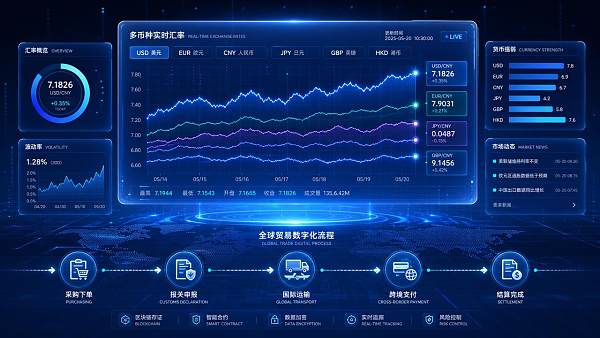
A stronger U.S. dollar, combined with depreciation pressure on the import country's local currency, leads to greater volatility in the procurement costs of upstream raw materials priced in U.S. dollars; the impact is mainly reflected in widening procurement budget deviations, a stronger need for forward foreign exchange hedging, and increased difficulty in negotiating supplier credit terms.
Processing and Manufacturing Enterprises
Most orders use U.S. dollar settlement terms such as FOB or CIF, and exchange rate fluctuations directly erode gross profit margins; the impact is mainly reflected in greater uncertainty in profit calculations, more frequent customer price pressure, and increased demand for negotiating exchange rate risk-sharing clauses in contracts.
Channel Distribution Enterprises
Distributors serving end markets in multiple countries must simultaneously respond to differences in collection cycles across currencies and local compliant quotation requirements; the impact is mainly reflected in lagging multi-currency inventory pricing, untimely updates to localized pricing pages, and rising consumer complaint rates.
Supply Chain Service Enterprises
Institutions providing settlement, credit insurance, logistics finance, and other services are facing a surge in customer demand for value-added services such as exchange rate risk alerts and staged payment protection; the impact is mainly reflected in insufficient adaptation of existing SaaS tool modules and increased complexity in customer service response.
What Key Points Should Relevant Enterprises or Practitioners Focus On, and How Should They Respond Now
Pay attention to the timing of subsequent public statements by Federal Reserve officials and the release of meeting minutes
What deserves more attention at present is the direction of officials' speeches before the June FOMC meeting, especially the frequency of keywords such as 'inflation stickiness' and 'signs of cooling in the labor market.' Such wording will help verify whether the interest rate path is truly shifting toward 'higher for longer.'
Prioritize verification of the data sources and update mechanism of the official website's multi-currency quotation engine
From an analytical perspective, if quotations still rely on manual entry or a T+1 foreign exchange rate interface, it will be difficult to meet buyers' basic requirements for real-time updates and traceability; it is recommended to verify whether the current system is connected to authoritative bank-grade APIs and supports automatic matching of local currencies and tax-inclusive price displays based on the customer's country.
Embed pop-up explanations of exchange rate fluctuation impacts at key transaction touchpoints
Observations show that the time overseas buyers spend on the order page is positively correlated with the professionalism of the pop-up content; it is recommended to set concise prompts on the shopping cart checkout page and contract generation page (for example: 'The current USD/CNY exchange rate has changed by ±1.2% compared with your last visit, and the total amount of this order may fluctuate by about $XXX') to avoid disputes afterward.
Sort out and visualize the execution logic of staged payment terms
From an industry perspective, the structure of 30% deposit + 40% before shipment + 30% upon presentation of the copy of the bill of lading is no longer sufficient to cover exchange rate risks; it is recommended to embed, in the form of a process chart, the corresponding currency for each stage, the party responsible for exchange rate locking, and the compensation mechanism for overdue unpaid exchange rate differences into the contract preview page, so as to enhance buyer trust and willingness to perform the contract.
Editorial Viewpoint / Industry Observation
Observably, this personnel appointment itself does not constitute a policy shift, but its public stance reinforces the signal of policy continuity in 'prioritizing anti-inflation'; it is more appropriately understood as a re-anchoring of market expectations rather than the immediate implementation of a policy. There has not yet been any rate hike action, but the market has already begun to reprice the midpoint of U.S. dollar funding costs for the next 12–18 months. What the industry needs to keep watching is how policy signals are transmitted to end-market procurement behavior—for example, whether small and medium-sized importers in North America generally shorten payment terms, and whether European buyers increase the proportion of euro-denominated quote inquiries.
Conclusion:
Kevin Warsh's appointment as Chair of the Federal Reserve is essentially a confirmatory event regarding the policy baseline. Its industry significance lies not in immediately changing interest rate levels, but in extending the market's adaptation cycle to a high-interest-rate environment. For foreign trade-related enterprises, it is more appropriate at present to view this as an opportunity for a systematic stress test: to examine their actual maturity in areas such as multi-currency operations, exchange rate risk communication, and contract clause design, rather than waiting for the external environment to improve.
Source note:
Main sources: official White House appointment announcement, news release on the Federal Reserve official website (2026-05-22);
Items for continued observation: June FOMC meeting minutes, updates to the Federal Reserve's Summary of Economic Projections (SEP), and the release of survey data on procurement behavior among importers in major economies.
Related Articles
 What should you think about before redesigning your company website? Category structure, conversion goals, and migration risks.
 What Determines Responsive Website Development Costs? Page Count, Functionality, and Language Versions Are Key
 Is responsive design absolutely necessary for cross-border e-commerce independent websites? Analysis of factors influencing mobile conversion rates.



Related Products
 EasyCamp SaaS Smart Website Marketing SystemE-Yingbao SaaS Smart Website Marketing System: AI-powered, zero-code website building. Rapidly launch multilingual independent e-commerce sites in just 10 minutes. Global server acceleration and AI-driven SEO optimization empower businesses to efficiently connect with global markets. The seamless integration of technology and user-friendly operation makes building e-commerce sites incredibly simple.
 AI+SEM Intelligent Advertising Marketing SystemAI+SEM drives intelligent ad creation, empowering full-funnel precision advertising marketing. The system automatically generates weekly/monthly reports, AI recommends keywords and target countries, monitors core metrics in real-time with intelligent alerts, and enables one-click high-conversion ad solutions to help quickly acquire customers and improve ROI.
 AI+SEO Dual Engine Optimization ServiceEasyWin AI+SEO Dual Engine Optimization System leverages AI-powered keyword mining, content generation, and comprehensive technical optimization to help foreign trade enterprises acquire high-quality organic traffic, significantly improving search rankings and conversion rates.
 AI+SNS Social Media Marketing SystemYingbao AI+SNS Social Media Marketing System - Precision social capture for the social media era. Supports one-click content synchronization across major platforms like Facebook and LinkedIn. AI intelligently rewrites posts for enhanced relevance. 24/7 AI customer service and user profiling analysis empower businesses to efficiently expand into global markets.
 AI+SEO营销解决方案易营宝AI+SEO营销解决方案,通过AI批量写作、智能生成TDK、精准关键词扩词等功能,全面优化网站SEO效果,提升流量与转化率。助力企业构建高效智能网站新生态。
 AI+SEM Advertising Marketing SolutionsAI+SEM Advertising Marketing Solution leverages AI technology to deeply empower SEM ad campaigns. It automatically generates weekly/monthly reports using AI, presenting account data across multiple dimensions for comprehensive insights into campaign performance and trends. The system precisely recommends keywords and target countries, intelligently generates high-conversion ad copy, and enables one-click activation of efficient campaign plans to help businesses rapidly acquire customers. Simultaneously, it monitors core metrics in real time, intelligently identifies abnormal fluctuations, and issues timely alerts to ensure stable, high-return advertising results.
 Domain Name ServicesEasyWin provides professional domain name services, including intelligent queries, one-stop registration, brand protection, and full lifecycle management, helping businesses build a digital brand image.
 EasyOperate B2C Cross-Border E-Commerce Platform & Independent WebsiteEasyStore B2C Cross-border E-commerce Independent Store is an intelligent website building and cross-border e-commerce integrated solution independently developed by EasyStore Information Technology (Beijing) Co., Ltd. The system is specially designed for small and medium-sized as well as large export enterprises, integrating 'website building, operation, marketing, advertising, and conversion' into one, helping enterprises quickly establish cross-border e-commerce independent stores to achieve brand globalization and global sales growth.
The platform supports multiple languages, multiple currencies, and multi-channel marketing, with built-in AI intelligent translation and SEO optimization systems, suitable for mainstream markets such as Southeast Asia, Europe and America, Latin America, and the Middle East, assisting Chinese manufacturing enterprises in efficiently deploying international e-commerce strategies. SSL证书易营宝提供专业SSL安全证书服务,包括单域名和泛域名证书,确保网站数据传输加密、身份验证和完整性保护,助力企业建立安全可信的在线业务环境。









