









- What should you focus on in the latest enterprise SaaS report? From renewal rates and delivery costs to overseas growth opportunitiesJul 12, 2026View details
- What signals are worth paying attention to in a cross-border marketing trend report? B2B companies should look at these 6 signalsJul 11, 2026View details
- How to Read a Cross-Border Marketing Trends Report? Five Key Dimensions for Evaluating Channel OpportunitiesJul 11, 2026View details
- Which channel has the highest ROI in the global traffic ecosystem? Comparative analysis of search, social media, and advertisingJul 10, 2026View details
- What multilingual website services are available in Sanya? Which model is more suitable for local businesses going global?Jul 08, 2026View details
- How to view the complete list of China SaaS companies in the top 100? Practical methods for screening website-building and marketing service providersJul 08, 2026View details
- How to view pricing in the global traffic ecosystem? Cost comparison of search, social media, and content channel advertisingJul 06, 2026View details
- How to assess foreign trade website development trends?Looking at 2026 changes from multilingual,AI content to conversion pathsJul 04, 2026View details
Google SEO ranking improvement is slow usually stalled by content or technical issues
When many companies work on improving Google SEO rankings,slow results are often not caused by a single issue,but by bottlenecks in both content quality and the technical foundation。For project managers,only by identifying the real bottleneck first can they drive traffic and inquiry growth more efficiently。
Why Google SEO ranking improvement is always slow:first determine whether the bottleneck is content or technology
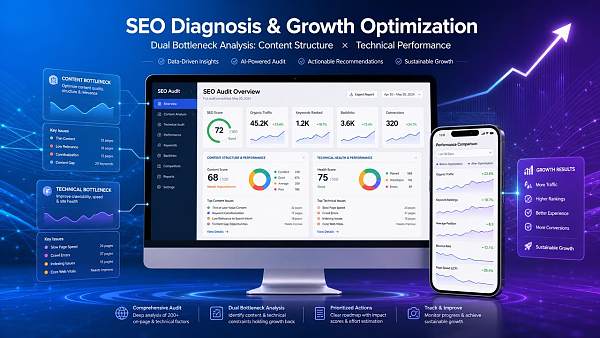
In integrated website + marketing service projects,slow Google SEO ranking improvement usually does not mean “SEO was done but did not work”,but rather that the website foundation,content production,page structure,and data feedback have not formed a closed loop。The most common difficulty for project managers is that the team has been busy for a long time,yet still cannot clearly determine whether the problem lies on the content side or the technical side。
If the diagnosis is wrong,resources will be allocated incorrectly。For example,the content is clearly insufficient,but the team keeps modifying code;or technical problems are serious,but articles continue to be added。The result is longer cycles,wasted budgets,inefficient cross-department collaboration,and ultimately an impact on inquiry targets and project delivery pace。
- Content bottlenecks often appear as:unclear page topics,scattered keyword layout,insufficient content depth,generic descriptions of industry scenarios,and weak conversion paths。
- Technical bottlenecks often appear as:blocked crawling,low index coverage,poor mobile experience,slow loading speed,and missing structured information。
- More commonly,both types of bottlenecks exist at the same time,especially on multilingual websites,revamped legacy websites,and foreign trade lead generation websites。
For engineering project leaders,SEO is not a single-point execution task,but a growth project that requires scheduling,acceptance checks,collaboration,and review。Only by breaking down the problem can you decide whether to fix the underlying foundation first or strengthen the content first,and avoid long-term investment without ranking improvement。
During project execution,what signs indicate that Google SEO ranking improvement is stuck at the technical layer
If a website remains unindexed for a long time,core pages are crawled infrequently,or pages are clearly live but cannot be found in search,technical factors should usually be checked first。Technical issues will not directly cause every keyword to disappear from the results pages,but they will continuously weaken Google’s understanding of the website,crawl efficiency,and the accumulation of page trust。
Common technical issue checklist
- The site structure is too deep,and important pages are too many clicks away from the homepage,resulting in lower crawl priority。
- Titles,descriptions,and canonical links are set chaotically,causing duplicate pages,parameter page competition,and dispersed indexing signals。
- Mobile adaptation is incomplete,and above-the-fold rendering is slow,affecting usability and visit depth。
- Internal linking is weak,and no topical connections are formed between sections,making it difficult for Google to judge how page authority should flow。
The table below is suitable for project managers to quickly assess the degree of technical impact on Google SEO ranking improvement,and to arrange optimization priorities accordingly。
Technical issues are characterized by “not obvious in the early stage,but amplified later”。When a website is first launched,it may seem accessible normally,but as pages increase,language versions expand,and paid traffic is introduced,underlying problems will quickly slow down Google SEO ranking improvement,and may even prevent search engines from fully recognizing the value of the content。
What situations indicate that the problem is more likely on the content side
If the website already has basic crawlability and pages can be indexed,but rankings remain beyond the second page,click-through rates are low,and inquiry pages receive shallow visits,content should be checked more carefully at this point。Many companies do not lack content;rather,their content does not truly match search intent,industry purchasing decisions,or the chain of user questions。
Common content-side points where value is lost
- Only product introductions are written,while application scenarios,project processes,delivery boundaries,and purchasing criteria are not covered,making it difficult for pages to satisfy the search intent of project managers。
- Too many terms are stacked on one page,the topic focus is unclear,and Google has difficulty identifying which type of search ranking the page should participate in most。
- Section planning lacks hierarchy,and solution pages,case pages,and Q&A pages are isolated from one another,so a content cluster cannot be formed。
- The content update rhythm is unstable,old pages are not maintained for a long time,and outdated information affects the overall activity of the site。
For overseas lead generation projects in engineering,manufacturing,and service sectors,project managers care more about delivery cycles,language versions,site scalability,and marketing conversion touchpoints,rather than generic brand introductions。If the content stays only at “who we are”,it will naturally be difficult to support Google SEO ranking improvement。
In content organization,knowledge-based content,scenario-based content,and conversion-oriented content can be built separately。For example,some management system or research information is more suitable as an extension of industry knowledge inserted into the content library。A title such as Research on Optimization Strategies for the Financial and Accounting Supervision System of Administrative and Public Institutions is more suitable for topic resources or knowledge citation scenarios,rather than occupying the position of a core business conversion page。
How to prioritize content and technology:project managers can make decisions this way
Truly efficient Google SEO ranking improvement does not start by subjectively betting on either content or technology,but by diagnosing first and then scheduling。For teams with tight delivery requirements,controlled budgets,and complex cross-department coordination,it is recommended to proceed by “removing blockers first,then working on amplifiers”。
The table below is suitable for developing phased SEO tasks,including both technology and content in project milestones separately,so that all tasks are not mixed together,which would lead to unclear responsibilities and difficult acceptance checks。
From a project management perspective,the biggest risk in SEO is having no phased goals。Splitting diagnosis,optimization,content reinforcement,and conversion validation into four modules makes it easier to control timelines and budgets,and also makes it more convenient to report the real progress of Google SEO ranking improvement to management。
Why an integrated website + marketing service solution is better suited to solving slow ranking improvement
For many companies,slow ranking improvement is not due to lack of execution effort,but because website building,content,promotion,and data analysis are scattered among different vendors。Page structure changes have to wait for development,keyword content has to wait for editors,conversion forms have to wait for operations,and once the chain becomes long,problems are repeatedly delayed。
Eyingbao Information Technology (Beijing) Co., Ltd. has been deeply engaged in global digital marketing services for more than ten years。Driven by artificial intelligence and big data,it has built full-chain capabilities covering intelligent website building,SEO optimization,social media marketing,and advertising。For project managers,the advantage of this integrated model is not that it offers many service items,but that it reduces communication breakpoints and rework costs。
What practical problems can the integrated model solve
- SEO structure is embedded during the website building stage,avoiding the need to rebuild sections and link systems later for rankings。
- Content planning and keyword strategy are synchronized,reducing repeated investment caused by “launch first,rework later”。
- Advertising and organic search share landing page data,making it easier to evaluate the real conversion capability of pages。
- Localized service facilitates cross-department communication,making it suitable for domestic teams coordinating overseas growth projects。
For engineering project leaders who need to control the delivery pace,this type of solution more easily forms an executable plan:first complete the underlying foundation,then build the content matrix,and finally connect advertising and remarketing to gradually amplify the inquiry value brought by Google SEO ranking improvement。
What to focus on during procurement and execution to avoid long-running ineffective SEO projects
Whether selecting a website building service provider,an SEO team,or an integrated marketing partner,project managers should not only ask “how long will it take to rank”。What matters more is whether the other party can clearly explain technical diagnosis,content planning,execution workflow,and data feedback,and whether they can match the company’s current stage。
It is recommended to focus on checking the following points
- Whether a website technical audit is performed first before keyword and content plans are provided,rather than directly promising results。
- Whether the content layout methods for brand keywords,product keywords,scenario keywords,and problem keywords can be clearly distinguished。
- Whether the team has implementation experience and process capabilities for multilingual sites,localized pages,and mobile optimization。
- Whether phased data reviews are provided,including metrics such as indexing,rankings,clicks,and lead quality。
If a vendor can only talk broadly about traffic but cannot break down pages,structure,content,and delivery milestones,the follow-up project will most likely still fall into a state of “continuous execution,unclear results”。Google SEO ranking improvement requires process transparency,not just slogans about final results。
FAQ:several questions project leaders most often ask when Google SEO ranking improvement is slow
1. How long does it take for a new website to see changes in Google SEO ranking improvement?
If the technical foundation is complete and the content direction is clear,indexing and fluctuations in some keywords are usually seen within 4 to 12 weeks。However,in the early stage,a new website should focus more on whether pages enter the index,whether topics are recognized,and whether core sections begin to gain impressions,rather than rushing to pursue rankings for broad keywords。
2. Does publishing more content mean faster ranking improvement?
No。Content without topic planning,internal link structure,or search intent matching may only increase management costs no matter how much is published。High-quality content development places more emphasis on page role division,keyword cluster grouping,conversion entrances,and update rhythm。
3. Can Google SEO ranking improvement be achieved with technical optimization only and no content work?
Technical optimization can solve the question of “whether you can be seen”,but content determines “why you should rank”。If a website does not have enough topic pages,scenario pages,Q&A pages,and conversion pages,it will be difficult to continuously gain higher rankings and stable inquiries in competition。
4. If rankings drop after an old website is redesigned,what should be done first?
First check link changes,redirects,title structure,section paths,and indexing status,then evaluate whether old content has been retained。In many cases,slower Google SEO ranking improvement after a redesign is not a capability problem,but signal loss during migration。If necessary,a page mapping table before and after the redesign should be established。
5. How can you judge whether an outsourced team truly understands SEO for project-based websites?
Focus on whether they can work backward from business goals to website structure,content hierarchy,and conversion paths,rather than only talking about the number of articles and backlinks。Whether they can connect technology,content,site experience,and inquiry goals is the key to judging cooperation value。
Why choose us:from diagnosis to delivery,a more controllable growth path for project managers
If you are advancing an overseas lead generation project but find that Google SEO ranking improvement is slow,team collaboration costs are high,and vendor feedback is not transparent,you can start with the diagnosis stage first。Eyingbao Information Technology (Beijing) Co., Ltd. can combine your company’s existing website architecture,content assets,and marketing goals to help identify the real bottlenecks。
Topics for discussion include:website technical issue troubleshooting,keyword-to-page matching relationships,content matrix planning,delivery cycle recommendations,multilingual site structure design,conversion page optimization,quotation ranges,and phased implementation plans。If you need knowledge-resource page planning as a complement,you can also evaluate how content such as Research on Optimization Strategies for the Financial and Accounting Supervision System of Administrative and Public Institutions can fit into topic-based sections。
For project managers,what truly matters is not “rushing rankings immediately”,but finding a path that is executable,verifiable,and sustainable。Only by first identifying whether the bottleneck is content or technology,and then advancing with an integrated solution,can Google SEO ranking improvement have a better chance of turning into stable traffic and qualified inquiries。
Related Articles

Related Products
 EasyCamp SaaS Smart Website Marketing SystemE-Yingbao SaaS Smart Website Marketing System: AI-powered, zero-code website building. Rapidly launch multilingual independent e-commerce sites in just 10 minutes. Global server acceleration and AI-driven SEO optimization empower businesses to efficiently connect with global markets. The seamless integration of technology and user-friendly operation makes building e-commerce sites incredibly simple.
 AI+SEM Intelligent Advertising Marketing SystemAI+SEM drives intelligent ad creation, empowering full-funnel precision advertising marketing. The system automatically generates weekly/monthly reports, AI recommends keywords and target countries, monitors core metrics in real-time with intelligent alerts, and enables one-click high-conversion ad solutions to help quickly acquire customers and improve ROI.
 AI+SEO Dual Engine Optimization ServiceEasyWin AI+SEO Dual Engine Optimization System leverages AI-powered keyword mining, content generation, and comprehensive technical optimization to help foreign trade enterprises acquire high-quality organic traffic, significantly improving search rankings and conversion rates.
 AI+SNS Social Media Marketing SystemYingbao AI+SNS Social Media Marketing System - Precision social capture for the social media era. Supports one-click content synchronization across major platforms like Facebook and LinkedIn. AI intelligently rewrites posts for enhanced relevance. 24/7 AI customer service and user profiling analysis empower businesses to efficiently expand into global markets.
 AI+SEO营销解决方案易营宝AI+SEO营销解决方案,通过AI批量写作、智能生成TDK、精准关键词扩词等功能,全面优化网站SEO效果,提升流量与转化率。助力企业构建高效智能网站新生态。
 AI+SEM Advertising Marketing SolutionsAI+SEM Advertising Marketing Solution leverages AI technology to deeply empower SEM ad campaigns. It automatically generates weekly/monthly reports using AI, presenting account data across multiple dimensions for comprehensive insights into campaign performance and trends. The system precisely recommends keywords and target countries, intelligently generates high-conversion ad copy, and enables one-click activation of efficient campaign plans to help businesses rapidly acquire customers. Simultaneously, it monitors core metrics in real time, intelligently identifies abnormal fluctuations, and issues timely alerts to ensure stable, high-return advertising results.
 Domain Name ServicesEasyWin provides professional domain name services, including intelligent queries, one-stop registration, brand protection, and full lifecycle management, helping businesses build a digital brand image.
 EasyOperate B2C Cross-Border E-Commerce Platform & Independent WebsiteEasyStore B2C Cross-border E-commerce Independent Store is an intelligent website building and cross-border e-commerce integrated solution independently developed by EasyStore Information Technology (Beijing) Co., Ltd. The system is specially designed for small and medium-sized as well as large export enterprises, integrating 'website building, operation, marketing, advertising, and conversion' into one, helping enterprises quickly establish cross-border e-commerce independent stores to achieve brand globalization and global sales growth.
The platform supports multiple languages, multiple currencies, and multi-channel marketing, with built-in AI intelligent translation and SEO optimization systems, suitable for mainstream markets such as Southeast Asia, Europe and America, Latin America, and the Middle East, assisting Chinese manufacturing enterprises in efficiently deploying international e-commerce strategies. SSL证书易营宝提供专业SSL安全证书服务,包括单域名和泛域名证书,确保网站数据传输加密、身份验证和完整性保护,助力企业建立安全可信的在线业务环境。









