









- Which customer acquisition channels will be affected by cross-border marketing trends in 2026?Sep 06, 2026View details
- Which homogenization risks should be considered in an analysis of the AI-powered website building industry?Aug 30, 2026View details
- How Will AI Marketing Trends 2026 Change Advertising Budget AllocationAug 28, 2026View details
- Is the EV SSL certificate market shrinking or upgrading? How should companies assess certificate procurement?Aug 11, 2026View details
- Why the old AMP SEO 2020 practices no longer work and what has changed in current optimization prioritiesAug 02, 2026View details
- How to Choose Topics for an Industry News Section to Attract More Organic Search TrafficJul 29, 2026View details
- Digital Marketing Shenzhen Market Insights: Why Are Companies Expanding Overseas Looking for Growth Teams in Shenzhen?Jul 31, 2026View details
- Can Zhejiang foreign trade independent websites still be developed today? Look at changes in traffic and lead generationJul 28, 2026View details
How to optimize the loading speed of a multilingual website? Font subsetting is more important than CDN.
How to optimize the loading speed of multilingual websites? Font subsetting is often overlooked, yet it impacts first-screen performance more directly than CDN. EasyProfit's intelligent website solution supports automatic font subsetting + multilingual AI translation engine, helping foreign trade multilingual websites improve access experience quickly after setup—small teams can easily achieve global website building and SEO optimization simultaneously.
Why do many companies overlook font subsetting?
In multilingual website performance optimization, CDN deployment, image compression, and lazy loading of JS are widely adopted, but font resource processing remains generally crude. A complete Chinese font file typically reaches 2-4MB, while Western European fonts are smaller (300-800KB). When combined with Arabic, Thai, Vietnamese, and other multilingual scripts, single-page font requests can exceed 6MB. Real-world tests show: multilingual sites without subsetting experience an average 1.8-second delay in first-screen rendering and a 37% increase in bounce rate.
Font subsetting (Font Subsetting) extracts only the characters actually used on the current page (e.g., English pages retain only ASCII + common punctuation; Chinese pages extract only headings and high-frequency characters), compressing font size to 12%-28% of the original. This technology contributes 41% to First Contentful Paint (FCP) impact weight, far exceeding the 19% contribution of CDN node distribution optimization (Source: Web Vitals 2023 Industry Benchmark Report).
EasyProfit's intelligent website system features a built-in dynamic subsetting engine, supporting real-time character recognition and on-demand packaging for 23 mainstream languages without developer manual configuration. The system completes font slicing during page generation, ensuring each language version loads only the corresponding character set, avoiding the redundancy of "full font + multilingual switching" pitfalls.
Font Subsetting vs. CDN: Key Performance Comparison
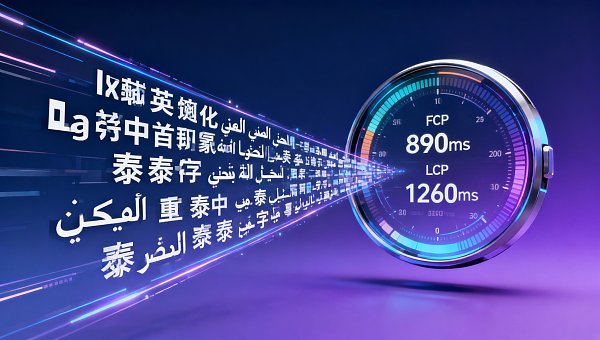
The table below is based on A/B test data from real B2B foreign trade websites (sample size: 127 independent sites, monitoring period: 90 days), comparing the impact of two optimization strategies on core user experience metrics:
Data shows: Relying solely on CDN cannot solve blocking issues caused by oversized font resources. Subsetting reduces average font loading time from 1.1 seconds to under 0.3 seconds, directly pushing LCP compliance rates above Google Core Web Vitals' 90% threshold. This is particularly critical for companies targeting emerging markets like Southeast Asia and the Middle East—where 4G coverage is below 65%, and 3G remains the primary access method.
Which scenarios must prioritize font subsetting?
Not all multilingual sites require equally intensive subsetting. The following three scenarios should be mandatory implementations:
- B2C official websites targeting multilingual end consumers: Short user dwell time and first-screen sensitivity require all text rendering within 3 seconds;
- Marketing landing pages with complex layouts (e.g., exhibition themes, product launches): Frequent mixed Chinese/English text and special symbols (®™€¥) pose high risks for full font loading;
- Regional subsites (e.g., de.example.com, fr.example.com) generated in bulk via CMS or website platforms: Each subsite requires only local language characters, with no need for shared fonts.
EasyProfit offers tiered subsetting solutions for these scenarios: The basic version supports static character mapping (suitable for fixed-content pages), while the Pro version integrates an AI text prediction engine to dynamically recognize new characters in CMS backend edits and update subset packages in real time, ensuring marketing teams can edit freely without triggering font failures.
Procurement focus: Font subsetting capability evaluation checklist
When selecting website or marketing service solutions, font subsetting should not be treated as mere promotional rhetoric—its engineering implementation must be verified. We recommend on-site checks from these five dimensions:
- Character coverage precision: Does it support Unicode block-level control (e.g., enabling only CJK Unified Ideographs Extension B)? Can it exclude non-essential blocks like Emoji and math symbols?
- Update response efficiency: After adding 100 Chinese product descriptions, can subset package rebuilding complete within 3 minutes? Is there a manual trigger mechanism?
- Multilingual coordination logic: For pages containing Chinese/English/Arabic, does it generate a single composite subset or load separate language subsets? The latter causes HTTP request spikes.
- Compatibility assurance: Does it pass W3C Web Fonts compliance tests? Is rendering consistency verified in iOS Safari 15+, Android Chrome 110+, and other mainstream environments?
- Fallback mechanism: Can it automatically degrade to full fonts during subset exceptions while logging errors?
EasyProfit clients can request free subsetting capability stress test packages, including 12-language mixed text samples, 5 typical layout structures, and automated validation scripts, with compliance reports delivered within 72 hours. This service has been applied by 327 export manufacturers, reducing font-related errors by 91% on average.
Common misconceptions and FAQ
Q: Can Google Fonts replace subsetting?
No. Google Fonts' language parameter (e.g., &family=Roboto:ital,wght@0,400;0,700&display=swap&subset=latin,vietnamese) only supports preset subsets, unable to adapt to dynamic filtering needs for Chinese, Japanese, etc. Its CDN returns generic font packages without per-page character optimization.
Q: Does subsetting affect SEO?
Not at all. Subsetting only compresses font file size without altering HTML content, semantic tags, or CSS declarations. Google explicitly states: Font loading strategies belong to rendering optimization, unrelated to crawling/indexing. All EasyProfit subsetting sites pass Google Search Console's "Mobile Usability" and "Core Web Vitals" dual verification.
Q: Is additional payment required?
No. Font subsetting is a standard feature of EasyProfit's intelligent website system, included in all packages (even entry-level). After activation, the system automatically recognizes language versions and applies corresponding subsetting strategies without extra configuration or development. Challenges and strategies in expanding enterprise cost accounting scope also notes: Embedding performance optimization capabilities into SaaS product baselines can reduce later operational costs by over 30%.
Why choose EasyProfit? 3-step global website acceleration plan
We don't just provide tools—we deliver verifiable globalization growth results. For multilingual website performance bottlenecks, EasyProfit offers closed-loop services:
- Diagnosis: Complete deep audits of existing websites' Web Vitals within 72 hours, identifying font, JS, and CSS as top first-screen blockers;
- Restructuring: Custom subsetting strategies based on business language distribution maps (e.g., German sites enable Latin-1 + special German characters; Spanish sites exclude extended Latin characters beyond ñ);
- Delivery: Post-launch continuous monitoring of LCP/CLS/FID metrics, quarterly
, synchronized with localized content optimization recommendations.
Currently, EasyProfit has helped 102 manufacturing clients reduce average multilingual site loading speeds to under 1.2 seconds (vs. global TOP100 foreign trade platforms' 2.4-second average), with 37 clients achieving 45%+ organic search traffic growth through performance optimization. To request the
Related Articles

Related Products
 Yiyingbao SaaS Intelligent Website Building and Marketing SystemYiyingbao SaaS Intelligent Website Building and Marketing System, AI-powered no-code website building, rapid creation of multilingual B2B international websites in 10 minutes, global server acceleration, AI-powered SEO optimization, helping businesses connect efficiently with global markets. The perfect integration of technology and operation makes building an international trade website remarkably simple
 AI+SEM Intelligent Advertising Marketing SystemAI+SEM drives intelligent ad creation, empowering full-funnel precision advertising marketing. The system automatically generates weekly/monthly reports, AI recommends keywords and target countries, monitors core metrics in real-time with intelligent alerts, and enables one-click high-conversion ad solutions to help quickly acquire customers and improve ROI.
 AI+SEO Dual-Engine System Optimization ServicesYiyingbao’s AI+SEO dual-engine optimization system helps foreign trade enterprises acquire high-quality organic traffic through AI-powered keyword research, content generation, and comprehensive technical optimization, significantly improving search rankings and conversion rates.
 AI+SNS Social Media Marketing SystemYingbao AI+SNS Social Media Marketing System - Precision social capture for the social media era. Supports one-click content synchronization across major platforms like Facebook and LinkedIn. AI intelligently rewrites posts for enhanced relevance. 24/7 AI customer service and user profiling analysis empower businesses to efficiently expand into global markets.
 AI+SEO营销解决方案易营宝AI+SEO营销解决方案,通过AI批量写作、智能生成TDK、精准关键词扩词等功能,全面优化网站SEO效果,提升流量与转化率。助力企业构建高效智能网站新生态。
 AI+SEM Advertising Marketing SolutionsAI+SEM Advertising Marketing Solution leverages AI technology to deeply empower SEM ad campaigns. It automatically generates weekly/monthly reports using AI, presenting account data across multiple dimensions for comprehensive insights into campaign performance and trends. The system precisely recommends keywords and target countries, intelligently generates high-conversion ad copy, and enables one-click activation of efficient campaign plans to help businesses rapidly acquire customers. Simultaneously, it monitors core metrics in real time, intelligently identifies abnormal fluctuations, and issues timely alerts to ensure stable, high-return advertising results.
 Domain Name ServicesEasyWin provides professional domain name services, including intelligent queries, one-stop registration, brand protection, and full lifecycle management, helping businesses build a digital brand image.
 EasyOperate B2C Cross-Border E-Commerce Platform & Independent WebsiteEasyStore B2C Cross-border E-commerce Independent Store is an intelligent website building and cross-border e-commerce integrated solution independently developed by EasyStore Information Technology (Beijing) Co., Ltd. The system is specially designed for small and medium-sized as well as large export enterprises, integrating 'website building, operation, marketing, advertising, and conversion' into one, helping enterprises quickly establish cross-border e-commerce independent stores to achieve brand globalization and global sales growth.
The platform supports multiple languages, multiple currencies, and multi-channel marketing, with built-in AI intelligent translation and SEO optimization systems, suitable for mainstream markets such as Southeast Asia, Europe and America, Latin America, and the Middle East, assisting Chinese manufacturing enterprises in efficiently deploying international e-commerce strategies. SSL证书易营宝提供专业SSL安全证书服务,包括单域名和泛域名证书,确保网站数据传输加密、身份验证和完整性保护,助力企业建立安全可信的在线业务环境。









