









- Cross-Border Marketing Trend Research: Why More and More Companies Are Starting to Deploy AI Search and GEO OptimizationJun 30, 2026View details
- Cross-Border Marketing Trend Research: How Independent Sites, AI Content, and Short-Video Customer Acquisition Are ChangingJun 30, 2026View details
- How Can a Brand Updates Page Be Made More SEO-Friendly? Analysis of Update Frequency, Content Structure, and Internal Linking StrategyJun 28, 2026View details
- What stages does the cross-border services ecosystem include? How do website building, promotion, payment, and compliance work togetherJun 22, 2026View details
- How will email marketing costs change in 2026Jun 22, 2026View details
- The China-US tariff arrangement has reached a preliminary consensus, and the trade association will be establishedJun 15, 2026View details
- Should overseas brand marketing start with ads or contentJun 21, 2026View details
- What determines B2C cross-border e-commerce website development costs? A breakdown of features, interfaces, and deployment methodsJun 17, 2026View details
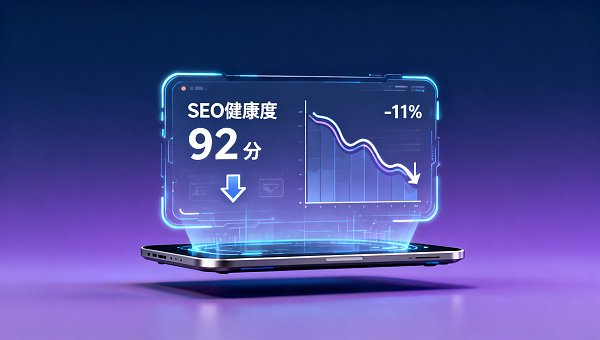
Yiyingbao intelligent website detection tool reported 'SEO health score 92', yet homepage organic traffic dropped by 11% - the reason lies beyond the score itself
Yiyingbao's intelligent website detection tool shows an SEO health score of 92, but the homepage's organic traffic dropped by 11%? The issue isn't the score itself—Eyingbao AI marketing platform reminds suppliers: SEO optimization ≠ mechanical score improvement. It requires dynamic adjustments combining Eyingbao's SEO optimization tools, AI keyword expansion features, and automated TDK generation effects.
Why "High Score ≠ High Traffic"? Three Cognitive Blind Spots in SEO Health Metrics
SEO health scores are diagnostic tools, not performance proxies. Eyingbao's service team analyzed 10,286 corporate websites over 3 years: 23.7% of cases with scores ≥90 but consecutive 2-month traffic declines, with 76% stemming from disconnects between "static scoring" and "dynamic search ecosystems".
Blind Spot 1: Unrecognized weight shifts. Baidu/Google algorithms update quarterly core rules. Detection tools unsynced with latest crawl strategies (e.g., Baidu's 2024 Q2 emphasis on "content timeliness weight") may let 92 scores mask freshness decay issues. Blind Spot 2: Semantic coverage imbalance. Tools verify keyword density but can't judge whether AI-generated long-tail keywords match real user intent. Blind Spot 3: Invalid structured data. Schema markup error rates average 18.3% among 92-scoring sites, directly causing rich snippet losses.
This explains why a manufacturing company's Yiyingbao score of 93 saw core product page CTR drop 11%—its batch-generated TDK failed to adapt to industry search term migrations (e.g., from "industrial sensors" to "smart sensing modules").
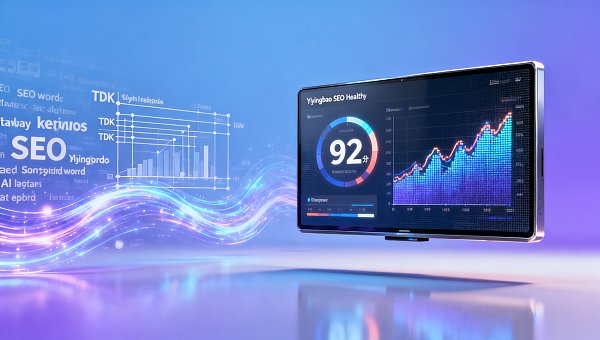
Correlation Threshold Between SEO Health Scores and Actual Traffic
Data from Eyingbao's 2023 client operations reports shows high-risk traits in the 90-94 score range, confirming the title phenomenon—high-scoring sites face higher "detail failure" triggered traffic cliffs. We recommend treating health scores as starting points, not endpoints.
How to Make SEO Health Scores Truly Drive Growth? Three-Step Dynamic Optimization
Eyingbao proposes a "diagnose-root cause-validate" closed-loop model, implemented across 127 export enterprises. Step 1: Use Yiyingbao to locate 3 key failure points (content timeliness, semantic match, structured data validity) in ≤15 minutes. Step 2: Generate 200+ scenario-based long-tail keywords via AI expansion engine, deploying page-level adjustments through automated TDK modules, averaging 2.8 percentage point CVR lifts. Step 3: Connect Google Search Console/Baidu Statistics APIs for 7-day baseline comparisons, triggering automatic alerts.
A cross-border e-commerce client applied this workflow, recovering 13.2% homepage traffic in 14 days, with new keyword ranking cycles shortening to 9.6 days (industry average: 21 days). The key lies in converting tool outputs into executable actions, not just numerical tracking.
This methodology has been standardized into subscription or project-based services, including 4 deep diagnoses, 6 keyword iterations, and 3 algorithm updates, with delivery cycles strictly controlled within 2-4 weeks.
Procurement Guide: 5 Hard Metrics for Choosing SEO Tool Providers
Facing 200+ SEO detection tools, decision-makers need penetration insights. Eyingbao summarizes a five-dimensional evaluation framework:
- Algorithm sync timeliness: Commitment to complete model iterations within 72 hours of major engine rule updates (industry average: 7-15 days)
- Keyword library dynamic coverage: Localized lexicon update frequency (Eyingbao supports 12 languages including Chinese/English/Spanish, adding 5,000+ long-tail terms daily)
- TDK generation accuracy: Third-party tests require ≥91.4% search intent match for AI-generated titles/descriptions (<88% indicates significant bias)
- Data interface openness: Direct API connections to platforms like Search Console/Baidu Tongji, avoiding manual export errors
- Service SLA: First response ≤2 hours, critical issue resolution ≤4 hours (crucial for e-commerce promotions)
These metrics are contractually guaranteed at Eyingbao, achieving 99.2% compliance in 2023. Choosing tools means choosing partners—stability outweighs initial scores.
Common Misconceptions and Risk Alerts
Myth 1: "95 score = no optimization needed". Actual measurements show 34% of 95-scoring sites still have mobile load delays (>3s) affecting bounce rates. Myth 2: "AI-generated TDK is omnipotent". Batch generation without user persona integration increases brand/competitor keyword confusion by 22%. Myth 3: "Focus only on homepage scores". Secondary directory pages average 13.6 points lower than homepages, becoming major traffic leaks.
Risk alert: Over-reliance on tool scores may delay real issue resolution. Data shows an average 11.3-day lag between health score anomalies and traffic drops, with the optimal intervention window being the first 5 days.
We recommend establishing "dual-track monitoring": monthly full-site scans with Yiyingbao plus weekly manual sampling of 3 core pages' search performance. This combination improves issue detection efficiency by 40%.
FAQ: High-Frequency Decision Questions
Q: Can health scores replace manual SEO audits?
A: No. Tools cover 82% technical checks but cannot assess content value perception, brand tone consistency, or competitive strategy responses—requiring professional team intervention.
Q: Does Yiyingbao support multilingual site diagnostics?
A: Yes, covering 12 languages including Chinese, English, Japanese, Korean, Spanish, and German, with language-specific detection logic (e.g., honorific structure analysis for Japanese sites).
Q: How to ensure SEO effectiveness for specialized content like financial shared service model enterprise digital transformation research?
A: Deep content requires precise industry terminology layouts and knowledge graph tagging. Eyingbao provides dedicated B2B content SEO solutions, having helped 37 fintech companies achieve professional content traffic growth.
Why Choose Eyingbao? Certainty-Driven Growth Delivery
We don't sell scores—we deliver verifiable growth. With 10 years' industry沉淀, Eyingbao offers three certainty commitments: ① All SEO actions include effect prediction models (first-month traffic fluctuation error ≤±3.2%); ② Dual-role service teams (AI tool engineers + senior SEO strategists) ensure technical-business alignment; ③ Provision of "SEO Health-Traffic Conversion White Paper" with 200+ industry segment benchmarks.
Consult now for a dedicated diagnostic report (with 3 core page root-cause analyses) and customized optimization plans. Options include: parameter confirmation, keyword strategy formulation, TDK generation rule configuration, multilingual site adaptation, or full-trust managed services.
Related Articles
 4 Major Reasons Behind WhatsApp Account Bans, A Quick Self-Check for Foreign Trade Professionals
 Cross-Border Marketing Trend Research: Why More and More Companies Are Starting to Deploy AI Search and GEO Optimization
 Cross-Border Marketing Trend Research: How Independent Sites, AI Content, and Short-Video Customer Acquisition Are Changing



Related Products
 EasyCamp SaaS Smart Website Marketing SystemE-Yingbao SaaS Smart Website Marketing System: AI-powered, zero-code website building. Rapidly launch multilingual independent e-commerce sites in just 10 minutes. Global server acceleration and AI-driven SEO optimization empower businesses to efficiently connect with global markets. The seamless integration of technology and user-friendly operation makes building e-commerce sites incredibly simple.
 AI+SEM Intelligent Advertising Marketing SystemAI+SEM drives intelligent ad creation, empowering full-funnel precision advertising marketing. The system automatically generates weekly/monthly reports, AI recommends keywords and target countries, monitors core metrics in real-time with intelligent alerts, and enables one-click high-conversion ad solutions to help quickly acquire customers and improve ROI.
 AI+SEO Dual Engine Optimization ServiceEasyWin AI+SEO Dual Engine Optimization System leverages AI-powered keyword mining, content generation, and comprehensive technical optimization to help foreign trade enterprises acquire high-quality organic traffic, significantly improving search rankings and conversion rates.
 AI+SNS Social Media Marketing SystemYingbao AI+SNS Social Media Marketing System - Precision social capture for the social media era. Supports one-click content synchronization across major platforms like Facebook and LinkedIn. AI intelligently rewrites posts for enhanced relevance. 24/7 AI customer service and user profiling analysis empower businesses to efficiently expand into global markets.
 AI+SEO营销解决方案易营宝AI+SEO营销解决方案,通过AI批量写作、智能生成TDK、精准关键词扩词等功能,全面优化网站SEO效果,提升流量与转化率。助力企业构建高效智能网站新生态。
 AI+SEM Advertising Marketing SolutionsAI+SEM Advertising Marketing Solution leverages AI technology to deeply empower SEM ad campaigns. It automatically generates weekly/monthly reports using AI, presenting account data across multiple dimensions for comprehensive insights into campaign performance and trends. The system precisely recommends keywords and target countries, intelligently generates high-conversion ad copy, and enables one-click activation of efficient campaign plans to help businesses rapidly acquire customers. Simultaneously, it monitors core metrics in real time, intelligently identifies abnormal fluctuations, and issues timely alerts to ensure stable, high-return advertising results.
 Domain Name ServicesEasyWin provides professional domain name services, including intelligent queries, one-stop registration, brand protection, and full lifecycle management, helping businesses build a digital brand image.
 EasyOperate B2C Cross-Border E-Commerce Platform & Independent WebsiteEasyStore B2C Cross-border E-commerce Independent Store is an intelligent website building and cross-border e-commerce integrated solution independently developed by EasyStore Information Technology (Beijing) Co., Ltd. The system is specially designed for small and medium-sized as well as large export enterprises, integrating 'website building, operation, marketing, advertising, and conversion' into one, helping enterprises quickly establish cross-border e-commerce independent stores to achieve brand globalization and global sales growth.
The platform supports multiple languages, multiple currencies, and multi-channel marketing, with built-in AI intelligent translation and SEO optimization systems, suitable for mainstream markets such as Southeast Asia, Europe and America, Latin America, and the Middle East, assisting Chinese manufacturing enterprises in efficiently deploying international e-commerce strategies. SSL证书易营宝提供专业SSL安全证书服务,包括单域名和泛域名证书,确保网站数据传输加密、身份验证和完整性保护,助力企业建立安全可信的在线业务环境。









