









- What multilingual website services are available in Sanya? Which model is more suitable for local businesses going global?Jul 08, 2026View details
- How to view the complete list of China SaaS companies in the top 100? Practical methods for screening website-building and marketing service providersJul 08, 2026View details
- How to view pricing in the global traffic ecosystem? Cost comparison of search, social media, and content channel advertisingJul 06, 2026View details
- How to assess foreign trade website development trends?Looking at 2026 changes from multilingual,AI content to conversion pathsJul 04, 2026View details
- What are the new trends in multilingual marketing data analytics tools in 2026? Focus on attribution、automation and complianceJul 04, 2026View details
- Is Brand Globalization Marketing Consulting Worth Buying? At What Stage Should Companies Bring It InJul 01, 2026View details
- Cross-Border Marketing Trend Research: Why More and More Companies Are Starting to Deploy AI Search and GEO OptimizationJun 30, 2026View details
- Cross-Border Marketing Trend Research: How Independent Sites, AI Content, and Short-Video Customer Acquisition Are ChangingJun 30, 2026View details
Which page rankings are affected by poor SEO keyword research
If SEO keyword research is done poorly, it will not only cause core pages to miss ranking opportunities, but also drag down the traffic performance of category pages, product pages, and content pages. This article will combine practical scenarios to analyze the specific impact of keyword strategy mistakes on page rankings.
Why when SEO keyword research goes wrong, it affects more than just the homepage
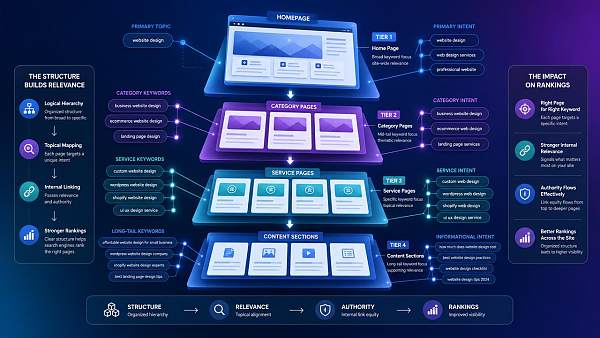
Many practitioners understand SEO keyword research as “finding keywords for a few articles,” and this is the most common starting-point mistake. For businesses integrating website + marketing services, keyword layout determines site structure, category planning, content direction, and conversion paths, with an impact far beyond a single page.
If keyword selection is off target, search engines will struggle to understand the topic of the page, and problems such as internal competition between pages, diluted authority, and wasted crawling will also arise. The final result is often not simply that “a certain keyword failed to rank,” but that related pages across the entire site struggle to gain stable visibility.
For users responsible for daily website operations, content publishing, and page maintenance, SEO keyword research is not a one-time early-stage task, but foundational work that determines the efficiency of later execution. If the wrong keywords are chosen, subsequent copywriting, redesign, and campaign coordination will all become passive.
- A mismatch between core keywords and page types will make it difficult for the homepage, service pages, and landing pages to establish clear topics.
- If synonyms and long-tail keywords are not properly layered, category pages and content pages will compete for the same search intent.
- Without alignment with business conversion goals, traffic growth may still fail to generate inquiries and deals.
Which pages are most likely to be dragged down by poor SEO keyword research
In integrated website + marketing service scenarios, different pages do not serve the same purpose. The homepage leans toward branding and broad coverage, category pages focus on topic coverage, product pages or service pages focus on conversion, and content pages focus on search expansion. Mistakes in SEO keyword research will cause different problems on each of these page types.
The table below helps practitioners make quick judgments: when keyword strategy deviates, which pages will lose momentum first, and where the problems usually show up.
As you can see, SEO keyword research is not as simple as “finding popular keywords.” It first requires clarifying the role of each page, and then matching keywords to pages. The more pages there are and the more complex the business is, the more refined the early-stage research needs to be; otherwise, the cost of later revisions will continue to rise.
Why the homepage often loses ranking opportunities due to distorted core keyword selection
The homepage is most vulnerable to two situations: one is chasing only broad keywords, and the other is stuffing too many business-related keywords. The former makes it easy to compete head-on with large platforms or portal sites, while the latter blurs the page topic, leaving search engines unable to determine what type of intent the homepage is actually meant to capture.
For integrated service providers offering smart website building, SEO optimization, social media marketing, and ad placement, the homepage is better suited to target brand keywords, capability keywords, and core solution keywords, rather than cramming all segmented business lines into a single entry point.
Why category pages become overlooked points of traffic loss
Category pages should carry a stable group of topic keywords, such as website building solutions, SEO optimization services, and overseas marketing promotion. If grouping is not completed during the SEO keyword research stage, category pages will overlap with content pages and service pages, and the result is that no page is strong enough.
A common misconception among practitioners is launching categories first and assigning keywords later. The problem with this approach is that the directory structure, internal links, breadcrumbs, and aggregation logic have already been fixed, so later changes usually require adjustments to templates and content planning as well.
If SEO keyword research is done poorly, what identifiable signals usually appear
Many teams do not completely skip SEO keyword research; rather, after doing it, they fail to turn it into actionable rules. In such cases, declining page rankings usually do not happen suddenly, but first leave traces in the data. The earlier practitioners identify them, the lower the cost of fixing them.
- Multiple pages can be found with similar titles, but none of them enters a stable top position, indicating obvious topic conflict.
- Many articles are indexed and impressions are also growing, but the click-through rate is low, indicating that the keywords do not match real search intent.
- The service page content is complete, yet it is consistently suppressed by informational pages, usually because high-conversion keywords were not properly assigned to conversion pages.
- Category pages have no rankings for a long time, while lower-level articles get scattered traffic, indicating deviations in site hierarchy and keyword grouping.
In Yiyingbao’s project practice, such issues are often related to the information architecture established in the early stage of website building. This is because site structure, URL logic, page templates, and internal linking strategy are all essentially built on SEO keyword research. If the foundation is weak, it is difficult for later traffic to form synergy.
How practitioners should determine whether keywords, page types, and conversion goals are aligned
Determining alignment cannot rely on search volume alone. A more practical method for practitioners is to simultaneously assess search intent, page carrying capacity, conversion distance, and maintenance cost. The table below can serve as a keyword selection checklist for daily execution.
If a keyword clearly has inquiry intent but is placed on a regular informational page, then even if rankings improve, conversion efficiency will still be low. Conversely, if a user only wants to learn something but lands directly on a hard-sell page, bounce rates are also likely to be high. The true importance of SEO keyword research lies in connecting traffic with conversion.
Three-step check method: suitable for quick reviews by daily execution staff
- First check the keyword: confirm whether it is informational, comparative, or transactional, and avoid using one keyword for multiple purposes.
- Then check the page: verify whether the page structure, title, summary, body text, and subheadings all revolve around the same topic.
- Finally check the path: whether the page can naturally guide users to the next step, such as inquiry, quotation, or solution explanation.
When a company is simultaneously doing website building, SEO, social media, and advertising, this kind of review becomes even more necessary. The more cross-channel business there is, the easier it is for one keyword to be reused by multiple teams, ultimately weakening the competitiveness of individual pages.
In integrated website + marketing service scenarios, how to fix an imbalanced keyword layout
Fixing the issue is not simply about changing titles, but about making coordinated adjustments across four levels: site structure, page role allocation, content production, and data monitoring. This is especially true for websites that have already been online for some time; if only surface-level copy is changed, ranking issues usually cannot be fundamentally resolved.
Taking a service system like Yiyingbao, which has capabilities in smart website building and the full digital marketing chain, its advantage lies in being able to handle technical architecture and marketing goals on the same map, instead of treating website building, SEO, and advertising as separate battles.
- First rebuild the keyword database hierarchy: distinguish brand keywords, core business keywords, scenario keywords, and long-tail question keywords.
- Then redefine page responsibilities: clarify what intent the homepage, category pages, service pages, and content pages should each capture.
- Optimize internal links simultaneously: let high-value content drive traffic to category pages and service pages, rather than competing with them.
- Establish a monitoring mechanism: review indexing, impressions, clicks, ranking fluctuations, and conversion path changes on a weekly basis.
If the company has a large amount of content, it can also introduce topic pages or knowledge base pages as a middle-layer aggregator, consolidating scattered long-tail traffic into more authoritative topic hub pages. This makes it easier to build sustainable rankings than simply piling up articles.
In content planning, it is also possible to moderately reference structural thinking from cross-domain research materials. For example, when breaking down content around decision logic, resource allocation, and risk control, the framework methodology of topics such as Research on Financing Strategies for Early-Stage Small and Micro Technology Enterprises from an Angel Investment Perspective is well suited to be adapted for marketing solution pages or industry insight pages, helping improve the decision-making readability of content.
Common misconceptions and FAQ: how SEO keyword research should actually be implemented
Are higher-search-volume keywords always more worth targeting?
Not necessarily. Higher search volume often means stronger competition and more complex intent. If the site’s authority, content depth, and conversion page capabilities are insufficient, forcing broad keyword targeting can easily lead to long-term investment with limited returns. For practitioners, a more realistic strategy is to first build topical relevance with mid- and long-tail keywords, and then gradually expand.
Why have I published many articles, but rankings still do not improve?
A common reason is not “too little content,” but overlapping content. If SEO keyword research is not done properly, ten articles may all be answering the same type of question, only with different wording. Search engines will consider the pages to have limited differentiation, and in the end none of them will consistently stand out.
Can service pages and article pages target the same keyword?
It is generally not recommended for the primary keywords to overlap completely. Service pages should target keywords closer to inquiry and purchase decisions, while article pages are better suited for explanatory, question-based, and comparative keyword groups. The two can be related, but they should have a primary-secondary relationship; otherwise, internal competition can easily arise.
How often should keyword strategy be reviewed?
If it is a new site, a monthly review is recommended; if it is a steadily operating website, a structural review is recommended quarterly, while the performance of core pages should be monitored weekly. Especially when adding new categories, redesigning, or launching new services, the SEO keyword research results must be updated in sync.
Why choose us: from keyword research to page growth, providing execution teams with actionable solutions
If you are responsible for operating a corporate website, marketing site, or multilingual site, and you find that the homepage lacks focus, category pages do not rank, service pages convert poorly, and content pages compete with each other, then the problem likely lies in the disconnect between SEO keyword research and site structure.
Yiyingbao Information Technology (Beijing) Co., Ltd. has long served global growth scenarios and is able to integrate artificial intelligence and big data capabilities into the full chain of smart website building, SEO optimization, social media marketing, and advertising, helping execution teams reduce repeated trial and error while improving consistency in page planning and content production.
If you need more specific support, communication can be centered around the following: keyword hierarchy and page mapping, category structure reorganization, role division between service pages and content pages, delivery cycle evaluation, multilingual site layout, data monitoring standards, and customized growth plans and quotation arrangements.
For teams that need to balance both content depth and business judgment, they can also combine the structural methodology of research-based content such as Research on Financing Strategies for Early-Stage Small and Micro Technology Enterprises from an Angel Investment Perspective to optimize the expression of industry topics and solution pages. First get SEO keyword research right, then let each page take on the right role, so that rankings and conversions have the foundation for sustained improvement.
Related Articles
 What multilingual website services are available in Sanya? Which model is more suitable for local businesses going global?
 How to view the complete list of China SaaS companies in the top 100? Practical methods for screening website-building and marketing service providers
 There are so many used heavy-duty construction machines for foreign trade. How exactly should we acquire customers?


Related Products
 EasyCamp SaaS Smart Website Marketing SystemE-Yingbao SaaS Smart Website Marketing System: AI-powered, zero-code website building. Rapidly launch multilingual independent e-commerce sites in just 10 minutes. Global server acceleration and AI-driven SEO optimization empower businesses to efficiently connect with global markets. The seamless integration of technology and user-friendly operation makes building e-commerce sites incredibly simple.
 AI+SEM Intelligent Advertising Marketing SystemAI+SEM drives intelligent ad creation, empowering full-funnel precision advertising marketing. The system automatically generates weekly/monthly reports, AI recommends keywords and target countries, monitors core metrics in real-time with intelligent alerts, and enables one-click high-conversion ad solutions to help quickly acquire customers and improve ROI.
 AI+SEO Dual Engine Optimization ServiceEasyWin AI+SEO Dual Engine Optimization System leverages AI-powered keyword mining, content generation, and comprehensive technical optimization to help foreign trade enterprises acquire high-quality organic traffic, significantly improving search rankings and conversion rates.
 AI+SNS Social Media Marketing SystemYingbao AI+SNS Social Media Marketing System - Precision social capture for the social media era. Supports one-click content synchronization across major platforms like Facebook and LinkedIn. AI intelligently rewrites posts for enhanced relevance. 24/7 AI customer service and user profiling analysis empower businesses to efficiently expand into global markets.
 AI+SEO营销解决方案易营宝AI+SEO营销解决方案,通过AI批量写作、智能生成TDK、精准关键词扩词等功能,全面优化网站SEO效果,提升流量与转化率。助力企业构建高效智能网站新生态。
 AI+SEM Advertising Marketing SolutionsAI+SEM Advertising Marketing Solution leverages AI technology to deeply empower SEM ad campaigns. It automatically generates weekly/monthly reports using AI, presenting account data across multiple dimensions for comprehensive insights into campaign performance and trends. The system precisely recommends keywords and target countries, intelligently generates high-conversion ad copy, and enables one-click activation of efficient campaign plans to help businesses rapidly acquire customers. Simultaneously, it monitors core metrics in real time, intelligently identifies abnormal fluctuations, and issues timely alerts to ensure stable, high-return advertising results.
 Domain Name ServicesEasyWin provides professional domain name services, including intelligent queries, one-stop registration, brand protection, and full lifecycle management, helping businesses build a digital brand image.
 EasyOperate B2C Cross-Border E-Commerce Platform & Independent WebsiteEasyStore B2C Cross-border E-commerce Independent Store is an intelligent website building and cross-border e-commerce integrated solution independently developed by EasyStore Information Technology (Beijing) Co., Ltd. The system is specially designed for small and medium-sized as well as large export enterprises, integrating 'website building, operation, marketing, advertising, and conversion' into one, helping enterprises quickly establish cross-border e-commerce independent stores to achieve brand globalization and global sales growth.
The platform supports multiple languages, multiple currencies, and multi-channel marketing, with built-in AI intelligent translation and SEO optimization systems, suitable for mainstream markets such as Southeast Asia, Europe and America, Latin America, and the Middle East, assisting Chinese manufacturing enterprises in efficiently deploying international e-commerce strategies. SSL证书易营宝提供专业SSL安全证书服务,包括单域名和泛域名证书,确保网站数据传输加密、身份验证和完整性保护,助力企业建立安全可信的在线业务环境。









