









- What should you focus on in the latest enterprise SaaS report? From renewal rates and delivery costs to overseas growth opportunitiesJul 12, 2026View details
- What signals are worth paying attention to in a cross-border marketing trend report? B2B companies should look at these 6 signalsJul 11, 2026View details
- How to Read a Cross-Border Marketing Trends Report? Five Key Dimensions for Evaluating Channel OpportunitiesJul 11, 2026View details
- Which channel has the highest ROI in the global traffic ecosystem? Comparative analysis of search, social media, and advertisingJul 10, 2026View details
- What multilingual website services are available in Sanya? Which model is more suitable for local businesses going global?Jul 08, 2026View details
- How to view the complete list of China SaaS companies in the top 100? Practical methods for screening website-building and marketing service providersJul 08, 2026View details
- How to view pricing in the global traffic ecosystem? Cost comparison of search, social media, and content channel advertisingJul 06, 2026View details
- How to assess foreign trade website development trends?Looking at 2026 changes from multilingual,AI content to conversion pathsJul 04, 2026View details
How to Do SEO Keyword Research Without Only Looking at Search Volume
When conducting SEO keyword research,if you only focus on search volume,you often miss the opportunities that can truly drive conversions。This article will help you build a more effective keyword selection approach from the perspectives of user intent,competition level,and business fit。
Why do many companies easily fall into the misunderstanding of “only looking at search volume” when conducting SEO keyword research?
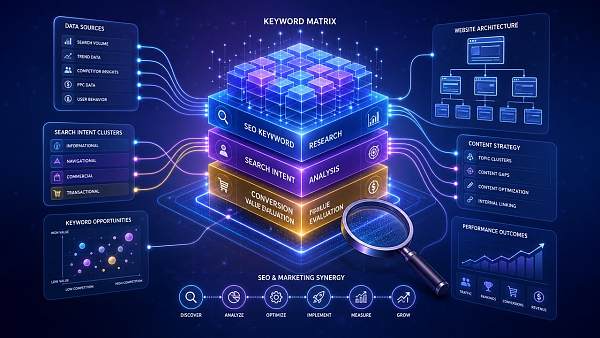
For information researchers,SEO keyword research looks like a data-driven task,so many teams’ first reaction is to look at search volume first。However,in an integrated website + marketing service scenario,traffic does not equal inquiries,and it certainly does not equal deals。High-search-volume keywords are often highly competitive,have scattered intent,and may not even match the company’s actual service capabilities。
For example,if a service provider offering smart website building,SEO optimization,social media marketing,and ad placement only pursues broad terms such as “marketing” and “promotion”,it will be difficult to obtain stable rankings in the short term。Even if visits are generated,they may not necessarily turn into high-quality leads。Truly effective SEO keyword research requires looking at user needs,page engagement,and business conversion together。
- Only looking at search volume can easily ignore whether users are in the research,comparison,or purchasing stage。
- Only looking at trending keywords can easily lead to investing a large amount of content resources while still finding it difficult to achieve effective rankings。
- Only looking at surface-level keyword data can easily overlook the company’s own service regions,industry experience,and delivery capabilities。
Therefore,the core of SEO keyword research is not to find “what most people search for”,but to find “which keywords are most worth targeting,most likely to be successfully ranked,and most likely to bring business results”。
When conducting SEO keyword research,judge user intent first instead of rushing to compete for popular keywords
When users search for the same topic,their underlying purposes may be completely different。Some want to understand concepts,some want to find service providers,and some have already entered the price comparison stage。For companies integrating website + marketing services,judging keyword intent is the first step in content planning and page layout。
How can common search intents be classified?
In SEO keyword research,at least three categories should be distinguished:informational,comparative,and conversion-oriented。Different intents correspond to different pages,and it is not suitable to use one article to address all of them。
This is also why SEO keyword research cannot be conducted separately from content architecture。A high-quality keyword should not only have data,but also be supported by the right page and guide users further down the decision-making process。
Competition level,relevance,and conversion value:only by evaluating all three dimensions together can you make sound judgments
If search volume is only a reference value,then truly practical SEO keyword research should be built on a multi-dimensional evaluation model。Especially for companies with limited budgets and tight delivery cycles,priority assessment is more important than blindly expanding content volume。
The table below is more suitable for information researchers to conduct initial screening。It is not only useful for content teams,but also suitable for procurement and marketing managers to determine whether a keyword is worth entering project execution。
Many companies fail to see results for a long time not because they have not written enough content,but because the order was reversed during the SEO keyword research stage。The correct approach should be to first match business and intent,then evaluate competition,and then prioritize based on search volume。
For companies integrating website + marketing services,how should keyword layout be closer to business outcomes?
For service providers that offer website building,SEO,social media,and ad placement at the same time,SEO keyword research should not revolve around a single keyword database,but should be organized around the customer growth journey。This is because customer search behavior itself is a continuous process from awareness to consultation,and from problem to solution。
It is recommended to segment the keyword database by business scenarios
- Website building scenario:build keyword layouts around corporate website development,overseas website setup,landing page optimization,website conversion structure,and other related terms。
- SEO scenario:build keyword layouts around SEO keyword research,on-page optimization,content strategy,organic traffic growth,and other related terms。
- Social media scenario:build layouts around needs such as brand exposure,social media content operations,lead collection,and private-domain collaboration。
- Ad placement scenario:build layouts around decision-making terms such as ad account setup,placement strategy,conversion tracking,and budget allocation。
Yiyingbao Information Technology(Beijing)Co., Ltd. has long been deeply engaged in global digital marketing services。Its core capability is not merely single-point execution,but the coordinated implementation of smart website building,SEO optimization,social media marketing,and ad placement driven by artificial intelligence and big data。This means that during the SEO keyword research stage,the consistency of subsequent pages,content,and conversion paths can be considered in advance。
If a company is researching cross-departmental digital collaboration issues,it will also encounter topics related to finance,processes,and informatization。For example,when building a content topic library,you can extend your reading to Optimization paths for financial management information systems of state-owned enterprises in the context of digital transformation,helping the team understand the value of collaboration between information systems and marketing data from a more complete digital perspective。
How to establish a more practical SEO keyword research process?
For information researchers,the biggest concern is collecting many keywords but not knowing how to filter,categorize,or implement them。An executable SEO keyword research process should support content team operations while also allowing managers to understand priorities。
It is recommended to proceed in five steps
- Step 1,clarify goals:first define whether the goal is brand exposure,organic customer acquisition,or service lead growth,as different goals determine the scope of the keyword database。
- Step 2,build seed keywords:collect them from four directions:main business,customer pain points,industry scenarios,and purchasing decision terms。
- Step 3,expand long-tail keywords:develop around real questions such as “how to do it,how to choose,how much does it cost,which provider is better,and what scenarios is it suitable for”。
- Step 4,group keywords and build pages:cluster keywords by topic to avoid multiple pages competing for the same search intent and affecting overall rankings。
- Step 5,conduct continuous reviews:observe indexing,clicks,time on page,and inquiry data,and regularly adjust the SEO keyword research model。
If a company wants to improve execution efficiency,it is best to involve a team with collaborative capabilities in website building,content,technology,and ad placement。Once the keyword strategy is determined,the subsequent page structure,content production,data tracking setup,and conversion engagement all need to be designed in sync。
When purchasing or selecting SEO services,the key should not be only asking “how many keywords can you work on”
When many companies outsource SEO keyword research,a common problem is that they only ask about quantity,not methodology。For example,“Can you optimize 100 keywords?” and “How long will it take to reach the first page?” These questions do not help assess service quality。What deserves more attention is whether the service provider has the overall design capability from keywords to website structure and then to inquiry conversion。
When selecting a provider,it is recommended to focus on checking the following items
From this perspective,SEO keyword research is not an isolated service,but part of a company’s digital marketing system。Especially when the business involves multiple regions,multiple languages,or multiple product lines,integrated services are more likely to generate long-term results than fragmented execution。
Common misconceptions and FAQ:How should the effectiveness of SEO keyword research be judged?
Are high-search-volume keywords always more worth targeting?
Not necessarily。High search volume often means higher competition and more complex user intent。For new websites or companies with limited resources,prioritizing highly relevant,high-converting long-tail keywords is usually more realistic than aggressively competing for broad keywords。The focus of SEO keyword research is to find breakthroughs that can deliver phased results。
Long-tail keywords have low traffic,so is their value limited?
Quite the opposite。Long-tail keywords are often more specific and have clearer decision-making intent。For example,terms such as “how to conduct SEO keyword research” and “how to choose an SEO service provider for a foreign trade website” may not bring much traffic individually,but they are closer to real inquiries。When multiple long-tail keywords form a topic cluster,the overall effect is usually more stable。
Keyword rankings have improved,so why are there still not many inquiries?
The reason usually lies in page engagement。The content may only solve awareness-level problems without providing a solution path;or the website structure,form design,case presentation,and calls to action may be incomplete。SEO keyword research must be evaluated together with website experience,content persuasiveness,and data tracking,not just rankings。
How can different departments collaborate in SEO keyword research?
The marketing department is responsible for demand direction,the sales team provides frequent customer questions,the technical team evaluates the feasibility of page implementation,and management is responsible for priorities and resource allocation。If the company has broader digital planning needs,it can also combine topics such as Optimization paths for financial management information systems of state-owned enterprises in the context of digital transformation to build a unified understanding of the collaborative relationship between business data and system development。
Why choose us:If you are researching SEO keyword research,you can start communication with these questions
Since its establishment in 2013,Yiyingbao Information Technology(Beijing)Co., Ltd. has continuously focused on artificial intelligence and big data capabilities,providing full-chain services covering smart website building,SEO optimization,social media marketing,and ad placement。For companies that need to systematically advance SEO keyword research,the value of this integrated capability lies in the fact that keyword selection,website building,content,promotion,and conversion engagement can be coordinated under the same framework。
If you are currently in the information research stage,it is recommended to first communicate the following points instead of only asking about price or ranking commitments。
- Whether the existing website is suitable for supporting the content layout after SEO keyword research,and whether the structure and page templates need to be optimized at the same time。
- When target markets,target languages,and target industries differ,how the keyword database strategy should be adjusted,and which keywords are suitable for pilot testing first。
- How the project delivery cycle should be arranged,and how long each stage requires,including preliminary research,keyword grouping,page planning,and content launch。
- Whether phased solutions can be provided based on the budget,for example,starting with core sections,then expanding to long-tail topics and conversion pages。
- Whether data tracking,inquiry form optimization,and follow-up ad placement collaboration suggestions can be provided simultaneously to form a closed growth loop。
If you want to complete parameter confirmation,product selection,delivery cycle evaluation,customized solution planning,or quotation communication more efficiently,clarify your business goals,current website status,and key market scope as early as possible before connecting with a professional team。This will make the input-output of SEO keyword research easier to see and easier to implement effectively。
Related Articles



Related Products
 EasyCamp SaaS Smart Website Marketing SystemE-Yingbao SaaS Smart Website Marketing System: AI-powered, zero-code website building. Rapidly launch multilingual independent e-commerce sites in just 10 minutes. Global server acceleration and AI-driven SEO optimization empower businesses to efficiently connect with global markets. The seamless integration of technology and user-friendly operation makes building e-commerce sites incredibly simple.
 AI+SEM Intelligent Advertising Marketing SystemAI+SEM drives intelligent ad creation, empowering full-funnel precision advertising marketing. The system automatically generates weekly/monthly reports, AI recommends keywords and target countries, monitors core metrics in real-time with intelligent alerts, and enables one-click high-conversion ad solutions to help quickly acquire customers and improve ROI.
 AI+SEO Dual Engine Optimization ServiceEasyWin AI+SEO Dual Engine Optimization System leverages AI-powered keyword mining, content generation, and comprehensive technical optimization to help foreign trade enterprises acquire high-quality organic traffic, significantly improving search rankings and conversion rates.
 AI+SNS Social Media Marketing SystemYingbao AI+SNS Social Media Marketing System - Precision social capture for the social media era. Supports one-click content synchronization across major platforms like Facebook and LinkedIn. AI intelligently rewrites posts for enhanced relevance. 24/7 AI customer service and user profiling analysis empower businesses to efficiently expand into global markets.
 AI+SEO营销解决方案易营宝AI+SEO营销解决方案,通过AI批量写作、智能生成TDK、精准关键词扩词等功能,全面优化网站SEO效果,提升流量与转化率。助力企业构建高效智能网站新生态。
 AI+SEM Advertising Marketing SolutionsAI+SEM Advertising Marketing Solution leverages AI technology to deeply empower SEM ad campaigns. It automatically generates weekly/monthly reports using AI, presenting account data across multiple dimensions for comprehensive insights into campaign performance and trends. The system precisely recommends keywords and target countries, intelligently generates high-conversion ad copy, and enables one-click activation of efficient campaign plans to help businesses rapidly acquire customers. Simultaneously, it monitors core metrics in real time, intelligently identifies abnormal fluctuations, and issues timely alerts to ensure stable, high-return advertising results.
 Domain Name ServicesEasyWin provides professional domain name services, including intelligent queries, one-stop registration, brand protection, and full lifecycle management, helping businesses build a digital brand image.
 EasyOperate B2C Cross-Border E-Commerce Platform & Independent WebsiteEasyStore B2C Cross-border E-commerce Independent Store is an intelligent website building and cross-border e-commerce integrated solution independently developed by EasyStore Information Technology (Beijing) Co., Ltd. The system is specially designed for small and medium-sized as well as large export enterprises, integrating 'website building, operation, marketing, advertising, and conversion' into one, helping enterprises quickly establish cross-border e-commerce independent stores to achieve brand globalization and global sales growth.
The platform supports multiple languages, multiple currencies, and multi-channel marketing, with built-in AI intelligent translation and SEO optimization systems, suitable for mainstream markets such as Southeast Asia, Europe and America, Latin America, and the Middle East, assisting Chinese manufacturing enterprises in efficiently deploying international e-commerce strategies. SSL证书易营宝提供专业SSL安全证书服务,包括单域名和泛域名证书,确保网站数据传输加密、身份验证和完整性保护,助力企业建立安全可信的在线业务环境。









