









- What multilingual website services are available in Sanya? Which model is more suitable for local businesses going global?Jul 08, 2026View details
- How to view the complete list of China SaaS companies in the top 100? Practical methods for screening website-building and marketing service providersJul 08, 2026View details
- How to view pricing in the global traffic ecosystem? Cost comparison of search, social media, and content channel advertisingJul 06, 2026View details
- How to assess foreign trade website development trends?Looking at 2026 changes from multilingual,AI content to conversion pathsJul 04, 2026View details
- What are the new trends in multilingual marketing data analytics tools in 2026? Focus on attribution、automation and complianceJul 04, 2026View details
- Is Brand Globalization Marketing Consulting Worth Buying? At What Stage Should Companies Bring It InJul 01, 2026View details
- Cross-Border Marketing Trend Research: Why More and More Companies Are Starting to Deploy AI Search and GEO OptimizationJun 30, 2026View details
- Cross-Border Marketing Trend Research: How Independent Sites, AI Content, and Short-Video Customer Acquisition Are ChangingJun 30, 2026View details
How to Find High-Converting Keywords Through SEO Keyword Research
SEO keyword research is not about first finding “the keywords with the highest traffic,” but rather first finding “the keywords most likely to generate inquiries, registrations, orders, and conversions.” For frontline practitioners working in integrated website and marketing services, the keywords that truly carry value often do not necessarily have the highest search volume, but are closer to users’ explicit needs, easier to align with landing pages, and better suited for conversion tracking and continuous optimization. This article will focus on real execution scenarios, breaking down how to determine whether a keyword is a high-conversion keyword and how to truly apply keyword research to customer acquisition.
Why many SEO keywords have traffic but no conversions
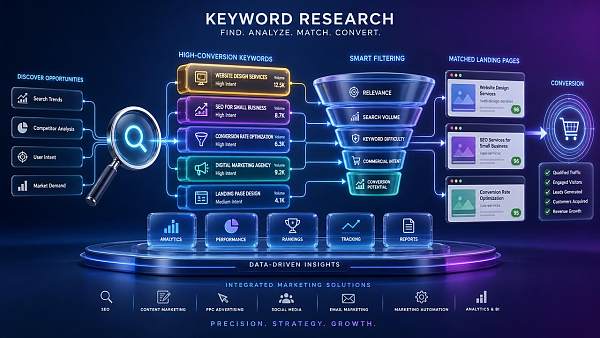
When many people conduct SEO keyword research, their first step is to focus on search volume and keyword rankings. As a result, although the website may gain some clicks, inquiries remain slow to come. This is usually not a ranking issue, but rather a problem of choosing the wrong keywords, attracting users who are not at the right stage of the decision-making process.
For example, keywords like “What is SEO” and “website building tutorial” may have a large number of searches, but most users are still in the awareness stage and are far from purchasing a service. In contrast, keywords like “Beijing foreign trade website building company,” “SEO outsourcing pricing,” and “independent site optimization service plan,” even if their volume is not large, are often much closer to actual conversion.
Therefore, at the operational level, a core judgment must be established: keyword value is not equal to search volume value. The keywords that truly deserve priority are those that match the business, can be supported by the page, can bring in effective leads, can be followed up by sales, and can ultimately lead to a possible deal.
When users search for “SEO keyword research,” what problem are they really trying to solve
From the perspective of search intent, users searching for “SEO keyword research” are not simply trying to know the definition of keywords, but are looking for an actionable method: how to filter keywords, how to judge whether a keyword is worth targeting, how to identify high-conversion keywords, and how to avoid wasting time on ineffective traffic.
For users and operators, what they usually care about most is not theoretical completeness, but three questions: first, how to quickly judge a keyword; second, how to prove to superiors that this keyword is worth investing resources in; third, how to connect keywords with pages, content, and conversion goals.
So the focus of this kind of article should not remain at broad introductions such as “keywords are divided into long-tail keywords, core keywords, and branded keywords,” but should answer: which keywords are more likely to convert, how to judge commercial intent, which keywords should be placed on different types of pages, and how to verify results with data.
The core characteristics of high-conversion keywords: don’t look at popularity, look at buying signals
In SEO keyword research, high-conversion keywords usually share one common feature: they carry a clear demand orientation. Users are not just casually browsing, but are looking for solutions, comparing service providers, evaluating prices, verifying capabilities, and may even be ready to submit an inquiry.
The first type of signal is “service-intent keywords.” For example, “SEO optimization company,” “website development service provider,” and “Google Ads outsourcing operation” directly reflect purchasing intent, and their commercial value is usually higher than informational keywords.
The second type of signal is “problem-solving keywords.” For example, “what to do if official website traffic is low,” “how to solve slow indexing for an independent site,” and “how to optimize a corporate website with no inquiries.” These keywords indicate that the user has already encountered a business problem. As long as the content and solution are highly relevant, the chance of conversion is greater.
The third type of signal is “comparison decision-making keywords.” For example, “which is more suitable for B2B, SEO or PPC,” “which foreign trade website building company is better,” and “how to choose website promotion pricing.” These keywords show that the user has entered the comparison stage and is often closer to leaving their contact information.
The fourth type of signal is “regional and industry-specific keywords.” Keywords such as “Beijing SEO company,” “manufacturing website optimization solution,” and “medical device independent site promotion” may not have large search volume, but because the scenario is more specific, their conversion rate is usually higher than broad generic keywords.
How to quickly identify high-conversion keywords in practice
The first step is to start from the business, not from the tools. First list your core services, typical customers, deal scenarios, and common sales questions, and then expand the keywords. For integrated website and marketing service businesses, keyword sources can come from real business entry points such as website building, SEO, social media, ad placement, and overseas growth.
The second step is to group by search intent. It is recommended to divide them into at least four categories: informational, solution-evaluation, service-purchase, and brand-navigation. The categories with truly higher priority are usually solution-evaluation and service-purchase, because they are closer to conversion actions.
The third step is to look at keyword modifiers. Modifiers such as “price, cost, quotation, plan, company, service, which is better, how to choose, case study, results, comparison” are often high-intent signals. They can help operators quickly identify keywords with greater commercial value.
The fourth step is to check landing page support capability. If a keyword has strong search intent but the website does not have a suitable page to support it, or the existing page content is too general, then even if it ranks, conversion may still be poor. High-conversion keywords must be considered together with specific page types.
The fifth step is to combine lead quality review. Not all keywords containing “company” or “service” are necessarily high-conversion. You also need to look at whether past inquiries were accurate, whether sales could easily follow up, and whether the deal cycle was reasonable. Keyword research must ultimately return to real business results.
To judge whether a keyword is worth targeting, you can use these 4 dimensions
The first dimension is commercial relevance. Does this keyword directly correspond to your business capabilities and delivery content? If users come in through this keyword, can they smoothly enter the inquiry path? The higher the relevance, the more it deserves priority.
The second dimension is the clarity of search intent. Is the user here to learn, compare, or prepare to purchase? The clearer the intent, the easier it is to design page structure and conversion paths, and the easier it is to evaluate SEO return on investment.
The third dimension is competitive feasibility. High-conversion keywords are often also highly competitive, so you need to judge whether, given the website’s current authority, content capabilities, backlink resources, and page foundation, you can achieve effective rankings within a reasonable period, rather than blindly pursuing the most difficult keywords.
The fourth dimension is conversion supportability. Does the page have case studies, solutions, pricing logic, FAQ, contact information, and trust signals? If not, even the best keywords will be difficult to realize their value. SEO keyword research and page optimization must be done together and cannot be separated.
What types of high-conversion keywords should be placed on different pages
Service pages should prioritize purchase-intent and solution-type keywords, such as “corporate website development services,” “SEO outsourcing solution,” and “overseas social media outsourcing operation company.” These pages should highlight service content, target customers, delivery process, case studies, and inquiry entry points.
Topic pages are suitable for industry-type and scenario-type keywords, such as “manufacturing overseas marketing solution” and “B2B official website lead generation optimization guide.” If the business involves niche sectors, topic pages are often better than ordinary blogs at capturing high-intent traffic.
Blog articles are more suitable for problem-based and comparison-based keywords, such as “how to choose between SEO and SEM” and “what to do when website traffic is high but there are no inquiries.” The role of articles is not only to bring traffic, but more importantly to push users into a deeper stage of decision-making.
In content planning, you can also appropriately learn from operational analysis methods across industries. For example, when some readers are studying process optimization, resource allocation, or cost control, they may also search for content such as the application of lean management in operational cost control of public hospitals. Although the industries are different, the underlying idea of “improving operational efficiency through structured methods” can also offer inspiration for judging keyword value.
The pitfalls operators are most likely to encounter when doing SEO keyword research
The first pitfall is only looking at tool data and not at real customer questions. Many high-conversion keywords do not appear completely in keyword tools, but they frequently appear in sales communications, customer service inquiries, WeChat conversations with enterprises, and customer descriptions of needs.
The second pitfall is treating traffic keywords as transaction keywords. Informational content does have value, but if the website is in a customer acquisition goal-oriented stage, the proportion should be controlled, prioritizing the development of high-intent content instead of investing all resources in broad traffic keywords.
The third pitfall is keyword-page mismatch. A user searches for “quotation” but lands on a general educational article; a user searches for “company recommendations” but the page has no case studies or qualifications. These situations lead to high bounce rates, few leads, and wasted ranking opportunities.
The fourth pitfall is failing to establish conversion feedback tracking. If you only track indexing, rankings, and clicks, but do not track form submissions, phone clicks, online inquiries, and final deals, then you cannot truly determine which keywords are high-conversion keywords, nor can you continuously optimize the keyword structure.
A keyword research process suitable for execution teams
In actual work, you can proceed in the order of “business sorting—intent classification—keyword expansion and filtering—page mapping—content launch—conversion review.” The benefit of doing this is that every keyword is linked to customer acquisition goals from the very beginning and is less likely to drift toward empty traffic.
First sort out the main business lines and clarify which services are most worth prioritizing for customer acquisition; then list the search questions customers have at different stages; then use tools to expand synonyms, regional keywords, industry keywords, and demand modifiers to build an initial keyword list.
After that, label each keyword with intent level, competition difficulty, page type, and expected conversion action. After going live, do not only look at rankings. Also review monthly which keywords bring high-quality inquiries, which keywords have clicks but almost no conversions, and adjust content investment in time.
If the company itself provides integrated services such as website building, SEO, social media, and ad placement, then when doing SEO keyword research, it should make even better use of its funnel advantage. Because you are not just competing for rankings, but using pages, content, and a closed data loop to gradually convert search demand into effective business opportunities.
Conclusion: the essence of high-conversion keywords is being closer to real transactions
In summary, the truly difficult part of SEO keyword research is not finding keywords, but judging the commercial intent behind them. High search volume does not equal high value. The closer a keyword is to users’ purchasing, comparison, problem-solving, and scenario constraints, the more likely it is to drive conversion.
For operators, the most effective approach is not to pursue ever-larger keyword lists, but to establish a mechanism that can continuously filter, verify, and review. As long as keywords, pages, and conversion goals can form a closed loop, SEO will no longer be just “traffic,” but will gradually become a growth channel with “results.”
Related Articles
 What multilingual website services are available in Sanya? Which model is more suitable for local businesses going global?
 How to view the complete list of China SaaS companies in the top 100? Practical methods for screening website-building and marketing service providers
 There are so many used heavy-duty construction machines for foreign trade. How exactly should we acquire customers?


Related Products
 EasyCamp SaaS Smart Website Marketing SystemE-Yingbao SaaS Smart Website Marketing System: AI-powered, zero-code website building. Rapidly launch multilingual independent e-commerce sites in just 10 minutes. Global server acceleration and AI-driven SEO optimization empower businesses to efficiently connect with global markets. The seamless integration of technology and user-friendly operation makes building e-commerce sites incredibly simple.
 AI+SEM Intelligent Advertising Marketing SystemAI+SEM drives intelligent ad creation, empowering full-funnel precision advertising marketing. The system automatically generates weekly/monthly reports, AI recommends keywords and target countries, monitors core metrics in real-time with intelligent alerts, and enables one-click high-conversion ad solutions to help quickly acquire customers and improve ROI.
 AI+SEO Dual Engine Optimization ServiceEasyWin AI+SEO Dual Engine Optimization System leverages AI-powered keyword mining, content generation, and comprehensive technical optimization to help foreign trade enterprises acquire high-quality organic traffic, significantly improving search rankings and conversion rates.
 AI+SNS Social Media Marketing SystemYingbao AI+SNS Social Media Marketing System - Precision social capture for the social media era. Supports one-click content synchronization across major platforms like Facebook and LinkedIn. AI intelligently rewrites posts for enhanced relevance. 24/7 AI customer service and user profiling analysis empower businesses to efficiently expand into global markets.
 AI+SEO营销解决方案易营宝AI+SEO营销解决方案,通过AI批量写作、智能生成TDK、精准关键词扩词等功能,全面优化网站SEO效果,提升流量与转化率。助力企业构建高效智能网站新生态。
 AI+SEM Advertising Marketing SolutionsAI+SEM Advertising Marketing Solution leverages AI technology to deeply empower SEM ad campaigns. It automatically generates weekly/monthly reports using AI, presenting account data across multiple dimensions for comprehensive insights into campaign performance and trends. The system precisely recommends keywords and target countries, intelligently generates high-conversion ad copy, and enables one-click activation of efficient campaign plans to help businesses rapidly acquire customers. Simultaneously, it monitors core metrics in real time, intelligently identifies abnormal fluctuations, and issues timely alerts to ensure stable, high-return advertising results.
 Domain Name ServicesEasyWin provides professional domain name services, including intelligent queries, one-stop registration, brand protection, and full lifecycle management, helping businesses build a digital brand image.
 EasyOperate B2C Cross-Border E-Commerce Platform & Independent WebsiteEasyStore B2C Cross-border E-commerce Independent Store is an intelligent website building and cross-border e-commerce integrated solution independently developed by EasyStore Information Technology (Beijing) Co., Ltd. The system is specially designed for small and medium-sized as well as large export enterprises, integrating 'website building, operation, marketing, advertising, and conversion' into one, helping enterprises quickly establish cross-border e-commerce independent stores to achieve brand globalization and global sales growth.
The platform supports multiple languages, multiple currencies, and multi-channel marketing, with built-in AI intelligent translation and SEO optimization systems, suitable for mainstream markets such as Southeast Asia, Europe and America, Latin America, and the Middle East, assisting Chinese manufacturing enterprises in efficiently deploying international e-commerce strategies. SSL证书易营宝提供专业SSL安全证书服务,包括单域名和泛域名证书,确保网站数据传输加密、身份验证和完整性保护,助力企业建立安全可信的在线业务环境。









