









- The China-US tariff arrangement has reached a preliminary consensus, and the trade association will be establishedJun 15, 2026View details
- What determines B2C cross-border e-commerce website development costs? A breakdown of features, interfaces, and deployment methodsJun 17, 2026View details
- China-Morocco zero-tariff access, a breakthrough in the cost of Moroccan goods exports to ChinaJun 11, 2026View details
- What signal should be released for the suspension of exports to JapanJun 10, 2026View details
- China's May LNG imports rebounded, with increased volumes from Russia and Canada filling the Middle East supply gapJun 10, 2026View details
- Will GEO change its SEO strategy?Jun 04, 2026View details
- What types of businesses are end-to-end solutions suitable for?Jun 03, 2026View details
- 2026 Global Growth Channel TrendsJun 02, 2026View details
How to Choose a Service Provider for B2B Website Development? Evaluate Structure, Content, and Conversion Capability One by One
Why shouldn't you only look at the price when building a B2B website?
Building a B2B website may seem like a simple website project, but it's actually more like setting up a customer acquisition system. Price is certainly important, but focusing solely on the quote often leads to problems such as a disorganized structure, superficial content, poor indexing, and weak conversion rates.
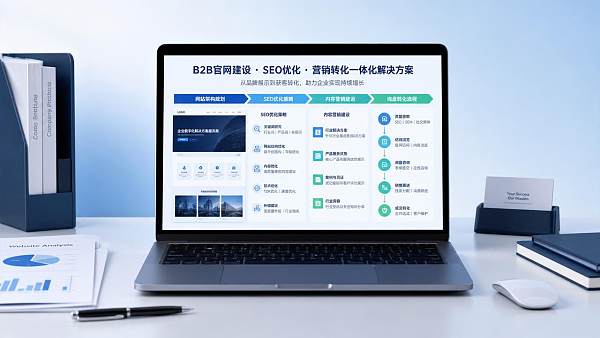
For decision-making, the real key is not who offers the cheapest option, but who can build a website that is scalable, indexable, and sustainably generates inquiries. This is the most easily overlooked crucial factor when selecting a B2B website development platform.
Recent changes indicate that many companies no longer view their official websites as merely "online business cards." A more significant trend is that official websites are now undertaking multiple tasks, including brand display, search engine acquisition, advertising revenue generation, and sales conversion.
Therefore, when evaluating B2B website development service providers, at least four things should be considered: whether the structure is reasonable, whether the content is professional, whether the SEO fundamentals are solid, and whether the conversion path is complete. If any one of these aspects is significantly weak, the subsequent investment may be amplified.
First, examine the structure: Is the official website designed for the transaction process?
Many website homepages are visually appealing, but users can't find the key information after clicking through. Such B2B website designs may look good, but they are inefficient for business operations. The core of structural design is not having a complete range of sections, but rather clear navigation.
A qualified service provider will typically first clarify their business objectives and then work backward to design the page structure. For example, if the goal is to generate inquiries, the website should prioritize highlighting product categories, application scenarios, delivery capabilities, case studies, and contact information, rather than simply piling on company information.
- Can the homepage clearly explain what it does, who it serves, and its advantages in a short time?
- Is the navigation based on the user's decision-making order, rather than on internal departmental divisions?
- Does the product page support further traffic segmentation by industry, function, scenario, and model?
- Are there fewer redirects on landing pages and inquiry pages to avoid user churn?
In practice, the closer the website structure is to the client's decision-making logic, the smoother the subsequent SEO strategy and advertising implementation will be. Conversely, if the website structure is only for "looking complete," the cost of redesigning it later is often much higher.
Next, let's look at the content: Can you clearly explain your professional skills?
The most common problem in B2B website construction is not a lack of pages, but rather a lack of persuasive content. Many websites only provide superficial information such as "when the company was founded" or "how much equipment it owns," while the content that truly influences inquiries is missing.
Good content planning should serve both search engines and potential customers. For the former, it's about topic relevance and information completeness; for the latter, it's about whether you truly understand industry needs, purchasing concerns, and cooperation standards.
- Product descriptions should include specifications, application scenarios, and solutions to problems.
- Case studies should include the process, results, and client benefits, not just a few pictures.
- The brand content should reflect its R&D, delivery, after-sales, and certification capabilities.
- The information content should focus on industry issues, forming a continuously updated content portal.
If a service provider only "fills in the words," that usually doesn't count as true content creation. A mature team will assist in refining keywords, page themes, content frameworks, and conversion copy, which has a significant impact on the outcome of B2B website development.
Some industry content requires stronger professional expression, such as in finance, education, or public service, which places a greater emphasis on the ability to abstract and apply content. For topics like the application and optimization of management accounting in the financial management of public institutions , if a service provider can naturally break down complex issues, it usually indicates that their content team possesses good comprehension and organizational skills.
SEO fundamentals determine whether a B2B website can acquire customers in the long run.
Many companies struggle to get traffic after launching their official websites. The problem often isn't with their advertising budget, but rather a lack of proper SEO foundation built during the website development phase. Ignoring search engine friendliness in B2B website construction not only makes later remediation difficult but can also negatively impact indexing efficiency.
When choosing a service provider, focus on asking about specific details rather than just listening to vague statements like "supports SEO." A website service provider that truly understands SEO will consider both the technical architecture and content layout.
- Are the URLs standardized? Are the category hierarchy concise and clear?
- Can the title, description, and tags be set independently?
- Does the page loading speed, mobile experience, and code cleanliness meet the standards?
- Can the internal links on the site support keyword expansion and topic aggregation?
- Does it support multiple languages, multiple regions, and continuous updates?
This is even more crucial for companies with overseas market needs. Integrated website and marketing service platforms like EasyCare typically consider intelligent website building, multilingual deployment, SEO optimization, ad handling, and AI search visibility together, avoiding the need to find different teams to fill gaps after the official website is launched.
This also means that building a B2B website should not just be about delivering web pages, but rather about delivering a digital platform with the foundation for growth. If the structure, technology, and content are fragmented from the start, it will naturally be difficult to achieve results in the long run.
Finally, consider conversion: Do you have the ability to turn traffic into inquiries?
The real difference in B2B website design lies not in page aesthetics, but in conversion design. Many websites attract visitors but fail to generate inquiries, essentially because they lack effective conversion tools. If users don't know what to do next after viewing the page, they naturally leave.
A reliable service provider will typically break down conversion actions into the details of each page. Different pages serve different objectives, and buttons, forms, trust endorsements, contact information, and content pacing should all serve this objective.
- The homepage is responsible for establishing awareness, highlighting value and entry points.
- The product page is responsible for building interest, highlighting the differentiators and benefits of the application.
- The case study page is responsible for building trust and reducing concerns about cooperation.
- The contact page is responsible for lowering the submission threshold and reducing invalid fields.
If the service provider can also offer data tracking, form analysis, page hotspot observation, and advertising landing page support, it means that their understanding goes beyond just building a B2B website, but rather managing the entire conversion journey.
This is especially suitable for businesses that need long-term promotion. Because an official website isn't a one-time delivery, but rather a channel asset that is continuously optimized. Even niche topics like the application and optimization of management accounting in the financial management of public institutions can be used as landing pages to test different search intents and conversion actions.
A Practical Evaluation Checklist for B2B Website Development Service Providers
To standardize the selection process, you can directly score the results based on the following dimensions. This makes it easier to avoid making judgments based solely on the demonstration results and reduces potential communication errors later on.
In summary, the selection criteria for B2B website construction have changed. Today, when evaluating service providers, we cannot only look at the beauty of their portfolios or compare one-time quotes. We must also consider whether they understand growth logic and can turn the website into a stable customer acquisition tool.
If a service provider understands website structure, content planning, SEO optimization, and conversion improvement, then every investment made after the official website goes live has a greater chance of accumulating long-term value. Choosing the right B2B website building partner means that the website is not a cost item, but a growth engine.
Related Articles



Related Products
 EasyCamp SaaS Smart Website Marketing SystemE-Yingbao SaaS Smart Website Marketing System: AI-powered, zero-code website building. Rapidly launch multilingual independent e-commerce sites in just 10 minutes. Global server acceleration and AI-driven SEO optimization empower businesses to efficiently connect with global markets. The seamless integration of technology and user-friendly operation makes building e-commerce sites incredibly simple.
 AI+SEM Intelligent Advertising Marketing SystemAI+SEM drives intelligent ad creation, empowering full-funnel precision advertising marketing. The system automatically generates weekly/monthly reports, AI recommends keywords and target countries, monitors core metrics in real-time with intelligent alerts, and enables one-click high-conversion ad solutions to help quickly acquire customers and improve ROI.
 AI+SEO Dual Engine Optimization ServiceEasyWin AI+SEO Dual Engine Optimization System leverages AI-powered keyword mining, content generation, and comprehensive technical optimization to help foreign trade enterprises acquire high-quality organic traffic, significantly improving search rankings and conversion rates.
 AI+SNS Social Media Marketing SystemYingbao AI+SNS Social Media Marketing System - Precision social capture for the social media era. Supports one-click content synchronization across major platforms like Facebook and LinkedIn. AI intelligently rewrites posts for enhanced relevance. 24/7 AI customer service and user profiling analysis empower businesses to efficiently expand into global markets.
 AI+SEO营销解决方案易营宝AI+SEO营销解决方案,通过AI批量写作、智能生成TDK、精准关键词扩词等功能,全面优化网站SEO效果,提升流量与转化率。助力企业构建高效智能网站新生态。
 AI+SEM Advertising Marketing SolutionsAI+SEM Advertising Marketing Solution leverages AI technology to deeply empower SEM ad campaigns. It automatically generates weekly/monthly reports using AI, presenting account data across multiple dimensions for comprehensive insights into campaign performance and trends. The system precisely recommends keywords and target countries, intelligently generates high-conversion ad copy, and enables one-click activation of efficient campaign plans to help businesses rapidly acquire customers. Simultaneously, it monitors core metrics in real time, intelligently identifies abnormal fluctuations, and issues timely alerts to ensure stable, high-return advertising results.
 Domain Name ServicesEasyWin provides professional domain name services, including intelligent queries, one-stop registration, brand protection, and full lifecycle management, helping businesses build a digital brand image.
 EasyOperate B2C Cross-Border E-Commerce Platform & Independent WebsiteEasyStore B2C Cross-border E-commerce Independent Store is an intelligent website building and cross-border e-commerce integrated solution independently developed by EasyStore Information Technology (Beijing) Co., Ltd. The system is specially designed for small and medium-sized as well as large export enterprises, integrating 'website building, operation, marketing, advertising, and conversion' into one, helping enterprises quickly establish cross-border e-commerce independent stores to achieve brand globalization and global sales growth.
The platform supports multiple languages, multiple currencies, and multi-channel marketing, with built-in AI intelligent translation and SEO optimization systems, suitable for mainstream markets such as Southeast Asia, Europe and America, Latin America, and the Middle East, assisting Chinese manufacturing enterprises in efficiently deploying international e-commerce strategies. SSL证书易营宝提供专业SSL安全证书服务,包括单域名和泛域名证书,确保网站数据传输加密、身份验证和完整性保护,助力企业建立安全可信的在线业务环境。









