









- What should you focus on in the latest enterprise SaaS report? From renewal rates and delivery costs to overseas growth opportunitiesJul 12, 2026View details
- What signals are worth paying attention to in a cross-border marketing trend report? B2B companies should look at these 6 signalsJul 11, 2026View details
- How to Read a Cross-Border Marketing Trends Report? Five Key Dimensions for Evaluating Channel OpportunitiesJul 11, 2026View details
- Which channel has the highest ROI in the global traffic ecosystem? Comparative analysis of search, social media, and advertisingJul 10, 2026View details
- What multilingual website services are available in Sanya? Which model is more suitable for local businesses going global?Jul 08, 2026View details
- How to view the complete list of China SaaS companies in the top 100? Practical methods for screening website-building and marketing service providersJul 08, 2026View details
Will a foreign trade website be penalized by Google if it doesn’t use HTTPS? Security and ranking impact explained
Will using HTTP instead of HTTPS on a foreign trade website be penalized by Google? The conclusion first
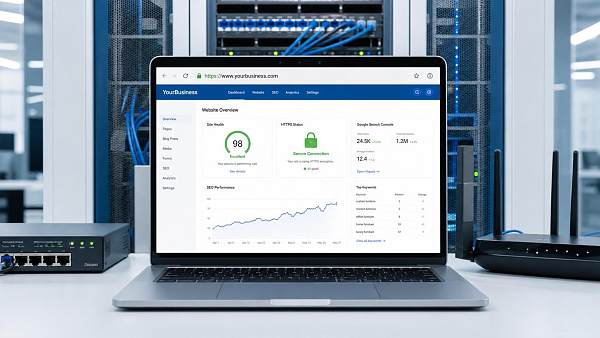
Will using HTTP instead of HTTPS on a foreign trade website be penalized by Google? The answer is yes, it will have an impact, but usually it is not a simple, blanket penalty. Google has long regarded HTTPS as a lightweight ranking signal, and browsers also display a "Not secure" warning on non-HTTPS pages, which directly affects the user experience.
For foreign trade websites, the issue is not only about rankings. Inquiry forms, login information, file downloads, and quotation communication all involve data transmission. As long as it is still HTTP, information may be intercepted, tampered with, or hijacked, and customer trust will also decline significantly.
A more realistic point is that SEO, ad placement, and website conversion are inherently connected. Even if a site has good content, if the security indicator is not up to standard, bounce rate, dwell time, and form submission rate may all be affected, which in turn drags down SEO performance.
Why does Google care about HTTPS, rather than only content quality?
Many people ask whether search engines should mainly evaluate content and links. In practice, it is not that simple. Google increasingly values page experience, and security is part of that experience. HTTPS encrypts transmission through an SSL certificate, reducing man-in-the-middle attacks, data sniffing, and page tampering risks.
If a page has security risks, it is hard for search engines to regard it as a highly trustworthy result. This is especially true for foreign trade websites, where visitors often come from different countries and network environments, the routing is more complex, and exposure to risk is higher. Without HTTPS, site credibility is naturally discounted.
It should be noted that HTTPS is not a magic cure for rankings. It cannot replace content quality, website structure, loading speed, or backlink quality. But when two pages are otherwise equally strong, the site with more complete security settings is more likely to gain both search engine and user recognition.
What ranking and business chain reactions can occur if HTTP is still used?
The more common situation is not a sudden "drop-out from rankings" on a certain day, but rather a gradual decline across multiple links.
In other words, the question of whether a foreign trade website that does not use HTTPS will be penalized by Google also involves inquiry loss, brand trust decline, and security audit risks. Rankings are only the first visible layer; the real losses often happen in the conversion path.
Which pages can no longer keep using HTTP, and what is the criterion?
If the website has not been fully upgraded yet, priorities should be clarified first. Any page involving data submission, identity verification, or marketing conversion is not suitable for continued use of HTTP.
- Inquiry forms, contact pages, quotation request pages
- Admin login, customer center, download center
- Ad landing pages, core entry pages of multilingual official websites
- Pages with online chat, file upload, or payment functions
In actual applications, many companies mistakenly believe that "only payment pages need HTTPS". This is a misunderstanding. As long as a page collects information such as email, phone number, name, country, or purchasing needs, it is already handling sensitive business data and can no longer be treated as a simple display page.
If a site is simultaneously handling SEO, advertising, and social media traffic acquisition, it is recommended to enable HTTPS across the entire site directly rather than only partially modifying it. Fragmented switching can easily cause mixed content, abnormal redirects, and split indexing, making later maintenance more complicated.
Will switching a website that has been online for many years to HTTPS affect indexing?
This is the issue many teams worry about most. The answer is that a standard migration usually will not cause long-term negative effects; the real problem lies in migration details. Certificate deployment is only the first step, and 301 redirects, internal links, resource references, sitemap, and search console settings all need to be handled in sync.
If only the certificate is installed, but images, scripts, and style files still load over HTTP, browsers will judge it as mixed content, security warnings will still exist, and page functions may also become abnormal. This not only fails to achieve the security goal, but also affects the crawling experience.
A more stable approach is to first complete URL cleanup, core page backups, redirect testing, and log monitoring before switching. After migration, continue observing whether indexing, crawl errors, bounce rate, and form conversion have returned to normal.
Several details that are easy to miss during migration
- HTTP is not uniformly 301 redirected to HTTPS
- canonical still points to the old URL
- In-site image, JS, and CSS references are not updated
- The HTTPS version of the sitemap is not submitted
- CDN, forms, and tracking code certificates are not linked
If you consider website building, SEO, and security at the same time, how should you move forward more efficiently?
The most efficient approach is not to add security after the website goes live, but to design HTTPS, SEO architecture, and data collection processes together during the website-building stage. This can reduce secondary revisions and also avoid later indexing fluctuations.
Nowadays, when building overseas independent sites, more and more emphasis is placed on integrated capabilities. A website should not only be able to display content, but also accommodate multilingual deployment, search indexing, ad landing, and online conversion. If security configuration lags behind, the later marketing investment can easily be offset.
This is also why many companies choose to place website building, SEO, and advertising within the same service system for unified planning. Platforms like Yiyingbao, which have long focused on intelligent website building and overseas marketing, usually consider certificate deployment, page structure, crawl rules, form conversion, and multi-region access experience together, reducing repetitive rework caused by single-point fixes.
In simple terms, the answer to whether a foreign trade website that does not use HTTPS will be penalized by Google is no longer about "whether it will or will not", but about "whether it will drag down the entire customer acquisition chain". Only looking at rankings and ignoring security and conversion will lead to inaccurate judgments.
How do you determine whether the current website should be upgraded immediately?
You can start with a quick check. If any two of the following appear, it is not recommended to continue delaying.
- The browser shows a security warning
- The website has inquiry, registration, or file upload functions
- Google SEO or ad placement is currently being done
- There are multilingual pages and overseas access requirements
- Security review or internal compliance checks are needed
In the end, will a foreign trade website that does not use HTTPS be penalized by Google? Yes, but what is more worth emphasizing is that it will also weaken search performance, customer trust, and data security at the same time. For foreign trade websites, HTTPS is no longer optional; it is a basic configuration.
The next step can start from three actions: first verify whether the whole site has been unified under HTTPS, then check redirects and mixed content, and finally put certificates, indexing, forms, and analytics tools into the same operations checklist. This makes judgment more accurate and the adjustment more efficient.
Related Articles


Related Products
 EasyCamp SaaS Smart Website Marketing SystemE-Yingbao SaaS Smart Website Marketing System: AI-powered, zero-code website building. Rapidly launch multilingual independent e-commerce sites in just 10 minutes. Global server acceleration and AI-driven SEO optimization empower businesses to efficiently connect with global markets. The seamless integration of technology and user-friendly operation makes building e-commerce sites incredibly simple.
 AI+SEM Intelligent Advertising Marketing SystemAI+SEM drives intelligent ad creation, empowering full-funnel precision advertising marketing. The system automatically generates weekly/monthly reports, AI recommends keywords and target countries, monitors core metrics in real-time with intelligent alerts, and enables one-click high-conversion ad solutions to help quickly acquire customers and improve ROI.
 AI+SEO Dual Engine Optimization ServiceEasyWin AI+SEO Dual Engine Optimization System leverages AI-powered keyword mining, content generation, and comprehensive technical optimization to help foreign trade enterprises acquire high-quality organic traffic, significantly improving search rankings and conversion rates.
 AI+SNS Social Media Marketing SystemYingbao AI+SNS Social Media Marketing System - Precision social capture for the social media era. Supports one-click content synchronization across major platforms like Facebook and LinkedIn. AI intelligently rewrites posts for enhanced relevance. 24/7 AI customer service and user profiling analysis empower businesses to efficiently expand into global markets.
 AI+SEO营销解决方案易营宝AI+SEO营销解决方案,通过AI批量写作、智能生成TDK、精准关键词扩词等功能,全面优化网站SEO效果,提升流量与转化率。助力企业构建高效智能网站新生态。
 AI+SEM Advertising Marketing SolutionsAI+SEM Advertising Marketing Solution leverages AI technology to deeply empower SEM ad campaigns. It automatically generates weekly/monthly reports using AI, presenting account data across multiple dimensions for comprehensive insights into campaign performance and trends. The system precisely recommends keywords and target countries, intelligently generates high-conversion ad copy, and enables one-click activation of efficient campaign plans to help businesses rapidly acquire customers. Simultaneously, it monitors core metrics in real time, intelligently identifies abnormal fluctuations, and issues timely alerts to ensure stable, high-return advertising results.
 Domain Name ServicesEasyWin provides professional domain name services, including intelligent queries, one-stop registration, brand protection, and full lifecycle management, helping businesses build a digital brand image.
 EasyOperate B2C Cross-Border E-Commerce Platform & Independent WebsiteEasyStore B2C Cross-border E-commerce Independent Store is an intelligent website building and cross-border e-commerce integrated solution independently developed by EasyStore Information Technology (Beijing) Co., Ltd. The system is specially designed for small and medium-sized as well as large export enterprises, integrating 'website building, operation, marketing, advertising, and conversion' into one, helping enterprises quickly establish cross-border e-commerce independent stores to achieve brand globalization and global sales growth.
The platform supports multiple languages, multiple currencies, and multi-channel marketing, with built-in AI intelligent translation and SEO optimization systems, suitable for mainstream markets such as Southeast Asia, Europe and America, Latin America, and the Middle East, assisting Chinese manufacturing enterprises in efficiently deploying international e-commerce strategies. SSL证书易营宝提供专业SSL安全证书服务,包括单域名和泛域名证书,确保网站数据传输加密、身份验证和完整性保护,助力企业建立安全可信的在线业务环境。









