









- What should you focus on in the latest enterprise SaaS report? From renewal rates and delivery costs to overseas growth opportunitiesJul 12, 2026View details
- What signals are worth paying attention to in a cross-border marketing trend report? B2B companies should look at these 6 signalsJul 11, 2026View details
- How to Read a Cross-Border Marketing Trends Report? Five Key Dimensions for Evaluating Channel OpportunitiesJul 11, 2026View details
- Which channel has the highest ROI in the global traffic ecosystem? Comparative analysis of search, social media, and advertisingJul 10, 2026View details
- What multilingual website services are available in Sanya? Which model is more suitable for local businesses going global?Jul 08, 2026View details
- How to view the complete list of China SaaS companies in the top 100? Practical methods for screening website-building and marketing service providersJul 08, 2026View details
How to assess the security of SaaS website building? SSL certificates, GDPR compliance, and a data privacy checklist
When evaluating SaaS website security, you cannot look only at page performance, launch speed, and procurement cost. What truly affects the long-term operation of a website is often the more underlying security capabilities, including whether the SSL certificate is standardized, whether GDPR compliance is implemented, and whether the data privacy mechanism can withstand review. Especially in website and marketing service integrated scenarios, the site not only carries content, but also connects forms, advertising, analytics, customer service, and payments; any weak link may amplify risks.
For enterprises targeting overseas markets, this judgment cannot stop at the level of “platform security claims.” Business in North America, Europe, and multiple regions usually involves cross-border data processing, visitor behavior collection, and third-party tool integration. In other words, evaluating SaaS website security requires looking at both technical configuration and compliance processes, as well as operational boundaries.
First, make it clear: SaaS website security is not just a server issue

When many teams purchase a website-building system, they tend to equate security with “whether the website can prevent attacks.” That is certainly important, but it is not enough. SaaS website security is more like a continuously operating control system, covering data transmission, account permissions, log retention, plugin access, backup recovery, and privacy exposure.
If a platform simultaneously handles marketing campaigns, lead collection, SEO optimization, and multilingual site management, the security boundary will expand further. A small mistake in the design of a form field on an overseas landing page may directly trigger data privacy issues; an incorrect integration of an analytics script may also cause GDPR compliance to lose its foundation.
Therefore, when assessing the security level, technical factors, processes, and business scenarios should be considered together, rather than looking only at a single feature.
SSL certificates are the gateway, but not the endpoint
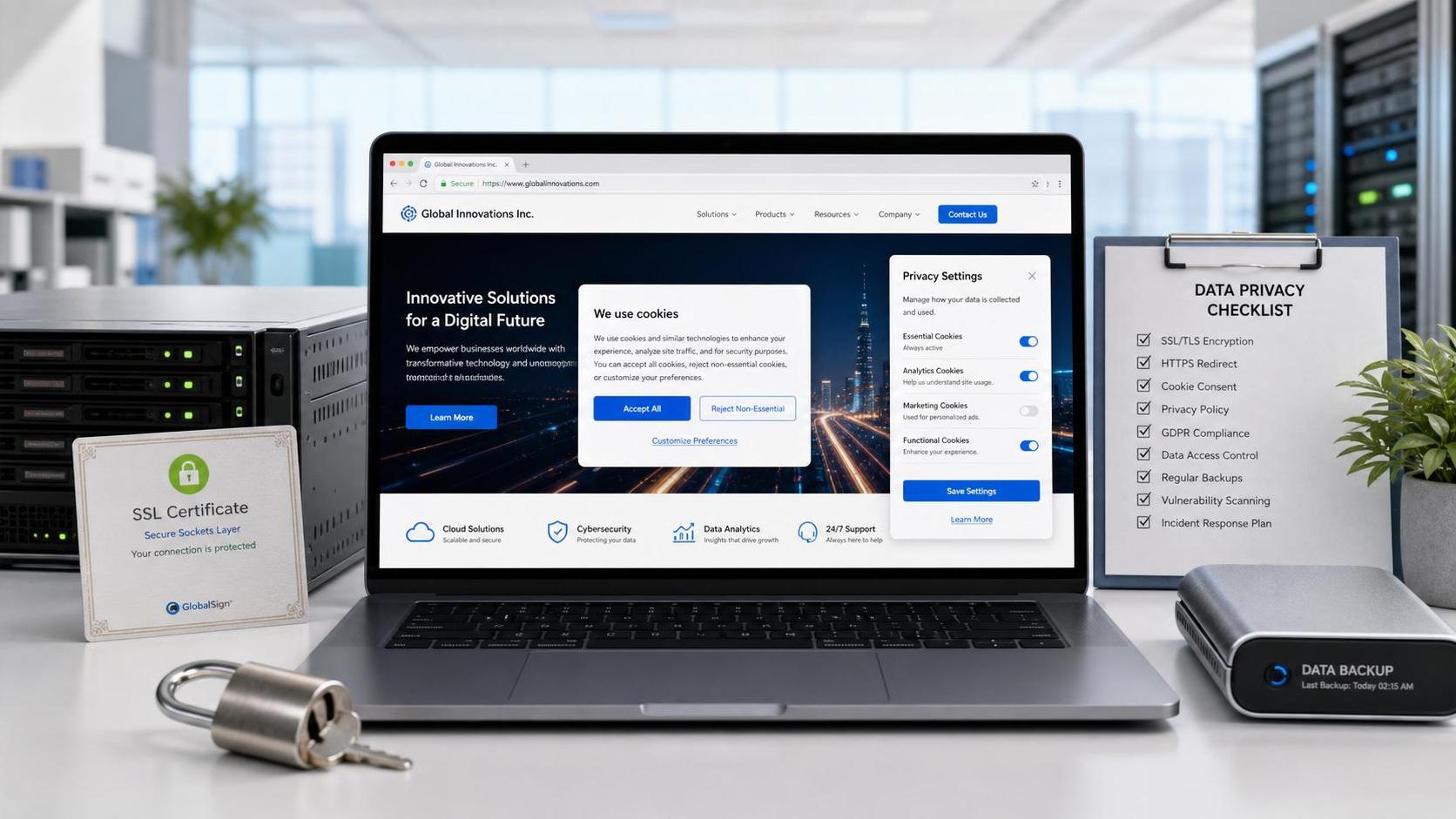
SSL certificates are usually the easiest item to notice. Whether the browser address bar shows a lock icon and whether the site has HTTPS enabled are indeed basic checks. But what deserves more attention is whether the certificate deployment is complete, whether the main domain, subdomains, and marketing campaign pages are all covered, and whether mixed content issues exist.
If the homepage uses HTTPS, but the form submission interface, static resources, or third-party scripts still use non-encrypted links, then the significance of the SSL certificate is greatly reduced. For foreign trade websites, cross-border e-commerce sites, and advertising landing pages, such issues directly affect user trust and may also affect search engine evaluation.
Usually, you can review this from three aspects:
- Whether the certificate type matches the business scale, and whether the single-domain, wildcard, or multi-domain configuration is reasonable.
- Whether the certificate renews automatically to avoid expiration causing page errors or traffic interruption.
- Whether all in-site resources are loaded over encryption to avoid mixed transmission of forms, images, and scripts.
From the perspectives of SEO and conversion, SSL certificates are no longer a bonus item, but a basic infrastructure. Without it, marketing channel stability and brand credibility will both be affected.
What GDPR compliance focuses on is “how you collect and use data”
Many enterprises mistakenly believe that GDPR compliance is only relevant to European companies. In fact, as long as a website targets EU users, or processes visitor data from the EU region, relevant obligations need to be carefully assessed. If a website-building platform does not provide clear compliance support, the later modification cost is often higher than the early selection cost.
The core of GDPR compliance is not simply publishing a privacy policy link, but making data collection, authorization, storage, invocation, and deletion traceable. For example, whether the Cookie pop-up supports explicit consent, whether the form explains its purpose, whether subscription emails can revoke authorization, and whether the backend can respond to deletion requests are all practical checkpoints.
In website + marketing service integrated scenarios, GDPR compliance also involves advertising pixels, remarketing tags, customer service tools, and data analytics systems. If these components are provided by multiple third parties, responsibility boundaries and data flows need to be confirmed even more carefully.
When judging GDPR compliance, don’t miss these steps
- Whether it includes Cookie consent management and supports category-based authorization.
- Whether privacy policies, data usage statements, and authorization records can be configured.
- Whether it supports data subject requests such as export, deletion, and restriction of processing.
- Whether it explains the data storage region, cross-border transmission method, and third-party processors.
- Whether marketing automation tools call visitor information within the scope of authorization.
Data privacy depends on mechanisms, not just promises
Data privacy is one of the areas in such evaluations most likely to be replaced by “promotional rhetoric.” A platform saying it “values privacy” does not mean a complete mechanism has already been established. What truly needs to be checked is how data is collected, classified, authorized, invoked, and destroyed within the system.
If a website handles inquiries, registrations, payments, or membership management, it usually touches data of varying sensitivity, such as names, email addresses, phone numbers, addresses, and company information. At this point, whether permission management is refined, whether logs are auditable, whether backups are encrypted, and whether interfaces restrict access are all directly related to data privacy risk.
For marketing websites, there is another commonly overlooked issue: whether the data is being “over-collected.” More form fields do not mean better leads; instead, they may increase compliance burden. The collection scope should match business objectives, which is itself an important principle of GDPR compliance and data privacy governance.
A practical checklist
For easier real-world evaluation, the core questions can be organized into an actionable checklist:
Integrated website and marketing platforms require a full-chain security review
If the platform is only a pure website-building tool, the evaluation dimensions are relatively concentrated. But in the model of intelligent website building, SEO, ad placement, and social media operation collaboration, the website is no longer an isolated page, but the hub of global customer acquisition. At this point, SaaS website security needs to cover content publishing, visitor identification, lead distribution, ad tracking, and cross-region access experience.
Taking integrated website and marketing service platforms such as Yiyingbao as an example, its self-developed cloud intelligent website-building system, cross-border e-commerce system, as well as AI advertising and SEO optimization capabilities, can help enterprises build overseas independent sites more quickly and connect search, advertising, and social channels. This advantage is obvious, but it also means the platform must be even more rigorous in data flow management, especially in data collaboration among multilingual sites, overseas access, and marketing automation.
In other words, the stronger the platform capability, the more necessary it is to verify whether its security and compliance keep pace with business complexity.
During actual evaluation, ask five questions first
When facing different vendors, you can first build a judgment framework around five questions.
- Where does the data reside, does it involve cross-border transmission, and is there a clear explanation?
- How is the SSL certificate deployed, and does it support full-site encryption and automatic renewal?
- Are GDPR compliance functions built into the system, or do they rely on manual patchwork processing?
- Are data privacy permissions refined down to roles, departments, and operation logs?
- Once an abnormality occurs, are there backups, alerts, and recovery commitments?
These questions may seem basic, but in practice they can quickly distinguish between “a platform that can build websites” and “a platform that can support long-term overseas operations.”
Only by bringing the checklist into the project does evaluation become meaningful
The value of SaaS website security does not lie in writing a beautiful policy, but in turning SSL certificates, GDPR compliance, and data privacy requirements into checklist actions that can be executed before launch, before ad placement, and before each revision. Every time a form, pixel, plugin, or overseas page is added, the data flow and authorization boundaries should be reviewed again.
If you are currently screening platforms, what should be compared is not only price and feature lists, but also security documentation, compliance support, logging capabilities, and recovery mechanisms in the same evaluation table. First sort out which markets the business needs to enter, then map what data the website collects and through which channels users are reached, and finally determine whether the platform is truly suitable. Only standards established this way are sufficient to support the long-term stable operation of the website and make subsequent marketing growth more controllable.
Related Articles


Related Products
 EasyCamp SaaS Smart Website Marketing SystemE-Yingbao SaaS Smart Website Marketing System: AI-powered, zero-code website building. Rapidly launch multilingual independent e-commerce sites in just 10 minutes. Global server acceleration and AI-driven SEO optimization empower businesses to efficiently connect with global markets. The seamless integration of technology and user-friendly operation makes building e-commerce sites incredibly simple.
 AI+SEM Intelligent Advertising Marketing SystemAI+SEM drives intelligent ad creation, empowering full-funnel precision advertising marketing. The system automatically generates weekly/monthly reports, AI recommends keywords and target countries, monitors core metrics in real-time with intelligent alerts, and enables one-click high-conversion ad solutions to help quickly acquire customers and improve ROI.
 AI+SEO Dual Engine Optimization ServiceEasyWin AI+SEO Dual Engine Optimization System leverages AI-powered keyword mining, content generation, and comprehensive technical optimization to help foreign trade enterprises acquire high-quality organic traffic, significantly improving search rankings and conversion rates.
 AI+SNS Social Media Marketing SystemYingbao AI+SNS Social Media Marketing System - Precision social capture for the social media era. Supports one-click content synchronization across major platforms like Facebook and LinkedIn. AI intelligently rewrites posts for enhanced relevance. 24/7 AI customer service and user profiling analysis empower businesses to efficiently expand into global markets.
 AI+SEO营销解决方案易营宝AI+SEO营销解决方案,通过AI批量写作、智能生成TDK、精准关键词扩词等功能,全面优化网站SEO效果,提升流量与转化率。助力企业构建高效智能网站新生态。
 AI+SEM Advertising Marketing SolutionsAI+SEM Advertising Marketing Solution leverages AI technology to deeply empower SEM ad campaigns. It automatically generates weekly/monthly reports using AI, presenting account data across multiple dimensions for comprehensive insights into campaign performance and trends. The system precisely recommends keywords and target countries, intelligently generates high-conversion ad copy, and enables one-click activation of efficient campaign plans to help businesses rapidly acquire customers. Simultaneously, it monitors core metrics in real time, intelligently identifies abnormal fluctuations, and issues timely alerts to ensure stable, high-return advertising results.
 Domain Name ServicesEasyWin provides professional domain name services, including intelligent queries, one-stop registration, brand protection, and full lifecycle management, helping businesses build a digital brand image.
 EasyOperate B2C Cross-Border E-Commerce Platform & Independent WebsiteEasyStore B2C Cross-border E-commerce Independent Store is an intelligent website building and cross-border e-commerce integrated solution independently developed by EasyStore Information Technology (Beijing) Co., Ltd. The system is specially designed for small and medium-sized as well as large export enterprises, integrating 'website building, operation, marketing, advertising, and conversion' into one, helping enterprises quickly establish cross-border e-commerce independent stores to achieve brand globalization and global sales growth.
The platform supports multiple languages, multiple currencies, and multi-channel marketing, with built-in AI intelligent translation and SEO optimization systems, suitable for mainstream markets such as Southeast Asia, Europe and America, Latin America, and the Middle East, assisting Chinese manufacturing enterprises in efficiently deploying international e-commerce strategies. SSL证书易营宝提供专业SSL安全证书服务,包括单域名和泛域名证书,确保网站数据传输加密、身份验证和完整性保护,助力企业建立安全可信的在线业务环境。









