









- Cross-Border Marketing Trend Research: Why More and More Companies Are Starting to Deploy AI Search and GEO OptimizationJun 30, 2026View details
- Cross-Border Marketing Trend Research: How Independent Sites, AI Content, and Short-Video Customer Acquisition Are ChangingJun 30, 2026View details
- How Can a Brand Updates Page Be Made More SEO-Friendly? Analysis of Update Frequency, Content Structure, and Internal Linking StrategyJun 28, 2026View details
- What stages does the cross-border services ecosystem include? How do website building, promotion, payment, and compliance work togetherJun 22, 2026View details
- How will email marketing costs change in 2026Jun 22, 2026View details
- The China-US tariff arrangement has reached a preliminary consensus, and the trade association will be establishedJun 15, 2026View details
How to Negotiate an Export Website Agency Partnership? Key Points on Settlement Methods, After-Sales Division of Responsibilities, and Regional Protection
For Foreign Trade Website Agency Partnerships, Clarify the Rules Before Discussing Scale
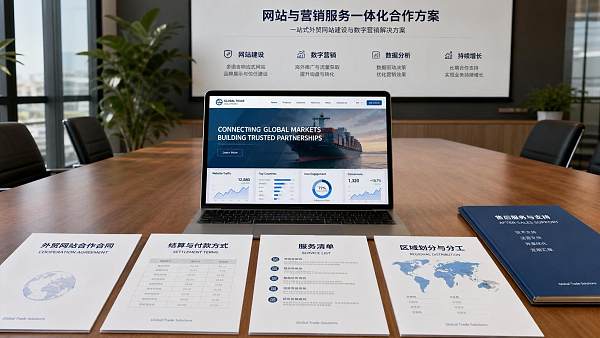
How a foreign trade website agency partnership is negotiated often determines whether it can generate profit later, and whether the partnership can remain stable. Many partnerships start with lively discussions, but when problems truly arise, they are usually not about the contract itself, but about unclear settlement methods, after-sales responsibilities, and regional boundaries.
This is especially true in the integrated website and marketing services sector, where the delivery chain is long and customer needs change quickly. Relying only on the phrase “long-term cooperation” is not enough. If a foreign trade website agency partnership does not have a clear mechanism, later issues such as price undercutting, order grabbing, disputes, and renewal fee disagreements can easily occur.
Judging from recent market changes, customers are no longer buying just a website. They are more concerned about whether website development, SEO, advertising, and social media operations can work together. This also means that negotiations for foreign trade website agency partnerships must shift from a one-time transaction mindset to a long-term service and repeat purchase mindset.
If the agency represents an integrated website and overseas marketing platform such as 易营宝, the focus of negotiation is not only price discounts, but also solution support, technical coordination, data ownership, customer maintenance, and room for continuous upselling.
How Settlement Methods Are Defined Directly Affects Profit and Cash Flow
In foreign trade website agency partnerships, the first thing to discuss is not the lowest purchase price, but how payments are collected, how revenue is shared, and when settlement takes place. This is because a seemingly high profit margin does not mean the money can actually be pocketed.
There are three common settlement models
- Prepaid procurement model: the agent purchases the product first and then sells it externally. This is suitable for parties with channels and an existing customer reserve.
- Order commission model: settlement is made proportionally after a deal is closed. The upfront pressure is low, but the basis for commission calculation must be clearly written.
- Tiered rebate model: rebates are given based on quarterly or annual completed volume. This is suitable for partnership models aiming for long-term growth.
In actual business, foreign trade website agency partnerships are more suitable for a “basic discount + phased rebate” combination. This can ensure profit on individual orders while leaving room for future volume growth.
Settlement terms should at least focus on four points
- Payment collection milestones. How much is paid at contract signing, how much is paid upon launch, and when renewal fees are settled.
- Performance calculation basis. Whether it is calculated by contract amount, received payment amount, or actual service period.
- Refund handling. If the customer terminates midway, who bears the refund and in what proportion it is shared.
- Cross-category revenue. How revenue is shared for upsell projects such as websites, SEO, advertising, and social media.
Many later-stage disputes in foreign trade website agency partnerships occur because only the first-order price was agreed upon, while renewals and upsells were not defined. In fact, what truly widens the revenue gap is often second-year renewals, language site expansion, advertising management, and SEO optimization services.
Unclear After-Sales Division of Labor Is Most Likely to Drag Down the Partnership
After a foreign trade website agency partnership enters the delivery stage, what customers care about most is response speed. As long as after-sales responsibilities are unclear, customer issues will be passed back and forth between the agent and the service provider, and trust will ultimately be consumed.
It is recommended to divide after-sales service into three layers of responsibility
- Front-end communication layer: the agent is responsible for customer communication, requirements organization, and progress synchronization.
- Implementation and delivery layer: the platform provider is responsible for website development, technical handling, and launch support.
- Ongoing operations layer: depending on the depth of cooperation, clarify who leads SEO, advertising, and social media.
For example, if a customer wants to build a multilingual foreign trade website, it is generally more reasonable for the platform provider to handle basic page construction, server stability, and form function debugging. If the customer later requests content updates, product uploads, or inquiry analysis, it must be defined in advance whether these are included in standard after-sales service.
If it is a comprehensive service platform such as 易营宝, covering intelligent website development, SEO, advertising, and social media, it is even more important to separate “standard services” from “value-added services” in foreign trade website agency partnerships. Otherwise, customers will assume everything is included by default, and the agent’s profit will quickly be consumed by after-sales work.
After-sales items recommended to be specified in the contract
- Response time, such as the first reply within a certain number of hours on working days.
- Number of revisions, such as how many rounds of adjustments are supported for the homepage, category pages, and detail pages.
- Training scope, such as backend usage, lead viewing, and basic content maintenance.
- Fault boundaries, such as responsibility for program issues, while problems caused by customer self-modification are charged separately.
Whether a foreign trade website agency partnership can last depends greatly on the after-sales experience. The clearer the rules are written, the higher customer satisfaction tends to be, because expectations have been managed in advance.
How to Set Regional Protection to Avoid Internal Conflicts
When many people discuss foreign trade website agency partnerships, they only emphasize “give me regional protection.” But if the protection rules are too vague, they often become ineffective in execution. What is truly useful is not a verbal promise, but a regional policy that is verifiable, triggerable, and retractable.
Regional protection should at least define three things
- Who is protected: an administrative region, industry customers, or specific channel leads.
- What the protection is based on: first registration, first contract signing, or first payment received.
- How long the protection period lasts, and how long without follow-up will result in release.
Here is a very common scenario. A customer’s headquarters is in Shenzhen, the factory is in Dongguan, the brand team is in Hangzhou, but the online inquiry comes from official website advertising. In this case, if the foreign trade website agency partnership does not have registration rules, it is very easy for multiple parties to claim the same lead at the same time.
A relatively sound approach is to establish a lead registration system and bind it to follow-up timeliness. Whoever first submits complete customer information enters the protection period first; if there is no substantive progress for several consecutive days, the platform provider reallocates the lead.
When foreign trade website agency partnerships involve online promotion, the ownership of public-domain leads must also be discussed separately. In particular, SEO organic inquiries, advertising leads, and social media private-message customers must have a clearly written allocation mechanism in advance if these leads come from unified campaigns run by the headquarters.
During Negotiations, Do Not Look Only at Price; Pay More Attention to Platform Support Capabilities
At the procurement decision stage, many people simplify foreign trade website agency partnerships into “who offers the lower discount.” But in the integrated website and marketing services sector, a low price does not necessarily mean higher profit; the support system is often more important.
Focus on evaluating these five capabilities
- Product capability: whether the website development system supports multiple languages, SEO structure, and independent site expansion.
- Delivery capability: whether the launch cycle is stable and whether the project process is standardized.
- Marketing capability: whether support can be provided for SEO, advertising, social media, and AI search optimization.
- Training capability: whether sales scripts, demo materials, and case support are available.
- Renewal capability: whether it can help customers continue to make additional purchases and increase lifecycle value.
Taking 易营宝 as an example, the advantage of this type of platform lies not only in website development itself, but also in its ability to connect AI-powered intelligent website development, Google SEO optimization, advertising, overseas social media operations, and GEO optimization into a complete growth chain. For foreign trade website agency partnerships, this means richer deal-closing scenarios and higher repeat purchase opportunities.
More practically speaking, a customer may first build an official website today, add Google advertising three months later, and then build multilingual sites six months later. If the partner platform has complete capabilities, the agent can continue to follow up instead of ending the relationship after completing a single order.
Before Signing, Go Through This Checklist Item by Item
To help foreign trade website agency partnerships avoid unnecessary detours, it is recommended to confirm the following questions one by one before signing:
Ultimately, a foreign trade website agency partnership is not a one-time purchase, but a long-term operating model. Only by discussing settlement methods in detail, clarifying after-sales division of labor, and making regional protection practical at the early stage can internal friction be reduced, profits stabilized, and scale achieved later.
If you are currently selecting a partner platform, it is recommended to prioritize whether the system capabilities, marketing capabilities, and agency support system are complete. The more transparent the rules are, the easier the partnership is to replicate; the more adequate the support is, the easier it is for a foreign trade website agency partnership to move from a single transaction to sustained growth.
Related Articles
 How to Make Agent Recruitment for Foreign Trade Websites More Effective? Policy Design, Sample Cases, and Training System Analysis
 Which companies are a good fit for a foreign trade website agency partnership? Analysis of entry requirements, revenue models, and risk points
 How to Negotiate an Export Website Agency Partnership? Key Points on Settlement Methods, After-Sales Division of Responsibilities, and Regional Protection
Related Products
 EasyCamp SaaS Smart Website Marketing SystemE-Yingbao SaaS Smart Website Marketing System: AI-powered, zero-code website building. Rapidly launch multilingual independent e-commerce sites in just 10 minutes. Global server acceleration and AI-driven SEO optimization empower businesses to efficiently connect with global markets. The seamless integration of technology and user-friendly operation makes building e-commerce sites incredibly simple.
 AI+SEM Intelligent Advertising Marketing SystemAI+SEM drives intelligent ad creation, empowering full-funnel precision advertising marketing. The system automatically generates weekly/monthly reports, AI recommends keywords and target countries, monitors core metrics in real-time with intelligent alerts, and enables one-click high-conversion ad solutions to help quickly acquire customers and improve ROI.
 AI+SEO Dual Engine Optimization ServiceEasyWin AI+SEO Dual Engine Optimization System leverages AI-powered keyword mining, content generation, and comprehensive technical optimization to help foreign trade enterprises acquire high-quality organic traffic, significantly improving search rankings and conversion rates.
 AI+SNS Social Media Marketing SystemYingbao AI+SNS Social Media Marketing System - Precision social capture for the social media era. Supports one-click content synchronization across major platforms like Facebook and LinkedIn. AI intelligently rewrites posts for enhanced relevance. 24/7 AI customer service and user profiling analysis empower businesses to efficiently expand into global markets.
 AI+SEO营销解决方案易营宝AI+SEO营销解决方案,通过AI批量写作、智能生成TDK、精准关键词扩词等功能,全面优化网站SEO效果,提升流量与转化率。助力企业构建高效智能网站新生态。
 AI+SEM Advertising Marketing SolutionsAI+SEM Advertising Marketing Solution leverages AI technology to deeply empower SEM ad campaigns. It automatically generates weekly/monthly reports using AI, presenting account data across multiple dimensions for comprehensive insights into campaign performance and trends. The system precisely recommends keywords and target countries, intelligently generates high-conversion ad copy, and enables one-click activation of efficient campaign plans to help businesses rapidly acquire customers. Simultaneously, it monitors core metrics in real time, intelligently identifies abnormal fluctuations, and issues timely alerts to ensure stable, high-return advertising results.
 Domain Name ServicesEasyWin provides professional domain name services, including intelligent queries, one-stop registration, brand protection, and full lifecycle management, helping businesses build a digital brand image.
 EasyOperate B2C Cross-Border E-Commerce Platform & Independent WebsiteEasyStore B2C Cross-border E-commerce Independent Store is an intelligent website building and cross-border e-commerce integrated solution independently developed by EasyStore Information Technology (Beijing) Co., Ltd. The system is specially designed for small and medium-sized as well as large export enterprises, integrating 'website building, operation, marketing, advertising, and conversion' into one, helping enterprises quickly establish cross-border e-commerce independent stores to achieve brand globalization and global sales growth.
The platform supports multiple languages, multiple currencies, and multi-channel marketing, with built-in AI intelligent translation and SEO optimization systems, suitable for mainstream markets such as Southeast Asia, Europe and America, Latin America, and the Middle East, assisting Chinese manufacturing enterprises in efficiently deploying international e-commerce strategies. SSL证书易营宝提供专业SSL安全证书服务,包括单域名和泛域名证书,确保网站数据传输加密、身份验证和完整性保护,助力企业建立安全可信的在线业务环境。









