









- What stages does the cross-border services ecosystem include? How do website building, promotion, payment, and compliance work togetherJun 22, 2026View details
- The China-US tariff arrangement has reached a preliminary consensus, and the trade association will be establishedJun 15, 2026View details
- Should overseas brand marketing start with ads or contentJun 21, 2026View details
- What determines B2C cross-border e-commerce website development costs? A breakdown of features, interfaces, and deployment methodsJun 17, 2026View details
- China-Morocco zero-tariff access, a breakthrough in the cost of Moroccan goods exports to ChinaJun 11, 2026View details
- What signal should be released for the suspension of exports to JapanJun 10, 2026View details
How to design channel collaboration for higher efficiency? Line distribution, quotation support, and regional protection rules analysis
Channel cooperation improves efficiency; first put the rules into the real business pipeline

Whether channel cooperation goes smoothly is often not determined by rapport, but by whether the rules are close to the business reality. Against the backdrop of online lead generation becoming increasingly dependent on websites, SEO, advertising, and social media traffic, channel cooperation is no longer simply contract-based distribution; it is a complete coordination process from lead acquisition to follow-up to closing.
Especially in the website + marketing services integration industry, lead sources are complex and the sales cycle varies greatly. Projects for multilingual website development, Google Ads, SEO optimization, and cross-border store operations are not delivered under the same logic. If channel cooperation is still handled with a unified template, it is easy to cause lead snatching, low pricing, dropped follow-ups, and regional conflicts.
Taking a platform service provider like Yiyingbao, which combines AI website building, SEO, advertising, social media, and GEO optimization capabilities, as an example, the effectiveness of channel cooperation is not just about the number of channels. The key is whether lead allocation, quotation support, and regional protection can be designed into an executable mechanism that makes partners willing to invest and the headquarters easier to manage.
Under different business scenarios, the focus of channel cooperation judgment is not the same
Many channel cooperation failures are not caused by insufficient resources, but by treating similar projects as the same kind of demand. In actual application, website projects place more emphasis on clarifying early-stage requirements, marketing projects place more emphasis on pacing and data feedback, while full-site overseas expansion solutions also involve multiple languages, regional promotion, and long-term content operations.
This means lead allocation cannot be judged only by whether the lead was submitted first, and quotation support cannot be judged only by the discount rate. If the lead comes from organic search on the official website, it is usually more suitable for channel partners with consulting capability and solution understanding; if it comes from local exhibitions or regional events, then local follow-up efficiency and on-the-ground service capability matter more.
A more common way to judge is to break channel cooperation into three layers: who gets the lead first, who has the ability to turn the lead into an effective business opportunity, and who can continuously maintain the customer lifecycle. The three are not necessarily the same entity, so rule design must allow cooperation rather than just rewarding “first claim.”
Lead allocation is not equal distribution, but a responsibility based on source, response, and conversion
In the lead-intensive stage, the most likely problem is that “everyone wants it, and everyone follows up poorly.” If channel cooperation only allocates leads evenly by region, it looks fair on the surface but actually slows down conversion. Because within the same region, the follow-up methods for B2B inquiry websites and B2C independent sites are not the same, and the depth of communication is different as well.
A more stable approach is to define lead tiers first. For example, advertising active leads, in-depth inquiries from the official website, referrals from old customers, and self-developed leads by channels should each have their own priorities and attribution logic. The value of doing this is that channel cooperation no longer revolves around “grabbing,” but around “matching.”
- High-intent leads obtained from headquarters investment should be given priority to partners with stable response times and high closing rates.
- Customers independently developed by the channel who have completed the initial requirement confirmation should be given stronger follow-up ownership.
- Cross-region inquiries or multi-country advertising requirements are suitable for joint handling by headquarters and regional channels.
- Leads that have exceeded the specified time limit without follow-up should trigger a reclaim and secondary allocation mechanism.
This is especially important for a service system like Yiyingbao that covers multiple markets. Customer demands in North America, Europe, and Southeast Asia vary in maturity. If channel cooperation has no lead scoring and reclaim mechanism, high-value leads are often lost because of slow responses and misunderstandings.
Quotation support must be tiered, otherwise channel cooperation can easily fall into low-price competition
Many channel cooperation efforts appear lively at first, but eventually fall into a vicious cycle of price competition. The reason is usually not insufficient discounting, but overly simplistic quotation support. Website development, SEO optimization, advertising outsourcing, and overseas social media operations each correspond to different delivery risks. If everything is executed according to one price sheet, it is difficult for channels to explain the value clearly.
More effective channel cooperation will break quotation support into three parts: basic quotation, solution support, and joint proposal. Basic quotation solves standard project closing, solution support solves complex project persuasion, and joint proposal is used for multi-module bundled projects to avoid misunderstanding caused by a channel quoting alone.
Some channels interpret all support as profit margins, which is actually a misjudgment. Truly stable channel cooperation often relies more on pre-sales materials, case templates, deployment judgment, and a reusable discourse system. Content-based materials like an analysis of practical implementation paths for ESG helping enterprises develop new quality productive forces, if placed at the right touchpoint, can also help channels build professionalism when communicating on complex topics, rather than just competing on price.
Regional protection rules are not about locking down territory, but about preventing investment from being diluted
When channel cooperation talks about regional protection, it often swings between two extremes. Either the protection is too strong, making headquarters unable to coordinate resources; or everything is completely open, and in the end whoever invests in market education suffers the most. For website + marketing services integration businesses, this issue is especially obvious because customers may consult online but make signing decisions offline.
A more appropriate form of regional protection is not a simple map, but to clearly define “valid registration period, promotion actions, business proof, and cooperation boundaries” together. If there is only a region but no action requirements, protection quickly becomes a placeholder; if there are only actions but no priority rights, channels will not be willing to continue investing in local activities and customer cultivation.
In practical application, regional protection is more suitable to be divided into customer protection and market protection. Customer protection solves the attribution of a single business opportunity, while market protection solves the return on long-term local investment. The two should not be mixed, otherwise channel cooperation will repeatedly dispute specific projects.
Several misjudgments that are easy to overlook
- Treating submitted business cards as valid registration without verifying whether the demand is real and whether follow-up records exist.
- Only looking at the signing location, not the actual service location and decision-making chain position, which leads to regional conflicts.
- Handling SEO, website building, and advertising projects with the same protection cycle, ignoring the differences in delivery cycles.
- Setting only regional protection but no invalidation conditions, which eventually becomes silent occupation of territory.
In high-frequency cooperation scenarios, rules must be adjusted according to project complexity
If the website product is highly standardized, channel cooperation can be more process-oriented, with the focus on lead response and quotation efficiency. Because the boundaries of such projects are clear, they are suitable for a unified page demo, standard packages, and fixed delivery rhythms, which keeps management costs relatively low.
But when it comes to full-site overseas expansion, long-term SEO growth, or AI advertising and marketing integration projects, the rules cannot be too rigid. The more complex the project, the more the headquarters and channels need to jointly judge customer stage, budget tolerance, regional language requirements, and content production capacity. Channel cooperation at this point is more like joint operations than one-way distribution.
The advantage of a platform like Yiyingbao lies in its ability to integrate cloud intelligent website building, cross-border stores, AI advertising systems, and SEO/GEO optimization systems. Correspondingly, channel cooperation should also evolve from a “single-service sale” to a “growth-combination sale.” In terms of rules, it is necessary to define in advance who is responsible for front-end relationships, who is responsible for solution implementation, and who is responsible for continuous review.
Truly executable channel cooperation usually comes down to these actions
Even the most complete rules are meaningless if they cannot be executed. A more practical approach is to first select three to five high-frequency scenarios for pilot operation, and then gradually expand the scope. This way, you can both see whether lead allocation is reasonable and expose gray areas in quotation support and regional protection.
- First sort out lead sources and distinguish between three entry points: headquarters-acquired customers, channel self-development, and joint activities.
- Establish four key nodes for channel cooperation: registration, response, reclaim, and review.
- Prepare tiered quotation packages according to project complexity so that complex solutions are not replaced by simple discounts.
- Set validity periods and action proof for regional protection to avoid long-term resource occupation.
- Review conflict cases every month and refine the rules rather than handling each case in isolation.
If you are rebuilding a channel cooperation system, before implementation it is worth clarifying a few questions first: which leads count as effective, which projects require joint quotation, which regions are suitable for customer-level protection, and which regions are more suitable for open collaboration. Once these conditions are confirmed, channel cooperation will shift from “looking complete” to “truly running.”
The goal of the rules is not to restrict actions, but to make investment, capability, and return better matched. Only in this way can channel cooperation form a stable closed loop between website development, overseas promotion, and continuous growth services, rather than renegotiating everything again at every key business opportunity.
Related Articles
 What should you ask before partnering with an export website service provider? Functionality, after-sales support, and data ownership checklist
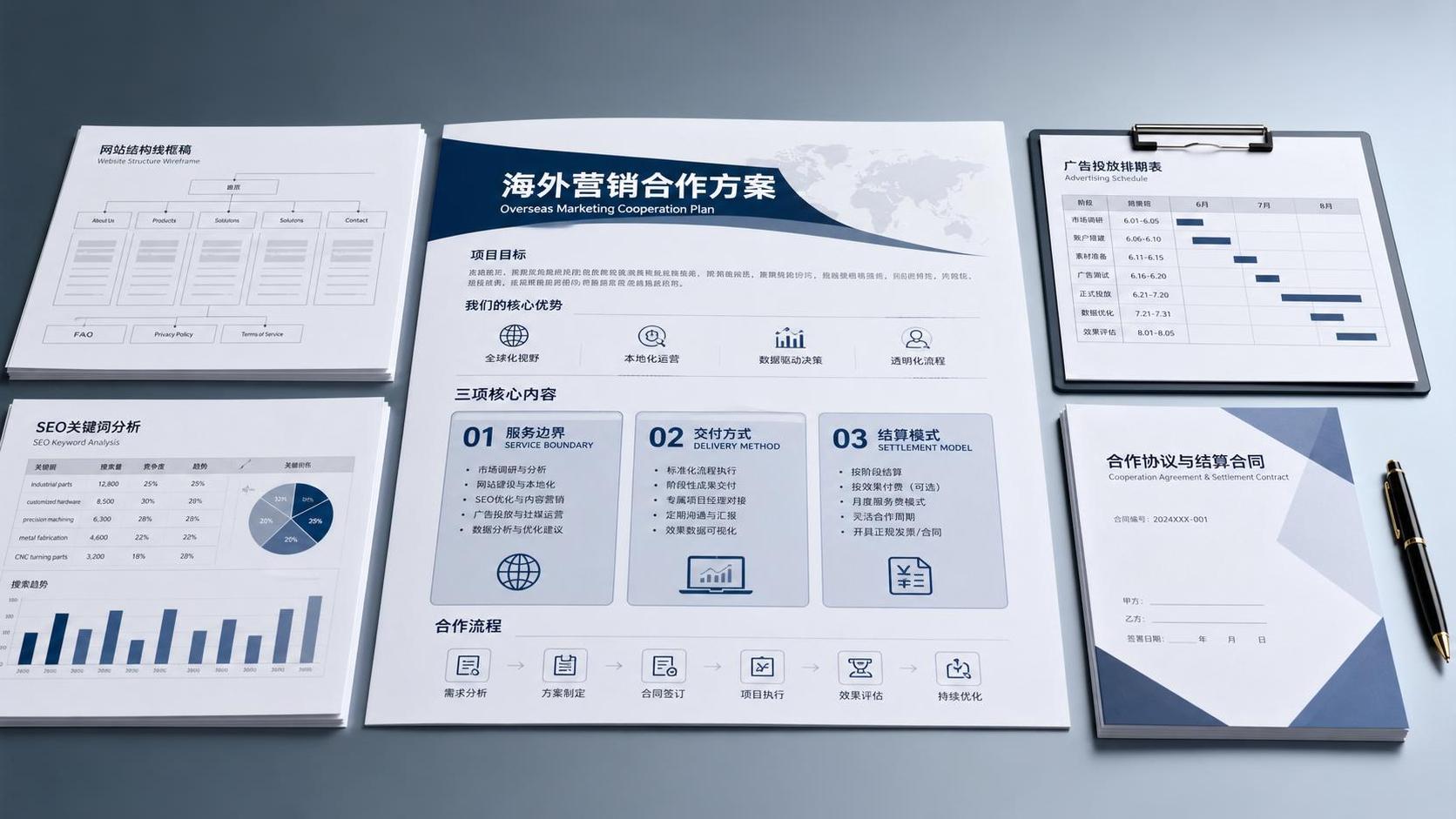
 How credible is an overseas marketing partner? A comparison of service scope, delivery approach, and settlement model
 How to design channel collaboration for higher efficiency? Line distribution, quotation support, and regional protection rules analysis


Related Products
 EasyCamp SaaS Smart Website Marketing SystemE-Yingbao SaaS Smart Website Marketing System: AI-powered, zero-code website building. Rapidly launch multilingual independent e-commerce sites in just 10 minutes. Global server acceleration and AI-driven SEO optimization empower businesses to efficiently connect with global markets. The seamless integration of technology and user-friendly operation makes building e-commerce sites incredibly simple.
 AI+SEM Intelligent Advertising Marketing SystemAI+SEM drives intelligent ad creation, empowering full-funnel precision advertising marketing. The system automatically generates weekly/monthly reports, AI recommends keywords and target countries, monitors core metrics in real-time with intelligent alerts, and enables one-click high-conversion ad solutions to help quickly acquire customers and improve ROI.
 AI+SEO Dual Engine Optimization ServiceEasyWin AI+SEO Dual Engine Optimization System leverages AI-powered keyword mining, content generation, and comprehensive technical optimization to help foreign trade enterprises acquire high-quality organic traffic, significantly improving search rankings and conversion rates.
 AI+SNS Social Media Marketing SystemYingbao AI+SNS Social Media Marketing System - Precision social capture for the social media era. Supports one-click content synchronization across major platforms like Facebook and LinkedIn. AI intelligently rewrites posts for enhanced relevance. 24/7 AI customer service and user profiling analysis empower businesses to efficiently expand into global markets.
 AI+SEO营销解决方案易营宝AI+SEO营销解决方案,通过AI批量写作、智能生成TDK、精准关键词扩词等功能,全面优化网站SEO效果,提升流量与转化率。助力企业构建高效智能网站新生态。
 AI+SEM Advertising Marketing SolutionsAI+SEM Advertising Marketing Solution leverages AI technology to deeply empower SEM ad campaigns. It automatically generates weekly/monthly reports using AI, presenting account data across multiple dimensions for comprehensive insights into campaign performance and trends. The system precisely recommends keywords and target countries, intelligently generates high-conversion ad copy, and enables one-click activation of efficient campaign plans to help businesses rapidly acquire customers. Simultaneously, it monitors core metrics in real time, intelligently identifies abnormal fluctuations, and issues timely alerts to ensure stable, high-return advertising results.
 Domain Name ServicesEasyWin provides professional domain name services, including intelligent queries, one-stop registration, brand protection, and full lifecycle management, helping businesses build a digital brand image.
 EasyOperate B2C Cross-Border E-Commerce Platform & Independent WebsiteEasyStore B2C Cross-border E-commerce Independent Store is an intelligent website building and cross-border e-commerce integrated solution independently developed by EasyStore Information Technology (Beijing) Co., Ltd. The system is specially designed for small and medium-sized as well as large export enterprises, integrating 'website building, operation, marketing, advertising, and conversion' into one, helping enterprises quickly establish cross-border e-commerce independent stores to achieve brand globalization and global sales growth.
The platform supports multiple languages, multiple currencies, and multi-channel marketing, with built-in AI intelligent translation and SEO optimization systems, suitable for mainstream markets such as Southeast Asia, Europe and America, Latin America, and the Middle East, assisting Chinese manufacturing enterprises in efficiently deploying international e-commerce strategies. SSL证书易营宝提供专业SSL安全证书服务,包括单域名和泛域名证书,确保网站数据传输加密、身份验证和完整性保护,助力企业建立安全可信的在线业务环境。









